

Quick Summary
- Primary Update: Kuwait General Administration of Customs and Ministry of Health directives enforce 100 percent inline radiological baggage scanning across all terminals at Kuwait International Airport (KWI), applying an absolute zero-tolerance ban on alcohol, pork products, and narcotics.
- Transit Impact: Arriving international passengers across Terminal 1 (international carriers), Terminal 4 (Kuwait Airways), and Terminal 5 (Jazeera Airways) must navigate dual Green and Red customs channels, with mandatory declarations for physical cash or bullion exceeding KD 3,000.
- Traveler Advice: Never bring duty-free liquor bottles purchased during overseas airport layovers into Kuwait, limit personal tobacco to 500 cigarettes, carry no more than a 30-day supply of doctor-certified maintenance medicines in original pharmaceutical packaging, and leave camera drones at home.
International air travelers entering the State of Kuwait via Kuwait International Airport (KWI) navigate one of the most strictly regulated customs security architectures in the Middle East. Administered by the General Administration of Customs (KGAC) in coordination with the Ministry of Interior, the Ministry of Health (MoH), and the Directorate General of Civil Aviation (DGCA), border enforcement combines the GCC Common Customs Law framework with Kuwait statutory penal statutes.
Whether flying on long-haul routes from Europe and North America or arriving on dense regional sectors from India, Dubai, Doha, or Cairo, travelers frequently encounter severe administrative and legal penalties for carrying everyday items that are legal elsewhere. Understanding statutory duty-free thresholds, controlled medicine lists, currency reporting triggers, and baggage scanning procedures ensures seamless entry while preventing immediate detention or deportation.
Statutory Allowances and Baggage Exemptions
Kuwait customs regulations distinguish strictly between bona fide personal belongings, gifts, taxable merchandise, and prohibited contraband. Personal effects that show clear signs of regular personal use—such as worn garments, personal toiletries, a primary smartphone, a personal laptop, and portable electronic accessories—are cleared duty-free without assessment.
Gifts and newly purchased commercial items brought by incoming air passengers are governed by specific statutory caps:
| Item Category | Statutory Duty-Free Allowance | Inspection & Valuation Protocol | Statutory Penalties for Violations |
|---|---|---|---|
| Alcohol & Spirits | 0 Liters (Absolute Ban) | 100% inline X-ray scanning and sniffer canine inspection | Immediate confiscation, arrest, criminal prosecution, deportation |
| Cigarettes | Up to 500 cigarettes (25 packs) | Physical count during baggage inspection at exit turnstiles | 100% GCC excise duty applied on excess; commercial seizure |
| Cigars & Shisha Tobacco | Max 50 cigars or 500g loose tobacco | Weight verification against statutory packaging standards | Reclassification as commercial import; excise tariff assessment |
| New Personal Gifts | Value up to KD 100 (~$325 USD) | Purchase invoices or customs assessor database evaluation | 5% standard GCC customs tariff assessed on value exceeding allowance |
| Gold & Fine Jewellery | Reasonable personal worn items | Visual check; bullion bars require immediate declaration | Detention under Section 80; referral to Precious Metals Department |
| Cash & Financial Assets | Under KD 3,000 or foreign equivalent | Spot checks and mandatory currency declaration counters | Temporary seizure under Law No. 106/2013; Public Prosecution referral |
| Consumer Camera Drones | 0 Units (Prohibited Import) | Inline baggage tomography flags multi-rotor aircraft | Immediate seizure; security impoundment by Ministry of Defense |
| Pork & Pork Products | 0 Grams (Absolute Ban) | Food inspection scanning and Ministry of Health checks | Immediate destruction; potential administrative warning or fine |
Absolute Prohibitions: Alcohol, Pork, and Contraband
Kuwait maintains an uncompromising legal ban on intoxicating liquors and pork derivatives. Unlike neighboring regional transit hubs that permit inbound passengers to carry one or two liters of spirits, Kuwait enforces complete domestic prohibition under Law No. 16 of 1960 (Kuwait Penal Code, Article 206) and Customs Law No. 10 of 2003.
The Transit Duty-Free Liquor Trap
A recurring error among international travelers involves purchasing bottles of Scotch whisky, wine, or liqueurs at duty-free shops in departure or transit airports such as London Heathrow, Frankfurt, Dubai International (DXB), or Hamad International (DOH) in Doha.
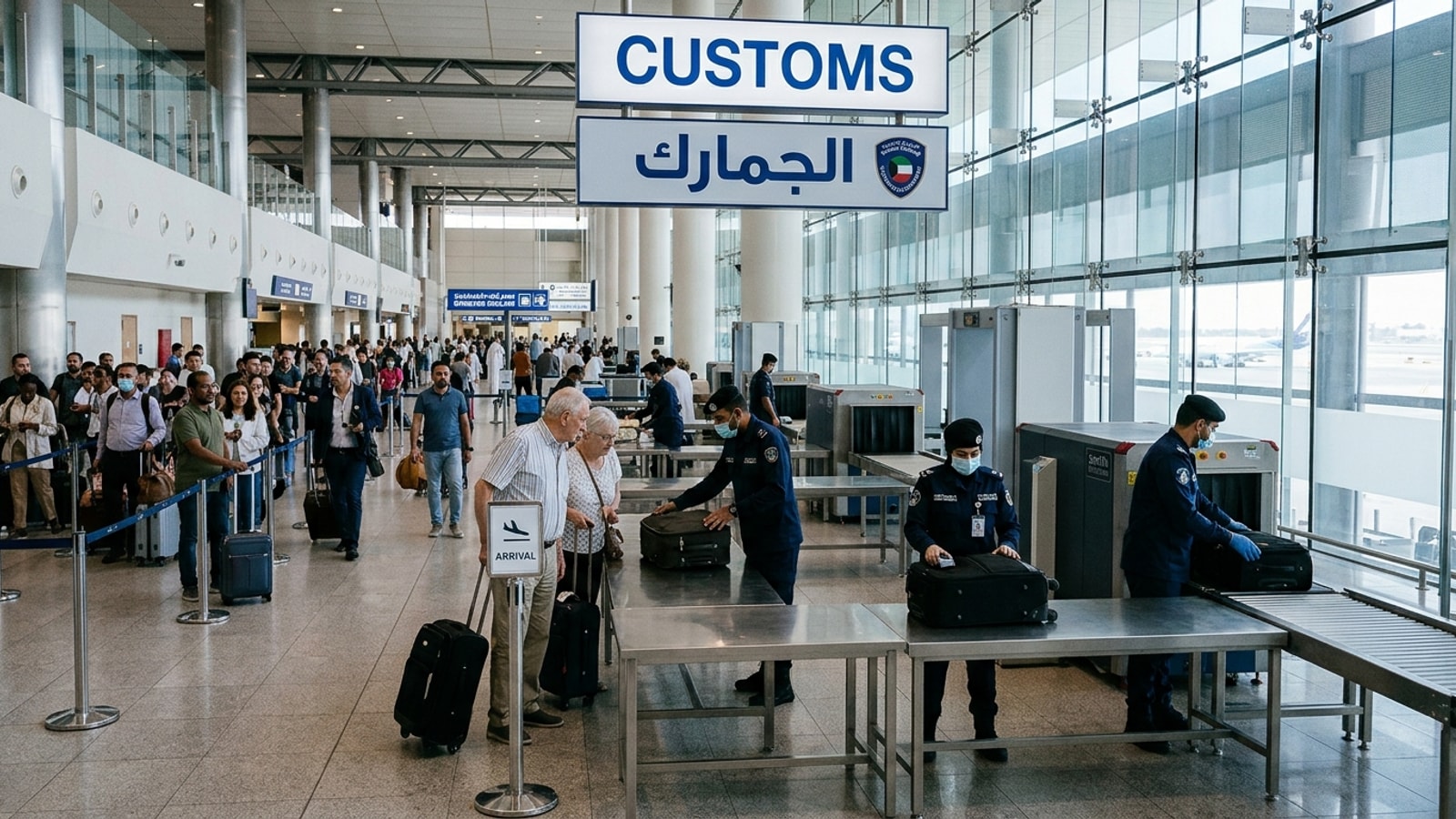
Customs officers stationed at KWI inspect every piece of checked and carry-on luggage through dual-energy X-ray equipment before passengers reach the baggage claim exit. When liquid bottles matching alcohol profiles appear on scans, officers open luggage immediately.
- Carrying any volume of alcohol—even miniature 50ml bottles, confectionery containing liqueur, or cooking wine—results in immediate confiscation.
- Possessing alcohol triggers criminal charges for contraband importation. Non-Kuwaiti expatriates and visitors face formal arrest, police questioning, cancellation of visas, and deportation with a lifetime entry ban.
Pork Derivatives and Food Restrictions
All pork meat, bacon, ham, lard, sausages, and food products containing pork gelatin or swine-based enzymes are totally forbidden. Unsealed cooked foods, fresh fruits, and vegetables from countries subject to agricultural quarantine notices are routinely impounded by agricultural inspectors at terminal exit points to protect local biosecurity.
Controlled Pharmaceuticals: Kuwait Ministry of Health Protocols
One of the highest-risk areas for incoming expatriates, business visitors, and tourists involves prescription medications. Kuwait Law No. 74 of 1983 on Combating Narcotics and Regulating their Use places stringent controls on analgesics, sedatives, stimulants, and psychotropic compounds.
Common medications readily sold over the counter or via basic prescriptions in India, Europe, or the United States are classified as controlled narcotics in Kuwait:
| Medication Class | Common Commercial Brand Names | Permitted Entry Quantity | Mandatory Documentation at KWI Airport |
|---|---|---|---|
| Opioid Analgesics | Tramadol, Ultracet, Codeine syrups, Solpadeine | Max 30-day personal supply | Attested specialist prescription, stamped medical report, valid passport match |
| Neuropathic Agents | Pregabalin (Lyrica), Gabapentin (Neurontin) | Max 30-day personal supply | Certified doctor prescription detailing clinical condition and daily dosage |
| Benzodiazepines | Alprazolam (Xanax), Clonazepam (Rivotril), Diazepam | Max 30-day supply (strictly verified) | Original physician report issued within past 30 days stating exact daily regimen |
| ADHD Stimulants | Methylphenidate (Ritalin, Concerta), Adderall | Max 30-day personal supply | Formal hospital prescription, clinical diagnosis chart, doctor contact credentials |
| General Maintenance Drugs | Blood pressure, diabetes, thyroid, cholesterol | Up to 90-day personal supply | Original pharmacy label displaying traveler name and prescription receipt |
Essential Rules for Traveling With Medications
- Retain Original Packaging: Never transfer pills into generic weekly pill organizers. All tablets must remain in original blister strips and commercial pharmacy boxes with legible batch numbers and expiration dates.
- Carry Attested Medical Certificates: If carrying psychotropic or narcotic medications, travelers must present an official medical report signed by a licensed physician, preferably translated into Arabic or English, explaining why the treatment cannot be interrupted.
- Quantity Ceilings: Customs officers at KWI will confiscate quantities exceeding a 30-day treatment cycle unless the passenger holds pre-approval issued by the Kuwait Ministry of Health Medical Licensing Department. Carrying bulk quantities without documentation results in felony narcotics trafficking charges.
Cash, Bullion, and Anti-Money Laundering Thresholds
Under Kuwait Law No. 106 of 2013 on Combating Money Laundering and Financing of Terrorism, travelers entering or departing the State of Kuwait must declare physical currency and negotiable financial instruments.
| Declaration Parameter | Statutory Requirement & Threshold | Regulatory Scope |
|---|---|---|
| Maximum Undeclared Threshold | KD 3,000 (Kuwaiti Dinars) | Aggregate value in local or equivalent foreign currencies (~$9,800 USD / €9,000 EUR / ₹8,20,000 INR / 36,000 AED) |
| Covered Financial Instruments | Banknotes, coins, traveler's checks, promissory notes | All physical negotiable instruments and bearer payment assets |
| Precious Metals & Bullion | Gold bars, coins, unworked metals | Must be declared regardless of form if part of financial investment assets |
| Mandatory Filing Channel | KGAC Cash Declaration Desk | Completed in bilingual format before crossing exit turnstiles |
| Required Proof of Funds | Bank withdrawal slips, trade invoices | Legal provenance required for large currency volumes |
Failing to declare cash or monetary instruments exceeding KD 3,000, or providing inaccurate source-of-fund explanations, leads to immediate administrative seizure by Customs Police and referral to the Public Prosecution Anti-Money Laundering unit.
Electronics, Drones, and Satellite Gear
Individual consumer electronics for personal work and leisure—such as one laptop computer, a tablet, up to two mobile smartphones, a handheld camera, and wireless headphones—pass through inspection lines duty-free.
However, specific technological items trigger immediate border restrictions:
- Drones and Quadcopters: The import of unmanned aerial vehicles (UAVs) of any size—including lightweight consumer drones like DJI Mini models—is prohibited in passenger luggage. Kuwait Civil Aviation and the Ministry of Defense require advance security defense clearance. Any drone detected in checked or cabin baggage is confiscated on arrival and retained in the airport customs warehouse until the passenger permanently departs the country.
- Satellite Communication Devices: Satellite phones (Thuraya, Iridium), high-power VHF/UHF radio transceivers, and long-range walkie-talkies require pre-clearance from the Ministry of Communications. Unlicensed units are impounded.
- E-Cigarettes and Vaping Kits: While personal vaping devices are generally tolerated for adult travelers, commercial quantities of pods, nicotine e-liquids, or bulk disposables face seizure. Any vaping product infused with CBD, THC, or cannabis extracts is treated as an illegal narcotic, triggering immediate arrest under Kuwait narcotics law.
Traveler Logistics Guide
To navigate customs clearance smoothly at Kuwait International Airport, follow this operational checklist:
1. Terminal Arrival Layout
- Terminal 1 (Main International): Handles foreign long-haul and regional carriers including IndiGo, Air India Express, Emirates, Qatar Airways, Turkish Airlines, and British Airways. Customs inspection lanes are located directly behind the central baggage carousels.
- Terminal 4: Dedicated exclusively to Kuwait Airways. Offers modern automated luggage screening and dedicated Red and Green customs inspection lanes.
- Terminal 5: Dedicated exclusively to Jazeera Airways. Compact arrival hall with inline baggage scanners positioned immediately before the public ground transport concourse.
2. Choosing the Correct Customs Channel
- Green Channel (Nothing to Declare): Permitted only if your baggage contains no alcohol, no pork, no controlled medicines without doctors' notes, cash under KD 3,000, tobacco under 500 cigarettes, and new gifts valued under KD 100. Note that customs officers conduct random luggage diversion to X-ray tables even in the Green Channel.
- Red Channel (Goods to Declare): Mandatory if carrying physical currency or gold bullion exceeding KD 3,000, commercial samples or goods intended for resale, specialized electronic transmitters, or maintenance quantities of scheduled prescription medications.
3. Step-by-Step Arrival Checklist
- Pre-Flight Baggage Inspection: Discard all duty-free alcohol bottles before boarding your flight to Kuwait. Check your toiletry kits for pork gelatin ingredients or CBD hemp products.
- Medical Paperwork Organization: Place all prescription medicines, clinical certificates, and doctor prescriptions in your carry-on bag for quick inspection. Never pack controlled pills inside checked luggage where baggage keys may not be accessible.
- Cash Inventory Check: Calculate the total value of all foreign banknotes, Indian Rupees, US Dollars, and gold bullion across all travel party members. If the collective sum exceeds KD 3,000, proceed straight to the KGAC Cash Declaration Counter.
- Customs Baggage Collection: Retrieve checked suitcases from the carousel. Look for chalk markings or security barcode stickers placed by inline baggage security teams; suitcases marked with specific color codes will be directed to secondary manual search tables.
- Exit Clearance: Hand your customs declaration slip (if completed) to the inspection officer, place cabin bags onto the exit X-ray belt when requested, and exit into the airport arrivals hall.
Frequently Asked Questions
Can I bring duty-free alcohol purchased at Dubai or Doha into Kuwait?
No. Kuwait enforces a complete zero-tolerance ban on all alcoholic beverages under Article 206 of the Kuwait Penal Code. Duty-free liquor bought in transit airports such as Dubai, Abu Dhabi, Doha, or European gateways will be detected by inline airport scanners and confiscated immediately. Carrying alcohol into Kuwait is a criminal offense that leads to arrest, court penalties, and deportation for non-citizens.
How many cigarettes can I carry into Kuwait without paying duty?
Adult travelers aged 18 and older are permitted to bring up to 500 cigarettes (equivalent to 25 standard 20-stick packs or 2.5 cartons), 50 cigars, or 500 grams of loose pipe tobacco duty-free. Any quantities exceeding these caps must be declared at the Red Channel and are subject to 100 percent GCC excise duty plus customs tariffs.
Is Tramadol or Lyrica allowed in Kuwait with a doctor's prescription?
Tramadol and Pregabalin (Lyrica) are strictly regulated psychotropic substances under Kuwait Law No. 74 of 1983. You may bring a maximum 30-day personal supply provided you carry the pills in their original manufacturer pharmacy packaging along with an official, stamped doctor's prescription and medical report detailing your medical condition. Carrying these medications without authentic medical documentation is classified as felony narcotics smuggling.
What is the maximum cash limit I can carry into Kuwait International Airport?
There is no upper limit on the amount of money you can bring into Kuwait, but you must legally declare any physical currency, traveler's checks, promissory notes, or gold bullion valued at KD 3,000 or more (or equivalent in foreign currency, approximately $9,800 USD) at the airport Customs Cash Declaration Desk. Failure to declare amounts exceeding KD 3,000 can result in funds being frozen and referral to the Public Prosecution.