

Quick Summary
- Primary Update: Germany strictly enforces European Union and national customs controls under the Federal Customs Administration (Bundeszollverwaltung / Zoll), applying a €430 duty-free value limit for air passengers, total biosecurity bans on meat and milk products, and statutory limits on personal medications.
- Transit Impact: Arriving international passengers at major gateways including Frankfurt Airport (FRA), Munich Airport (MUC), Berlin Brandenburg Airport (BER), and Düsseldorf Airport (DUS) face active bag scans and spot checks at both Red and Green arrival channels.
- Traveler Advice: High-value individual purchases exceeding €430 cannot be divided across family members or traveling companions; declare all goods over the threshold at the Red Channel to access simplified flat-rate duty (17.5%) and avoid criminal tax evasion proceedings.
Navigating German border formalities requires a clear distinction between immigration control and customs verification. While passport checks under the Schengen Agreement regulate legal entry into the territory, customs inspection is governed by the Federal Customs Administration (Bundeszollverwaltung, commonly referred to as Zoll). German customs officers exercise strict statutory authority at border entry points, targeting tax compliance, biosecurity threats, and illicit currency movements.
For international travelers arriving on long-haul flights from India, the Middle East, North America, and Southeast Asia, German customs compliance is not a perfunctory formality. At major hubs such as Frankfurt am Main and Munich, Zoll inspectors actively monitor arrival halls, deploy sniffer dogs trained for meat and cash detection, and conduct non-intrusive mobile X-ray screenings immediately before terminal exits. Understanding statutory allowances, non-divisibility rules, and prohibited cargo prevents unexpected financial penalties, luggage confiscation, or formal criminal citations.
General Duty-Free Allowance for Air Travelers (€430 Threshold)
Air passengers aged 15 and older arriving in Germany from a non-EU country are entitled to import personal goods and souvenirs up to a total commercial value of €430 without paying customs duties or Import Turnover Tax (Einfuhrumsatzsteuer - EUSt). For travelers younger than 15 years of age, the duty-free ceiling drops to €175.
  NON-EU AIR PASSENGER ALLOWANCE SUMMARY
  ┌─────────────────────────────────────────────────────────────┐
  │ Adult Passengers (Age 15+)       │ Up to €430 total value   │
  ├──────────────────────────────────┼──────────────────────────┤
  │ Child Passengers (Under Age 15)  │ Up to €175 total value   │
  ├──────────────────────────────────┼──────────────────────────┤
  │ Flat-Rate Duty Bracket           │ €430 to €1,130 (€700 cap)│
  ├──────────────────────────────────┼──────────────────────────┤
  │ Flat Tax Rate (*Pauschalsatz*)   │ 17.5% (15% preferential) │
  ├──────────────────────────────────┼──────────────────────────┤
  │ Standard Tariff + EUSt Bracket   │ Items exceeding €1,130   │
  └─────────────────────────────────────────────────────────────┘
The Inflexibility of the Non-Divisibility Principle
A frequent point of confusion among traveling families and couples is whether individual high-value items can be pooled across multiple allowances. Under German and EU customs law, the non-divisibility principle (Grundsatz der Nicht-Aufteilung) strictly prohibits splitting the value of a single item.
If an adult passenger purchases a designer handbag, watch, or electronic camera costing €700, that individual item cannot be divided between two spouses to stay within the combined €860 threshold. The full item belongs to the traveler who imported it. Because its individual purchase value exceeds €430, customs duty and Import Turnover Tax must be assessed on the entire item or the excess value depending on applicable assessment brackets.
Personal Used Travel Equipment vs New Purchases
Used personal effects that passengers bring for their own comfort and utility during their journey—such as clothing, personal grooming appliances, an active mobile phone, and a personal laptop computer—are exempt from duty calculations, provided they were owned prior to departure and are re-exported upon departure.
However, brand-new electronics, packaged designer garments with tags, factory-sealed boxes, and gifts intended for third parties in Germany are counted against the €430 limit. Travelers carrying newly purchased items must carry original retail purchase invoices. Without an authentic receipt, Zoll officers hold statutory power to estimate the market value based on official valuation databases, often resulting in higher tax assessments.
Flat-Rate Duty (Pauschalsatz) vs Standard Commercial Tariff
When non-commercial passenger goods exceed the €430 allowance, German customs provides a simplified assessment procedure:
- Flat-Rate Taxation (Pauschalierung): If the excess value of the imported goods does not exceed €700 (meaning the total value of goods is between €430 and €1,130), customs assesses a flat tax rate of 17.5% of the value. For goods originating in countries that enjoy reciprocal EU trade tariff preferences, the flat rate is reduced to 15%. This flat rate covers both import duty and the standard 19% German Import Turnover Tax.
- Commercial Tariff Assessment: If the total value of excess items exceeds €700, or if the traveler explicitly requests an itemized assessment, customs levies the specific Common Customs Tariff (TARIC) applicable to each item category (ranging from 0% for smartphones and computers up to 14% or more for certain footwear and apparel) plus the standard 19% Import Turnover Tax (or 7% for books and select print items).
German Customs Baggage Limits & Duty Table
The following structured table outlines key statutory allowances, applicable thresholds, and regulatory constraints enforced by German Customs for passengers arriving from non-EU origins:
| Category | Duty-Free Allowance (Age 15+) | Excess Duty & Tax Rules | Statutory Enforcement Authority |
|---|---|---|---|
| General Merchandise & Gifts | Up to €430 total value (€175 for passengers under 15) | Flat 17.5% up to €700 excess; standard TARIC rate + 19% EUSt above €700 | German Fiscal Code (AO) & EU Baggage Regulations |
| Spirits & Strong Alcohol | 1 liter exceeding 22% ABV, OR 2 liters up to 22% ABV | Full spirits tax (Branntweinsteuer) + customs duty + 19% EUSt; ages 17+ only | EU Excise Duty Directives & TabStG / SchaumwZwStG |
| Wine (Still) | 4 liters of still (non-sparkling) wine | Specific excise surcharge + 19% EUSt; ages 17+ only | Federal Customs Wine Taxation Directives |
| Beer | 16 liters of malt beer | German Beer Tax (BierstG) + 19% EUSt; ages 17+ only | Federal Customs Beer Assessment Schedule |
| Cigarettes | 200 cigarettes (or 100 cigarillos, 50 cigars, 250g tobacco) | Surcharge: German Tobacco Tax (Tabaksteuer) + 19% EUSt; ages 17+ only | German Tobacco Tax Act (TabStG) |
| Meat, Poultry & Dairy | Zero Allowance (Total prohibition from non-EU countries) | Immediate seizure, destruction; disposal fee levied (€50–€300) | EU Regulation 2019/2122 (African Swine Fever defense) |
| Fresh Fruits & Vegetables | Prohibited without official Phytosanitary Certificate | Immediate confiscation; only bananas, pineapples, coconuts, durians, dates exempt | EU Plant Health Regulation 2016/2031 |
| Personal Medicines | Maximum 3-month personal supply per medication | Seizure of excess quantities; criminal inquiry for unapproved drugs | Section 73 German Medicines Act (AMG) |
| Cash & Liquid Assets | Up to €9,999.99 without declaration | Mandatory written declaration for €10,000 or more; fines up to €1,000,000 | Section 31b Customs Administration Act (ZollVG) |
Strict Biosecurity Bans: Meat, Dairy, and Agricultural Items
Germany strictly enforces European Union biosecurity safeguards designed to prevent the introduction of devastating livestock pathogens, including African Swine Fever, Foot-and-Mouth Disease, and avian influenza.
  STRICT BIOSECURITY DISPOSITIONS (NON-EU FLIGHTS)
  ┌─────────────────────────────────────────────────────────────┐
  │ BANNED: Fresh, cooked, cured, or dried meat (pork, beef)    │
  │ BANNED: Sausages, salami, cold cuts, poultry, meat curries  │
  │ BANNED: Milk, cheese, paneer, butter, condensed milk khoya  │
  │ BANNED: Traditional dairy sweets (gulab jamun, rasgulla)    │
  ├─────────────────────────────────────────────────────────────┤
  │ EXEMPT: Powdered infant milk / food (sealed, max 2 kg)      │
  │ EXEMPT: Special medical clinical diet food (sealed, max 2 kg)│
  │ EXEMPT: Eviscerated fresh/dried fish products (up to 20 kg) │
  │ EXEMPT: Dry bakery goods, dry roasted spices, plain tea     │
  └─────────────────────────────────────────────────────────────┘
The Total Prohibition on Meat and Milk
Under EU Regulation 2019/2122, travelers entering Germany from non-EU countries are prohibited from importing any meat, meat products, milk, or dairy products in personal luggage. This prohibition applies regardless of whether items are commercially sealed, vacuum-packed, cooked, canned, or prepared at home.
For Indian travelers, this ban directly impacts common travel gifts:
- Traditional Indian sweets prepared with milk solids, condensed milk, khoya, mawa, or paneer (such as peda, barfi, gulab jamun, and rasgulla) are classified as milk products and will be confiscated by Zoll inspectors at Frankfurt and Munich.
- Clarified butter (ghee) is an animal dairy derivative and cannot enter Germany from a non-EU country without commercial veterinary certification.
- Non-dairy sweets, dry roasted snacks (namkeen), bakery biscuits, and plant-based lentils are permitted, provided they contain no animal meat fats or dairy extracts.
Phytosanitary Certificate Mandate for Fresh Produce
Under EU Regulation 2016/2031, international passengers cannot bring fresh fruits, vegetables, seeds, live plants, or cut flowers into Germany without an official Phytosanitary Certificate (Pflanzengesundheitszeugnis) issued by the agricultural authority of the departure country.
Only five tropical fruits are exempt from this requirement and may enter without inspection:
- Bananas
- Pineapples
- Coconuts
- Durians
- Dates
All other fresh produce—including popular items like mangoes, guavas, fresh chillies, citrus fruits, and fresh curry leaves (kadi patta)—are confiscated upon arrival. Travelers carrying prohibited produce without certification may be billed for official incinerator destruction fees.
Alcohol and Tobacco Quotas (Ages 17 and Older)
Zoll enforces explicit quantitative limits on alcoholic beverages and tobacco products imported from non-EU origins. These exemptions apply exclusively to passengers aged 17 and older; minors receive zero alcohol or tobacco allowance.
Tobacco Allowances
Each eligible passenger may import one of the following duty-free tobacco allocations (or a proportionate combination thereof):
- 200 cigarettes, OR
- 100 cigarillos (cigars weighing no more than 3 grams each), OR
- 50 cigars, OR
- 250 grams of smoking tobacco (such as pipe tobacco or rolling tobacco).
Alcoholic Beverage Allowances
Eligible travelers may bring:
- 1 liter of spirits or distilled beverages with an alcohol content exceeding 22% ABV, OR undenatured ethyl alcohol of 80% ABV or higher; OR
- 2 liters of fortified wine, sparkling wine, or liqueurs with an alcohol content not exceeding 22% ABV; PLUS
- 4 liters of still (non-sparkling) wine; PLUS
- 16 liters of beer.
Quantities exceeding these allowances require immediate declaration at the Red Channel and incur excise taxation, customs tariffs, and Import Turnover Tax.
Prescription Medications and Medical Devices (§ 73 AMG)
Importation of pharmaceuticals into Germany by travelers is strictly regulated under Section 73 of the German Medicines Act (Arzneimittelgesetz - AMG).
3-Month Personal Supply Ceiling
Passengers are permitted to bring prescription drugs and over-the-counter medical preparations into Germany solely for their personal medical requirements during their intended stay, capped at a maximum of a three-month supply per medication based on standard dosing schedules.
Key medical compliance standards include:
- Original Packaging: Carry all tablets and capsules in their original manufacturer blister packs and cartons displaying commercial batch details and expiration dates.
- Doctor’s Attestation: Carry an official medical prescription or doctor’s certificate written in German or English. The documentation must state the patient’s full legal name, diagnosed condition, generic international non-proprietary name (INN) of the medicine, and daily dosage.
- Controlled Narcotics (Betäubungsmittel): Strong painkillers, prescription opioids, and psychoactive central nervous system stimulants (such as methylphenidate or dexamphetamine) fall under the German Narcotics Act (BtMG). Travelers carrying these controlled substances must carry a specialized multilingual medical certificate compliant with the Schengen Agreement Article 75 standard or International Narcotics Control Board (INCB) travel guidelines.
- Prohibited Substances: Anabolic steroids and performance-enhancing substances exceeding statutory personal limits under the German Anti-Doping Act (AntiDopG), counterfeit medicines, and unauthorized experimental chemicals are strictly illegal and lead to immediate criminal referral.
Cash and Liquid Assets Controls (€10,000 Threshold)
In compliance with European Union cash monitoring regulations, any passenger entering or exiting Germany carrying €10,000 or more in cash or equivalent liquid assets must declare the total sum in writing to German Customs.
Equivalent liquid assets (gleichgestellte Zahlungsmittel) include:
- Banknotes and coins in any currency.
- Traveler’s cheques, bank drafts, and signed promissory notes.
- Gold coins with a minimum gold purity of 90%.
- Gold bullion, bars, or nuggets with a minimum gold purity of 99.5%.
Travelers carrying €10,000 or more must obtain and submit the official written declaration form (Anmeldung von Barmitteln - Form 040000) at the airport customs desk before exiting the baggage area. Failing to declare, under-declaring the total sum, or providing fraudulent documentation constitutes an administrative offense under Section 31b of the Customs Administration Act (Zollverwaltungsgesetz - ZollVG), punishable by administrative fines of up to €1,000,000 and provisional confiscation of the funds pending financial intelligence verification.
Traveler Logistics Guide
Navigating customs clearance at major German airports requires strict adherence to inspection channel protocols:
  AIRPORT BAGGAGE INSPECTION CHANNEL DECISION TREE
  ┌─────────────────────────────────────────────────────────────┐
  │ Do you have goods over €430, commercial samples, excess     │
  │ alcohol/tobacco, €10,000+ cash, restricted food, or plants? │
  └──────────────────────────────┬──────────────────────────────┘
                                                                │
                 ┌───────────────┴───────────────┐
                 ▼                               ▼
               [YES]                            [NO]
                 │                                              │
                 ▼                               ▼
       RED CHANNEL (Rot)               GREEN CHANNEL (Grün)
   "Anmeldepflichtige Waren"          "Anmeldefreie Waren"
  ┌─────────────────────────────┐   ┌─────────────────────────────┐
  │ • Present baggage to Zoll   │   │ • Direct exit walk        │
  │ • Show invoices & receipts  │   │ • Spot checks by Zoll     │
  │ • Pay flat 17.5% or tariff  │   │ • Walking through is legal  │
  │ • Official tax receipt issued│  │   declaration of nothing  │
  └─────────────────────────────┘   └─────────────────────────────┘
Terminal Clearance Workflows at Frankfurt, Munich, and Berlin
- Frankfurt Airport (FRA): International arrivals at Terminal 1 (Concourses B, C, Z) and Terminal 2 (Concourses D, E) proceed through Federal Police (Bundespolizei) passport gates to the baggage reclaim carousels. Upon retrieving checked luggage, passengers must choose between the Red and Green customs channels situated at each baggage hall exit.
- Munich Airport (MUC): Long-haul non-Schengen arrivals at Terminal 1 (Hall B, C) and Terminal 2 (Level 04 / 05) collect luggage before reaching the Zoll inspection checkpoints. Zoll maintains stationary desks and roaming plainclothes agents inside the baggage hall.
- Berlin Brandenburg Airport (BER): Terminal 1 non-Schengen international arrivals complete baggage collection on Level U1 before passing the clearly signposted red and green portals.
The Legal Ramifications of the Green Channel Trap
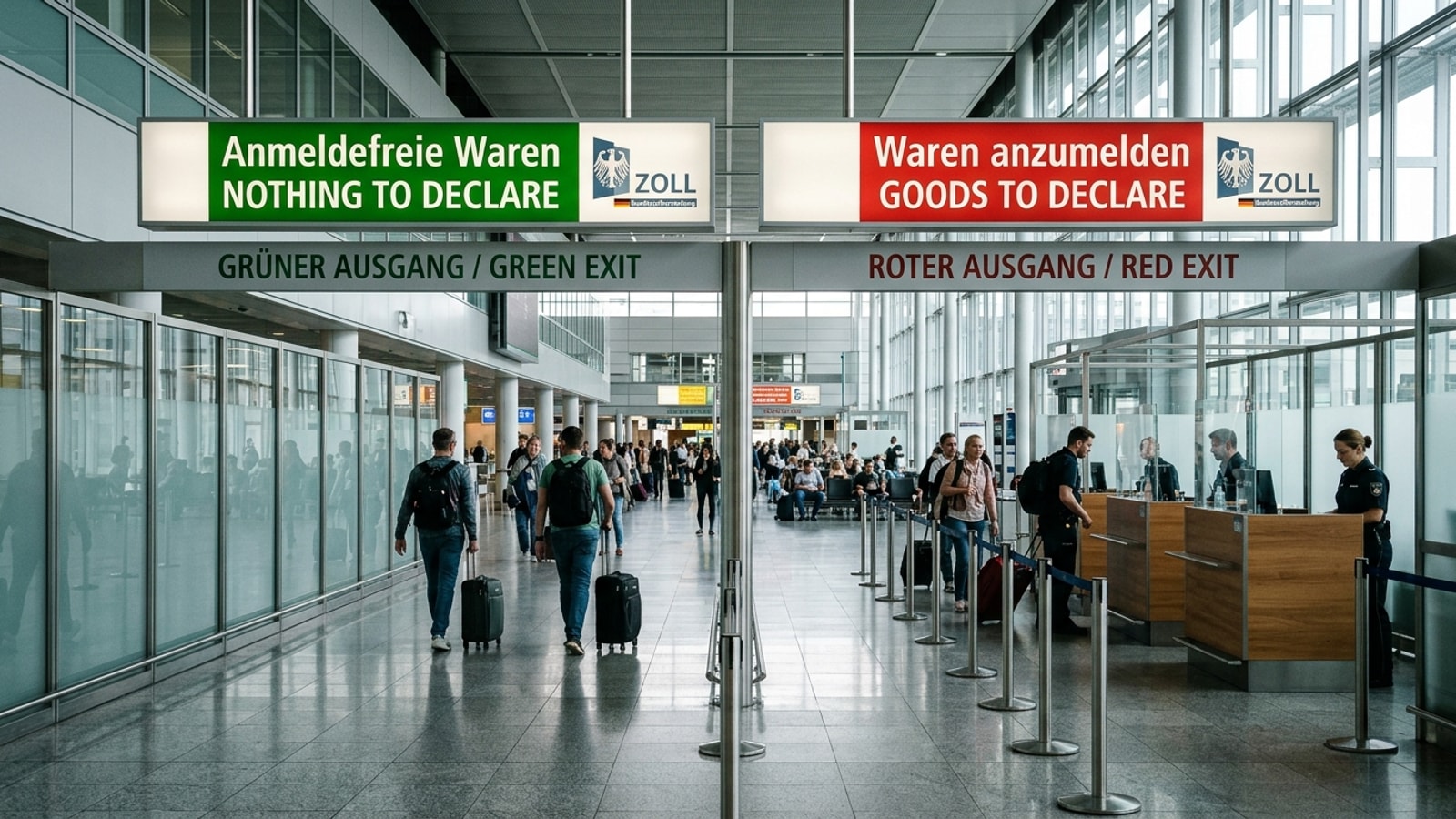
Walking past the threshold into the Green Channel (Grüner Ausgang - Anmeldefreie Waren) is legally recognized under German administrative law as an active, binding declaration that you carry no goods exceeding allowances and no restricted items.
If a Zoll officer intercepts a passenger in the Green Channel and discovers undeclared electronics, commercial samples, or excess goods:
- Negligent Failure to Declare: If deemed an unintentional oversight, the officer initiates administrative penalty proceedings (leichtfertige Steuerverkürzung under Section 378 of the German Fiscal Code - AO), assessing import duty, Import Turnover Tax, and an administrative fine.
- Intentional Tax Evasion: If goods were deliberately concealed (such as unboxing a new iPhone, hiding retail boxes in dirty laundry, or concealing jewelry), customs officers file formal criminal charges for tax fraud (Steuerhinterziehung under Section 370 AO). This results in a criminal fine (Geldstrafe), confiscation of the items, and potential entry into the German Federal Central Criminal Register (Bundeszentralregister).
- Red Channel Immunity: Selecting the Red Channel (Roter Ausgang - Anmeldepflichtige Waren) eliminates any risk of tax evasion charges. Even if an item is ultimately deemed non-dutiable, declaring it transparently ensures straightforward assessment and complete legal protection.
Frequently Asked Questions
Can two traveling family members combine their €430 allowances to bring an item worth €750 duty-free?
No. Under the German customs non-divisibility rule (Grundsatz der Nicht-Aufteilung), an individual item’s value cannot be split across multiple passengers. An item costing €750 belongs to one traveler and exceeds that individual’s €430 allowance. The passenger must declare the item at the Red Channel. If eligible for simplified assessment, the traveler pays flat-rate duty (17.5%) on the excess value up to €700 beyond the allowance.
Can Indian passengers bring homemade ghee, sweets, or pickles into Germany?
Homemade dairy products, including ghee, butter, paneer, and sweets made with condensed milk (khoya, peda, barfi, gulab jamun), are strictly prohibited from entering Germany from non-EU countries under biosecurity rules. They will be seized and destroyed by customs officers at the airport. However, non-dairy sweets, dry roasted snacks (namkeen), and commercially bottled vegetable pickles containing no animal or dairy ingredients are permitted within reasonable personal quantities.
What should travelers do if they are uncertain whether an item requires declaration?
Always proceed directly to the Red Channel (Roter Ausgang) and present the items to the duty officer. Declaring goods transparently protects passengers from all criminal tax evasion penalties. If the officer confirms that the goods fall within statutory duty-free exemptions, you will be cleared immediately without any fees or paperwork.
Can a traveler bring an iPhone and a personal laptop to Germany without paying customs tax?
Yes, provided both the iPhone and the laptop are used personal devices brought for personal communication and work during the trip and will be taken back upon departure. However, if a device is brand-new, factory-sealed, or purchased overseas as a gift exceeding the €430 duty-free allowance, it must be declared at the Red Channel and assessed for import duties and 19% Import Turnover Tax.