

Quick Summary
- Primary Update: France strictly enforces national and European Union customs regulations under the Directorate General of Customs and Indirect Taxes (Douane / DGDDI), applying a €430 duty-free ceiling for air arrivals, a world-leading zero-tolerance criminal ban on counterfeit luxury items, total biosecurity prohibitions on meat and dairy, and mandatory cash declarations over €10,000.
- Transit Impact: Arriving international passengers at Paris Charles de Gaulle (CDG), Paris Orly (ORY), and Nice Côte d'Azur (NCE) encounter dedicated Douane inspection checkpoints, sniffer dog patrols, and mobile baggage X-ray screenings at both Green and Red channels.
- Traveler Advice: High-value single purchases exceeding €430 cannot be pooled between family members; declare excess goods at the Red Channel before exiting the baggage hall to pay standard duties and avoid steep contraband fines, confiscation, or criminal penalties under French Customs Code Article 414.
Navigating international arrivals in France involves passing through two entirely separate administrative checkpoints: immigration verification and customs clearance. While passport control is managed by the French Border Police (Police aux Frontières - PAF) under Schengen border rules, physical baggage inspection and fiscal duty assessments fall under the statutory jurisdiction of the Directorate General of Customs and Indirect Taxes (Direction générale des douanes et droits indirects, universally known as Douane).
Douane officers exercise broad statutory powers under the French Customs Code (Code des douanes). Unlike routine immigration officers, customs agents operate not only at designated red and green exit doors, but also directly along airside corridors, baggage claim carousels, tarmac transfers, and terminal rail stations. For travelers landing from non-EU origins—including India, the United States, the United Kingdom, Canada, Southeast Asia, and the Gulf—compliance with French duty-free allowances, agricultural biosecurity rules, and intellectual property statutes is strictly enforced.
France maintains some of the most rigorous border protections in the world, particularly regarding intellectual property and luxury brand preservation. Understanding how Douane calculates value allowances, enforces biosecurity prohibitions, and screens international travelers protects visitors from substantial fiscal fines, luggage seizure, or formal legal action.
General Duty-Free Allowance for Air Travelers (€430 Threshold)
Air passengers aged 15 and older arriving in France from a non-EU country are entitled to bring personal goods, electronics, clothing, and souvenirs up to a total cumulative value of €430 without paying customs duties or French Value-Added Tax (Taxe sur la valeur ajoutée - TVA, standard rate 20%). For minors under 15 years old, this exemption drops to €150, regardless of whether they travel accompanied or unaccompanied.
  NON-EU AIR PASSENGER ALLOWANCE SUMMARY (FRANCE)
  ┌─────────────────────────────────────────────────────────────┐
  │ Adult Passengers (Age 15+)       │ Up to €430 total value   │
  ├──────────────────────────────────┼──────────────────────────┤
  │ Child Passengers (Under Age 15)  │ Up to €150 total value   │
  ├──────────────────────────────────┼──────────────────────────┤
  │ Simplified Flat-Rate Bracket     │ Up to €700 excess value  │
  ├──────────────────────────────────┼──────────────────────────┤
  │ Flat Customs Duty Rate           │ 2.5% ad valorem + 20% TVA│
  ├──────────────────────────────────┼──────────────────────────┤
  │ Standard Tariff Bracket          │ Excess values above €700 │
  └─────────────────────────────────────────────────────────────┘
The Non-Divisibility Principle (Principe de non-fractionnement)
A central rule enforced by Douane is that individual high-value items cannot be divided or pooled across multiple travelers' allowances. The value of a single item belongs entirely to the individual passenger importing it.
If a husband and wife travel together and purchase a designer jacket, luxury handbag, or camera costing €750, they cannot split the €750 valuation into two portions of €375 to fit under their combined €860 allowance. Because the individual item exceeds €430, customs duty and French TVA must be assessed on the item. Splitting an invoice across family members is explicitly prohibited under Article 414 of the French Customs Code.
Personal Used Effects vs Commercial Purchases
Used personal effects that travelers carry for their direct utility during their journey—such as personal clothing, a daily smartphone, a personal laptop computer, toiletries, and active sports equipment—are exempt from customs duties, provided they were owned and used prior to departure and will be re-exported at the end of the trip.
Conversely, brand-new electronics, items in retail packaging, designer garments carrying factory sales tags, and gifts intended for residents in France are assessed against the €430 threshold. Arriving passengers should carry original retail purchase invoices for newly acquired items. If receipts are missing, Douane officers possess statutory authority to appraise the merchandise using official customs valuation registers, which usually reflect full French retail prices.
Flat-Rate Duty vs Standard Common Customs Tariff
When non-commercial passenger goods exceed the €430 ceiling, French Customs applies a simplified tax calculation structure:
- Flat-Rate Duty (Taxation forfaitaire): For non-commercial goods whose excess value does not exceed €700 beyond the exemption, Douane applies a flat ad valorem customs duty rate of 2.5%, plus the standard French 20% TVA. This simplified calculation avoids complex tariff classifications for modest overages.
- Standard Tariff Assessment: If the excess value exceeds €700, or if the imported goods consist of commercial samples, Douane applies the European Union Common Customs Tariff (TARIC), which varies by category (e.g., 0% for computers and mobile phones, up to 12% for select footwear and textiles), in addition to 20% TVA.
France Customs Baggage Limits & Duty Table
The following operational table outlines key statutory allowances, duty structures, and legal constraints enforced by French Customs (Douane) for passengers arriving from non-EU origins:
| Category | Non-EU Duty-Free Allowance (Age 15+) | Excess Duty & Assessment Rules | Statutory Enforcement Authority |
|---|---|---|---|
| General Merchandise & Gifts | Up to €430 cumulative value (€150 under age 15) | Flat 2.5% duty up to €700 excess + 20% TVA; standard TARIC rate + 20% TVA above €700 | French Customs Code (Art. 414) & EU Baggage Directives |
| Counterfeit Luxury Goods | Zero Allowance (Total prohibition) | Immediate confiscation, destruction; customs fine of 1x–2x authentic retail price; up to €300,000 fine & 3 yrs prison | Code des douanes (Art. 414 & 428) |
| Spirits & Strong Alcohol | 1 liter exceeding 22% ABV, OR 2 liters up to 22% ABV | Full excise duties + spirits surcharges + 20% TVA; ages 17+ only | French General Tax Code (CGI) & EU Directives |
| Still Wine | 4 liters of still grape wine | Standard French wine circulation excise + 20% TVA; ages 17+ only | Direction générale des douanes et droits indirects (DGDDI) |
| Beer | 16 liters of malt beer | Specific excise rate per hectoliter/degree Plato + 20% TVA; ages 17+ only | French Excise Schedule & DGDDI Directives |
| Cigarettes & Tobacco | 200 cigarettes (or 100 cigarillos, 50 cigars, 250g tobacco) | Immediate confiscation of undeclared excess; heavy excise fines; ages 17+ only | Code général des impôts (CGI Art. 575) |
| Meat, Poultry & Dairy | Zero Allowance (Absolute prohibition from non-EU origins) | Immediate seizure and biosecurity destruction; disposal charge (€50–€300) | EU Regulation 2019/2122 (Livestock Health Safeguards) |
| Fresh Produce & Plants | Prohibited without Phytosanitary Certificate | Confiscation & incinerator destruction; only bananas, pineapples, coconuts, durians, dates exempt | EU Plant Health Regulation 2016/2031 |
| Personal Medicines | Maximum 3-month personal treatment supply | Seizure of uncertified drugs; criminal inquiry for unapproved psychotropics | French Public Health Code (Code de la santé publique) |
| Cash & Liquid Assets | Up to €9,999.99 without declaration | Mandatory DALIA declaration for €10,000+; undeclared cash fined up to 50% + seizure | Code monétaire et financier (Art. L152-1) |
Strict Zero-Tolerance Ban on Counterfeit Goods (Contrefaçon)
France is the global capital of high fashion, leather craftsmanship, perfumery, and luxury watchmaking. Consequently, the French state treats counterfeit goods (contrefaçons) far more severely than most international jurisdictions. In France, the importation, transport, or simple personal possession of counterfeit goods is not treated as a minor civil trademark matter; it is classified as a serious customs criminal offense (délit douanier).
  FRENCH COUNTERFEIT ENFORCEMENT SANCTIONS
  ┌─────────────────────────────────────────────────────────────┐
  │ LEGAL STATUS: Criminal customs offense (Code des douanes)   │
  ├─────────────────────────────────────────────────────────────┤
  │ PENALTY 1: Immediate seizure and destruction of the item    │
  │ PENALTY 2: Customs fine equal to 1x to 2x the authentic     │
  │            retail value of the genuine luxury item          │
  │ PENALTY 3: Judicial prosecution: fines up to €300,000 and   │
  │            up to 3 years imprisonment for aggravated acts   │
  ├─────────────────────────────────────────────────────────────┤
  │ SCOPE: Applies to luggage, hand baggage, and worn items     │
  │ ENFORCEMENT: Specially trained Douane authentication units  │
  └─────────────────────────────────────────────────────────────┘
Personal Possession Is Fully Actionable
Under Article 414 and Article 428 of the French Customs Code, Douane agents make no legal distinction between a commercial smuggler carrying 50 fake handbags and an unsuspecting international tourist carrying a single fake designer tote bag, imitation luxury watch, or counterfeit sneakers purchased at a night market in Bangkok, Istanbul, or Delhi.
Personal use provides zero legal immunity. If an arriving passenger at Paris Charles de Gaulle (CDG) or Paris Orly (ORY) is found with an imitation Louis Vuitton bag, fake Rolex watch, counterfeit Chanel perfume, or counterfeit Gucci belt, customs officers will:
- Immediately confiscate and log the item for destruction.
- Issue an administrative customs fine based on the retail price of the genuine article. For example, carrying a fake handbag that mimics a €2,500 designer original can trigger an instant fine of €2,500 to €5,000.
- Refer severe or contested cases to the public prosecutor for judicial proceedings.
Douane officers stationed at French border hubs undergo specialized brand-protection training with leading French luxury manufacturers. Officers inspect stitch patterns, edge coatings, serial stamping, metal hardware alloys, packaging typography, and weight distributions. International travelers should avoid packing any replica or knockoff apparel, watches, or accessories when traveling to France.
Alcohol and Tobacco Quotas (Ages 17 and Older)
Passengers arriving on flights from outside the European Union are subject to quantitative limits on alcoholic beverages and tobacco products. Minors under 17 years of age receive zero alcohol or tobacco allowances.
Alcoholic Beverage Limits
Eligible adult travelers (17+) may import alcoholic beverages within the following statutory categories:
- Spirits and Strong Liquors: 1 liter of alcohol exceeding 22% alcohol by volume (ABV), such as whisky, gin, rum, vodka, or cognac.
- Fortified and Sparkling Wines: 2 liters of fortified wine, liqueur, aperitif, or sparkling wine containing 22% ABV or less (such as port, sherry, vermouth, or Champagne).
- Still Wine: 4 liters of non-sparkling grape wine.
- Beer: 16 liters of beer.
Travelers may split their spirit and fortified wine allowance proportionally. For instance, an arriving passenger may carry 0.5 liters of spirits (50% of the category limit) plus 1 liter of fortified wine (50% of the category limit), along with 4 liters of still wine and 16 liters of beer. Any volumes exceeding these limits must be declared at the Red Channel, where full customs duty, excise taxes, and 20% TVA will be levied.
Tobacco Product Limits
Passengers entering France from non-EU origins may import one of the following tobacco allowances duty-free:
- 200 cigarettes (equivalent to 1 standard carton), OR
- 100 cigarillos (cigars weighing a maximum of 3 grams each), OR
- 50 cigars, OR
- 250 grams of smoking tobacco.
Proportional combinations across these tobacco types are permitted, provided the total percentage does not exceed 100%. Bringing quantities exceeding 200 cigarettes from outside the EU is strictly regulated. Travelers attempting to carry multiple cartons through the Green Channel face immediate confiscation, heavy fiscal penalties calculated per carton, and potential seizure of the items.
Electronic Cigarettes and Vaping Liquids
Travelers may bring e-cigarettes and personal vaping equipment for their own use during their stay. However, European and French tobacco control regulations enforce strict standards:
- Refill liquids containing nicotine cannot exceed a concentration of 20 mg/ml.
- Individual refill containers cannot exceed 10 ml in volume.
- Spare lithium batteries and vaping devices must be carried exclusively in cabin baggage in compliance with international aviation safety mandates; they are strictly prohibited in checked luggage.
- Single-use disposable electronic cigarettes (commonly known as "puffs") face severe regulatory restrictions in France, and travelers carrying commercial quantities will face customs seizure.
Biosecurity Prohibitions: Meat, Dairy, and Agricultural Products
To shield European agricultural ecosystems and domestic livestock from catastrophic biological hazards—such as African Swine Fever, Foot-and-Mouth Disease, and avian viruses—France enforces European Union biosecurity safeguards under EU Regulation 2019/2122.
  STRICT BIOSECURITY DISPOSITIONS (NON-EU ARRIVALS)
  ┌─────────────────────────────────────────────────────────────┐
  │ PROHIBITED: All fresh, cured, dried, or cooked meats        │
  │ PROHIBITED: Beef, pork, poultry, mutton, venison, sausages  │
  │ PROHIBITED: Meat-filled pastries, patties, samosas, curries │
  │ PROHIBITED: Milk, cheese, butter, paneer, ghee, milk powder │
  │ PROHIBITED: Traditional dairy sweets (peda, barfi, khoya)   │
  ├─────────────────────────────────────────────────────────────┤
  │ ALLOWED: Commercially packaged infant milk formula (<2 kg)  │
  │ ALLOWED: Medically certified specialized dietary food (<2 kg)│
  │ ALLOWED: Cleaned, gutted fresh or smoked fish (<20 kg)      │
  │ ALLOWED: Dry bakery biscuits, plain tea, roasted spices     │
  └─────────────────────────────────────────────────────────────┘
Complete Prohibition on Meat and Milk Products
Passengers entering France on non-EU flights are barred from bringing any meat, meat-derived products, milk, or dairy products in cabin or checked luggage. This prohibition applies universally, regardless of whether goods are industrially sealed, vacuum-packed, tinned, cooked, or home-cooked.
For travelers from South Asia and the Middle East, this policy directly impacts commonly packed culinary items:
- Dairy-based confections prepared with milk solids, condensed milk, khoya, mawa, or paneer (including peda, barfi, gulab jamun, rasgulla, and kaju katli containing dairy binders) are treated as milk products and will be confiscated by Douane.
- Clarified butter (ghee) is an animal dairy derivative and cannot enter France from a non-EU origin without commercial health certification.
- Non-dairy dry snacks, roasted pulses, plant-based chips, plain tea leaves, and roasted spices are permitted, provided they contain no animal meat fats or dairy extracts.
Phytosanitary Mandate for Fresh Produce and Plants
Under EU Plant Health Regulation 2016/2031, international travelers cannot bring fresh fruits, vegetables, seeds, cut flowers, or live plants into France without an official Phytosanitary Certificate issued by the quarantine authority of the country of origin.
Only five tropical fruits are exempt from this requirement:
- Bananas
- Pineapples
- Coconuts
- Durians
- Dates
All other fresh produce—including mangoes, apples, citrus fruits, guavas, fresh chillies, and fresh curry leaves—are subject to immediate confiscation and incinerator destruction upon arrival at French airports. Carrying uncertified fresh produce across the customs threshold can result in an official biosecurity destruction surcharge of €50 to €300.
Personal Prescription Medications and Medical Devices
Travelers visiting France may bring personal prescription medications necessary for their medical care, subject to provisions in the French Public Health Code (Code de la santé publique).
- Duration Limit: Travelers may carry a quantity corresponding to a maximum of 3 months of personal treatment, or the exact duration specified on their official medical prescription for the trip.
- Original Packaging: Medications must remain in their original pharmacy containers clearly displaying the patient's name, dosage instructions, and active pharmaceutical compounds.
- Prescription Requirements: Passengers must carry a legible medical prescription (ordonnance) issued by a licensed physician, preferably written in French or English. The prescription must state the medical necessity, daily dosage, and patient identity matching the traveler's passport.
- Controlled Substances and Psychotropics: For medications containing narcotics, opioids (such as codeine or tramadol), or psychotropics (such as methylphenidate, Adderall, or strong sleeping sedatives), travelers must carry an official medical certificate specifying the therapeutic requirement. Travelers carrying more than a 30-day supply of narcotic substances must verify whether prior import authorization is required through the French National Agency for the Safety of Medicines and Health Products (ANSM).
Cash Declarations: The €10,000 Threshold and DALIA Online System
Under the French Monetary and Financial Code (Code monétaire et financier, Article L152-1) and European Union Regulation 2018/1672, any individual entering or exiting France carrying cash or equivalent negotiable liquid assets with a total value equal to or exceeding €10,000 (or its equivalent in foreign currencies) must declare it to French Customs.
  ASSETS SUBJECT TO THE €10,000 DECLARATION RULE
  ┌─────────────────────────────────────────────────────────────┐
  │ - Currency banknotes and circulation coins (any currency)   │
  │ - Traveler's cheques, bearer cheques, and money orders      │
  │ - Promissory notes and negotiable debt instruments          │
  │ - Gold coins containing at least 90% gold content           │
  │ - Gold bullion, bars, or nuggets with at least 99.5% purity │
  │ - Prepaid payment cards not linked to a bank account        │
  └─────────────────────────────────────────────────────────────┘
Digital Declaration via the DALIA Online Portal
Travelers carrying €10,000 or more can submit their customs declaration digitally using the French Customs online declaration portal, DALIA (Déclaration d'argent liquide en ligne), available on the official customs website (douane.gouv.fr). The digital declaration can be completed between 30 days and up to the moment of physical clearance.
Alternatively, travelers can complete physical customs form Cerfa n° 13426 directly at the airport customs office before clearing border control.
Penalties for Undeclared Currency
Failure to declare €10,000 or more, or providing an inaccurate declaration, triggers severe statutory penalties:
- An administrative customs fine equal to up to 50% of the undeclared or falsely declared amount.
- Temporary or permanent physical confiscation of the undeclared funds by Douane pending an investigation into the financial source.
- Immediate notification to TRACFIN (the French financial intelligence service combating money laundering and terrorist financing).
Tax-Free Shopping and the PABLO Electronic VAT Refund System
International visitors residing outside the European Union who purchase retail goods during their stay in France can reclaim the French Value-Added Tax (TVA) under the export tax refund scheme (Détaxe).
  PABLO VAT REFUND ELIGIBILITY BENCHMARKS
  ┌─────────────────────────────────────────────────────────────┐
  │ Residency Status                 │ Non-EU resident          │
  ├──────────────────────────────────┼──────────────────────────┤
  │ Age Requirement                  │ 16 years or older        │
  ├──────────────────────────────────┼──────────────────────────┤
  │ Stay Duration in France          │ Less than 6 months       │
  ├──────────────────────────────────┼──────────────────────────┤
  │ Minimum Purchase Threshold       │ > €100 in a single store │
  ├──────────────────────────────────┼──────────────────────────┤
  │ Purchase Timeframe               │ Incurred on the same day │
  ├──────────────────────────────────┼──────────────────────────┤
  │ Electronic Validation Terminal   │ PABLO optical kiosk      │
  └─────────────────────────────────────────────────────────────┘
The PABLO System (Programme d'Apurement des Bordereaux par Lecture Optique)
France was among the first nations to fully automate airport VAT refunds through electronic optical scanners called PABLO kiosks. When shopping at registered retail stores in France, international travelers present their passport to receive a tax-free refund form (bordereau de détaxe) equipped with an official PABLO barcode.
Upon departing France from an international airport—such as Paris Charles de Gaulle (CDG), Paris Orly (ORY), or Nice Côte d'Azur (NCE)—travelers must scan their forms at an optical PABLO kiosk before checking in their luggage.
Operational Sequence for Departure Validation
- Locate the PABLO Kiosk Before Check-In: PABLO terminals are situated in terminal departure halls prior to airline check-in desks.
- Scan the Barcode: Hold the barcode of each tax refund slip under the optical scanner. A green screen with a confirmation checkmark indicates that the electronic customs clearance is successful.
- Goods Must Be Available for Inspection: Douane agents reserve the legal right to inspect any tax-free items before departure. Goods must remain unused, in their original retail packaging, and accessible. If goods are placed inside checked luggage before PABLO scanning, and an agent requests verification, the refund will be denied and fines may be issued.
- Collect Refund: Once validated, travelers can collect their cash refund at airport refund operators (such as Global Blue or Planet) or receive the reimbursement directly onto their credit card.
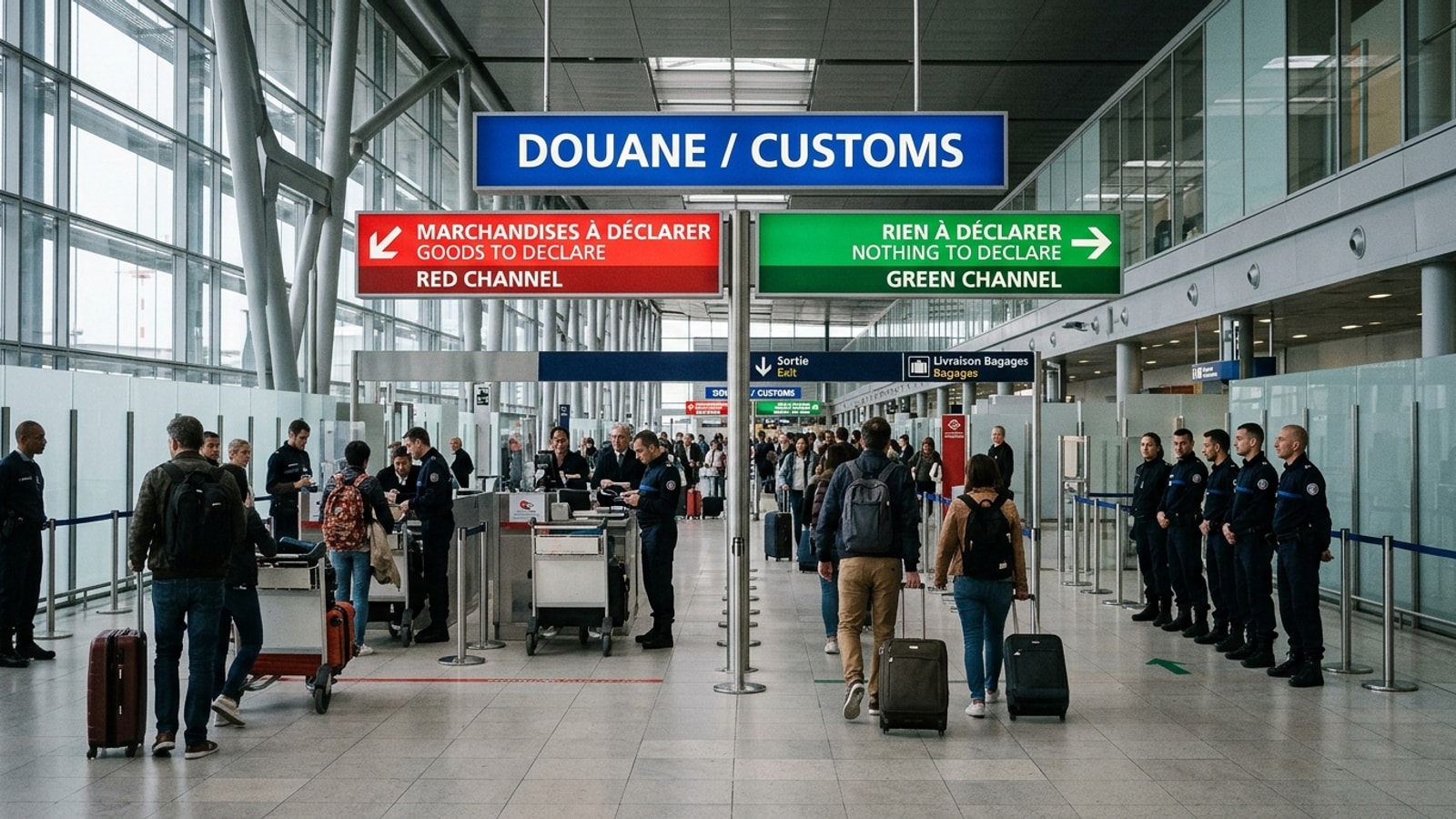
Red Channel vs Green Channel at Paris CDG, Orly, and Nice
Upon collecting checked baggage from the international carousel halls, arriving passengers must choose between two distinct clearance exits:
  AIRPORT ARRIVAL CLEARANCE CORRIDORS
  ┌─────────────────────────────────────────────────────────────┐
  │ GREEN CHANNEL ("Rien à déclarer" / Nothing to Declare)      │
  │ - Goods within the €430 value allowance                     │
  │ - Alcohol and tobacco within quantitative allowances        │
  │ - Zero meat, dairy, or prohibited agricultural items        │
  │ - Under €10,000 cash or liquid assets                       │
  ├─────────────────────────────────────────────────────────────┤
  │ RED CHANNEL ("Marchandises à déclarer" / Goods to Declare)  │
  │ - Goods exceeding the €430 allowance                        │
  │ - Alcohol or tobacco exceeding duty-free allowances         │
  │ - Commercial samples, merchandise for resale                │
  │ - Cash or negotiable instruments of €10,000 or more         │
  │ - Items requiring special phytosanitary/veterinary permits  │
  └─────────────────────────────────────────────────────────────┘
Douane Legal Authority and Spot Inspections
Walking into the Green Channel constitutes a formal legal declaration that the passenger carries no goods exceeding statutory exemptions and no prohibited items. Under the French Customs Code (droit de visite), Douane officers have full legal authority to intercept, question, and search any traveler passing through either channel, as well as anywhere within the airport premises.
Customs inspection teams frequently deploy specialized detector dog squads (chiens détecteurs) trained to identify:
- Concealed banknotes and currency.
- Meat, cheese, and agricultural products.
- Narcotics and illicit pharmaceuticals.
- Hidden tobacco and cigarettes.
Passing through the Green Channel with undeclared excess goods, commercial quantities, or banned food items constitutes an unlawful declaration (fausse déclaration). If caught, the traveler forfeits the right to simplified flat-rate taxation, faces confiscation of the items, and must pay mandatory penalty surcharges equal to 100% to 200% of the evaded taxes, in addition to potential criminal prosecution.
Traveler Logistics Guide
To navigate French border customs efficiently and avoid administrative delays or financial penalties, international travelers should follow this practical clearance checklist.
  OPERATIONAL CUSTOMS ACTION PLAN
  ┌─────────────────────────────────────────────────────────────┐
  │ 1. INVOICE ORGANIZATION                                     │
  │    Pack receipts for electronics or luxury items purchased  │
  │    within the last 12 months in an easily accessible folder.│
  ├─────────────────────────────────────────────────────────────┤
  │ 2. BIOSECURITY SCRUB                                        │
  │    Remove all meat snacks, dairy products, paneer, ghee, and│
  │    fresh fruit before boarding your flight to France.       │
  ├─────────────────────────────────────────────────────────────┤
  │ 3. CURRENCY COMPLIANCE                                      │
  │    Submit online DALIA declaration if carrying €10,000+     │
  │    in cash, traveller's cheques, or gold assets.            │
  ├─────────────────────────────────────────────────────────────┤
  │ 4. RED CHANNEL NAVIGATION                                   │
  │    If carrying goods above €430, proceed directly to the    │
  │    Douane service counter before leaving the baggage hall.  │
  ├─────────────────────────────────────────────────────────────┤
  │ 5. PABLO DEPARTURE LOGISTICS                                │
  │    Arrive 3.5 hours before departure flights if claiming    │
  │    VAT refunds; validate forms prior to bag check-in.       │
  └─────────────────────────────────────────────────────────────┘
Arriving at Paris Charles de Gaulle (CDG)
- Terminal 1: Customs clearance points are located on the arrivals level immediately following the circular baggage claim area. The Douane office is adjacent to Exit 36.
- Terminal 2E (Halls K, L, M): International long-haul flights from India, North America, the Middle East, and Asia arrive at Terminal 2E. Customs exits are situated immediately after baggage carousels 1 to 14. If declaring goods, the Douane inspection counter is clearly signed on the right-hand side before exiting to the public landside arrivals greeting area.
- Terminal 2F: Primarily handles Schengen arrivals. If transferring from an international non-Schengen flight to a Schengen connection at 2F, baggage is typically checked through, but Douane officers conduct random checks along the transfer corridors.
Arriving at Paris Orly (ORY)
- Orly 4: Serves international long-haul and regional North African flights. Douane inspection desks are situated right at the exit of the international baggage hall. Red and green channels are strictly enforced with active sniffer dog patrols.
- Orly 1-2-3: Handles domestic and intra-European traffic; spot checks are conducted for counterfeit items and high-value luxury goods arriving from non-EU transfer hubs.
Frequently Asked Questions
Can I bring 2 iPhones or a personal laptop to France without paying customs duty?
Yes, provided the electronics are for your personal use and are not brand-new packaged goods intended for resale or gifting in France. Used personal electronics—such as an active smartphone, a secondary work phone, and a personal laptop computer—are classified as personal effects and are exempt from duties under temporary admission rules. However, if you are carrying brand-new, factory-sealed devices in their retail boxes with a purchase price exceeding €430, they count against your duty-free allowance and must be declared at the Red Channel upon arrival.
Can I bring homemade food, pickles, ghee, or Indian sweets into France?
You can bring plant-based homemade foods such as dry roasted snacks (namkeen), dry spices, plain tea leaves, and oil-based pickles that contain no meat or dairy ingredients. However, you are strictly prohibited from importing any dairy products or meats from outside the EU. Clarified butter (ghee), paneer, and sweets made with condensed milk or milk solids (khoya, peda, barfi, gulab jamun) will be confiscated and destroyed by Douane inspectors at Paris CDG and Orly under EU Regulation 2019/2122.
What happens if I accidentally carry a counterfeit designer bag into Paris CDG?
Under Articles 414 and 428 of the French Customs Code, personal possession of counterfeit goods is a criminal customs offense with zero tolerance. Even if you purchased a single replica bag or imitation watch innocently for personal use, Douane officers will confiscate and destroy the item, and levy an immediate administrative customs fine based on the retail value of the authentic original designer item (ranging from 1x to 2x the retail price, often running into thousands of euros).
How do I validate tax-free shopping purchases at Paris Charles de Gaulle with PABLO?
Before checking in your luggage with your airline, take your tax refund forms (bordereau de détaxe) and your passport to an electronic PABLO kiosk located in the departures hall. Scan the barcode on the form against the optical reader. When the screen turns green, your tax refund is officially approved. Ensure that all purchased luxury goods remain unused, in their original packaging, and accessible in your carry-on or checked baggage, as Douane agents may request an on-the-spot physical inspection before you hand your luggage to the airline.