

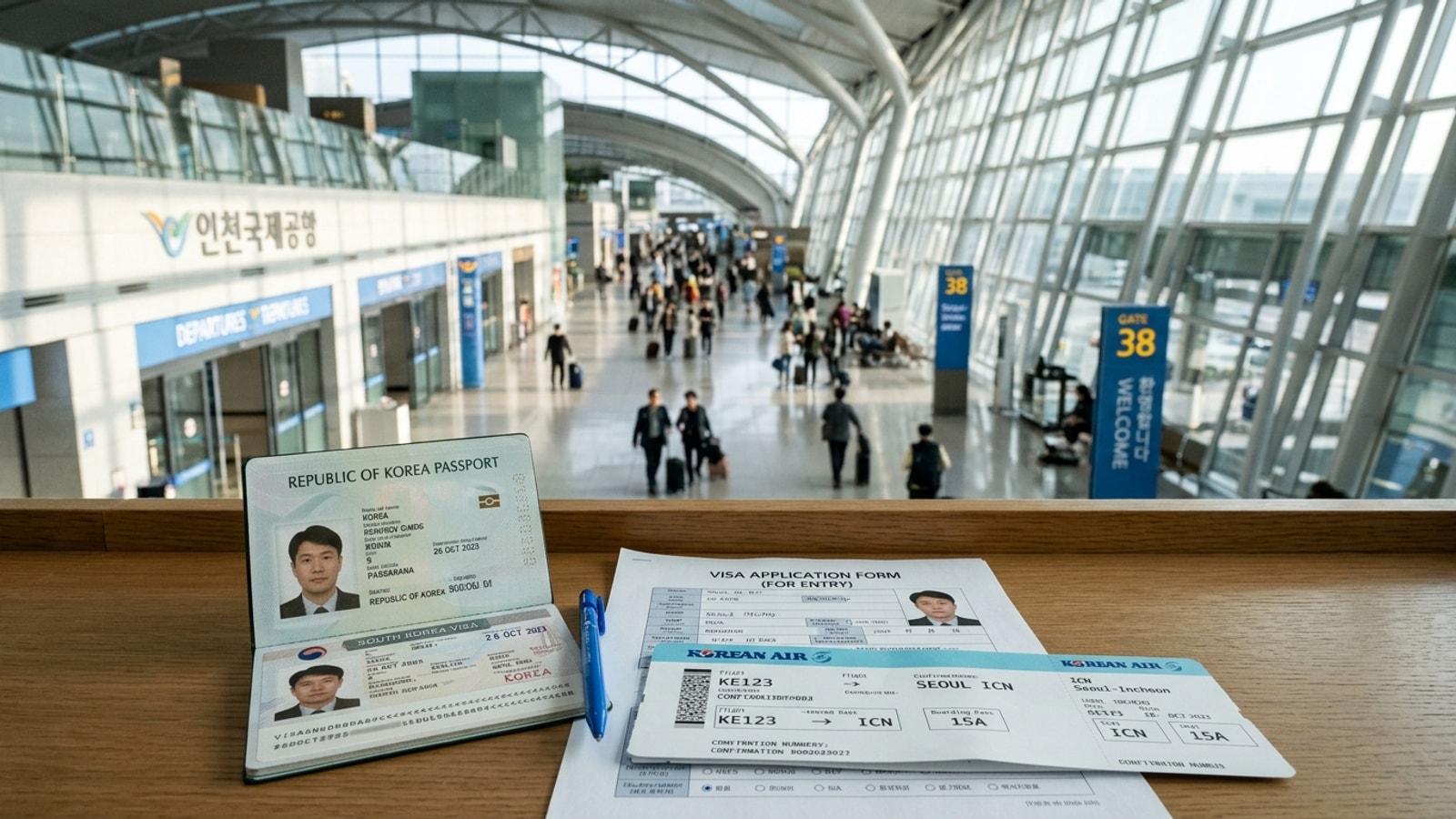
Quick Summary
- Primary Update: Indian passport holders traveling to the Republic of Korea for tourism, sightseeing, or private family visits must obtain a C-3-9 Short-Term General (Tourist) Visa prior to travel. Indian citizens are strictly not eligible for the Korea Electronic Travel Authorization (K-ETA), and South Korea does not issue Visas on Arrival (VoA) for regular passport holders at Seoul Incheon (ICN) or Gimpo (GMP). Applications must be lodged through official Korea Visa Application Centers (KVAC) in New Delhi, Mumbai, or Kolkata. Since 2020, South Korea has eliminated physical passport visa stickers; successful applicants download a digital Confirmation of Visa Issuance (Visa Grant Notice) from the official Korea Visa Portal (
visa.go.kr) to present at airline check-in and border control.- Transit & Border Impact: Travelers transiting through Seoul Incheon Airport holding a confirmed onward ticket to a third destination within 24 hours can remain airside without a Korean visa. Crucially, Indian nationals holding a valid physical visa, residence permit, or re-entry permit issued by the United States (including Guam and Saipan), Canada, Australia, New Zealand, or 32 European/Schengen nations qualify for the B-2-1 Tourist Transit Without Visa (TWOV) scheme. This program allows visa-free landside entry into South Korea for up to 30 consecutive days, provided the traveler transits directly between India and the visa-issuing country.
- Traveler Advice: The Embassy and Consulate General of the Republic of Korea maintain rigid financial verification thresholds. Applicants must submit original bank statements covering the preceding 6 consecutive months, each page stamped and signed by the issuing bank branch (or carrying a verifiable bank security QR code), alongside Income Tax Return Acknowledgments (ITR-V) for the last 2 assessment years. A minimum clear closing balance of ₹2,50,000 to ₹3,50,000 per traveler is strongly recommended. Qualified professionals, graduates of top-tier universities, and travelers earning over ₹5,00,000 annually can apply directly for a 5-year multiple-entry visa granting stays of up to 30 days per visit.
With non-stop flights connecting Delhi (DEL) and Mumbai (BOM) to Seoul Incheon (ICN) on Air India and Korean Air—supplemented by one-stop connections across Southeast Asia on Singapore Airlines, Thai Airways, Cathay Pacific, and VietJet—South Korea has evolved into a high-demand destination for Indian leisure travelers, solo backpackers, cultural tourists, and corporate delegates.
However, Korean immigration authorities and consular missions enforce strict administrative scrutiny regarding documentation authenticity, fund liquidity, and itinerary plausibility. Misconceptions regarding online K-ETA eligibility, improper bank statement certifications, or incorrect jurisdictional routing represent the leading causes of application delays and visa refusals.
This operational guide provides an exhaustive blueprint for navigating the South Korea C-3-9 visa process: jurisdictional assignments across KVAC hubs, detailed financial documentation standards, step-by-step application filing, qualifying criteria for the 5-year multiple-entry visa, full operational rules for the 30-day B-2-1 Incheon transit waiver, and airport immigration clearance in Seoul.
1. Visa Category Architecture and Statutory Fee Schedules
South Korea offers three distinct fee tiers for C-3-9 tourist visas based on entry frequency and duration of validity. All fees must be paid in Indian Rupees (INR) at the designated KVAC application counter via demand draft, debit/credit card, or unified payments interface (UPI), depending on the center. Consular fees are pegged to South Korean Won (KRW) and undergo quarterly foreign exchange adjustments.
The table below outlines the fee structures, permitted validity windows, stay allowances, and recommended financial thresholds:
| Visa Classification | Consular Fee (INR Equiv.) | KVAC Service Charge | Validity Period | Maximum Stay Per Visit | Recommended Bank Balance (INR) |
|---|---|---|---|---|---|
| C-3-9 Single Entry | ₹3,200 (KRW 52,000) | ₹1,600 | 90 Days from Issuance | Up to 90 Days (standard: 30 days) | ₹2,50,000 – ₹3,50,000 |
| C-3-9 Double Entry | ₹5,600 (KRW 91,000) | ₹1,600 | 6 Months from Issuance | Up to 30 Days per Entry | ₹3,50,000 – ₹5,00,000 |
| C-3-9 Multiple Entry (5 Years) | ₹7,200 (KRW 117,000) | ₹1,600 | 5 Years from Issuance | Up to 30 Days per Entry | ₹5,00,000+ or ITR > ₹5 Lakh/yr |
| B-2-1 Transit Without Visa | ₹0 (Free Waiver) | None | Entry Window on Ticket | Up to 30 Days | Valid 3rd-Country Visa Proof |
Note: Optional return passport courier service is available at KVAC centers for approximately ₹550 per applicant. Consular visa fees are strictly non-refundable once an application has entered processing, regardless of whether the visa is granted or refused.
2. Diplomatic Jurisdiction and KVAC Submission Hubs
The Republic of Korea divides India into two consular jurisdictions. Applying through an incorrect KVAC center without proving a minimum 6-month continuous residency (via registered rental agreement, utility bills, or employer transfer letter) in that territory will lead to an immediate file return:
+-----------------------------------------------------------------------------------+
|               REPUBLIC OF KOREA VISA JURISDICTION IN INDIA                        |
+-----------------------------------------------------------------------------------+
                                                                                    |
                                                                                    +
         |                                                                          |
         v                                                               v
 [KVAC NEW DELHI / KOLKATA]                                  [KVAC MUMBAI]
  Jurisdiction:                                               Jurisdiction:
  - Embassy of the Republic of Korea, New Delhi               - Consulate General of Korea, Mumbai
  - Covers: Delhi NCR, Haryana, Punjab, Himachal              - Covers: Maharashtra, Gujarat, Goa,
    Pradesh, Jammu & Kashmir, Ladakh, Uttar Pradesh,            Madhya Pradesh, Karnataka, Kerala,
    Uttarakhand, Bihar, Jharkhand, Odisha,                      Tamil Nadu, Telangana, Andhra Pradesh,
    West Bengal, Assam, and North-East States                   Puducherry, Daman & Diu, Dadra & NH
  - Submission: Direct walk-in or travel agent                - Submission: Managed by IOM / KVAC
KVAC Center Locations:
- KVAC New Delhi:
- Address: 5th Floor, Shivaji Stadium Metro Station, Baba Kharak Singh Marg, Connaught Place, New Delhi 110001.
- Operating Hours: Submission: 09:00 – 12:00 (Individual) / 09:00 – 14:00 (Travel Agents); Passport Collection: 15:00 – 17:00.
- KVAC Mumbai:
- Address: Level 7, Trade Centre, Bandra Kurla Complex (BKC), Bandra East, Mumbai 400051.
- Operating Hours: Submission: 09:00 – 13:00; Passport Collection: 14:00 – 16:30.
- KVAC Kolkata (Application Drop Hub):
- Address: 5th Floor, Rene Tower, Plot AA-I, 1842 Rajdanga Main Road, Kasba, Kolkata 700107.
- Note: Files submitted in Kolkata are physically couriered to the Korean Embassy in New Delhi, adding 2 to 3 additional transit days to overall processing.
3. Mandatory Document Checklist for the C-3-9 Tourist Visa
To achieve approval without supplementary document requests, your application dossier must be arranged in the exact order specified by the Korean Consular Service:
  1. Original Passport (Valid 6+ Months, 2 Blank Pages)
  2. Korea Visa Application Form (Signed, with 35x45mm Color Photo)
  3. Detailed Personal Cover Letter & Day-by-Day Travel Itinerary
  4. 6-Month Personal Bank Statements (Original Branch Seal & Signature on Every Page)
  5. Income Tax Return Acknowledgments (ITR-V) for Preceding 2 Assessment Years
  6. Employment Verification / NOC Letter + Last 3 Months Salary Slips
  7. Flight Reservation (Confirmed PNR) & Hotel Booking Vouchers
  8. Proof of Civil Status / Family Ties (If applying as a family unit)
1. Passport and Photograph Standards
- Passport: Must possess at least 6 months remaining validity from your planned departure date from South Korea and have at least two consecutive blank pages for immigration entry/exit stamps. All previous passports containing prior international visas must be submitted.
- Photograph: One color passport-size photograph (35mm wide × 45mm high) taken within the last 6 months against an off-white or plain white background. The face must occupy 70% to 80% of the frame (chin to crown between 32mm and 36mm). Teeth must not be visible; eyeglasses with heavy frames, tinted lenses, or glare reflections are prohibited. Do not staple the photograph; affix it with glue stick in the designated box on page 1 of the application form.
2. Comprehensive Financial Proof (Consular Core Requirement)
Financial assessment forms the crux of Korean visa adjudication. Consular officers evaluate your financial solvency to verify that you can comfortably absorb Korean domestic expenses without resorting to unauthorized employment:
- Personal Bank Statement: You must furnish original savings bank account statements covering the preceding 6 consecutive months, issued no more than 7 calendar days before your submission date.
- Branch Seal Rule: Every single page of the printed statement must bear the physical ink stamp and signature of the bank branch officer. Uncertified internet printouts or monthly e-statements without branch endorsement are rejected outright, unless the statement is generated from an institutional banking portal with a scannable, cryptographic validation QR code (e.g., HDFC, ICICI, or SBI digital validation systems).
- Fund Authenticity: Avoid sudden "booster deposits" or large unexplained lump-sum inflows immediately prior to statement generation. Consuls look for regular, consistent income credits matching your salary or business cash flow.
- Target Balance: A minimum closing balance of ₹2,50,000 to ₹3,50,000 per person (or ₹5,00,000+ for families) is strongly advised.
- Income Tax Returns (ITR-V): Submit the official Income Tax Return Verification (ITR-V) forms for the last two assessment years (e.g., AY 2025–26 and AY 2024–25). If your gross annual income on your ITR is below ₹3,00,000, consider providing a formal financial affidavit of support from a parent or spouse accompanied by their certified financial records.
3. Occupational and Professional Documentation
- For Salaried Employees:
- Original No Objection Certificate (NOC) / Leave Approval Letter on official company letterhead signed by HR or an authorized signatory, stating your name, passport number, designation, monthly remuneration, date of joining, approved leave dates, and explicitly confirming your return to duties.
- Salary pay slips for the preceding 3 months.
- Copy of your corporate identification badge.
- For Self-Employed Individuals & Business Owners:
- Certificate of Business Incorporation, GST Registration Certificate, or Partnership Deed.
- Company/Firm current bank statements for the preceding 6 months, stamped by the bank branch.
- Company Income Tax Returns for the last 2 assessment years with computation of income.
- For Retirees:
- Pension payment order (PPO) copy or 6 months pension bank credit statement, alongside fixed deposit certificates or mutual fund summary statements.
- For Students and Minors:
- School/College enrollment certificate or student ID card copy.
- Sponsorship letter and financial dossier from parents.
- Birth certificate showing parental names (mandatory for applicants under 18).
- If traveling without both parents, a notarized parental consent affidavit from the non-accompanying parent(s).
4. Cover Letter and Day-by-Day Travel Itinerary
Submit an individualized cover letter addressed to "The Visa Officer, Embassy / Consulate General of the Republic of Korea". The letter must outline:
- Primary purpose of visit (e.g., tourism, cultural exploration, attending Seoul festivals).
- Detailed breakdown of travel dates, ports of entry/departure, and accommodation addresses.
- Clear statement regarding who is funding the trip.
- A concise day-by-day table showing planned activities (e.g., Day 1: Arrive ICN, Gyeongbokgung Palace; Day 2: Namsan Seoul Tower & Myeongdong; Day 3: KTX train to Busan, Haeundae Beach).
- Explicit declaration affirming compliance with Korean immigration laws and timely departure before visa expiry.
4. Eligibility Criteria for the 5-Year Multiple-Entry Visa
Under regulations revised by the Ministry of Justice of the Republic of Korea, Indian passport holders meeting any of the following standardized profiles can bypass single-entry permits and secure a 5-year multiple-entry C-3-9 visa (granting up to 30 days per entry):
+-----------------------------------------------------------------------------------+
|               5-YEAR MULTIPLE-ENTRY KOREA VISA QUALIFYING CRITERIA                |
+-----------------------------------------------------------------------------------+
  1. Higher Education Graduates:
     - Bachelor's, Master's, or PhD degree holders from top 500 universities worldwide
       (QS, Times Higher Education, ARWU) or top NIRF Indian institutions.
  2. High-Income Professionals:
     - Salaried professionals demonstrating an annual income exceeding INR 5,00,000
       on Form 16 / ITR acknowledgments.
  3. Licensed Certified Specialists:
     - Practicing Medical Doctors, Chartered Accountants (ICAI), Lawyers (Bar Council),
       Architects, or permanent University Professors.
  4. Frequent International Travelers:
     - Individuals who have visited South Korea previously on an official C-3 visa
       (excluding group visa or transit schemes).
     - Individuals who hold valid visas or proven travel history to OECD nations
       (US, UK, Canada, Australia, New Zealand, Japan, Schengen Area).
  5. Immediate Family Members:
     - Spouses, minor children, and parents of an active 5-year multiple-entry visa holder.
Applicants applying under category 1 must attach their degree certificate along with official university ranking documentation. Applicants applying under professional licenses must include valid bar, medical council, or institute membership cards.
5. The B-2-1 30-Day Incheon Transit Without Visa (TWOV) Exemption
One of the most valuable yet misunderstood privileges available to Indian passport holders is South Korea's B-2-1 Tourist Transit Without Visa program. This framework allows eligible travelers to exit Seoul Incheon (ICN) or Gimpo (GMP) airport, enter the Republic of Korea without a visa, and remain in the country for up to 30 consecutive days.
                           B-2-1 TRANSIT ROUTING LOGIC

  OUTBOUND:  India -----------> South Korea (Stay <= 30 Days) ---------> Qualifying Country
             [Origin]           [Incheon Airport Entry]                 (US/CA/AU/NZ/Schengen)

  INBOUND:   Qualifying Country ---------> South Korea (Stay <= 30 Days) ---------> India
             (US/CA/AU/NZ/Schengen)        [Incheon Airport Entry]                 [Final Destination]
Qualifying Visa/Permit Requirements:
To utilize the B-2-1 exemption, you must possess a valid physical visa, residence permit, or permanent resident card issued by one of the following jurisdictions:
- United States (including Guam and the Northern Mariana Islands / Saipan)
- Canada
- Australia
- New Zealand
- 32 European / Schengen Nations: Austria, Belgium, Bulgaria, Croatia, Cyprus, Czechia, Denmark, Estonia, Finland, France, Germany, Greece, Hungary, Iceland, Ireland, Italy, Latvia, Liechtenstein, Lithuania, Luxembourg, Malta, Netherlands, Norway, Poland, Portugal, Romania, Slovakia, Slovenia, Spain, Sweden, Switzerland, and the United Kingdom.
Mandatory Operational Conditions:
- Physical Sticker / Card Mandate: The qualifying visa must be physically affixed to your passport or held as an original plastic biometric residence card. Digital e-visas or electronic travel authorities (such as Australian ETA subclass 601 or US ESTA) are accepted only if verifiable directly via official airline portal queries or when accompanied by certified physical visa labels, depending on airline check-in rules.
- Direct Transit Continuum:
- Valid Route: Delhi (DEL) → Seoul (ICN) → Los Angeles (LAX) on Korean Air or connecting carriers.
- Valid Route: San Francisco (SFO) → Seoul (ICN) → Mumbai (BOM).
- Invalid Route: Delhi (DEL) → Bangkok (BKK) → Seoul (ICN) → Tokyo (NRT) → San Francisco (SFO), if transit involves intermediate stays exceeding standard transfer windows.
- Confirmed Onward Ticket: You must hold a confirmed onward flight ticket departing South Korea within 30 calendar days. Standby or open-ended tickets are strictly disqualified.
- Clean Immigration History: The traveler must have no record of illegal stay, visa violations, or criminal convictions in the Republic of Korea.
Warning: If your 3rd-country visa is a single-entry visa, you may only use the B-2-1 exemption when traveling TO that country (while the visa is unutilized), or when returning DIRECTLY FROM that country back to India immediately following your stay.
6. Step-by-Step Application Submission Workflow
Follow this chronological checklist to file your C-3-9 application seamlessly:
[Step 1: Download & Complete Form]
       |---> Obtain official form from visaforkorea-in.com; fill in English block capitals.
       v
[Step 2: Compile & Certify Dossier]
       |---> Procure bank branch stamps on every statement page; collect 2 years ITR-V.
       v
[Step 3: Book KVAC Appointment / Walk-In]
       |---> Book online slot at KVAC Delhi or Mumbai; walk-in accepted during designated hours.
       v
[Step 4: Biometrics & Document Lodgment]
       |---> Submit physical paperwork; pay consular fee + KVAC charge; retain receipt & tracking code.
       v
[Step 5: Consular Review & Korea Visa Portal Tracking]
       |---> Monitor status at visa.go.kr (Under Review -> Approved -> Notice Issued).
       v
[Step 6: Download & Print Visa Grant Notice]
       |---> Download Confirmation of Visa Issuance; print in clear color/monochrome A4.
Tracking and Printing the Digital Visa:
- Navigate to the official Korea Visa Portal at
visa.go.kr. - Select Check Application Status → Check Application Status & Print.
- Choose Diplomatic Office in the dropdown.
- Select Passport No., enter your passport number, full name (format:
SURNAME GIVEN NAMEexactly as entered on the application form), and date of birth (YYYY-MM-DD). - Click Search. When the status displays Approved, click the Certificate button to generate your official PDF Confirmation of Visa Issuance (Visa Grant Notice).
- Print at least two high-resolution copies on standard A4 paper. You must carry this physical printout throughout your journey; digital images on mobile phones are not accepted by airline boarding gate agents or Korean immigration officers.
7. Seoul Incheon (ICN) Airport Arrival and Border Control Clearance
Upon landing at Seoul Incheon International Airport (Terminal 1 or Terminal 2), proceed through the foreign passenger arrival corridor to the primary immigration hall:
                               INCHEON (ICN) BORDER CLEARANCE FLOW

 [Aircraft Disembarkation]
            v
 [Health Quarantine Counter (Q-Code / Yellow Form)]
            v
 [Foreign Passport Immigration Counter]
            |---> Present: Original Passport + Printed Visa Grant Notice + Arrival Card
            |---> Biometrics: Place both index fingers on scanner; look into digital facial camera
            v
 [Immigration Officer Verification & Entry Slip]
            |---> Officer retains Arrival Card; hands back passport with printed Entry Slip
            v
 [Baggage Reclaim & Customs Green/Red Channel]
            |---> Clear customs; proceed to AREX Airport Railroad / KTX / Limousine Buses
Critical Arrival Tips:
- Electronic Arrival Card (e-Arrival Card): South Korea permits arriving passengers to complete a digital arrival card online prior to travel, or you may fill out the traditional paper Arrival Card handed out by flight attendants before landing.
- Customs Declaration: If you are carrying unaccompanied baggage, commercial goods, or currency exceeding USD 10,000 equivalent, you must declare it via the paper customs declaration slip or the Korea Customs Service mobile app.
- Biometric Registration: All foreign visitors aged 17 and above must register fingerprints and facial biometrics at the immigration counter. Hats, sunglasses, and surgical masks must be removed.
- Entry Slip: Immigration officers do not stamp physical ink entry endorsements into passports. Instead, the officer prints a small paper Landing Slip (Entry Slip) indicating your visa category (C-3-9 or B-2-1), entry date, and permitted period of stay. Keep this slip securely inside your passport until departure.
8. Frequently Asked Questions (FAQ)
Is an interview required at the Korean Embassy or Consulate?
Consular interviews are extremely rare for Indian tourist visa applicants. In over 98% of cases, decisions are made entirely on the documentary evidence submitted through KVAC. In rare instances where bank transactions, leave letters, or travel purposes require verbal clarification, the consular officer may schedule a telephonic inquiry or request an in-person interview.
Can I travel to Jeju Island visa-free directly from India?
While Jeju Island operates a special visa-free entry regime for most global nationalities, there are no direct international commercial flights connecting India to Jeju International Airport (CJU). Any flight routing through Seoul Incheon (ICN), Seoul Gimpo (GMP), or Busan Gimhae (PUS) requires crossing mainland Korean border control, which legally mandates a standard C-3-9 visa or B-2-1 transit exemption. Direct visa-free entry to Jeju is only practical if arriving on international charters or transit flights via third countries (such as Hong Kong or Shanghai) that land directly at Jeju.
What is the standard processing time at KVAC New Delhi and Mumbai?
Standard processing takes 7 to 10 working days from the date your application is physically lodged at KVAC New Delhi or Mumbai. Applications submitted at the Kolkata drop-off center require an additional 2 to 3 working days for round-trip courier transit. During peak travel windows (March–May for cherry blossom season and September–November for autumn foliage), processing can extend to 12–14 working days. You should submit your application 3 to 4 weeks prior to your target departure date.
Can I submit internet banking statements downloaded as PDFs?
Only if the downloaded e-statement features a scannable, cryptographic validation QR code issued directly by the bank's digital verification system. Regular plain PDF printouts without verification codes are strictly rejected. To eliminate refusal risk, take your printed statements to your local bank branch and obtain an ink branch stamp and signature on each page.
If my C-3-9 visa is approved for 90 days single entry, how long can I actually stay?
The "90 Days" printed on your Confirmation of Visa Issuance under "Period of Validity" means you have a 90-day window from the date of issuance to enter South Korea. Upon arrival, your permitted length of stay is determined by the immigration officer based on your submitted travel itinerary, standardly granted for up to 30 days or 90 days. Check the exact "Period of Stay" authorized on your printed Landing Slip at Incheon airport.