

Quick Summary
- Primary Update: Indian travelers arriving from Saudi Arabia receive a statutory General Free Allowance of ₹50,000 for new merchandise and one duty-free laptop computer under Rule 5, alongside specialized concessions for eligible expatriates returning with gold jewellery and pilgrims carrying certified Zamzam water.
- Transit Impact: Daily nonstop flights from Riyadh (RUH), Jeddah (JED), Dammam (DMM), and Medina (MED) into Delhi (DEL T3), Mumbai (BOM T2), Hyderabad (HYD), Calicut (CCJ), and Kochi (COK) undergo mandatory inline X-ray screening and targeted profiling at customs exits.
- Traveler Advice: Short-term visitors and pilgrims hold zero duty-free gold allowance; Zamzam water is restricted to 5 liters in official factory-sealed cans strictly checked into the aircraft hold; commercial drones remain completely banned under DGFT import mandates; and any dutiable goods must be declared via the Red Channel or the ATITHI mobile app.
The aviation corridor connecting the Kingdom of Saudi Arabia and India represents one of the busiest and most strategically significant passenger transit corridors in the world. Daily flight schedules operated by flag carriers and low-cost airlines—including Saudia, flynas, Air India, IndiGo, Air India Express, Akasa Air, and SpiceJet—link major Saudi gateways including Riyadh King Khalid International (RUH), Jeddah King Abdulaziz International (JED), Dammam King Fahd International (DMM), and Medina Prince Mohammad bin Abdulaziz Airport (MED) directly with Indian commercial centers and regional gateways such as Delhi Indira Gandhi International (DEL T3), Mumbai Chhatrapati Shivaji Maharaj International (BOM T2), Hyderabad Rajiv Gandhi International (HYD), Calicut International (CCJ), Cochin International (COK), Chennai International (MAA), and Lucknow Chaudhary Charan Singh International (LKO).
This transit corridor serves an exceptionally diverse demographic: millions of Indian expatriate workers returning on annual leave or final exit, Umrah and Hajj pilgrims concluding religious journeys, business executives, and visiting families. Consequently, inbound passenger baggage frequently contains specialized items: traditional 24-karat and 22-karat gold jewellery, premium consumer electronics like iPhones purchased at Jarir Bookstore or Extra, certified Zamzam water cans, luxury Arabian oudh perfumes, vacuum-packed Medjool and Ajwa dates, and kitchen appliances.
Upon touching down at any Indian international port of entry, every inbound passenger enters the legal jurisdiction of the Customs Act, 1962, and the Baggage Rules, 2016 (as amended), administered by the Central Board of Indirect Taxes and Customs (CBIC). Navigating Indian customs clearance smoothly requires a precise understanding of the statutory boundaries separating duty-free personal effects, financial value ceilings, gold import regulations, and absolute statutory prohibitions.
Statutory Legal Framework for Saudi Arabia Arrivals
Indian customs regulations classify inbound baggage under three distinct operational tiers: bona fide personal effects, the General Free Allowance (GFA), and restricted or conditional commodities governed by specific statutory notifications.
Under Rule 3 of the Baggage Rules, 2016, an Indian resident or an overseas tourist of Indian origin arriving by air from countries other than Nepal, Bhutan, or Myanmar is granted clearance of bona fide personal effects free of duty, alongside an aggregate General Free Allowance of articles up to a total assessable value of ₹50,000.
Personal effects include items required for daily personal use, such as worn clothing, basic footwear, personal toiletries, one active personal mobile phone, and standard personal accessories. All newly purchased boxed items, packaged gifts, electronics, and consumer appliances carried in checked or cabin baggage must fit within the combined ₹50,000 financial ceiling. Any aggregate value exceeding ₹50,000 attracts standard customs duty at an effective rate of 38.5% (comprising 35% Basic Customs Duty plus a 10% Social Welfare Surcharge).
Gold Jewellery, Coins, and Bullion Import Regulations
Gold remains the single most heavily scrutinized commodity carried by passengers returning from Saudi Arabia. Due to price differentials, manufacturing standards, and the cultural tradition of purchasing gold in Jeddah, Riyadh, and Dammam souks, customs officers maintain strict surveillance at international arrival halls.
Indian Customs maintains an absolute legal boundary between bona fide gold jewellery and raw gold bullion, bars, or coins:
Passenger Category                     | Weight Limit        | Value Ceiling  | Applicable Duty

Male Passenger (Stay abroad > 1 year)  | Up to 20 grams      | Up to ₹50,000  | 0% (Duty-Free)
Female Passenger (Stay abroad > 1 year)| Up to 40 grams      | Up to ₹100,000 | 0% (Duty-Free)
Short-Term Visitor (Stay < 1 year)     | ZERO grams          | ₹0             | Fully Dutiable
Umrah / Hajj Pilgrim (Stay < 1 year)   | ZERO grams          | ₹0             | Fully Dutiable
Children / Minors (Stay abroad > 1 yr) | Subject to residency| Same as adult  | 0% within caps
The 1-Year Overseas Residency Rule
To claim any duty-free gold jewellery allowance, the passenger must have resided abroad for a continuous period exceeding one year (at least 365 days). Expatriates on valid Iqama visas returning on annual leave or final exit qualify for this concession.
Umrah pilgrims, Hajj pilgrims on short-duration pilgrimage packages, business delegates, and vacationers who have been outside India for less than 365 days receive zero duty-free gold jewellery allowance. Any new gold jewellery purchased by short-term travelers in Saudi Arabia cannot be adjusted against the ₹50,000 General Free Allowance; gold is explicitly listed in Annexure I of the Baggage Rules, 2016, which strictly excludes gold and silver in any form from the GFA.
Dual Cap Enforcement: Weight and Financial Value
For eligible long-term residents, customs law enforces a dual-condition test:
- Male passengers may import up to 20 grams of gold jewellery, provided the total assessable value does not exceed ₹50,000.
- Female passengers may import up to 40 grams of gold jewellery, provided the total assessable value does not exceed ₹100,000.
Because international gold prices routinely exceed statutory rupee valuation caps per gram, customs valuation officers apply prevailing CBIC tariff values published fortnightly in official notifications. If a female passenger brings 35 grams of gold jewellery valued by customs at ₹2,50,000, only ₹1,00,000 is exempted; the remaining ₹1,50,000 assessable balance is taxed at the applicable customs duty rate.
Gold Bars, Gold Coins, and Bullion Rules
Gold coins, gold biscuits, minted bullion ingots, and tola bars are completely excluded from the duty-free baggage allowance for all travelers, regardless of length of stay.
An eligible Indian passenger who has resided abroad for at least six continuous months may legally import gold bars or coins up to a maximum ceiling of 1 kilogram. However, this import is strictly subject to:
- Mandatory declaration at the Red Channel inspection desk prior to exiting customs.
- Payment of concessional customs duty in convertible foreign currency (or approved international banking instruments).
- Submission of official purchase invoices showing weight, purity (fineness), and serial numbers.
Carrying gold coins or unminted gold through the Green Channel without declaration constitutes intentional smuggling under Section 111 of the Customs Act, leading to immediate confiscation, heavy statutory penalties under Section 112, and potential criminal arrest under Section 135 if the value exceeds statutory prosecution thresholds.
Electronics, Laptops, and Smartphone Assessment
Electronics purchased across Saudi commercial retailers such as Jarir Bookstore, Extra, Lulu Hypermarket, or airport duty-free outlets attract high passenger demand due to regional sales promotions.
Device Category      | Statutory Allowance & Conditions               | Customs Duty Assessment

Personal Laptop      | One unit exempt under Rule 5 (Age 18 and over) | 0% (Fully Exempt)
Active Used Phone    | One unit cleared as bona fide personal effect  | 0% (Fully Exempt)
Second Smartphone    | Counts toward ₹50,000 General Free Allowance   | 0% within GFA; 38.5% above
Tablets / iPads      | Counts toward ₹50,000 General Free Allowance   | 0% within GFA; 38.5% above
Smart TV / Monitor   | Excluded from GFA (Annexure I item)            | 38.5% flat duty on full val
Consumer Drones      | Absolute import ban under DGFT notification    | Prohibited (Confiscation)
E-Cigarettes / Vapes | Absolute ban under PECA 2019                   | Prohibited (Confiscation)
The Rule 5 Laptop Exemption
Under Rule 5 of the Baggage Rules, 2016, every passenger aged 18 years or older is entitled to bring one laptop computer (notebook, MacBook, or portable PC) into India completely duty-free. This exemption is statutory and operates independently of the ₹50,000 General Free Allowance. A traveler carrying a personal business laptop and purchasing a brand-new boxed laptop overseas may claim the Rule 5 exemption on one unit, while the second unit must be absorbed within the ₹50,000 GFA or assessed for duty.
Carrying iPhones and Additional Mobile Handsets
Smartphones represent a recurring focal point at customs screening counters:
- Primary Handset: An active smartphone carried on the person with an active SIM card, personal apps, and visible wear is cleared as an exempt personal effect.
- Second Handset (New or Unboxed): Bringing a second smartphone—such as an iPhone 16 or 17 purchased in Saudi Arabia—requires careful accounting. The market purchase value (converted to Indian rupees using official CBIC exchange rates) is deducted from the passenger's ₹50,000 GFA.
- Valuation and Duty Calculation: If a newly purchased smartphone has an assessable value of ₹95,000, the first ₹50,000 is sheltered by the GFA (assuming no other dutiable goods are carried). The remaining balance of ₹45,000 is assessed at the flat baggage rate of 38.5%, resulting in an payable customs duty of ₹17,325.
- Retaining retail invoices with clear serial numbers and IMEI documentation prevents arbitrary valuation markups by customs assessors.
Flat-Panel Televisions: Annexure I Exclusion
Flat-screen televisions (LED, OLED, QLED) are explicitly categorized under Annexure I of the Baggage Rules. Televisions are completely excluded from the ₹50,000 General Free Allowance. Regardless of screen size (even 32-inch displays), every television imported as passenger baggage is subject to customs duty at 38.5% calculated on the full assessed value determined by the customs tariff database.
Absolute Prohibition: Drones and E-Cigarettes
- Drones: In accordance with Directorate General of Foreign Trade (DGFT) Notification No. 54/2015-2020, the import of consumer, commercial, and toy drones (including popular DJI Mini, Air, and Mavic series) into India via passenger baggage is absolutely prohibited. Indian customs officers will confiscate any drone discovered in checked or cabin baggage at the inline X-ray point. Confiscated drones cannot be redeemed upon payment of fine or duty.
- E-Cigarettes and Vapes: Under the Prohibition of Electronic Cigarettes Act (PECA), 2019, the import, possession, and transit of all electronic nicotine delivery systems (ENDS), vapes, e-hookahs, and replacement cartridges are illegal across India. Vaping devices found in baggage are seized immediately.
Zamzam Water Regulations: Airline and Customs Protocols
Zamzam water holds deep religious significance for Umrah and Hajj pilgrims returning to India. The transport of Zamzam water is governed by strict civil aviation safety standards, biosecurity protocols, and bilateral aviation directives.
Parameter             | Mandatory Operational Requirement

Volume Limit          | Exactly 5 liters per passenger holding an Umrah or Hajj visa
Container Standard    | Official factory-sealed leak-proof can produced by King Abdullah Project
Outer Packaging       | Encased in tamper-evident sealed plastic wrapping with official barcode
Transport Mode        | Strictly Checked Baggage (Cargo Hold); Absolute Ban in Cabin Baggage
Airline Allowance     | Handled as complimentary checked baggage by major carriers (Saudia, Air
                      | India, IndiGo) without deducting from standard ticket baggage weight
Tourist/Business Visa | May not qualify for complimentary baggage; must comply with standard hold
Resale Restrictions   | Commercial sale or distribution in India is strictly prohibited
The 5-Liter Sealed Container Standard
Pilgrims are permitted to bring a maximum of 5 liters of Zamzam water per passenger. The water must be acquired in certified, standardized containers manufactured by the National Water Company under the King Abdullah bin Abdulaziz Zamzam Water Project (KAZWP / Zamazemah).
Key operational rules:
- Unsealed plastic jerrycans, loose bottles, or improvised containers purchased from unauthorized street vendors outside holy sites are rejected during airport security screening in Saudi Arabia.
- Every container must feature the official tamper-evident sealed cap and must be enclosed within the heavy-duty branded plastic protective sleeve distributed at designated airport distribution centers in Jeddah (Terminal 1 and Hajj Terminal) and Medina.
Cabin vs. Checked Baggage Restrictions
Under international civil aviation safety rules established by ICAO and enforced by the Bureau of Civil Aviation Security (BCAS) and Saudi aviation authorities (GACA), liquids, aerosols, and gels (LAGs) exceeding 100 ml are strictly forbidden in aircraft passenger cabins.
- Zamzam water cannot be carried as hand luggage, even if purchased past initial security checkpoints.
- It must be checked into the aircraft hold at dedicated check-in counters.
Airline Baggage Policies: Free Allocation
Major carriers operating the Saudi-India route—including Saudia, Air India, Air India Express, IndiGo, and flynas—provide a special complimentary baggage allowance for Zamzam water:
- Passengers traveling on a valid Umrah or Hajj visa are permitted to check in one 5-liter can of certified Zamzam water free of charge, over and above their booked checked luggage allowance (e.g., 20 kg, 30 kg, or 2-piece allowance).
- The airline tags the Zamzam container separately, and it is reclaimed at a specialized bulky-baggage conveyor belt upon arrival in India.
- Passengers traveling on standard tourist e-visas or business visas should confirm airline-specific rules prior to check-in, as some budget carriers may require the Zamzam weight to be included within the purchased check-in baggage limit unless specifically covered by pilgrimage waivers.
Liquor, Tobacco, Perfumes, Oudh, and Food Allowances
Baggage arriving from the Arabian Peninsula often includes traditional luxury scents, natural spices, and premium dates. Navigating customs requires adherence to both outbound Saudi law and inbound Indian statutory limits.
Commodity Category    | Statutory / Permitted Allowance | Clearance Conditions & Legal Basis

Alcoholic Beverages   | 2 liters (Adults 18+ only)      | Zero outbound from KSA; Allowed via
                      |                                 | Indian Airport Arrival Duty-Free shops
Cigarettes / Tobacco  | 100 cigarettes OR 25 cigars OR  | Permitted within the ₹50,000 GFA
                      | 125 grams of tobacco            | (Bidi/Gutkha restricted)
Arabian Oudh / Attar  | Up to 250 ml / personal qty     | Sealed retail packaging; CITES permits
                      |                                 | required for raw Agarwood timber/chips
Packaged Perfumes     | Reasonable personal quantities  | Liquid limits apply in cabin; pack in
                      | (within ₹50,000 GFA cap)        | checked baggage to avoid cabin seizure
Dried Dates / Nuts    | Up to 5 kg (commercially sealed)| Vacuum-sealed Ajwa/Medjool dates pass
                      |                                 | freely; fresh agricultural unsealed ban
Saffron               | Up to 100 grams (sealed retail) | Permitted within personal baggage GFA
Alcohol Policies: Outbound Ban vs. Inbound Arrival Duty-Free
Saudi Arabia strictly enforces a complete prohibition on the manufacture, sale, possession, and export of alcoholic beverages. Travelers departing Saudi airports cannot purchase or transport alcohol in any form.
However, under Indian Customs Baggage Rules, every passenger aged 18 years or older entering India from any international destination is legally entitled to import up to two liters of alcoholic liquor or wine:
- Travelers arriving on direct flights from Saudi Arabia may exercise this statutory right by purchasing their two-liter allowance directly at the Duty-Free Arrival shops located inside Indian international terminals (prior to immigration/customs clearance desks at DEL T3, BOM T2, HYD, CCJ, COK, etc.).
- Spirits purchased at Indian arrival duty-free shops count toward personal duty-free liquid quotas and are placed in official tamper-evident security bags (STEBs) for straightforward transit through the Green Channel.
Tobacco Allowances
Under Annexure I of the Baggage Rules, duty-free clearance of tobacco products is strictly capped per adult passenger at:
- 100 cigarettes, or
- 25 cigars, or
- 125 grams of pipe/smoking tobacco. Carrying quantities exceeding these numbers requires declaring the excess at the Red Channel, where customs duty exceeding 100% is assessed. Electronic cigarettes remain completely prohibited.
Oudh (Agarwood), Attar, and Arabian Scents
Oudh wood chips and concentrated attar oils are prized purchases in Saudi Arabia.
- Packaged Perfumes and Attar: Commercially bottled perfumes and attar intended for personal use pass without hindrance, provided their collective cost falls within the ₹50,000 GFA. Due to cabin liquid security rules (100 ml cap), large perfume bottles must be stowed in checked baggage.
- Raw Agarwood (Aquilaria) Chips: Agarwood is an endangered species protected under the Convention on International Trade in Endangered Species of Wild Fauna and Flora (CITES). While small personal quantities of processed oudh chips generally pass customs inspection, commercial-scale quantities of raw agarwood logs or chips without official CITES export permits from Saudi Arabia and import clearance from India’s Wildlife Crime Control Bureau (WCCB) face instant confiscation and forestry charges.
Dates, Saffron, and Packaged Food
- Dates (Ajwa, Medjool, Safawi): Dried dates in commercially sealed retail packaging (vacuum packs or factory boxes) are classified as processed dry fruits and are fully permitted in checked luggage for personal use up to reasonable household quantities (typically 5 kg per family).
- Fresh Fruits and Unprocessed Plants: Carrying fresh unsealed dates, raw seeds, live cuttings, or soil is strictly prohibited under Indian Plant Quarantine (Regulation of Import into India) Order, 2003, to prevent agricultural pests.
- Saffron: Pure saffron threads in sealed commercial containers (up to 100 grams) pass freely within the GFA.
Comprehensive Customs Allowances & Penalties Table
The following operational reference details statutory limits, eligibility thresholds, assessment rates, and clearance channels across all major commodity classes:
| Commodity Category | Statutory Duty-Free Limit | Eligibility Requirements | Excess Duty Rate / Legal Action | Operational Clearance Channel |
|---|---|---|---|---|
| Bona Fide Personal Effects | Unlimited reasonable personal items | All inbound passengers | 0% (Fully exempt under Rule 3) | Green Channel |
| General Merchandise & Gifts | Up to ₹50,000 aggregate value | Indian residents & tourists of Indian origin | 38.5% effective duty on assessable value above ₹50,000 | Green Channel (if ≤ ₹50k); Red Channel (if > ₹50k) |
| Personal Laptop | 1 portable PC / laptop | Passengers aged 18 and older | 0% (Exempt under Rule 5 independently of GFA) | Green Channel |
| Gold Jewellery (Male) | Up to 20 grams AND max ₹50,000 value | Indian resident abroad continuously > 1 year | Assessed at tariff rate on value exceeding ₹50,000 | Red Channel if declaring excess |
| Gold Jewellery (Female) | Up to 40 grams AND max ₹100,000 value | Indian resident abroad continuously > 1 year | Assessed at tariff rate on value exceeding ₹100,000 | Red Channel if declaring excess |
| Gold Coins / Bullion Bars | ZERO grams duty-free | Expatriate stay > 6 months allows up to 1 kg import | Concessional duty in forex; Unannounced = Confiscation | Red Channel (Mandatory Declaration) |
| Zamzam Water | Exactly 5 liters | Umrah / Hajj visa holders; KAZWP sealed can | Confiscation if unsealed; Excess rejected by airlines | Checked Baggage Only |
| Alcohol / Wine | 2 liters per adult | Passengers aged 18 and older | Purchase at Indian Arrival Duty-Free; > 2L confiscated | Green Channel (with duty-free bag) |
| Cigarettes | 100 sticks | Adult passengers | > 100 sticks taxed at high duty or confiscated | Green Channel (if ≤ 100) |
| Consumer Drones | ZERO (Absolute Ban) | No exemptions | Absolute confiscation under DGFT Notification | Prohibited / Seized at X-ray |
| E-Cigarettes / Vapes | ZERO (Absolute Ban) | No exemptions | Immediate seizure under PECA 2019 | Prohibited / Seized at X-ray |
| Foreign Currency | Up to USD 5,000 cash; USD 10,000 total | All inbound passengers | Mandatory Currency Declaration Form (CDF) if exceeded | Red Channel (CDF filing) |
| Indian Currency (INR) | Up to ₹25,000 per person | Indian residents | Excess currency seized under FEMA regulations | Red Channel |
Currency Declaration Rules: Saudi Departure and Indian Arrival
Transporting physical currency across the Saudi-India sector is subject to stringent anti-money laundering and exchange control regulations.
Saudi Arabia Departure Thresholds (ZATCA)
When departing from any Saudi airport (RUH, JED, DMM, MED), the Zakat, Tax and Customs Authority (ZATCA) requires every traveler carrying cash, precious metals, or bearer negotiable instruments valued at 60,000 Saudi Riyals (SAR) or more (or equivalent in foreign currencies) to complete a mandatory electronic customs declaration prior to airport security screening. Failure to declare amounts equal to or exceeding SAR 60,000 can result in financial penalties of up to 25% of the seized sum for first-time non-commercial violations, or referral to public prosecution.
Indian Customs Arrival Currency Thresholds
Upon arrival in India, the Reserve Bank of India (RBI) and CBIC enforce the following currency limits under the Foreign Exchange Management Act (FEMA):
- Foreign Currency: A passenger can bring an unlimited amount of foreign currency into India. However, a formal Currency Declaration Form (CDF) must be submitted to the customs officer at the Red Channel if:
- The total value of foreign currency notes exceeds USD 5,000 (or equivalent in other currencies like SAR).
- The aggregate value of foreign currency notes, bank drafts, and traveler’s cheques exceeds USD 10,000 (or equivalent).
- Indian Currency (INR): Indian residents returning from abroad are permitted to carry up to ₹25,000 in physical Indian currency notes. Carrying Indian currency notes exceeding ₹25,000 is prohibited under FEMA and risks confiscation.
Traveler Logistics Guide
Smoothly navigating customs checkpoints at Indian arrival terminals requires structured pre-flight preparation in Saudi Arabia and disciplined execution upon landing.
1. Pre-Flight Preparation in Saudi Arabia
- Retain All Purchase Receipts: Keep original retail invoices for all consumer electronics, smartphones, gold jewellery, and luxury watches in your carry-on bag. Customs valuation officers evaluate declared items based on verified transaction invoices; in the absence of an invoice, customs appraisers use standard reference price lists that may exceed the actual promotional price paid.
- Inspect Zamzam Water Packaging: Ensure that your 5-liter Zamzam water can is an authentic King Abdullah Project sealed can encased in the official plastic sleeve with unbroken security seals. Check with your airline counter in Jeddah or Medina to receive the specialized baggage tag for Zamzam hold handling.
- Power Banks and Lithium Batteries: Stow all portable power banks, spare lithium-ion camera batteries, and e-gadgets exclusively in your cabin baggage. Placing lithium batteries inside checked luggage is strictly prohibited by international aviation safety standards and will trigger off-loading of your suitcase during inline baggage screening.
- Separate Used Personal Items from New Purchases: Keep newly purchased items in distinct packaging or bags so that you can quickly present them if selected for routine customs inspection.
2. Digital Declaration via the ATITHI Mobile App
To avoid delays at physical customs desks, international travelers can submit an electronic baggage declaration using the official CBIC ATITHI mobile app (available on iOS and Android) up to 24 hours prior to boarding:
- Enter your flight details, passport number, and list of dutiable items (such as electronics exceeding ₹50,000, dutiable gold jewellery, or currency requiring declaration).
- Upon completing the declaration, the app generates a unique digital QR code.
- Upon arrival at the Indian terminal, proceed directly to the designated ATITHI customs counter, present your digital QR code, and pay any assessed duties electronically using UPI, debit/credit cards, or net banking.
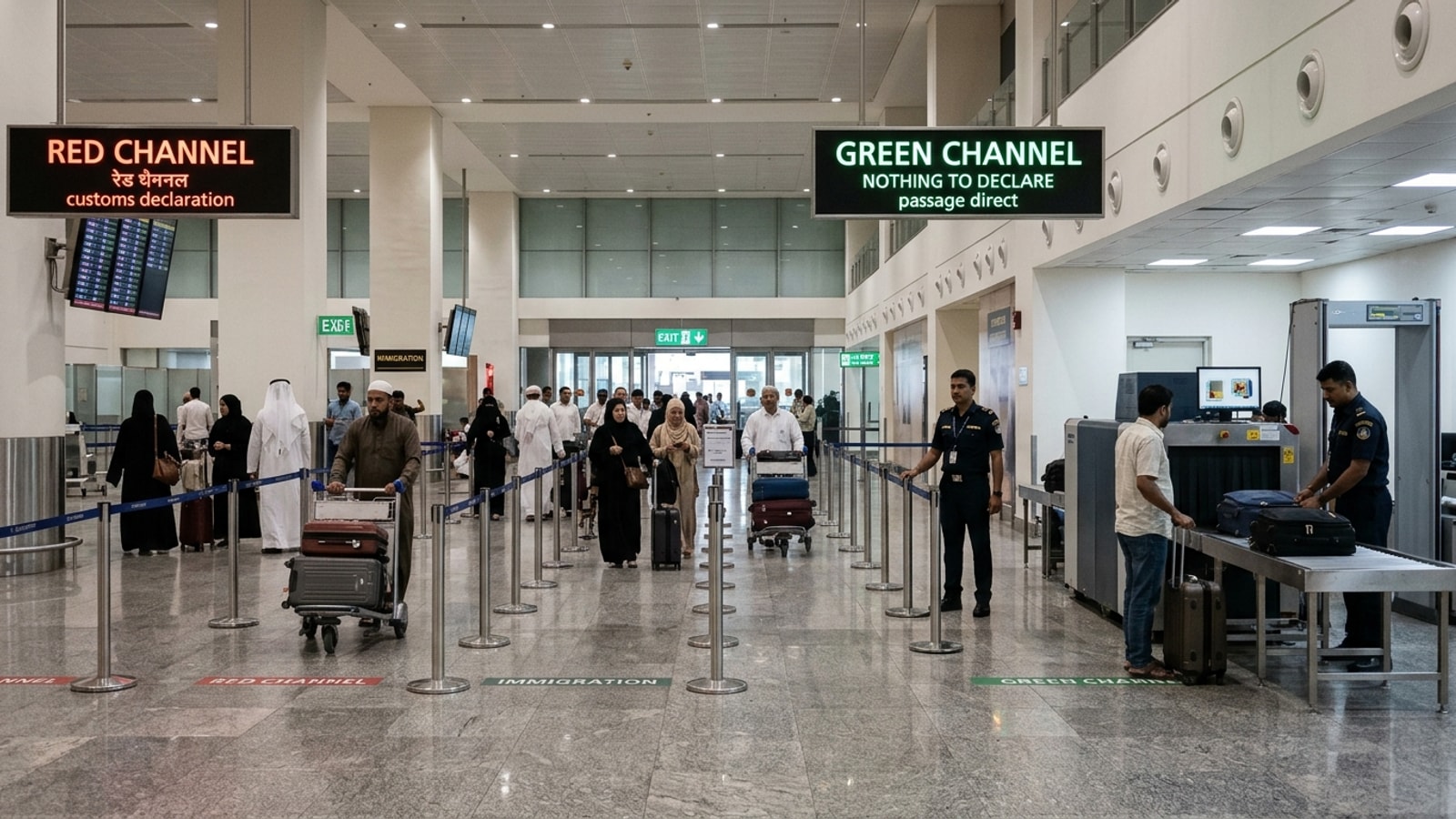
3. Arrival Terminal Navigation: Red Channel vs. Green Channel
After completing immigration clearance and collecting all checked bags (and Zamzam water cans from the oversize conveyor), passengers face the terminal exit corridors:
- The Green Channel: For passengers who have nothing to declare—meaning all carried items fall strictly within the ₹50,000 General Free Allowance, no commercial quantities are carried, no gold bullion/coins are in baggage, and no restricted items (drones, excess currency) are present.
- The Red Channel: Mandatory for any passenger carrying:
- Goods exceeding the ₹50,000 General Free Allowance.
- Gold jewellery exceeding the 20g/40g or ₹50k/₹100k limits, or any gold coins/bars.
- Foreign currency exceeding USD 5,000 in notes or USD 10,000 in aggregate.
- Commercial goods, samples, or restricted agricultural products.
4. Penalties for Green Channel Evasion
Walking through the Green Channel with undeclared dutiable goods is a serious legal violation:
- Section 111 Confiscation: Goods carried through the Green Channel without declaration are liable to absolute confiscation by the Government of India.
- Section 112 Penalties: Customs authorities impose monetary penalties of up to five times the value of the goods or the duty evaded.
- Section 135 Prosecution: If the total market value of undeclared dutiable goods exceeds ₹50 lakh, the offender faces non-bailable criminal arrest and rigorous imprisonment extending up to seven years.
Frequently Asked Questions
Can I bring gold jewellery bought in Saudi Arabia without paying customs duty?
Only if you are an Indian resident who has lived abroad for at least one continuous year (365 days). Under Rule 5, eligible male passengers can bring up to 20 grams of gold jewellery valued up to ₹50,000 duty-free, while eligible female passengers can bring up to 40 grams valued up to ₹100,000 duty-free. Short-term visitors, tourists, and pilgrims who have been abroad for less than one year receive zero duty-free gold allowance; any gold jewellery brought by them is fully taxable at applicable customs rates.
Is Zamzam water counted against my 30 kg ticket check-in baggage allowance?
For passengers traveling on a valid Umrah or Hajj visa, major scheduled airlines—including Saudia, Air India, Air India Express, and IndiGo—provide a complimentary 5-liter allowance for certified Zamzam water in addition to your standard ticket baggage allowance. The Zamzam water must be in an official factory-sealed can produced by the King Abdullah Project and checked into the aircraft hold. Passengers traveling on general tourist or business visas should confirm their airline's specific policy, as some budget carriers may deduct the weight from the standard allowance.
Can I bring an iPhone and a personal laptop to India without paying duty?
Yes, under specific conditions. Under Rule 5 of the Baggage Rules, 2016, any passenger aged 18 or older is entitled to bring one laptop computer duty-free, over and above the ₹50,000 General Free Allowance. Your primary active personal smartphone is exempt as a personal effect. If you purchase an additional new smartphone (such as an iPhone 16), its assessable value is deducted from your ₹50,000 GFA. If the phone’s value exceeds ₹50,000, you pay 38.5% customs duty only on the amount exceeding ₹50,000, provided you declare it at the Red Channel.
Can I buy duty-free alcohol when landing in India from Saudi Arabia?
Yes. While Saudi Arabia is completely alcohol-free and no alcoholic beverages can be purchased or exported from Saudi airports, adult passengers aged 18 and older landing at Indian international airports are legally permitted to purchase up to two liters of liquor or wine at the Arrival Duty-Free shops located inside the Indian terminal before clearing customs. These purchases are fully recognized as duty-free under Indian baggage laws.