

Quick Summary
- Primary Update: Indian travelers arriving from Malaysia receive a statutory General Free Allowance of ₹50,000 for new merchandise and one duty-free personal laptop under Rule 5, alongside strict caps of two liters of alcohol and 100 cigarettes.
- Transit Impact: High-frequency routes connecting Kuala Lumpur (KLIA1/KLIA2) and Penang (PEN) to Chennai (MAA), Tiruchirappalli (TRZ), Delhi (DEL T3), Mumbai (BOM T2), and Kochi (COK) face intensive inline X-ray baggage screening and covert tagging.
- Traveler Advice: Short-term tourists have zero duty-free gold jewellery allowance; commercial drone imports are completely banned under DGFT notifications, vaping hardware is confiscated under PECA 2019, and Langkawi duty-free purchases remain subject to standard Indian import duties.
Malaysia represents one of the highest-density air corridors for outbound Indian travel. Across business trips, leisure holidays in Kuala Lumpur and Penang, island getaways in Langkawi, and visits to extended family, hundreds of thousands of Indian passengers fly annual return routes aboard carriers such as AirAsia, Malaysia Airlines, IndiGo, Batik Air Malaysia, and Air India. Retail shopping forms a significant segment of these visits. Indian travelers regularly shop for consumer electronics at Low Yat Plaza in Bukit Bintang, purchase new devices at the Apple Store in The Exchange TRX, acquire duty-free liquor and confectionery on Langkawi island, and purchase gold jewellery in Brickfields or Little India in Penang.
When landing back at an Indian port of entry, every passenger passes under the statutory jurisdiction of the Central Board of Indirect Taxes and Customs (CBIC) under the Customs Act, 1962, and the Baggage Rules, 2016 (as amended). Because flights arriving from Southeast Asian hubs undergo rigorous inline scanning, physical baggage spot-checks, and risk-profiling at arrival halls—especially at high-volume southern gateways like Tiruchirappalli (TRZ) and Chennai (MAA)—travelers must understand the precise boundaries of duty-free allowances, assessable valuations, and mandatory Red Channel declaration protocols.
Statutory Legal Framework for Malaysia Arrivals
Clearance through Indian customs is structured around three distinct legal categories: bona fide personal effects, the General Free Allowance (GFA), and restricted or dutiable items subject to specific statutory schedules.
Under Rule 3 of the Baggage Rules, 2016, an Indian resident or an international traveler of Indian origin arriving by air from any country other than Nepal, Bhutan, or Myanmar is permitted to clear used personal effects and new articles up to an aggregate assessable value of ₹50,000 without paying customs duty.
Key statutory conditions governing the General Free Allowance include:
- Individual Entitlement: The ₹50,000 allowance is personal to each passenger. Allowances cannot be pooled, transferred, or combined across spouses, children, or traveling companions to clear a single high-value item (such as an expensive camera or premium laptop).
- Passenger Exclusion: Infant travelers under two years of age receive zero General Free Allowance and are limited strictly to used personal clothing and baby care items.
- Assessment Threshold: If the aggregate assessable value of new, dutiable merchandise exceeds ₹50,000, customs duty is levied only on the excess value, provided the items constitute bona fide personal baggage and not commercial quantities.
- Standard Customs Duty Rate: The standard customs duty on baggage items cleared under Chapter 98 of the Indian Customs Tariff is 35% Basic Customs Duty (BCD) plus a 10% Social Welfare Surcharge (SWS), resulting in an effective tax rate of 38.5%.
Comprehensive Baggage Allowance and Duty Rate Schedule
The following data table outlines statutory allowances, assessment rules, and effective duty rates applied to popular items carried on flights from Malaysia into India:
| Category / Item | Statutory Allowance / Cap | Effective Duty Rate | Declaration Condition & Assessment Rule |
|---|---|---|---|
| Personal Used Clothing & Toiletries | Reasonable quantity for travel | 0% (Exempt) | Exempt under Rule 3 as bona fide personal effects; tags removed. |
| Primary Laptop Computer | 1 laptop (passenger age 18+) | 0% (Exempt) | Exempt under Rule 5; applies to new or used laptops/MacBooks. |
| Secondary Laptop / Tablet | Assessed under ₹50,000 GFA | 38.5% on value exceeding GFA | Counts toward ₹50,000 pool; requires purchase invoice. |
| Primary Active Smartphone | 1 phone carried on person | 0% (Exempt) | Must show active SIM or operational setup as personal device. |
| Second Smartphone (Boxed iPhone/Android) | Value deducted from ₹50,000 GFA | 38.5% on value exceeding ₹50,000 | Invoices required; undeclared boxed units risk confiscation. |
| Alcoholic Spirits, Wine & Beer | Maximum 2 liters total per adult | 0% within 2L cap; >160% on excess | Passengers aged 18+ only; excess alcohol cannot use 38.5% rate. |
| Commercial Tobacco & Cigarettes | 100 cigarettes / 25 cigars / 125g tobacco | 38.5% within limits; seized if commercial | Commercial cartons or loose foreign tobacco face detention. |
| E-Cigarettes & Vapes | 0 units (Zero allowance) | Prohibited (Confiscation + Fine) | Banned under PECA 2019; prohibited in cabin and checked luggage. |
| Gold Jewellery (Tourists < 1 Year Stay) | 0 grams (Zero duty-free allowance) | Standard bullion/jewellery rates | All gold jewellery brought by short-term visitors is dutiable. |
| Gold Jewellery (Male Resident > 1 Year Stay) | Up to 20g (max value ₹50,000) | 0% within cap; standard duty above | Requires proof of overseas residence exceeding 365 days. |
| Gold Jewellery (Female Resident > 1 Year Stay) | Up to 40g (max value ₹100,000) | 0% within cap; standard duty above | Requires proof of overseas residence exceeding 365 days. |
| Gold Coins, Bars, & Bullion | Excluded from ₹50,000 GFA | ~13.75% for eligible NRIs; restricted for tourists | Must be declared at Red Channel; tourists face seizure. |
| Consumer Drones (DJI Mini, Air, Mavic) | 0 units (Zero import allowance) | Prohibited (Immediate Seizure) | DGFT import ban on drones; passenger baggage clearance prohibited. |
| Satellite Phones (Thuraya, Iridium) | 0 units without DoT permit | Prohibited (Seizure + Police FIR) | Banned under Section 6 of Indian Wireless Telegraphy Act. |
| Langkawi Duty-Free Confectionery & Gifts | Value absorbed in ₹50,000 GFA | 38.5% on value exceeding GFA | Langkawi tax exemptions do not apply at Indian border ports. |
Electronics Clearance: iPhones, Laptops, and Gadgets from Malaysia
Kuala Lumpur is a premier retail destination for tech-focused travelers. Retail zones such as Plaza Low Yat in Bukit Bintang, Digital Mall in Petaling Jaya, and the official Apple Store at The Exchange TRX attract shoppers seeking electronics priced lower than Indian domestic retail rates due to currency differentials and seasonal promotional discounts.
The Rule 5 Laptop Computer Exemption
Rule 5 of the Baggage Rules, 2016, provides a specific, standalone statutory exemption: one laptop computer (notebook, MacBook, or portable workstation) is permitted duty-free entry per passenger aged 18 years or older. This exemption applies independently of whether the laptop is new or pre-owned, and it does not consume any portion of the traveler's ₹50,000 General Free Allowance.
However, carrying two laptops introduces duty liability:
- The first laptop is cleared at 0% duty under Rule 5.
- The second laptop is treated as standard dutiable merchandise. Its assessable value is deducted against any remaining balance of the ₹50,000 GFA. Any amount remaining above ₹50,000 is assessed customs duty at 38.5%.
Bringing iPhones and Secondary Smartphones
Travelers purchasing an iPhone 16, iPhone 17, or premium flagship phone in Malaysia must recognize that customs officers do not classify sealed, boxed phones as personal effects.
- A smartphone carried in a pocket or handbag with an active SIM card and personal user accounts configured is accepted as personal used baggage under Rule 3.
- A secondary phone, whether sealed in retail shrink-wrap or unboxed in luggage, must be evaluated against the ₹50,000 allowance.
- If a traveler carries an existing personal smartphone and imports a new iPhone purchased at The Exchange TRX for RM 4,800 (approximately ₹96,000 depending on exchange rates):
- The officer verifies the invoice.
- The statutory ₹50,000 GFA is applied.
- The assessable excess of ₹46,000 is taxed at 38.5%, generating a customs levy of approximately ₹17,710.
- If original receipts are missing, customs appraisers assign a valuation using the CBIC national electronic valuation database, which often reflects higher baseline manufacturer list prices.
Gold Jewellery, Bullion, and Coins: Strict Border Rules
Gold regulations represent the most heavily audited and strictly enforced segment of Indian customs, particularly on flights from Southeast Asia and the Middle East.
The Tourist Gold Misconception
Many Indian vacationers visiting Kuala Lumpur believe that purchasing 10 to 20 grams of gold jewellery in Brickfields or Little India in Penang qualifies under the ₹50,000 General Free Allowance. This assumption is legally incorrect.
Under Annexure-I of the Baggage Rules, 2016, gold in any form—other than ornaments within the specific limits for passengers residing abroad for more than one year—is explicitly excluded from the ₹50,000 General Free Allowance. Short-term tourists have zero duty-free gold allowance. Any gold jewellery carried by a tourist must be declared at the Red Channel.
Export Certificate for Personal Jewellery
Indian residents traveling from India to Malaysia wearing high-value gold jewellery or diamond ornaments should always obtain an Export Certificate at the customs departure counter before boarding their outbound flight at Delhi, Mumbai, Chennai, or Bengaluru.
- The customs appraiser inspects the jewellery, verifies gross and net weight, records gemstone descriptions, and issues an official endorsement slip.
- Upon returning from Malaysia, presenting this Export Certificate guarantees that officers cannot treat the previously owned jewellery as a new dutiable import. Without this certificate, proving that jewellery was taken from India rather than purchased abroad can result in lengthy administrative delays and provisional assessments.
Gold Bars and Coins
Gold bars, minted biscuits, and coins cannot be cleared duty-free under any circumstances. Unless a passenger qualifies under the NRI concessional import scheme (requiring continuous overseas residence of at least six months) and declares the bullion at the Red Channel to pay customs duty in convertible foreign exchange, bringing gold bars from Malaysia into India via passenger baggage is illegal and triggers confiscation under Section 111 of the Customs Act, 1962.
Liquor, Wine, and the Langkawi Duty-Free Trap
Alcoholic beverages carried into India are governed by specific statutory volume limits rather than monetary value.
Navigating the Langkawi Island Duty-Free Conundrum
Langkawi holds special designated duty-free island status within Malaysia under Malaysian customs law. Spirits, wines, beers, and chocolates are sold across Kuah and Cenang Beach at prices significantly lower than mainland peninsular Malaysia.
However, travelers must avoid two critical logistical pitfalls:
- Malaysian Domestic Transit Security: When flying from Langkawi International Airport (LGK) to Kuala Lumpur (KUL) on a domestic flight before connecting to India, liquids, aerosols, and gels (LAGs) exceeding 100ml cannot be carried in hand baggage through KLIA terminal security screening unless purchased inside the international transit departure area in Security Tamper-Evident Bags (STEBs). Alcohol bought in Langkawi towns must be checked inside hold luggage before leaving LGK.
- Indian Import Jurisdiction: Malaysian duty-free exemptions end at the Malaysian border. Indian customs evaluates Langkawi alcohol strictly under standard CBIC rules: exactly two liters per adult passenger. Carrying six or eight bottles because they were inexpensive in Langkawi results in immediate detention of excess bottles or an assessment of over 160% customs duty at the Indian arrival terminal.
Prohibited Commodities: Drones, Vapes, and Strict Bans
Indian border regulations enforce complete statutory prohibitions on several items commonly sold in Malaysian retail markets.
The Consumer Drone Ban
Low Yat Plaza and electronics retailers across Malaysia display consumer drones—including popular models such as the DJI Mini 4 Pro, DJI Neo, and DJI Air 3—at competitive prices. Many travelers buy them under the false assumption that lightweight drones weighing under 250 grams can be brought into India.
Under Directorate General of Foreign Trade (DGFT) regulations, the import of drones into India in completely built-up (CBU), semi-knocked-down (SKD), or completely knocked-down (CKD) condition is prohibited for passenger baggage. Only government agencies and educational entities with prior DGFT licenses and Equipment Type Approval (ETA) from the Wireless Planning and Coordination (WPC) wing can import drones.
If a traveler carries a drone in checked or cabin baggage from Malaysia, customs officers at DEL, BOM, MAA, or TRZ will intercept the device during X-ray inspection, issue a formal detention receipt, and initiate confiscation proceedings under Section 111 of the Customs Act. Passengers cannot retrieve the drone even upon payment of fines.
E-Cigarettes and Vaping Devices
While vape shops operate openly throughout Kuala Lumpur, Selangor, and Penang, India enforces a zero-tolerance policy under the Prohibition of Electronic Cigarettes Act (PECA), 2019. The law prohibits the import of all forms of electronic nicotine delivery systems (ENDS), vape pens, replacement pods, and e-liquids into India.
Carrying vapes in carry-on backpacks or checked luggage leads to immediate confiscation by customs or CISF airport security, with repeat offenders facing monetary penalties.
Red Channel vs Green Channel: Screening and Legal Penalties
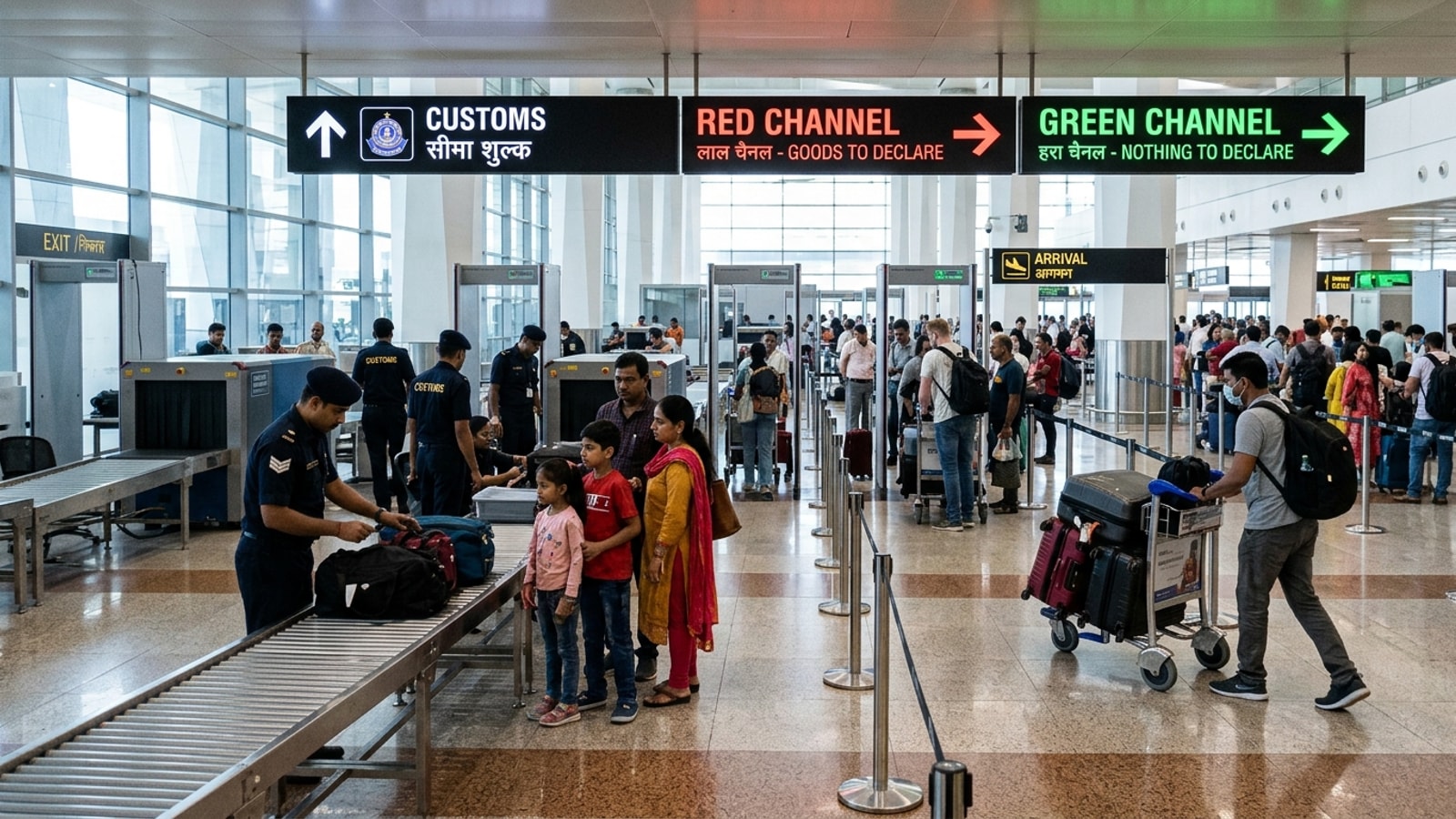
At every Indian international airport, the customs arrival concourse is divided into two operational streams: the Green Channel and the Red Channel.
                          [ INTERNATIONAL ARRIVALS / BAGGAGE CAROUSEL ]
                                                                         |
                     +-------------------------+-------------------------+
                     |                                                   |
                     v                                                   v
            [ GREEN CHANNEL ]                                     [ RED CHANNEL ]
- For passengers with nothing to declare.             - For passengers carrying:
- Goods within ₹50,000 GFA.                           * Goods exceeding ₹50,000 GFA.
- Max 1 laptop under Rule 5.                          * Alcohol exceeding 2 liters.
- Max 2 liters alcohol.                               * Gold coins, bars, or jewellery.
- No prohibited or commercial items.                  * Commercial merchandise / samples.
- All bags subject to covert spot X-ray.              * Dutiable electronics / secondary PCs.
                     |                                                   |
                     |                                                   v
                     |                                        [ CUSTOMS ASSESSMENT DESK ]
                     |                                        - Present invoices.
                     |                                        - Assessable duty calculated.
                     |                                        - Pay via Card / Cash / UPI.
                     |                                        - Obtain official receipt.
                     v                                                   |
             [ AIRPORT EXIT ] <------------------------------------------+
Baggage Profiling on Malaysia Corridors
Customs intelligence across Indian airports maintains heightened scrutiny on flights originating from Southeast Asian transfer hubs. High-frequency services—including AirAsia flights into Tiruchirappalli (TRZ) and Chennai (MAA), Malaysia Airlines into Delhi (DEL) and Mumbai (BOM), and IndiGo into Bengaluru (BLR)—undergo pre-carousel inline baggage X-ray screening.
Baggage handlers and customs profiling teams place chalk markings or barcoded covert tags on suitcases containing high-density items, multiple electronics, or metal masses before bags reach the baggage collection carousel. Plainclothes customs officers monitor passengers collecting marked luggage.
Green Channel Interception and Statutory Penalties
Walking into the Green Channel represents an explicit legal declaration that the passenger is carrying no goods exceeding statutory allowances and no prohibited items.
If customs officers intercept a traveler in the Green Channel and discover undeclared dutiable goods:
- Loss of Concessions: The ₹50,000 General Free Allowance is forfeited. Duty is levied on the entire value of goods rather than only the excess.
- Confiscation (Section 111): Goods are seized under Section 111 of the Customs Act, 1962, for improper importation.
- Monetary Penalty (Section 112): A personal penalty of up to five times the value of the goods (or ₹5,000, whichever is higher) can be imposed.
- False Declaration Penalty (Section 114AA): Making a false declaration or presenting altered receipts attracts penalties up to five times the value of the goods.
- Criminal Prosecution (Section 135): If the assessable duty evasion exceeds ₹50 lakh, customs authorities are empowered to arrest the passenger and initiate criminal prosecution in court.
Declaring goods at the Red Channel protects the traveler completely from confiscation penalties and criminal liability. The officer simply assesses the applicable duty, provides a formal payment challan, issues an official CBIC receipt, and releases the baggage upon payment.
Traveler Logistics Guide
Navigating Malaysian shopping and Indian customs clearance smoothly requires practical preparation before leaving Malaysia and systematic compliance upon landing in India.
Pre-Departure Logistics in Malaysia
- Organize Tax Invoices: Retain all physical and digital receipts from retail stores in Malaysia (Low Yat, The Exchange TRX, Suria KLCC, Mid Valley Megamall). Ensure invoices clearly list serial numbers, date of purchase, and price in Malaysian Ringgit (MYR).
- Separate Personal from Packaged Goods: If carrying a new secondary smartphone, decide whether it fits within your ₹50,000 GFA. Do not attempt to conceal unopened retail boxes inside wrapped clothing; X-ray scanners readily detect factory packaging.
- Pack Alcohol for Transit: If purchasing alcohol in Langkawi, ensure bottles are safely packed in checked hold baggage before checking in for your domestic flight to Kuala Lumpur. If buying alcohol at KLIA duty-free, keep bottles sealed inside official Security Tamper-Evident Bags (STEBs) with the receipt visible inside the bag.
- Check Flight Baggage Limits: Malaysian carriers enforce strict 7kg cabin baggage limits. AirAsia and Malaysia Airlines gate agents at KLIA audit cabin bags, charging heavy gate baggage fees if duty-free shopping bags cause your carry-on weight to exceed the 7kg limit.
Indian Arrival Concourse Checklist
- Step 1: Retrieve Checked Baggage: Collect all luggage from the carousel at DEL, BOM, MAA, BLR, TRZ, or COK. Inspect bags for any chalk marks (often an "X" or code written by customs personnel during inline screening).
- Step 2: Assess Your Duty Status: Total the value of all newly acquired goods. If total new purchases exceed ₹50,000, if you carry a secondary laptop, if you have more than two liters of alcohol, or if you are carrying gold jewellery as a tourist, immediately proceed to the Red Channel.
- Step 3: Red Channel Processing: Present your passport, boarding pass, and purchase receipts to the customs appraiser. The officer converts MYR to INR at the official CBIC exchange rate, applies the ₹50,000 GFA, and calculates assessable duty at 38.5%.
- Step 4: Payment and Clearance: Settle duty using an Indian debit card, credit card, net banking, or UPI at the customs cashier counter. Ensure you collect the stamped Customs Duty Receipt (Baggage Clearance Challan) before exiting the terminal. Retain this receipt as permanent proof of legal importation.
Frequently Asked Questions
Can I bring two laptops from Malaysia to India without paying customs duty?
No. Under Rule 5 of the Baggage Rules, 2016, only one laptop computer is exempt from customs duty for passengers aged 18 and older. If you carry two laptops (for example, your used work laptop and a new MacBook purchased at The Exchange TRX in Kuala Lumpur), the first laptop is cleared duty-free under Rule 5. The second laptop is treated as standard dutiable merchandise; its value is offset against your ₹50,000 General Free Allowance, and any assessable amount exceeding ₹50,000 is taxed at 38.5%.
Can a family of three pool their ₹50,000 allowances to bring an expensive gadget worth ₹1,20,000 duty-free?
No. Indian customs law explicitly prohibits the pooling or combining of baggage allowances across family members or traveling companions. The ₹50,000 General Free Allowance is personal to each individual traveler. A single item costing ₹1,20,000 cannot be split across three passenger allowances; it will be assessed against one passenger's ₹50,000 allowance, leaving an assessable excess of ₹70,000 subject to 38.5% customs duty (₹26,950).
Does alcohol bought on Langkawi island receive duty-free exemption when landing in India?
Indian customs does not recognize Langkawi's local duty-free status. While Langkawi is exempt from Malaysian domestic excise taxes, all goods entering India are governed exclusively by Indian CBIC regulations. Every adult passenger (aged 18 and older) is permitted a maximum of two liters of alcoholic liquor or wine duty-free. Any alcohol exceeding two liters attracts severe customs duty exceeding 160% (150% Basic Customs Duty + 50% AIDC + SWS), regardless of how inexpensive the bottles were on Langkawi.
Can I buy a DJI drone in Kuala Lumpur and pay customs duty to bring it to India?
No. The import of consumer drones (including lightweight models like the DJI Mini 4 Pro, DJI Neo, or DJI Air) in passenger baggage is completely prohibited under DGFT Notification No. 54/2015-2020. Drones cannot be imported by paying customs duty. If detected in your baggage at an Indian airport, the drone will be seized and confiscated by customs authorities under Section 110 and Section 111 of the Customs Act, 1962, with no provision for return to the passenger.