

Quick Summary
- Primary Update: Indian Customs enforces strict dual-channel exit protocols at all international entry ports, governed by the Customs Act, 1962, and Baggage Rules, 2016. Travelers carrying dutiable goods exceeding the ₹50,000 General Free Allowance, commercial quantities, or restricted items must declare them in the Red Channel.
- Transit Impact: Walking through the Green Channel with undeclared dutiable items automatically forfeits the ₹50,000 allowance, triggering statutory goods seizure under Section 111, personal penalties up to five times the evaded duty under Section 112, and possible prosecution. Legitimate declarations incur a flat 38.5% composite baggage duty.
- Traveler Advice: Submit advance declarations using the CBIC ATITHI mobile app before clearing customs to speed up processing at Red Channel counters. Keep store invoices accessible, never pool personal allowances across family members, and unbox genuinely used personal gadgets before traveling.
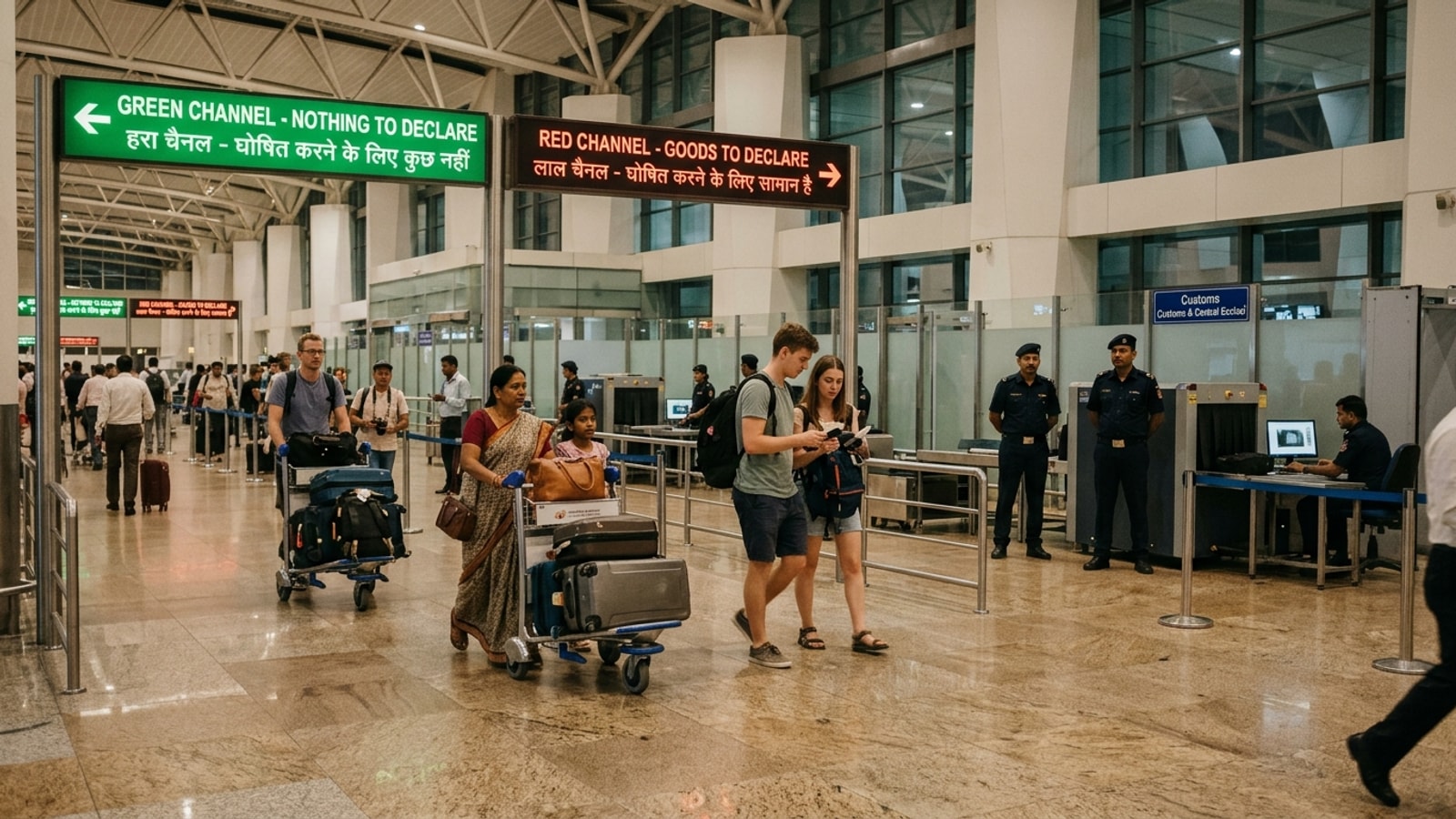
International arrivals at Indian airports encounter a dual-channel clearance system immediately following baggage claim: the Green Channel and the Red Channel. While this design facilitates rapid exit for travelers carrying personal effects within statutory duty-free thresholds, navigating it incorrectly carries severe legal consequences. Under the Customs Act, 1962, passing through the Green Channel constitutes a legally binding declaration that a passenger possesses no dutiable, prohibited, or restricted items.
Understanding how the Central Board of Indirect Taxes and Customs (CBIC) administers the Baggage Rules, 2016, what qualifies under the ₹50,000 General Free Allowance (GFA), how baggage duty is assessed, and how to utilize the digital ATITHI platform ensures compliance and prevents unexpected baggage confiscation or hefty fines.
Dual-Channel Clearance: Green Channel vs Red Channel Architecture
The dual-channel customs clearance model operates across all international passenger terminals in India, including Delhi Indira Gandhi International (DEL Terminal 3), Mumbai Chhatrapati Shivaji Maharaj International (BOM Terminal 2), Bengaluru Kempegowda International (BLR Terminal 2), Chennai International (MAA), Hyderabad Rajiv Gandhi International (HYD), and Kochi International (COK).
[ Baggage Reclaim Carousels ]
              │
              ▼
   [ Exit Screening Area ]
              │
      ┌───────┴───────┐
      ▼               ▼
[ Green Channel ]  [ Red Channel ]
(Nothing to Declare) (Dutiable / Restricted)
      │               │
      │         [ Inspection & Duty Assessment ]
      │               │
      │         [ Duty Payment Counter ]
      │               │
      └───────┬───────┘
              ▼
      [ Public Arrival Hall ]
The Legal Weight of the Green Channel
Under Section 77 of the Customs Act, 1962, every international passenger must make an oral or written declaration of the contents of their baggage to a proper customs officer. Choosing to walk through the Green Channel ("Nothing to Declare") is legally recognized as a formal declaration that:
- Your baggage contains only bona fide personal effects and items within statutory duty-free thresholds.
- You are not carrying dutiable goods exceeding the ₹50,000 General Free Allowance.
- You are carrying no commercial merchandise, gold bullion, coins, or raw precious metals.
- You do not carry restricted or prohibited items such as drones, satellite phones, or unapproved communications equipment.
- Your foreign currency holdings do not exceed declaration thresholds ($5,000 in physical cash or $10,000 in aggregate foreign exchange).
Behind-the-Scenes Airport Scanning
Many passengers mistakenly believe that entering the Green Channel guarantees an unmonitored exit. In practice, Indian customs authorities utilize advanced risk-management systems and multi-layered monitoring:
- Inline X-Ray Tagging: Checked baggage undergoes automated CT and X-ray scanning in the baggage make-up area before delivery to luggage carousels. Suspect luggage is discreetly marked with colored chalk, barcoded security stickers, or electronic RFID tags.
- Belt-Side Surveillance: Plainclothes customs officers monitor luggage belts for passengers claiming marked baggage.
- Exit-Gate Dual-View Scanners: Officers stationed at Green Channel exits conduct random or targeted profiling. Passengers selected for screening must place all hand luggage and checked trolleys through dual-view X-ray inspection belts.
The ₹50,000 General Free Allowance (GFA) Explained
The cornerstone of passenger clearance under the Baggage Rules, 2016 (Rule 3 and Rule 4) is the General Free Allowance. This allowance covers consumer goods, gifts, and souvenirs brought into India.
Eligibility Criteria
- Eligible Travelers: Indian residents, foreigners residing in India, and tourists of Indian origin arriving by air or sea from any country other than Nepal, Bhutan, or Myanmar.
- Value Threshold: Up to ₹50,000 per passenger in total market value for articles carried in accompanied baggage.
- Infants: For infants (children under two years of age), the allowance is strictly limited to personal effects, with zero General Free Allowance for new consumer articles.
- Land Borders: Passengers arriving by land borders or from Nepal, Bhutan, and Myanmar have an allowance capped at ₹15,000.
The Strict Non-Pooling Invariant
One of the most frequent points of contention at customs checkpoints is the pooling of allowances. Under Rule 3 of the Baggage Rules, 2016, allowances cannot be combined or pooled among family members, spouses, or traveling companions.
Example of Non-Pooling Enforcement: If a husband and wife travel together and bring a single consumer electronic device (such as an unsealed luxury camera or retail-boxed smartphone) valued at ₹80,000, they cannot combine their individual ₹50,000 allowances to claim a total of ₹1,00,000 duty-free clearance. Because the item is an indivisible single article, one passenger must claim their ₹50,000 allowance, and customs duty is charged on the remaining ₹30,000 balance at standard rates.
Items Excluded from the General Free Allowance
Certain high-risk or specialized items cannot be imported under the ₹50,000 GFA:
- Gold and Silver Bullion: Gold or silver in any form other than eligible personal worn jewellery under Annexure I is excluded.
- Commercial Merchandise: Goods imported in commercial quantities or intended for resale.
- Alcohol and Tobacco in Excess of Caps: The GFA cannot be used to import more than 2 liters of alcohol or 100 cigarettes duty-free.
- Banned Drones: Drones and unmanned aerial vehicles (UAVs) of any class cannot be imported under the baggage allowance without DGFT authorization.
Customs Clearance and Penalty Threshold Matrix
The following operational matrix details clearance routes, duty rates, and statutory enforcement parameters across common arrival baggage categories:
| Clearance Category | Statutory Eligibility / Allowance Limit | Applicable Duty Rate | Required Customs Channel | Non-Declaration Penalty Risk |
|---|---|---|---|---|
| Used Personal Effects | Clothing, personal toiletries, footwear, everyday essentials | 0% (Fully exempt) | Green Channel | None (Permitted personal effects) |
| Personal Laptop Exemption | 1 laptop computer per traveler aged 18+ (Rule 5) | 0% (Fully exempt) | Green Channel | None (Eligible travelers only) |
| New Consumer Goods & Gifts | Total invoice value up to ₹50,000 per adult | 0% (Under GFA) | Green Channel | Forfeiture of allowance if undeclared |
| Goods Exceeding ₹50,000 | Any consumer articles or electronics above ₹50,000 | 38.5% (35% BCD + 10% SWS) on excess | Red Channel | Confiscation under Sec 111, fine up to 5x under Sec 112 |
| Alcohol / Wine / Spirits | Up to 2.0 liters per passenger aged 18+ | 0% (Within 2L cap) | Green Channel | Full seizure of excess volume; 150%+ tariff |
| Tobacco / Cigarettes | Up to 100 cigarettes or 25 cigars or 125g tobacco | 0% (Within statutory cap) | Green Channel | Confiscation of unapproved health warning packs |
| Gold Jewellery (Men) | 20 grams up to ₹50,000 value (Residing abroad 1+ yr) | 0% (Under Annexure I) | Red Channel (Verification) | Mandatory seizure and fine if undeclared |
| Gold Jewellery (Women) | 40 grams up to ₹1,00,000 value (Residing abroad 1+ yr) | 0% (Under Annexure I) | Red Channel (Verification) | Mandatory seizure and fine if undeclared |
| Gold Bars / Coins | Nil under GFA; requires 6+ months foreign stay | 13.75% concessional or 38.5% tariff | Red Channel (Mandatory) | Absolute confiscation, arrest under Sec 135 |
| Foreign Currency | Up to $5,000 cash notes or $10,000 total FX | 0% (Below declaration line) | Green Channel | Confiscation under FEMA and Customs Act |
| Drones / Remote Aircraft | Nil (DGFT Import Policy Ban) | Prohibited import | Red Channel (Surrender/Bond) | Seizure, warehouse detention, criminal compounding |
Understanding Baggage Customs Duty: The 38.5% Composite Calculation
When passengers declare goods in the Red Channel that exceed the General Free Allowance, duty is assessed under Customs Tariff Heading 9803 of the First Schedule to the Customs Tariff Act, 1975.
Breakdown of the 38.5% Baggage Rate
Unlike commercial cargo, which carries variable Harmonized System (HS) code tariffs, passenger accompanied baggage is subject to a simplified composite rate:
- Basic Customs Duty (BCD): 35% ad valorem.
- Social Welfare Surcharge (SWS): 10% calculated on the BCD amount (3.5%).
- Effective Composite Duty Rate: 38.5%.
Item Value: ₹1,00,000
Less: General Free Allowance: ₹50,000
Taxable Value: ₹50,000

Basic Customs Duty (35%): ₹17,500
Social Welfare Surcharge (10% of BCD): ₹1,750
Total Customs Duty Payable: ₹19,250
Valuation Procedures
Customs officers calculate value based on:
- Original Purchase Invoices: Invoices from official foreign retailers (with serial numbers for electronics) serve as primary evidence.
- CBIC Tariff Values / Database Reference: If an invoice is absent, appears undervalued, or represents a private sale, the assessing officer applies standardized catalog prices or current retail values in the country of origin.
- Official Exchange Rates: Valuations are converted to Indian Rupees using the monthly exchange rates officially notified by CBIC, not commercial credit card or interbank rates.
Penalties for False Declarations and Green Channel Evasion
Attempting to clear dutiable goods through the Green Channel without declaration triggers statutory enforcement mechanisms under the Customs Act, 1962:
1. Automatic Forfeiture of General Free Allowance
The moment an undeclared dutiable item is intercepted in the Green Channel, the passenger loses the legal entitlement to the ₹50,000 General Free Allowance. Customs duty is charged on the entire assessed value from the first rupee, rather than only the excess.
2. Confiscation of Goods (Section 111)
Under Section 111(l) and Section 111(m), goods brought through the Green Channel contrary to any prohibition or without a valid declaration are liable to absolute confiscation or seizure.
3. Redemption Fines (Section 125)
If the goods are not strictly prohibited, the adjudicating customs officer may allow the passenger to redeem the seized goods upon payment of a redemption fine. Redemption fines typically range from 15% to 35% of the market value of the goods, assessed in addition to the standard 38.5% customs duty.
4. Personal Penalties (Section 112)
Section 112 empowers authorities to levy personal fines on the traveler:
- For dutiable goods (other than prohibited goods), a penalty up to the value of the goods or ₹5,000, whichever is greater.
- In cases of intentional concealment, false compartments, or deliberate fraud, the penalty can reach up to five times the value of the goods or duty evaded.
5. Arrest and Criminal Prosecution (Section 135)
When the market value of undeclared dutiable goods or evaded duty exceeds statutory prosecution limits (generally ₹50 lakh for non-commercial baggage offenses, or any commercial smuggling syndicate activity), customs authorities can effect immediate arrest under Section 104 of the Customs Act, leading to non-bailable judicial custody.
Digital Declarations: The CBIC ATITHI Mobile Application
To modernize border processing and reduce queuing at Red Channel counters, the CBIC introduced the ATITHI mobile application, available on Android and iOS.
[ Download CBIC ATITHI App ]
              │
              ▼
[ Enter Flight & Passport Data ]
              │
              ▼
[ Select Dutiable / Restricted Goods ]
              │
              ▼
[ Upload Purchase Invoices ]
              │
              ▼
[ Generate Digital QR Code ]
              │
              ▼
[ Scan QR at Airport Red Channel Desk ]
              │
              ▼
[ Fast-Track Duty Assessment & UPI Payment ]
Key Features of ATITHI
- Electronic Baggage Declaration Form (e-BDF): Replaces legacy paper declaration forms. Travelers can complete the filing up to 24 hours prior to departure or while in transit.
- Advance Duty Estimation: The app provides an indicative duty calculation based on declared purchase values, helping travelers budget for assessment fees.
- Express QR Verification: Upon landing, travelers present the generated QR code on their smartphone at the designated ATITHI Customs Counter. Officers scan the code, inspect the corresponding goods, verify invoices, and print the duty receipt in minutes.
Traveler Logistics Guide
Navigating arrival terminals requires a disciplined approach to documentation, packing, and channel selection.
Terminal Arrival Flow
- Disembarkation & Immigration: Complete standard passport control at the arrival hall counters or Fast Track Immigration-Trusted Traveler Program (FTI-TTP) e-Gates where available.
- Baggage Reclaim: Collect checked baggage from carousels. Inspect your luggage for colored chalk marks or tamper-evident customs tags. If tags are present, you must proceed directly to the Red Channel.
- Duty-Free Shop Shopping: Purchases made at Indian airport arrival duty-free shops (such as liquor, perfume, or confections) count toward statutory personal limits (e.g., the 2-liter alcohol cap). Keep duty-free receipts stapled to your carry bags.
- Channel Selection: Assess your belongings honestly. If carrying goods over ₹50,000, foreign currency requiring declaration, or commercial samples, take the Red Channel. If within all statutory limits, exit via the Green Channel.
Currency Declaration Limits (CDF Rules)
- Indian Currency (INR): Indian residents can carry up to ₹25,000 in physical cash into India. Bringing larger amounts of Indian currency from overseas is strictly prohibited under RBI Foreign Exchange Management Act (FEMA) regulations.
- Foreign Currency: There is no upper limit on the total foreign currency brought into India, provided it is declared. Travelers must file a Currency Declaration Form (CDF) at the Red Channel if:
- The total value of foreign currency notes exceeds $5,000 USD (or equivalent).
- The aggregate value of foreign exchange (banknotes, traveler's cheques, and drafts) exceeds $10,000 USD (or equivalent).
Handling Electronics and Personal Laptops
- Single Laptop Exemption (Rule 5): Every passenger aged 18 years or older is entitled to bring one laptop computer into India duty-free, regardless of whether it is new or used, and this exemption operates independently of the ₹50,000 GFA.
- Smartphones and Tablets: Personal smartphones and tablets in active use are treated as personal effects. However, brand-new devices carried in factory-sealed retail packaging attract customs scrutiny. Unbox genuinely personal devices, insert a working SIM, and set up your user account before arriving in India to establish legitimate personal use.
- Export Certificate: If you are departing India with high-value personal equipment (such as expensive professional cameras, high-end production laptops, or family jewellery), obtain an Export Certificate at the airport customs departure counter prior to boarding. Presenting this certificate upon your return prevents officers from treating the items as newly purchased overseas imports.
Payment Modes at Red Channel Counters
Indian airport customs collection counters accept:
- Unified Payments Interface (UPI): Supported via official BharatQR and terminal POS machines.
- Indian Debit and Credit Cards: Processed through nationalized bank POS terminals without international markup.
- International Credit Cards: Accepted (Visa, Mastercard, American Express), though foreign transaction markups and bank service surcharges apply.
- Cash: Accepted in Indian Rupees (INR) at designated airport bank counters adjacent to the Red Channel.
Frequently Asked Questions
What happens if I get intercepted in the Green Channel with items exceeding ₹50,000?
If intercepted in the Green Channel with undeclared dutiable goods, you immediately forfeit the ₹50,000 General Free Allowance. Customs officers will seize the items under Section 111 of the Customs Act, 1962. To recover them, you must pay the full 38.5% customs duty assessed on the entire value from rupee one, plus an adjudicating redemption fine (typically 15% to 35% of the item's value) and an additional personal penalty under Section 112.
Can a family of three pool their ₹50,000 allowances to bring an item worth ₹1,20,000 duty-free?
No. Rule 3 of the Baggage Rules, 2016, strictly prohibits pooling or combining individual allowances. An indivisible item valued at ₹1,20,000 cannot be split across multiple family members. One passenger must claim their single ₹50,000 allowance against the item, and the remaining ₹70,000 balance is taxed at the standard 38.5% composite baggage duty rate (yielding approximately ₹26,950 in customs duty).
Do I need to declare personal laptops and phones that I took from India on my trip?
Used personal electronics taken from India for your trip do not require duty payment upon return, provided they are identifiable as your personal belongings. To avoid disputes over high-value cameras or high-end gear, travelers should obtain an Export Certificate from the airport customs counter before departing India. Alternatively, keep digital copies of original Indian purchase invoices, serial numbers, and warranty registrations on your phone. Under Rule 5, every passenger aged 18 or older is also permitted one laptop duty-free regardless of origin.
How does the CBIC ATITHI mobile app change the arrival customs process?
The ATITHI app allows travelers to complete an electronic Baggage Declaration Form (e-BDF) before reaching the customs hall. Instead of waiting for manual assessment, travelers scan their generated digital QR code at the dedicated ATITHI Red Channel desk. Customs officers verify the item against the digital declaration and uploaded invoices, assess duty immediately, and issue an electronic payment receipt, reducing clearance time from over an hour to under ten minutes.