

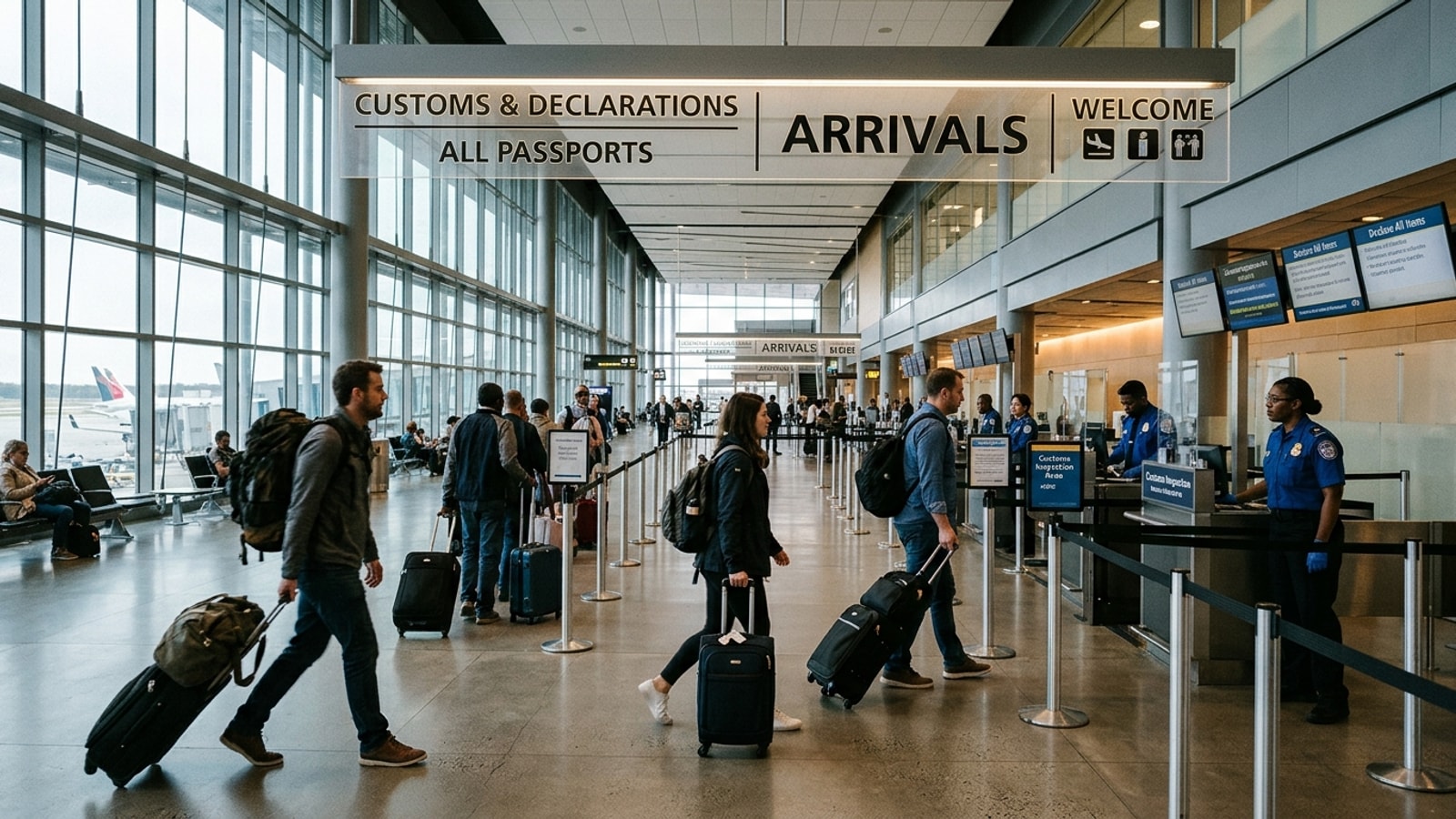
Quick Summary
- Primary Update: Indian Customs enforces strict passenger baggage limits under Baggage Rules 2016 for flights arriving from Kuwait, granting an individual ₹50,000 General Free Allowance, one exempt laptop per adult, and gender-specific duty-free gold jewellery allowances strictly conditional on over one year of continuous overseas residence.
- Transit Impact: Direct and connecting flights from Kuwait International Airport (KWI) landing across Mumbai, Delhi, Kochi, Kozhikode, and Chennai undergo rigorous baggage X-ray profiling; unboxed secondary iPhones, gold bars, commercial tech, and undeclared currency trigger mandatory 38.50% baggage duties or Section 111 confiscation.
- Traveler Advice: Because 1 Kuwaiti Dinar equals approximately ₹275, the ₹50,000 duty-free threshold is exhausted at just ~180 KWD of retail goods; file advance declarations via the CBIC ATITHI mobile app, keep original Kuwait Souk receipts, and present high-value items voluntarily at the Red Channel.
The aviation corridor between Kuwait and India represents one of the busiest expatriate and transit lifelines in the Middle East. With an Indian diaspora exceeding one million residents in Kuwait, flights operated by Kuwait Airways, Jazeera Airways, IndiGo, and Air India Express shuttle thousands of passengers daily from Kuwait International Airport (KWI Terminals 1, 4, and 5) to major Indian hubs including Mumbai (BOM), Delhi (DEL), Cochin (COK), Kozhikode (CCJ), Kannur (CNN), Thiruvananthapuram (TRV), Chennai (MAA), Hyderabad (HYD), Ahmedabad (AMD), and Mangalore (IXE).
Travelers returning on annual leave, relocating permanently, or visiting family frequently carry gifts, consumer gadgets, gold jewellery from Kuwait City’s Souk Al-Mubarakiya, and duty-free purchases. However, passenger clearance at Indian ports of entry is strictly governed by the Central Board of Indirect Taxes and Customs (CBIC) under the Baggage Rules, 2016, and the Customs Act, 1962. A critical factor for travelers from Kuwait is the sheer strength of the Kuwaiti Dinar (KWD): with 1 KWD trading around ₹275, a purchase of merely 182 KWD completely absorbs the statutory ₹50,000 duty-free ceiling, catching unprepared passengers off guard during terminal baggage appraisals.
Statutory Framework: General Free Allowance and Rule 5 Tech Exemptions
Indian Customs classifies all personal goods carried by incoming international air passengers into specific legal tiers: personal effects, the General Free Allowance, conditional statutory exemptions, and restricted or prohibited items.
The ₹50,000 General Free Allowance (GFA)
Under Rule 3 and Rule 4 of the Baggage Rules, 2016, any Indian resident or foreign national of Indian origin arriving by air from Kuwait is entitled to clear up to ₹50,000 worth of bona fide personal items, gifts, and souvenirs completely free of customs duty.
This allowance is subject to strict statutory rules:
- Individual and Non-Transferable: Allowances cannot be pooled or transferred between family members or travel companions. For example, a husband and wife cannot combine their allowances to clear a single luxury gadget or gold item valued at ₹90,000. Each item is assessed individually against a single passenger's entitlement.
- Conversion Reality: Because the Kuwaiti Dinar is the highest-valued sovereign currency in the world, travelers purchasing perfumes, clothing, or small home appliances in Kuwait City, Salmiya, or Fahaheel must monitor their spending in KWD. At an exchange benchmark of 1 KWD = ₹275, an expenditure of 182 KWD reaches the ₹50,000 limit. Any value exceeding this benchmark is subject to customs duty.
- Exclusions: Flat-screen televisions, gold or silver bullion, commercial quantities of goods, and prohibited items cannot be cleared under the General Free Allowance under any circumstances.
The Laptop Exemption Under Rule 5
Under Rule 5 of the Baggage Rules, 2016, any passenger aged 18 years or older is entitled to bring one laptop or notebook computer into India free of customs duty. This concession is granted in addition to the ₹50,000 General Free Allowance.
Key operational guidelines for electronic computers include:
- Age Requirement: The traveler must be at least 18 years of age on the date of clearance. Minors traveling from Kuwait are not entitled to the Rule 5 laptop concession.
- Single Machine Limit: Only one laptop is exempt under Rule 5. If an expatriate carries a corporate workstation alongside a personal MacBook or gaming laptop, only one computer is cleared under Rule 5.
- Handling Dual Laptops: Travelers carrying two laptops must substantiate the status of the second device:
- Employer-Assigned Asset: If the secondary laptop is a company-owned device issued in Kuwait or India, the passenger should carry an official corporate asset letter on company letterhead detailing the make, model, serial number, and confirmation of personal assignment for employment duties.
- Indian Export Certificate: If the machine was originally purchased in India and taken to Kuwait, presenting an Export Certificate issued and stamped by Indian Customs prior to initial departure ensures zero duty on re-entry.
- Second Newly Acquired Unit: If a second laptop is purchased in Kuwait, the passenger must declare it at the Red Channel. The ₹50,000 GFA may be deducted from its assessed value, and the remaining balance is taxed at the flat 38.50% baggage rate.
Gold Jewellery and Bullion Allowances from Kuwait
Gold souks across Kuwait—particularly Souk Al-Mubarakiya in Kuwait City, the gold complexes in Salmiya, and retail centers in Fahaheel—are world-famous for 21-karat, 22-karat, and 24-karat ornaments. Hundreds of thousands of Indian expatriates buy gold jewellery in Kuwait to bring home for weddings, personal savings, or family gifts. However, Indian Customs enforces rigorous restrictions and statutory thresholds on gold imports.
The 1-Year Overseas Residency Rule
To claim the duty-free gold jewellery allowance under Annexure-II of the Baggage Rules, 2016, an Indian passenger must have resided outside India for a continuous period of not less than one year. Short-term visitors, vacationers, and workers who have spent fewer than 365 days abroad do not qualify for any duty-free gold allowance. For such travelers, all gold jewellery carried into India must be declared at the Red Channel and is fully dutiable.
Gender Caps and the Statutory Valuation Ceiling
For eligible passengers who have resided in Kuwait for more than one year:
- Male Passengers: Permitted to bring up to 20 grams of gold jewellery with a total value not exceeding ₹50,000 free of customs duty.
- Female Passengers: Permitted to bring up to 40 grams of gold jewellery with a total value not exceeding ₹1,00,000 free of customs duty.
A critical legal reality that frequently penalizes passengers is the concurrent application of both the weight limit and the rupee valuation cap:
- Under Indian law, the allowance is capped at whichever threshold is reached first.
- Because retail gold prices in 2026 hover well above ₹7,500 per gram for 22K/24K purity, 20 grams of gold jewellery is valued at approximately ₹1,50,000 to ₹1,60,000, while 40 grams exceeds ₹3,00,000.
- As a direct mathematical consequence, a male passenger exhausts his duty-free ceiling after bringing only about 6 to 7 grams of gold jewellery (reaching the ₹50,000 cap). A female passenger reaches her ₹1,00,000 ceiling at roughly 13 to 14 grams.
- Customs valuation officers calculate gold values using the official fortnightly tariff notifications published by the CBIC, not the retail invoice from Kuwait Souk or personal estimates. Any excess value beyond ₹50,000 (men) or ₹1,00,000 (women) is subject to customs duty at the Red Channel.
Gold Bars, Coins, and Raw Bullion
Gold bars, coins, biscuits, tolas, and unfinished bullion are categorically excluded from the duty-free jewellery allowance and cannot be adjusted against the ₹50,000 General Free Allowance.
Under CBIC Notification No. 50/2017-Customs (as amended), an Indian passenger or person of Indian origin who has maintained a continuous stay abroad of at least six months is permitted to import up to 1 kilogram of gold bars and coins, provided they:
- Enter through the Red Channel and declare the bullion on arrival.
- Pay the applicable customs duty in convertible foreign currency (such as Kuwaiti Dinars or US Dollars).
- Ensure the gold bars bear standard serial numbers and manufacturer hallmarks verifying purity from accredited international refineries.
Passengers who fail to declare gold coins or bars at the Red Channel and attempt to exit through the Green Channel face immediate confiscation under Section 111 of the Customs Act, heavy penalties under Section 112, and potential arrest and prosecution under Section 135 if the undeclared value exceeds statutory thresholds.
Consumer Electronics, iPhones, and Prohibited Cargo
Consumer electronics purchased across commercial malls in Kuwait City, The Avenues, or electronic retail chains attract close inspection from customs appraisal officers at Indian arrival gates.
The Two-Smartphones Rule and Unboxed Handsets
Many expatriates returning from Kuwait carry two smartphones: an active primary handset and a newly purchased flagship device, such as an iPhone 16 or Samsung Galaxy device, purchased in Kuwait to take advantage of favorable regional pricing.
The legal treatment of two phones is clear:
- Primary Handset: The passenger's daily used phone, showing active carrier service, personal messages, and wear, is cleared duty-free as a personal effect under Rule 3.
- Secondary Handset: The second smartphone is treated as an imported consumer acquisition. The passenger may apply their unused ₹50,000 General Free Allowance against its appraised value.
- Tax Calculation Example: Suppose an imported iPhone is appraised by Indian Customs at ₹1,15,000 (roughly 418 KWD). Deducting the ₹50,000 GFA leaves a dutiable balance of ₹65,000. Applying the flat 38.50% baggage duty rate (35% BCD + 10% SWS) results in a customs duty of ₹25,025 payable at the Red Channel.
- The Unboxing Myth: Discarding the retail packaging, placing the phone in a pocket, or removing plastic wrap does not classify a newly purchased device as a used personal effect. Customs appraisal officers routinely inspect device activation logs, battery cycle counts, IMEI registrations, and physical condition. Attempting to conceal a newly acquired phone across the Green Channel is treated as intentional evasion.
Absolute Prohibition on Consumer Drones
The Directorate General of Foreign Trade (DGFT) strictly prohibits the import of unmanned aerial vehicles (UAVs), camera drones, and remote-controlled aircraft in passenger baggage. This prohibition applies universally across all weight classes, including sub-250-gram models such as the DJI Mini 4 Pro or DJI Neo.
Drones packed in either checked suitcases or carry-on luggage are detected during inline X-ray scans and seized immediately under Section 111 of the Customs Act. Passengers cannot retrieve seized drones by offering to pay customs duty.
Flat-Panel Televisions
All flat-screen LED, OLED, and QLED televisions are listed in Annexure-I of the Baggage Rules, 2016. Televisions are categorically excluded from the ₹50,000 General Free Allowance. Every television imported from Kuwait is assessed at the flat baggage rate of 38.50% on its full CIF (Cost, Insurance, and Freight) value, regardless of screen dimensions. In addition, airlines operating flights between Kuwait and India (including Jazeera Airways and Air India Express) charge substantial oversize baggage handling fees for television cartons.
Alcohol, Tobacco, Currency, and Regulated Goods
Duty-Free Alcohol Regulations
While the domestic sale and public consumption of alcohol are strictly prohibited within the State of Kuwait, travelers flying from Kuwait International Airport have access to international duty-free transit shops at KWI (Terminals 1, 4, and 5) or can purchase alcoholic beverages at Indian arrival duty-free shops (such as Delhi Duty Free, Mumbai Duty Free, or Cochin Duty Free):
- Statutory Allowance: Up to 2 litres of alcoholic liquor, spirits, or wine per passenger aged 18 years and older.
- Excess Alcohol: Any volume exceeding the 2-litre limit cannot be cleared under the baggage tariff. It attracts the standard commercial import tariff exceeding 160% (150% Basic Customs Duty plus Social Welfare Surcharge and applicable cess) or is detained under Section 80 for re-export.
- Domestic Flight Transit: Passengers connecting from their international arrival port (e.g., BOM or DEL) to a domestic destination must ensure duty-free bottles comply with Bureau of Civil Aviation Security (BCAS) carry-on liquid limits (placed in secure tamper-evident bags with receipts) or re-pack them into checked baggage before domestic check-in.
Tobacco Allowances and E-Cigarette Ban
Incoming adult travelers may bring one of the following tobacco allowances duty-free:
- Up to 100 cigarettes, OR
- Up to 25 cigars, OR
- Up to 125 grams of manufactured tobacco.
Electronic Cigarettes Prohibition: Under the Prohibition of Electronic Cigarettes Act (PECA), 2019, the import of e-cigarettes, vapes, vape pods, heat-not-burn devices, and e-liquids into India is completely prohibited in both checked and cabin baggage. Customs officers confiscate any vaping hardware found during baggage scans.
Currency and Foreign Exchange Thresholds
Financial regulations governed by the Reserve Bank of India (RBI) and the Foreign Exchange Management Act (FEMA) dictate cash limits for passengers arriving from Kuwait:
- Indian Currency (INR): Indian residents returning to India are permitted to carry up to ₹25,000 in Indian currency notes. Non-residents (NRIs) and foreign nationals are not permitted to bring Indian currency notes into India.
- Foreign Currency (KWD and USD): Passengers may bring unlimited foreign currency into India, but mandatory reporting thresholds apply:
- Cash Threshold: If foreign currency cash (in KWD, USD, EUR, etc.) exceeds US$5,000 (or equivalent, approximately 1,530 KWD), the passenger must declare it at the Red Channel.
- Aggregate Threshold: If total foreign exchange (cash notes plus travellers cheques, drafts, and instruments) exceeds US$10,000 (or equivalent, approximately 3,070 KWD), mandatory declaration is required.
- Currency Declaration Form (CDF): Passengers meeting these thresholds must complete a CDF certified by customs officials at the Red Channel. This document is essential for legally depositing foreign funds into Indian bank accounts or exchanging currency through authorized dealers.
Comparative Allowances and Duty Structure
The following structured table provides a comprehensive overview of passenger allowances, duty rates, and clearance channels for travelers flying from Kuwait to India in 2026:
| Item Category | Permissible Allowance / Value Cap | Statutory Prerequisite / Conditions | Applicable Duty Rate | Required Clearance Channel |
|---|---|---|---|---|
| Bona Fide Personal Effects | Worn clothing, personal toiletries, in-use watch | Items must show genuine personal use | 0% (Completely Exempt) | Green Channel |
| Primary Smartphone | 1 active handset with SIM & call history | Bona fide personal effect under Rule 3 | 0% (Completely Exempt) | Green Channel |
| General Free Allowance (GFA) | Up to ₹50,000 (approx. 180–185 KWD) | Air mode; residents & Indian origin travelers | 0% within ₹50,000 limit | Green Channel |
| Secondary Smartphone / iPhone | 1 additional handset (boxed or unboxed) | Deduct available ₹50,000 GFA from value | 38.50% on value exceeding GFA | Red Channel |
| Laptop Computer (Rule 5) | Exactly 1 notebook computer | Passenger must be aged 18 years or older | 0% (Rule 5 Concession) | Green Channel |
| Second Laptop Computer | 1 additional laptop | Deduct available GFA; or corporate letter | 38.50% on residual value | Red Channel |
| Gold Jewellery (Men) | 20 grams, capped at ₹50,000 maximum value | Continuous stay abroad > 1 year; ornaments only | 0% up to statutory caps | Red Channel |
| Gold Jewellery (Women) | 40 grams, capped at ₹1,00,000 maximum value | Continuous stay abroad > 1 year; ornaments only | 0% up to statutory caps | Red Channel |
| Gold Jewellery (Short Stay) | NIL (0 grams / ₹0 value) | Overseas stay under 1 year | 38.50% flat baggage rate | Red Channel |
| Gold Bars & Coins (Bullion) | Up to 1 kg total weight | Stay abroad > 6 months; halls & serial marks | Concessional rate in foreign forex | Red Channel |
| Alcoholic Beverages | Up to 2.0 litres of spirits, wine, or beer | Passenger must be aged 18 years or older | 0% up to 2 litres; >160% on excess | Green Channel / Red Channel |
| Cigarettes | Up to 100 sticks (or 25 cigars / 125g tobacco) | Passenger must be aged 18 years or older | 0% up to 100 sticks | Green Channel |
| E-Cigarettes & Vapes | NIL (Strictly Prohibited under PECA 2019) | Banned in all baggage forms | Confiscation under Section 111 | Red Channel (Surrender) |
| Consumer Drones (UAVs) | NIL (Strictly Prohibited by DGFT) | Banned in passenger baggage | Confiscation under Section 111 | Red Channel (Surrender) |
| Flat-Panel Televisions | No duty-free allowance (Annexure-I item) | Must pay duty on full assessed value | 38.50% on full appraised value | Red Channel |
| Indian Currency (INR) | Up to ₹25,000 in Indian banknotes | Returning Indian residents only | 0% within statutory limit | Green Channel |
| Foreign Currency (KWD / Forex) | Cash > US$5,000 or aggregate > US$10,000 | Mandatory Currency Declaration Form (CDF) | 0% (Subject to CDF filing) | Red Channel |
Traveler Logistics Guide
To navigate customs clearance seamlessly upon arriving in India from Kuwait, passengers should follow this practical, step-by-step operational checklist.
Pre-Arrival Declaration via the ATITHI Mobile App
The CBIC provides the official ATITHI mobile application (available on iOS and Android) to simplify passenger declarations. Travelers departing Kuwait can input their flight information, declare dutiable merchandise, secondary tech, gold jewellery, or currency, and generate a secure QR code prior to boarding. Upon landing at Indian international terminals, scanning the QR code at the dedicated ATITHI Red Channel counter expedites duty assessment and reduces terminal wait times.
Terminal Customs Layout Across Major Gateways
- Mumbai (BOM Terminal 2): Flights arriving from Kuwait on Kuwait Airways, Jazeera, or IndiGo deplane into T2. Baggage carousels 1 to 14 lead directly to the customs hall. The Red Channel appraisal booths and duty payment cash counters are located on the extreme right, while Green Channel walkthrough gates occupy the center.
- Delhi (DEL Terminal 3): International arrivals at T3 exit the reclaim hall into a wide customs barrier. Red Channel appraisal counters are located adjacent to Pillar 10. Secondary X-ray scanners monitor all passengers exiting toward the public arrivals concourse.
- Cochin (COK Terminal 3) & Kozhikode (CCJ): With massive expatriate volumes from Kuwait, customs appraisal counters at COK and CCJ deploy intensive secondary profiling. Passengers carrying oversized cartons or gold jewellery boxes are directed to dedicated appraisal desks.
Temporary Customs Detention Under Section 80
If a passenger arrives carrying dutiable or restricted items that they cannot clear immediately (for example, lacking sufficient funds to pay duty, or carrying items intended for re-export upon returning to Kuwait after a short vacation), they may formally request detention of the goods under Section 80 of the Customs Act, 1962:
- Detention Receipt (DR): The customs officer inventories the merchandise and issues an official Detention Receipt recording the item description, serial numbers, and condition.
- Safe Custody: The items are sealed and stored in the bonded airport customs warehouse.
- Clearance or Re-Export: Upon departing India back to Kuwait, the passenger presents their passport, boarding pass, and original Detention Receipt at the airport customs warehouse to reclaim their goods for re-export without paying import duty, subject to nominal warehouse storage charges.
Frequently Asked Questions
Can I bring two iPhones from Kuwait to India without paying customs duty?
No. While your primary, active smartphone is cleared completely duty-free as a personal effect under Rule 3, any secondary smartphone is treated as an imported electronic acquisition. You may apply your individual ₹50,000 General Free Allowance toward the second phone's assessed value, but the remaining balance is taxed at the flat baggage rate of 38.50%. Removing the handset from its box, placing it in personal pockets, or peeling off packaging does not exempt it from duty. Customs officers inspect activation dates, serial numbers, and device history.
How much gold jewellery can an NRI woman bring from Kuwait duty-free?
An Indian female passenger (including an NRI) who has resided outside India for a continuous period of at least one year may bring up to 40 grams of gold jewellery free of duty, provided the total value does not exceed ₹1,00,000. Because retail gold prices in 2026 exceed ₹7,500 per gram, the ₹1,00,000 valuation ceiling is reached at approximately 13 to 14 grams of gold. Any weight or value beyond ₹1,00,000 is assessed for customs duty at the Red Channel. Women who have lived abroad for less than one continuous year receive no duty-free gold allowance.
Can I bring gold coins or bars from Kuwait under the ₹50,000 duty-free allowance?
No. Gold coins, bullion bars, biscuits, and ingots are strictly excluded from the ₹50,000 General Free Allowance under Annexure-I of the Baggage Rules. Gold bullion can never be imported duty-free. Passengers who have resided abroad for at least six months may import up to 1 kilogram of gold bars or coins by declaring them at the Red Channel and paying the applicable customs duty in convertible foreign currency (such as Kuwaiti Dinars or US Dollars). Bringing gold coins through the Green Channel without declaration constitutes smuggling.
Can I carry alcohol from Kuwait to India?
Although domestic alcohol retail is prohibited within Kuwait, adult passengers flying from Kuwait International Airport may purchase alcoholic beverages at KWI duty-free shops (in international transit) or at arrival duty-free shops in Indian airports (such as Delhi, Mumbai, or Cochin). Each adult passenger aged 18 years or older is legally permitted to bring up to 2.0 litres of spirits, wine, or beer into India free of customs duty. Any volume exceeding 2 litres attracts customs duties exceeding 160% and must be declared at the Red Channel.
What are the consequences of walking through the Green Channel with dutiable goods?
Entering the Green Channel constitutes an explicit legal declaration that you are carrying only permissible duty-free items within statutory limits. If customs officers intercept you and discover undeclared dutiable goods—such as commercial electronics, excess gold jewellery, gold bars, or commercial merchandise—the items are subject to immediate seizure under Section 111 of the Customs Act, 1962. You may face redemption fines, penal duties under Section 112 up to 100% of the goods' value, and potential criminal prosecution under Section 135 if the duty evaded exceeds statutory thresholds.