

Quick Summary
- Primary Update: Under the Central Board of Indirect Taxes and Customs (CBIC) Baggage Rules 2016, passengers arriving in India from Sri Lanka receive a ₹50,000 General Free Allowance, one fully exempt laptop computer per adult traveler under Rule 5, and an allowance of up to 2.0 liters of spirits or wine, while loose gemstones and newly purchased tech face strict appraisal.
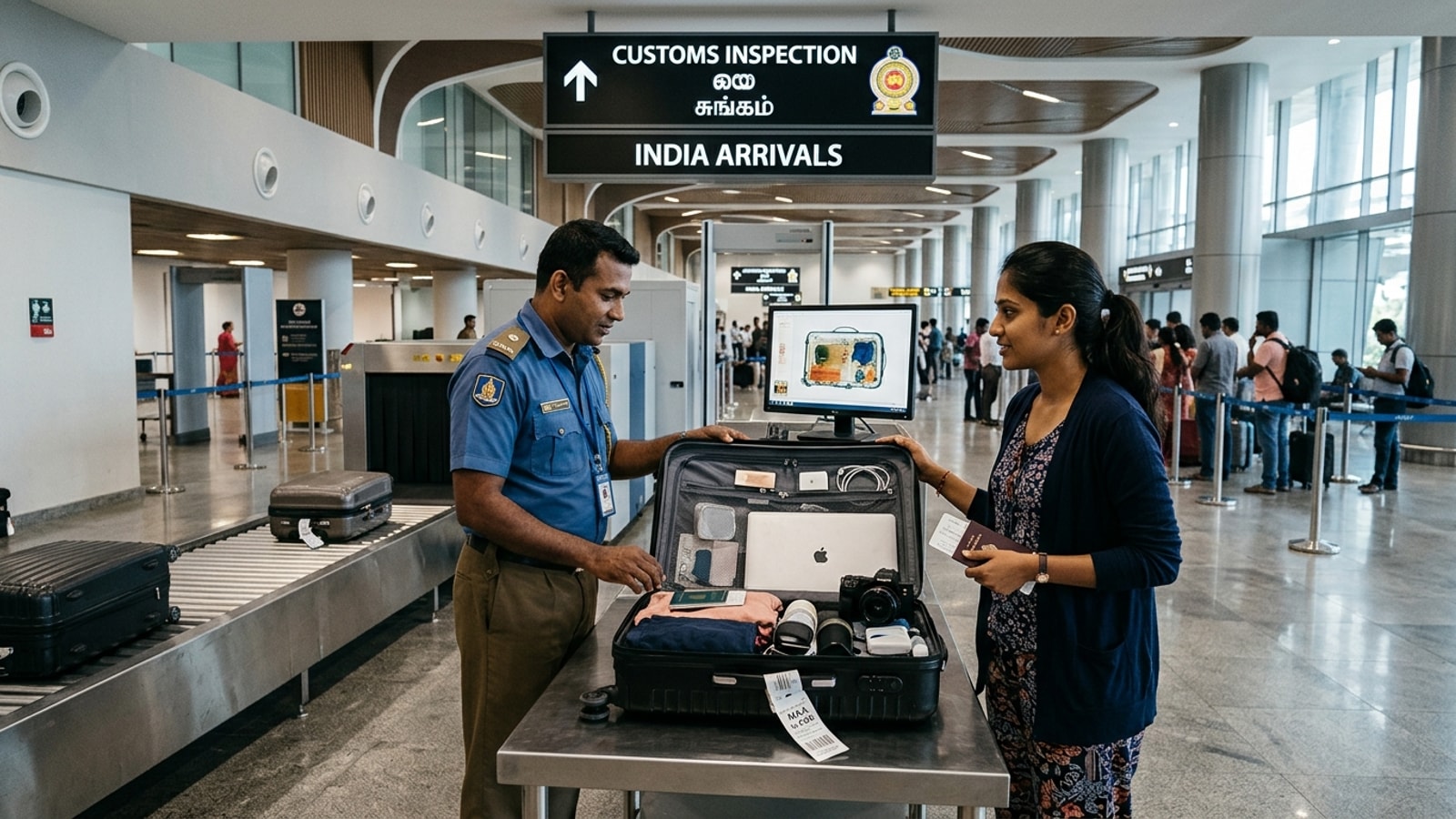
- Transit Impact: Direct and connecting flights departing Bandaranaike International Airport (CMB) in Colombo landing at Chennai (MAA), Mumbai (BOM T2), Delhi (DEL T3), Bengaluru (BLR T2), and Kochi (COK) undergo mandatory inline dual-energy X-ray luggage screening; chalk-marked bags are diverted to Red Channel tables for physical inspection.
- Traveler Advice: Exchange rates hover around 1 INR to 3.50 Sri Lankan Rupees (LKR), meaning shopping receipts totaling 175,000 LKR fully exhaust the ₹50,000 duty-free threshold; keep itemized tax receipts for Ceylon tea, spices, and certified gems, submit declarations through the ATITHI mobile app, and declare excess goods at the Red Channel to avoid confiscation and a 38.50% composite penalty duty.
The short air route connecting Bandaranaike International Airport (CMB) in Katunayake outside Colombo with southern and northern Indian gateways is one of the highest-frequency international corridors in South Asia. Operating daily rotations on SriLankan Airlines, IndiGo, Air India, and FitsAir, flights link Colombo directly to Chennai (MAA), Mumbai (BOM), Delhi (DEL), Bengaluru (BLR), Kochi (COK), Hyderabad (HYD), Tiruchirappalli (TRZ), Madurai (IXM), and Thiruvananthapuram (TRV). Flight durations range from 45 minutes across the Palk Strait into Tamil Nadu to three and a half hours into the capital.
Passengers traveling this corridor comprise leisure vacationers returning from Colombo, Kandy, Galle, Bentota, and Nuwara Eliya; business delegates; transit passengers connecting via Colombo from Europe, the Middle East, or the Maldives; and retail shoppers purchasing Ceylon tea, culinary spices, handlooms, and certified gemstones.
Border control upon arrival in India is governed by the Central Board of Indirect Taxes and Customs (CBIC) pursuant to the Baggage Rules, 2016, enacted under Section 79 of the Customs Act, 1962. A common financial issue confronting returning travelers is currency conversion. Because 1 Indian Rupee equals roughly 3.40 to 3.60 Sri Lankan Rupees, retail purchases totaling 175,000 LKR completely absorb the standard statutory allowance. Carrying retail gadgets, certified sapphires, or gifts without understanding CBIC classification risks unexpected duty assessments and baggage detention in airport arrival terminals.
Statutory Framework: General Free Allowance and Concessional Caps
Under the Baggage Rules, 2016, Indian Customs classifies incoming passenger baggage into used personal effects, general duty-free merchandise, specialized statutory exemptions, and restricted or prohibited articles.
| Article Category | Statutory Authority | Operational Scope | Duty-Free Allowance | Duty Rate on Excess Value |
|---|---|---|---|---|
| Used Personal Effects | Rule 3, Baggage Rules 2016 | Worn garments, personal toiletries, 1 active personal mobile phone, personal footwear | Fully Exempt (No monetary limit) | 0% (Bona fide personal property) |
| General Free Allowance (GFA) | Rule 3, Baggage Rules 2016 | Packaged souvenirs, Ceylon tea, spices, retail gifts, unboxed accessories | Up to ₹50,000 per passenger (~175,000 LKR) | 38.50% composite duty (35% BCD + 10% SWS) |
| Personal Laptop Computer | Rule 5, Baggage Rules 2016 | 1 portable notebook or laptop computer for passengers aged 18 and older | Fully Exempt (1 machine per adult) | 38.50% flat duty applied to any second unit |
| Smartphones / Tech Gadgets | Rule 3 & Rule 5 | Primary handset exempt; boxed, sealed, or secondary phones assessed under GFA | Covered under ₹50,000 GFA if unused | 38.50% on market value exceeding remaining GFA |
| Loose Precious Gemstones | Chapter 71 / Baggage Rules | Cut and polished Ceylon sapphires, rubies, semi-precious stones with lab memo | Assessed against ₹50,000 GFA | 38.50% passenger baggage duty on excess value |
| Gold Jewellery (Tourists) | Rule 3 & Annexure I | Gold bangles, chains, rings, or ornaments on short holiday itineraries | ₹0 (Zero duty-free allowance for tourists) | 38.50% composite duty on entire assessed weight |
| Gold Jewellery (Eligible NRI Female) | Rule 5, Annexure I | Resident abroad for more than 1 continuous year (365+ days) | Up to 40 grams (value capped at ₹1,00,000) | Tariff rate or 38.50% on excess weight |
| Gold Jewellery (Eligible NRI Male) | Rule 5, Annexure I | Resident abroad for more than 1 continuous year (365+ days) | Up to 20 grams (value capped at ₹50,000) | Tariff rate or 38.50% on excess weight |
| Gold Bullion / Minted Coins | Annexure I, Baggage Rules | Ingot bars, tola bars, minted gold coins of any purity | ₹0 (Strictly excluded from GFA) | Dutiable under formal customs import tariffs |
| Alcohol & Spirits | Annexure I, Baggage Rules 2016 | Sri Lankan arrack, whiskey, rum, wine, or champagne (Ages 18+) | Up to 2.0 Liters total volume | Excluded from GFA; up to 150% duty + AIDC on excess |
| Manufactured Tobacco | Annexure I, Baggage Rules 2016 | Commercial packaged cigarettes or cheroots | 100 cigarettes OR 25 cigars OR 125g tobacco | Commercial duty rates; E-cigarettes strictly banned |
| Packaged Ceylon Tea & Spices | Rule 3, Baggage Rules 2016 | Retail branded tea packets, cinnamon quills, peppercorns, cloves | Covered under ₹50,000 GFA (Personal use) | 38.50% if total baggage exceeds ₹50,000 |
| Civilian Camera Drones | DGFT Notification No. 54/2015 | Quadcopters, camera drones, mini drones (e.g. DJI Neo, DJI Mini) | Strictly Prohibited in passenger baggage | 100% detention, seizure under Section 111, penalty |
| Flat-Screen Televisions | Annexure I, Baggage Rules 2016 | LED, OLED, QLED displays of any size | ₹0 (Strictly excluded from GFA) | 38.50% on assessed CBIC tariff valuation |
Rule 3: Used Personal Effects vs. New Retail Purchases
Rule 3 of the Baggage Rules, 2016, allows an Indian resident or a foreign visitor arriving in India to clear bona fide personal effects free of customs duty. Bona fide personal effects include apparel, footwear, personal toiletries, and a working mobile phone carrying an active cellular SIM card.
Newly packaged articles, retail merchandise, gift packs, and boxed souvenirs do not qualify as personal effects. They are pooled under the individual General Free Allowance of ₹50,000. When the cumulative value of dutiable goods in a passenger's possession exceeds ₹50,000, the excess value attracts a composite customs duty of 38.50%, consisting of a 35% Basic Customs Duty (BCD) and a 10% Social Welfare Surcharge (SWS).
Gemstones, Ceylon Sapphires, and Gold Jewellery
Sri Lanka's historic gem trade centered around Ratnapura, Galle Fort, and Colombo gem exchanges makes sapphires, rubies, and precious stones a frequent purchase for Indian tourists. Handling these precious articles through Indian Customs requires understanding the statutory treatment of loose stones versus crafted jewellery.
| Item Description | Customs Classification | Documentation Required | Valuation Methodology | Duty Treatment |
|---|---|---|---|---|
| Cut & Polished Loose Sapphires | Dutiable merchandise under GFA | Retail invoice, National Gem & Jewellery Authority (NGJA) certificate | Appraised by government approved customs valuer | Covered under ₹50,000 GFA; excess taxed at 38.50% |
| Rough / Uncut Gemstones | Restricted import | Mining origin certificate, commercial import license | Assessed by trade board valuation panel | Strictly prohibited in passenger baggage |
| Gem-Studded Gold Jewellery | Dutiable under Rule 5 / Annexure I | Detailed invoice separating metal weight from carat weight | Metal weight verified against gold tariff; stones appraised | Short-term tourists pay 38.50% on full appraised value |
| Plain Gold Jewellery (Tourists) | Dutiable under Annexure I | Itemized hallmarked receipt | Daily CBIC tariff notification rate per 10 grams | Zero duty-free allowance; taxed at 38.50% |
| Plain Gold Jewellery (NRI > 1 Year) | Concessional allowance under Rule 5 | Foreign residency proof, passport entry/exit stamps | Assessed against statutory weight and value thresholds | 40g (Women, ₹1L cap) / 20g (Men, ₹50k cap) duty-free |
| Minted Gold Coins & Bars | Commercial bullion (Annexure I) | Purchase receipt showing serial number and purity assay | Tariff notification rate; subject to Section 77 declaration | Zero GFA eligibility; commercial duty rates applied |
Loose Sapphires and Precious Stones
Cut and polished gemstones brought by individual air passengers are not personal effects. Travelers must carry an itemized invoice from an authorized Sri Lankan dealer and an official authenticity certificate, preferably issued or endorsed by the National Gem and Jewellery Authority (NGJA) of Sri Lanka.
Upon arrival at Indian international terminals, passengers carrying loose precious stones must enter the Red Channel. Customs officers refer the stones to the on-duty Government Approved Gem Valuer stationed at the terminal appraisal counter. If the appraised fair market value is within the traveler's ₹50,000 General Free Allowance, the stones are cleared without duty. Any value exceeding ₹50,000 attracts the standard composite baggage duty of 38.50%. Uncut, raw, or rough minerals cannot be imported through passenger baggage channels.
The Tourist Zero-Gold Policy
A persistent misunderstanding among travelers flying from Colombo to Chennai, Bengaluru, or Mumbai is that tourists enjoy a fractional duty-free gold allowance. Under the Baggage Rules, 2016, the concessional gold jewellery allowance (20 grams for men capped at ₹50,000; 40 grams for women capped at ₹1,00,000) applies exclusively to passengers who have resided outside India for more than one continuous year (at least 365 days).
Indian residents returning from a short tourist or business trip of a few days or weeks to Sri Lanka receive zero duty-free allowance for newly acquired gold jewellery, gold bars, or minted coins. All newly purchased gold ornaments must be declared at the Red Channel and are subject to 38.50% duty based on the daily tariff notification rate published by the CBIC.
Consumer Electronics: Laptops, Mobile Devices, and the Drone Ban
Electronics pricing at Bandaranaike International Airport duty-free stores and retail tech centers in Colombo attracts Indian shoppers looking for deals on portable devices.
| Device Type | Exemption Category | Permitted Units | Customs Assessment Rule |
|---|---|---|---|
| Primary Laptop Computer | Rule 5 Statutory Exemption | 1 unit per passenger aged 18+ | 100% duty-free regardless of retail purchase price |
| Secondary Laptop / Notebook | Taxable Baggage Merchandise | Additional units | Fully assessable; 38.50% duty applied to market value |
| Primary Personal Smartphone | Rule 3 Used Personal Effect | 1 active handset | Duty-free if actively activated with personal SIM |
| Secondary / Brand-New Phone | General Free Allowance | Additional units | Deducted from ₹50,000 GFA; excess taxed at 38.50% |
| Tablet / iPad | General Free Allowance | 1 unit within value | Counted toward ₹50,000 GFA; not covered by Rule 5 |
| Mirrorless / DSLR Camera | Personal Effects Exemption | 1 body + standard kit lens | Used personal gear exempt; extra lenses assessed |
| Smartwatches & Audio Gear | General Free Allowance | Reasonable personal quantities | Covered under ₹50,000 GFA if total value fits |
| Consumer Drones (Any Size) | DGFT Import Prohibition | 0 units permitted | Strictly banned; immediate seizure under Section 111 |
The Rule 5 Laptop Provision
Under Rule 5 of the Baggage Rules, 2016, every passenger aged 18 years or older is entitled to import one portable laptop computer free of customs duty. This exemption operates completely independently of the ₹50,000 General Free Allowance. Whether the laptop is a standard office notebook or a high-end workstation retailing above ₹2,50,000, it passes free of duty.
However, Rule 5 covers exactly one unit per adult traveler. Carrying two laptops—even if one is an employer-issued machine and the other is a personal device—triggers tax scrutiny. If you traveled out of India with your company laptop, carry an employer asset letter specifying the machine's serial number or secure an Indian Customs Export Certificate at the departure airport before flying to Sri Lanka. Without this proof, customs officers assess the second machine at the composite 38.50% baggage rate.
Smartphones and the Two-Phones Invariant
Carrying an active smartphone in your pocket with an operating domestic or international SIM card qualifies as a personal effect under Rule 3. If you purchase a new smartphone in Sri Lanka or carry a second boxed device, it does not qualify as an exempt personal effect.
The new phone is valued against your individual ₹50,000 GFA. Flagship smartphones that cost over ₹80,000 exceed the free allowance; the value above ₹50,000 is taxed at 38.50%. Removing the factory plastic wrap or discarding the retail carton does not exempt the device. Customs inspectors check IMEI registration dates, battery health charge cycles, and serial numbers. If the handset was acquired abroad during the journey, it is assessed for duty.
The Absolute Drone Prohibition
India enforces a strict ban on importing civilian camera drones through passenger baggage under Directorate General of Foreign Trade (DGFT) Import Policy Notification No. 54/2015-2020. This prohibition applies to all categories and weight brackets, including sub-250-gram ultralight units like the DJI Mini series, DJI Neo, and consumer FPV drones.
Travelers who take drones to Sri Lanka to capture aerial footage of Sigiriya rock, the Nine Arch Bridge in Demodara, or Mirissa beaches will have the equipment confiscated upon arrival at Indian airports. Drones identified in checked or cabin luggage during X-ray scans are seized under Section 111 of the Customs Act, 1962. Seized drones cannot be redeemed by paying customs duties or administrative penalties.
Alcohol, Tobacco, Ceylon Tea, and Agricultural Goods
Shopping at Colombo Bandaranaike's duty-free arrivals and departures concourse presents popular purchases including Sri Lankan arrack, imported single malts, and premium Ceylon tea blends.
| Commodity | Duty-Free Quantitative Limit | Regulatory Conditions | Penalty / Rate on Violation |
|---|---|---|---|
| Alcoholic Spirits & Wine | Up to 2.0 Liters total volume | Passenger must be aged 18 or older | Excess volume taxed at ~150% duty or confiscated |
| Beer / Malt Liquor | Counted toward 2.0-liter allowance | Total combined alcohol volume cannot exceed 2L | Commercial duties applied to excess volume |
| Manufactured Cigarettes | 100 sticks | Packets must comply with warning norms | Excess confiscated; commercial resale penalized |
| Cigars / Cheroots | 25 sticks | Intended strictly for personal consumption | Commercial duties applied to excess quantity |
| Commercial Pipe Tobacco | 125 grams | Sealed retail packaging required | Assessed at standard tariff rates |
| Electronic Cigarettes / Vapes | 0 units (Completely Prohibited) | Banned under PECA 2019 Act | Immediate seizure, destruction, possible fine |
| Branded Packaged Ceylon Tea | Covered under ₹50,000 GFA | Commercial factory-sealed retail tins / boxes | Personal use permitted; unsealed leaves inspected |
| Culinary Spices (Cinnamon/Cloves) | Covered under ₹50,000 GFA | Dried, packaged culinary spices (2–5 kg personal cap) | Bulk agricultural consignments rejected |
| Raw Seeds, Soil, Live Plants | Strictly Prohibited in Baggage | Governed by Plant Quarantine Order 2003 | Seized and destroyed by quarantine officers |
The Two-Liter Liquor Rule
Under Annexure I of the Baggage Rules, adult passengers (18 years and above) can bring up to 2.0 liters of alcoholic spirits, wine, or beer into India free of customs duty. This volume can be purchased at Bandaranaike Airport duty-free shops in Colombo or at arrival duty-free shops inside Indian terminals (Delhi, Mumbai, Chennai, Bengaluru, Kochi).
Any volume exceeding 2.0 liters is excluded from the ₹50,000 General Free Allowance. Excess liquor is taxed at the statutory customs rate for alcoholic beverages, which can reach 150% Basic Customs Duty plus applicable agricultural cesses. In many cases, customs authorities will confiscate quantities exceeding the two-liter threshold.
Sri Lankan coconut arrack—including popular labels such as Old Arrack, Mendis Special, and Rockland—is classified as spirits and counts directly toward the 2.0-liter volume allowance.
Ceylon Tea and Culinary Spices
Ceylon black tea (Orange Pekoe, Broken Orange Pekoe) and authentic Sri Lankan true cinnamon (Cinnamomum verum) are classic souvenirs. Indian Customs permits passengers to import branded, commercially packaged, sealed tea boxes and dried culinary spices for personal family consumption duty-free, provided their total cost remains within the ₹50,000 General Free Allowance.
Carrying commercial quantities (such as sacks of loose bulk spices or unbranded tea chests exceeding 10 kilograms) raises suspicion of unauthorized trade. Raw agricultural seeds, unroasted plant materials, soil, or live cuttings are prohibited under the Destructive Insects and Pests Act and Plant Quarantine regulations, and will be confiscated by Plant Quarantine authorities at the airport.
The Electronic Cigarette Prohibition
Under the Prohibition of Electronic Cigarettes Act (PECA), 2019, India bans the import, export, transport, sale, distribution, storage, and advertisement of electronic nicotine delivery systems, including vapes, e-hookahs, vape pens, and heat-not-burn devices like IQOS.
Security and customs checkpoints at Indian arrival terminals confiscate all discovered vaping devices, pods, and e-liquids. Vapes packed in checked baggage or cabin luggage will be identified during baggage screening and seized under Section 111.
Currency Regulations and Physical Cash Declarations
Moving currency between Sri Lanka and India requires compliance with both the Central Bank of Sri Lanka and the Reserve Bank of India (RBI).
| Currency Form | Permitted Amount Without Declaration | Mandatory Declaration Requirement | Regulatory Agency |
|---|---|---|---|
| Indian Rupees (INR) | Up to ₹25,000 per Indian resident | Bringing INR from abroad is restricted to residents | Reserve Bank of India (RBI) |
| Foreign Currency Banknotes | Up to US$ 5,000 (or foreign equivalent) | Amounts exceeding US$ 5,000 require CDF | CBIC / RBI Foreign Exchange Rules |
| Total Foreign Exchange (Cash + TCs) | Up to US$ 10,000 (or foreign equivalent) | Amounts exceeding US$ 10,000 require CDF | CBIC / RBI Foreign Exchange Rules |
| Sri Lankan Rupees (LKR) | Up to 20,000 LKR departing Sri Lanka | Exporting high amounts of LKR out of Sri Lanka is barred | Central Bank of Sri Lanka |
If you carry cash banknotes exceeding US$ 5,000, or a combined total of physical currency, traveler's cheques, and drafts exceeding US$ 10,000, you must submit a Currency Declaration Form (CDF) to customs officers at the Red Channel upon arrival in India.
Traveler Logistics Guide
Ensuring a hassle-free arrival through Indian international terminals when landing from Sri Lanka requires organized documentation, physical baggage awareness, and adherence to channel protocols.
| Stage | Operational Step | Critical Action | Terminal Checkpoint |
|---|---|---|---|
| 1. Colombo Departure | Document Collection & Packaging | Retain original invoices for gems, tea, and electronics; pack liquids >100ml in checked bags | Colombo Bandaranaike (CMB) T1 Check-in |
| 2. In-Flight Prep | Digital Customs Declaration | Complete the digital declaration form on the CBIC ATITHI mobile app before landing | In-flight / Pre-arrival |
| 3. Baggage Claim | Luggage Inspection & Chalk Check | Examine suitcase exteriors for white or yellow chalk marks ('X' or codes) from inline X-ray | Baggage Reclaim Belts (MAA / DEL / BOM / BLR) |
| 4. Channel Selection | Green vs Red Channel Decision | If carrying >₹50k goods, loose gems, >2L liquor, or chalked bags, proceed to Red Channel | Customs Hall Entrance |
| 5. Red Channel Duty | Formal Assessment & Receipt | Present invoices to the customs appraiser; pay assessed duty by card or UPI; retain receipt | Red Channel Cash Counter |
1. Pre-Departure Preparation in Sri Lanka
- Keep Original Receipts: Store itemized receipts for all jewelry, gems, electronics, tea, and packaged spices in your carry-on bag.
- Gemstone Credentials: Ensure any loose gemstones or studded jewelry pieces carry authentic certificates from the National Gem and Jewellery Authority (NGJA) or recognized gemological laboratories with carat weight, cut, and clarity clearly stated.
- Liquid Packaging Rules: Any bottles of arrack or spirits bought outside airport duty-free must go into checked luggage to comply with airline 100ml liquid rules. Bottles purchased inside the CMB secure airside area can be carried aboard as cabin baggage, provided they remain sealed inside tamper-evident bags (STEBs) alongside the receipt.
2. Digital Clearance via the ATITHI App
The CBIC provides the ATITHI mobile app (available on iOS and Android) for travelers arriving in India. Travelers can submit their customs declaration digitally prior to boarding in Colombo or while waiting at the gate. If you have dutiable tech, valuable gemstones, or commercial items, entering them in ATITHI generates a reference QR code that expedites processing at the Red Channel inspection counter.
3. Understanding Baggage Chalk Marks
Indian international airports—including Chennai International Airport (MAA), Mumbai Chhatrapati Shivaji Maharaj International Airport (BOM T2), Delhi Indira Gandhi International Airport (DEL T3), and Bengaluru Kempegowda International Airport (BLR T2)—utilize inline dual-energy X-ray luggage screening systems before checked bags are placed onto carousels.
Customs officers monitoring these scanners identify organic patterns (liquor bottles), high-density metals (gold, silver), electronic motherboards (laptops, phones), and drone silhouettes. Bags flagged for inspection receive exterior chalk markings:
- An "X" mark indicates general excess dutiable goods, boxed electronics, or multiple devices.
- Specific alphanumeric codes indicate precious metals, liquor, or restricted agricultural goods.
Customs surveillance officers stationed at the Green Channel monitor passengers collecting luggage from the conveyor belts. Any passenger wheeling a trolley with chalked bags is directed to the Red Channel physical examination tables. Attempting to rub off chalk marks is detected by terminal security cameras and leads to immediate bag inspection.
4. Choosing the Proper Channel: Green vs. Red
- The Green Channel: Intended exclusively for travelers carrying goods within statutory duty-free allowances (used personal items, 1 Rule 5 laptop, purchases within the ₹50,000 GFA, alcohol within 2.0 liters, and no restricted items like drones or vapes).
- The Red Channel: Mandatory for any passenger carrying goods valued over ₹50,000, loose gemstones, commercial trade merchandise, gold bullion, excess alcohol, or items marked with chalk.
Passing through the Green Channel with undeclared dutiable goods is an offense under Section 77 of the Customs Act, 1962. If intercepted, the passenger risks:
- Confiscation of undeclared articles under Section 111.
- Mandatory penalty duties amounting to 38.50% or higher.
- Administrative fines under Section 112, which can equal up to 100% of the goods' value.
- Criminal prosecution under Section 135 for deliberate smuggling or fraudulent evasion of customs duty.
Frequently Asked Questions
Can I bring loose Ceylon sapphires or gemstones from Sri Lanka to India duty-free?
Cut and polished loose gemstones, such as Ceylon blue sapphires or rubies, do not qualify as exempt personal effects under Indian Customs Baggage Rules. Loose stones are classified as dutiable merchandise. You can offset their purchase value against your standard individual ₹50,000 General Free Allowance, provided you have not used this allowance on other retail purchases. If the appraised value of the loose gems exceeds ₹50,000, the remaining balance is taxed at the composite baggage rate of 38.50%. You must declare all loose gemstones at the Red Channel and present an authentic invoice along with an authenticity certificate from the National Gem and Jewellery Authority (NGJA) of Sri Lanka. Rough, uncut mineral stones are prohibited in passenger baggage.
How much Sri Lankan arrack or liquor can I bring into India?
Every adult passenger aged 18 years or older is permitted to bring up to 2.0 liters of alcoholic liquor, spirits, or wine duty-free into India under Annexure I of the Baggage Rules, 2016. Sri Lankan coconut arrack falls under the spirits category and counts toward this 2.0-liter volume cap. You may purchase the bottles at Colombo Bandaranaike International Airport duty-free shops or at Indian airport arrival duty-free stores. Any quantity exceeding 2.0 liters is excluded from the ₹50,000 General Free Allowance, incurs customs duty of roughly 150% plus agricultural cess, and is subject to detention or confiscation by customs authorities.
Can I bring two mobile phones or a new iPhone bought at Colombo airport duty-free without paying tax?
You cannot bring two newly purchased mobile phones duty-free. Your primary, active mobile phone containing a functioning SIM card and personal user data is exempt as a personal effect under Rule 3. A second phone—whether purchased in Colombo, bought at airport duty-free, or carried in unopened retail packaging—is classified as dutiable merchandise. You can deduct its cost from your ₹50,000 General Free Allowance. If the device's retail price exceeds ₹50,000 (as is standard for current flagship smartphones), the excess value is taxed at 38.50%. Removing the protective film or discarding the box does not bypass duty; customs officers inspect activation records, hardware serial numbers, and device history.
Are consumer camera drones permitted if I used them for holiday filming in Galle or Ella?
No. The Directorate General of Foreign Trade (DGFT) strictly bans the import of civilian camera drones into India via passenger baggage under Notification No. 54/2015-2020. This ban applies to all consumer drones, including sub-250-gram models such as the DJI Mini 3, Mini 4 Pro, DJI Neo, and aerial action cameras. Even if the drone was taken from India for vacation videography, you cannot bring it back through passenger channels without an Indian Customs Export Certificate obtained prior to departure. Uncertified drones identified during arrival baggage screening are seized under Section 111 of the Customs Act, 1962, and travelers cannot retrieve them by paying customs duties or administrative penalties.