

Quick Summary
- Primary Update: Sharjah Customs strictly enforces UAE Federal Customs Authority standards alongside Sharjah-specific municipal laws, maintaining a complete prohibition on alcohol imports, an AED 3,000 gift allowance, and an AED 60,000 currency reporting threshold.
- Transit Impact: Arriving passengers at Sharjah International Airport (SHJ)—including Air Arabia, Air India Express, and IndiGo flyers—face 100% hold-baggage screening and automated X-ray detection at terminal customs checkpoints.
- Traveler Advice: Never purchase duty-free liquor when flying into Sharjah, obtain advance MoHAP online permits for controlled prescription medications, and declare cash or gold bullion exceeding AED 60,000 at the Red Channel.
Sharjah International Airport (SHJ) serves as one of the premier air transport hubs in the United Arab Emirates, functioning as the primary operating base for Air Arabia and welcoming millions of regional and international passengers annually. A significant portion of this traffic originates across South Asia, the Middle East, Central Asia, and Europe. While Sharjah shares federal customs legislation with neighboring Dubai and Abu Dhabi under the Gulf Cooperation Council (GCC) Unified Customs Law, critical local statutes create distinct compliance requirements that every inbound traveler must understand before packing their bags.
Most notably, the Emirate of Sharjah maintains a strict statutory prohibition on alcoholic beverages. International travelers accustomed to the 4-liter duty-free allowance permitted at Dubai International Airport (DXB) or Abu Dhabi Zayed International Airport (AUH) frequently encounter severe penalties when landing at SHJ under the mistaken belief that UAE customs rules are uniform across all emirates. Understanding Sharjah Customs protocols, prescribed duty-free thresholds, Ministry of Health and Prevention (MoHAP) drug schedules, and cash declaration systems prevents unexpected confiscations, administrative fines, and criminal proceedings.
The Core Distinction: Sharjah's Total Alcohol Prohibition
Under Sharjah Law No. 8 of 1986 and local municipal penal directives, Sharjah is designated as a dry emirate. Consequently, passenger exemptions for alcoholic beverages do not exist at Sharjah International Airport.
Dubai (DXB / DWC)           | Abu Dhabi (AUH)             | Sharjah (SHJ)
Up to 4 Liters Duty-Free    | Up to 4 Liters Duty-Free    | ZERO TOLERANCE (0 Liters)
Non-Muslim adults (18+)     | Non-Muslim adults (18+)     | Prohibited in luggage
Key operational realities for incoming passengers include:
- Zero Baggage Allowance: Arriving passengers cannot carry beer, wine, or spirits in checked baggage or carry-on luggage into Sharjah, regardless of where the items were purchased.
- Duty-Free Departure Purchases Confiscated: Buying alcohol at departure duty-free shops in Delhi, Mumbai, Kochi, London, or Istanbul will lead to immediate confiscation at the SHJ baggage reclaim exit. Customs officers scan 100% of arriving baggage, and liquids inside sealed tamper-evident bags (STEBs) are intercepted.
- Airside Transit Exception: Passengers on direct international-to-international airside connections on Air Arabia who remain in the transit zone without clearing UAE border control may transit with sealed duty-free liquor, provided the bottles remain in approved security bags matching boarding pass itineraries. However, if flight delays or itinerary changes require entering the country, the alcohol must be surrendered at border control.
- Legal Penalties: Attempting to smuggle commercial quantities or conceal liquor bottles inside clothing triggers criminal referral to Sharjah Police and the Public Prosecution office, resulting in heavy fines, vehicle impoundment (if transported inland), and potential detention.
Duty-Free Allowances and Tariff Structure at SHJ
Personal effects and worn clothing entering Sharjah are exempt from customs taxation, provided they bear clear evidence of personal ownership and match the passenger's travel duration. For new items, consumer electronics, and gifts, Sharjah Customs enforces the standard GCC Unified Customs threshold:
| Category / Item | Statutory Limit / Exemption | Excess Duty / Clearance Protocol | Penalty for Non-Declaration |
|---|---|---|---|
| Personal Gifts & New Goods | Up to AED 3,000 total value | 5% Customs Duty + 5% VAT on excess CIF value | Confiscation, 100% to 300% fine on duty |
| Alcoholic Beverages | Zero Allowance (0 Liters) | Complete import prohibition | Immediate seizure, police referral |
| Cigarettes | Up to 400 sticks | Confiscation of commercial quantities | Destruction, administrative fines |
| Cigars & Pipe Tobacco | 50 cigars or 500g tobacco | 100% excise tax on commercial surplus | Seizure at terminal X-ray desks |
| Vapes & E-Cigarettes | 1–2 devices for personal use | Unregistered bulk lots strictly barred | Commercial import confiscation |
| Currency & Financial Assets | AED 60,000 (or forex equivalent) | Mandatory declaration via Afsah portal | AML investigation, asset detention |
| Personal Used Laptops/Phones | Reasonable personal quota (1-2) | Brand-new boxed devices counted toward AED 3,000 | Full duty assessment + valuation fee |
| Civilian Camera Drones | Prohibited in baggage | Mandatory customs bonded detention | Confiscation, security investigation |
Calculating Duty on High-Value Items
When the aggregate value of gifts, luxury handbags, new electronics, or packaged commercial goods exceeds AED 3,000, customs appraisers at SHJ assess duty solely on the excess value. Duty is calculated at the standard 5% ad valorem rate based on the Cost, Insurance, and Freight (CIF) valuation, accompanied by the UAE 5% Value Added Tax (VAT). Travelers should retain original purchase receipts; in the absence of valid retail invoices, customs evaluators assign value based on local UAE retail market price databases.
MoHAP Controlled Medicines and Restricted Narcotics
The UAE enforces some of the world's most stringent narcotics and pharmaceutical control policies under Federal Decree Law No. 30 of 2021 on Combating Narcotics and Psychotropic Substances. Sharjah Customs works closely with federal health regulators to intercept unauthorized substances at the border.
1. CHECK STATUS    -> Verify medication on UAE MoHAP Controlled Drug Schedule
2. DOCTOR REPORT   -> Obtain medical report & prescription (<3 months old)
3. ONLINE PERMIT   -> Register online at mohap.gov.ae prior to travel
4. QUANTITY LIMIT  -> Max 30-day supply for visitors; max 3 months for residents
5. CARRY ON ARRIVAL-> Present digital permit & original packaging at customs desk
High-Risk Prescriptions Requiring Electronic Permits
Common pain relief, psychiatric, and sleep-aid medications prescribed freely in other nations require pre-travel clearance before entry into Sharjah:
- Opioid Analgesics: Tramadol, Codeine, Morphine, Fentanyl, Oxycodone.
- Sedatives & Anxiolytics: Alprazolam (Xanax), Diazepam (Valium), Clonazepam (Klonopin), Lorazepam (Ativan).
- ADHD & Stimulant Drugs: Methylphenidate (Ritalin, Concerta), Amphetamine combinations.
- Neuropathic Pain Medications: Pregabalin (Lyrica), Gabapentin (Neurontin).
Prohibited Narcotics and Traditional Substances
Certain botanical and herbal substances carry absolute bans and zero medical exemptions in Sharjah. Carrying any volume of the following items leads to mandatory arrest:
- Cannabis Products: Marijuana buds, hashish, CBD oils, THC vape cartridges, and cannabis-infused gummies or cosmetics.
- Poppy Seeds: Raw poppy seeds (known regionally as khash-khash or posta dana), frequently used in South Asian cooking, are treated as controlled opium derivatives.
- Betel Nut & Paan: Raw betel leaves, gutkha, and processed chewing tobacco blends are banned under municipal public health bylaws.
- Qat / Khat: Plant leaves containing cathinone are categorized as Schedule 1 narcotics.
Cash, Bullion, and the Afsah Currency Declaration System
In compliance with international anti-money laundering (AML) protocols and Financial Action Task Force (FATF) standards, the UAE Federal Authority for Identity, Citizenship, Customs and Port Security (ICP) requires mandatory declarations for substantial funds entering or leaving the nation.
Qualifying Financial Instruments
The AED 60,000 ceiling applies collectively to all liquid monetary instruments held by an individual or family traveling together, including:
- Physical currency notes and coins (AED, USD, EUR, INR, GBP, SAR, etc.).
- Gold bars, bullion coins, and unworked precious metals.
- Traveler's cheques, bearer cheques, money orders, and promissory notes.
Personal gold jewellery worn by passengers is evaluated based on volume and intent. While reasonable wedding jewellery and personal ornaments worn on the body do not require commercial clearance, bringing commercial displays, gold biscuits, or trays of unused jewellery requires formal import declaration and proof of legitimate source of funds.
Declarations can be completed digitally prior to departure using the official UAE "Afsah" mobile application or at the designated Sharjah Customs currency declaration desk located adjacent to the baggage reclaim belts.
Drone Regulations and Prohibited Technology
Under directives from the UAE General Civil Aviation Authority (GCAA) and the Sharjah Department of Civil Aviation, recreational and commercial drone flights by tourists and unaccredited operators remain suspended across the emirate.
- Baggage Scanning Interception: Advanced 3D computed tomography (CT) scanners at SHJ detect quadcopter frames, gimbal assemblies, and lithium battery banks instantly.
- Customs Bonded Detention: If a traveler arrives with a camera drone (such as a DJI Mini, Mavic, or professional rig), customs inspectors confiscate the equipment and issue an official Detention Receipt under customs custody.
- Retrieval Upon Departure: The traveler must present the detention receipt at the Sharjah Customs export warehouse prior to departing the UAE on an outbound international flight. A storage fee of AED 20 to AED 50 per day applies. Unclaimed equipment is forfeit to state custody after 90 days.
Traveler Logistics Guide
Navigating border formalities smoothly at Sharjah International Airport requires strict adherence to arrival sequences and baggage channel rules. Follow this operational checklist when traveling through the terminal:
[Arrive at SHJ] ---> [Immigration & e-Gates] ---> [Baggage Reclaim Hall]
                                                                        |
                                            +-------------+-------------+
                                            |                           |
                                    [Green Channel]              [Red Channel]
                                  Nothing to Declare           Goods to Declare
                                  - Zero alcohol               - Goods > AED 3,000
                                  - Gifts < AED 3,000          - Cash >= AED 60,000
                                  - Cash < AED 60,000          - MoHAP medicines
                                  - No banned items            - Commercial samples
Pre-Travel Packing Checklist
- Inspect hand luggage and checked suitcases to ensure zero alcohol, wine bottles, or liqueur chocolates are packed.
- Verify that prescription medications are accompanied by a doctor's prescription in English or Arabic detailing medical history and dosage.
- Complete the MoHAP online approval process at
mohap.gov.aeif carrying controlled pain or psychiatric drugs. - Leave camera drones, walkie-talkies, and crude poppy seeds (khash-khash) at home.
- Calculate the total value of gifts and packaged consumer tech; if exceeding AED 3,000, have original invoices organized.
- Count total physical cash and monetary instruments; if exceeding AED 60,000, submit a digital declaration on the Afsah portal.
Terminal Arrival Protocol
- Disembarkation: Follow terminal signs to the main immigration hall. Eligible passengers (UAE nationals, GCC citizens, and registered visa-holders) can utilize smart automated e-Gates. First-time visitors and tourist visa holders proceed to standard immigration counters.
- Baggage Reclaim: Collect your checked baggage from the designated carousel. Customs officers and security dogs conduct routine checks within the reclaim hall.
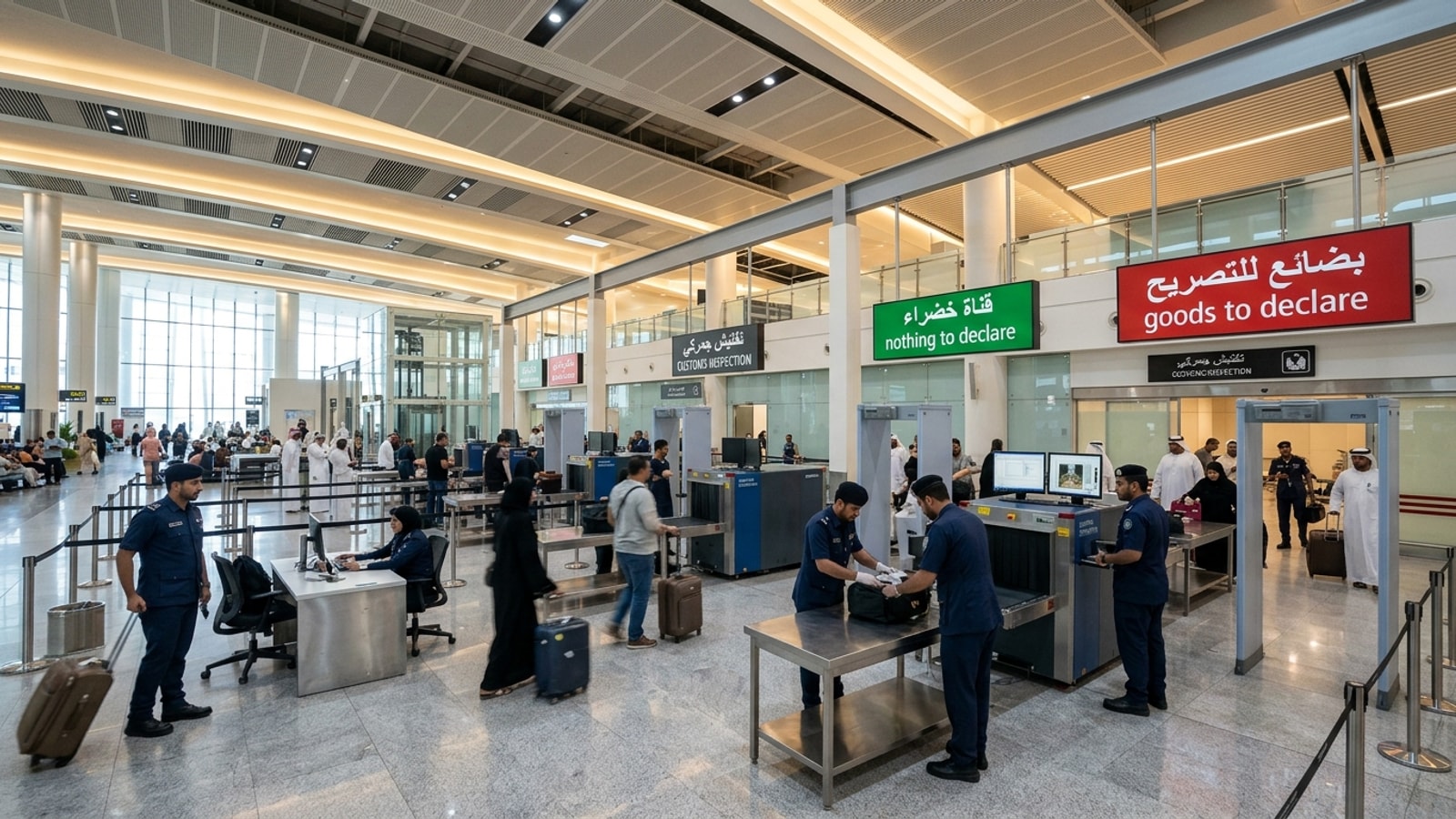
- Selecting the Correct Channel:
- Green Channel ("Nothing to Declare"): Choose this lane only if you are carrying zero alcohol, gifts valued under AED 3,000, currency under AED 60,000, and no controlled or restricted merchandise. Be aware that customs personnel carry out random secondary X-ray scans at the green channel exit.
- Red Channel ("Goods to Declare"): Proceed to this counter if you possess gifts over AED 3,000, commercial products, currency exceeding AED 60,000, or controlled medicines requiring official verification. Present invoices and permits to the duty officer.
Frequently Asked Questions
Can I bring a bottle of wine or whiskey from Dubai into Sharjah by car?
Transporting alcohol into Sharjah by road is regulated by local emirate laws. While non-Muslim residents in Dubai can legally purchase and possess alcohol under Dubai licensing rules, transporting liquor across the Sharjah border into Sharjah without a special transit or transport permit is illegal. Sharjah Police conduct roadside vehicle inspections, and unauthorized carriage within Sharjah territory constitutes an offense punishable by confiscation and court fines.
What happens if I accidentally bring alcohol in my luggage to Sharjah Airport?
If you arrive at SHJ with duty-free alcohol, approach the customs inspection desk immediately before walking through the green channel. Declare the bottles to the customs officer voluntarily. In cases of honest voluntary declarations, customs officers typically confiscate and destroy the alcohol without imposing criminal charges or fines. However, attempting to pass through the Green Channel with concealed bottles will be treated as an unlawful import attempt, triggering formal penalties and police recording.
Can I carry gold coins or gold bars from Sharjah back to India?
Exporting gold from Sharjah is permitted, provided you declare quantities exceeding AED 60,000 upon airport departure. However, Indian Customs enforces strict import rules on arrival in India. Indian passengers cannot bring gold bars or coins duty-free under the general baggage allowance. Only eligible Non-Resident Indians (NRIs) who have resided overseas for over one year may import up to 1 kg of gold bars by paying concessional customs duties in convertible foreign currency. Short-term tourists must declare gold at the Indian Customs Red Channel and pay standard customs duties exceeding 38.5%.
Are e-cigarettes and vaping liquids allowed through Sharjah Customs?
Arriving passengers may carry 1 or 2 vape devices and a small supply of e-liquid (up to 60 ml) exclusively intended for personal use in their baggage. Devices must be carried in cabin baggage in compliance with airline lithium battery flight safety standards. Importing large commercial boxes, disposable vapes in bulk, or unstamped e-liquids for resale is strictly barred and results in seizure at the customs desk.