

Quick Summary
- Primary Update: Under Directorate General of Foreign Trade (DGFT) Import Policy Notification No. 54/2015-2020 and Indian Customs Baggage Rules 2016, importing completely built-up (CBU) consumer camera drones in passenger baggage is strictly prohibited, with zero weight exemptions for sub-250g "nano" models.
- Transit Impact: Arriving passengers at Delhi (DEL T3), Mumbai (BOM T2), Bengaluru (BLR T2), Kochi (COK), and other international gateways face inline X-ray detection, chalk-marking on checked luggage, immediate equipment seizure under Section 110 of the Customs Act, and severe smuggling fines under Section 112 if using the Green Channel.
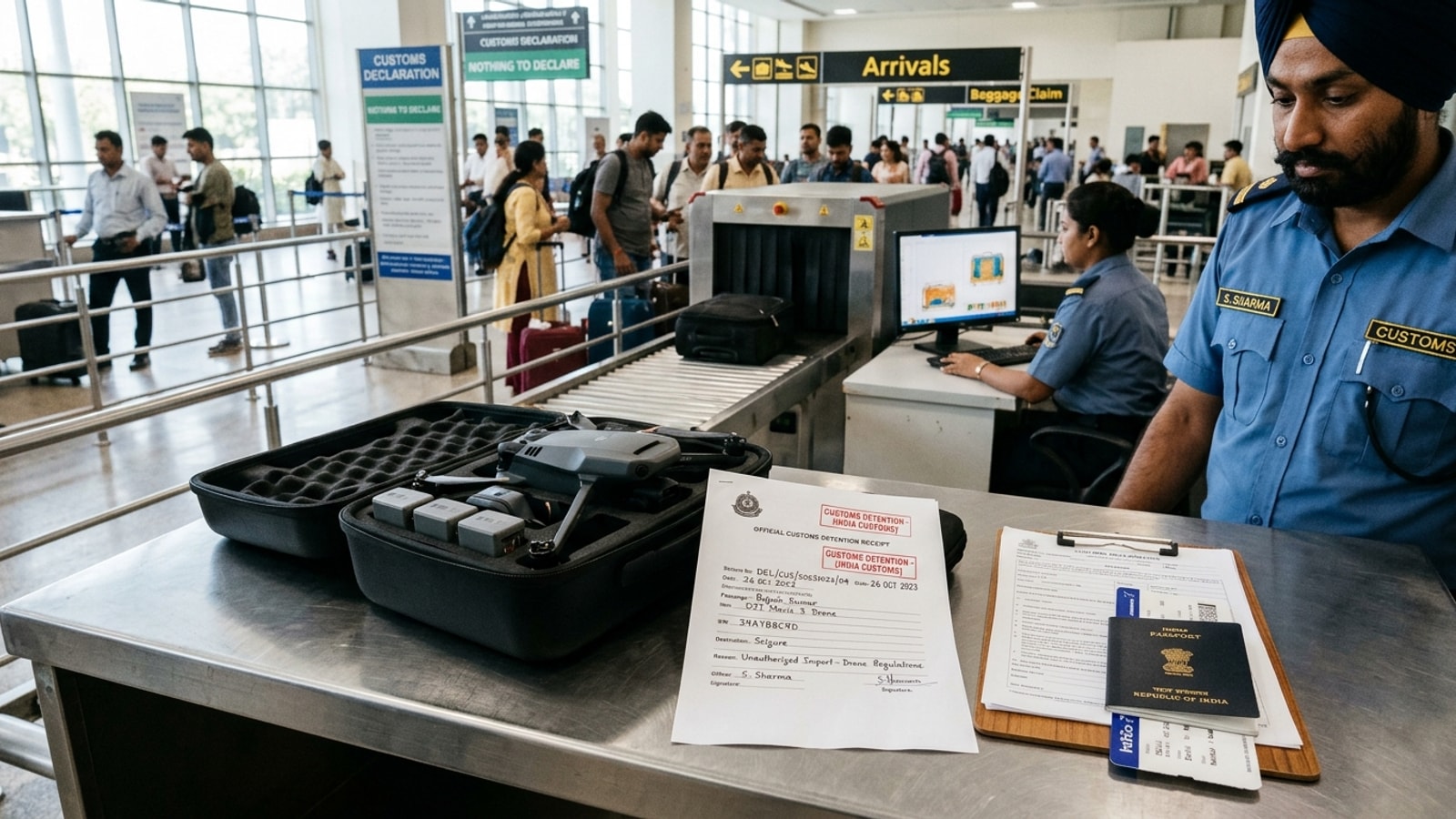
- Traveler Advice: Never purchase DJI or consumer drones overseas expecting to bring them into India; if arriving with an undeclared overseas drone, walk directly to the Red Channel to request a Detention Memo under Section 80 for temporary warehouse custody and subsequent re-export when departing India.
International travelers returning to India from technology shopping hubs such as Dubai, Singapore, Bangkok, Hong Kong, and the United States frequently encounter unexpected regulatory friction when carrying consumer camera drones. Attractive retail pricing, promotional bundle packages, and early global availability make flagship quadcopters—such as the DJI Mini 4 Pro, DJI Neo, DJI Air 3, DJI Avata 2, and Mavic 3 Pro—tempting purchases for tourists, content creators, and non-resident Indians (NRIs).
However, attempting to transport these devices through Indian airport customs checkpoints triggers immediate enforcement actions. Under statutory directives issued by the Directorate General of Foreign Trade (DGFT) under the Ministry of Commerce and Industry, in coordination with the Ministry of Civil Aviation (MoCA) and the Central Board of Indirect Taxes and Customs (CBIC), foreign-manufactured drones are classified as prohibited goods for passenger baggage importation.
Understanding the strict boundary between domestic flying regulations and cross-border customs import law is vital. Misinterpreting these rules routinely leads to baggage confiscation, heavy administrative fines, and the loss of expensive equipment at international arrival terminals.
Statutory Framework: The DGFT Drone Import Prohibition
The physical importation of unmanned aircraft systems into India is governed by the Foreign Trade Policy administered by the DGFT.
Under DGFT Notification No. 54/2015-2020, dated February 9, 2022, and reiterated under subsequent Foreign Trade Policies, the import of drones under Indian Trade Classification (Harmonized System) heading 8806 is prohibited. The restriction covers completely built-up (CBU) units, semi-knocked-down (SKD) kits, and completely knocked-down (CKD) assemblies.
The objective of this policy is twofold: strengthening national security and stimulating indigenous manufacturing under the Government of India’s Production Linked Incentive (PLI) scheme for drones and drone components. While drone parts and sub-assemblies can be imported by approved domestic manufacturers, assembled consumer drones cannot enter the country through individual passenger baggage under any circumstances.
In statutory terms, drones are excluded from the General Free Allowance (GFA) of ₹50,000 provided under Rule 3 of the Baggage Rules, 2016. Because the item is prohibited by law, customs officers cannot calculate customs duty or allow clearance upon payment of taxes.
The Sub-250g "Nano Drone" Misconception
The most widespread misunderstanding among international passengers involves lightweight drones weighing under 250 grams, such as the DJI Mini series or DJI Neo. Overseas electronics retailers in Dubai or Bangkok frequently assure Indian customers that "nano" drones are exempt from regulatory control. This assurance is completely false under Indian customs law.
The confusion stems from two distinct legal frameworks operating under different government ministries:
- DGCA Drone Rules 2021 (Ministry of Civil Aviation): These rules govern the operational use of drones within Indian sovereign airspace. Under DGCA rules, drones weighing up to 250 grams (the Nano category) are exempt from requiring a remote pilot license, and recreational pilots are not required to obtain prior operational flight permissions in designated Green Zones on the DigitalSky platform.
- DGFT Import Policy (Ministry of Commerce and Industry): This policy governs whether an item can cross the physical borders of India. DGFT import policy makes zero distinction based on weight, camera capability, or recreational intent.
Every unmanned aircraft system—regardless of whether it weighs 135 grams or 10 kilograms—is subject to the absolute import prohibition. When a traveler carries a sub-250-gram quadcopter into an Indian airport, customs inspectors evaluate the item strictly under import law, not domestic airspace rules.
Airport Detection and Inline Radiological Screening
Indian international airports employ multi-layered screening protocols designed to detect prohibited electronics, commercial cargo, and high-density components before passengers reach the baggage carousel.
At major international arrival terminals—including Delhi Indira Gandhi International (DEL Terminal 3), Mumbai Chhatrapati Shivaji Maharaj International (BOM Terminal 2), Bengaluru Kempegowda International (BLR Terminal 2), Hyderabad Rajiv Gandhi International (HYD), and Cochin International (COK)—all checked baggage passes through inline Dual-Energy Automated X-Ray Inspection Systems directly from the aircraft ramp.
+--------------------------------------------------------------------------------------------------+
|                            INDIAN AIRPORT ARRIVAL SCREENING SEQUENCE                             |
+--------------------------------------------------------------------------------------------------+
| [Aircraft Belly Cargo]                                                                           |
|         │                                                                                        |
|         ▼                                                                                        |
| [Inline Dual-Energy Radiological X-Ray Scan]                                                     |
|         │                                                                                        |
|         ├──► Quadcopter motors, lithium cells, or gimbals flagged by automated imaging algorithm |
|         │                                                                                        |
|         ▼                                                                                        |
| [Physical Chalk Marking Applied by Customs Screening Cell: "D" (Drone) or "X" (Inspection)]      |
|         │                                                                                        |
|         ▼                                                                                        |
| [Passenger Collects Luggage from Arrival Carousel]                                               |
|         │                                                                                        |
|         ├──► GREEN CHANNEL EXIT: Baggage scanned at exit gate; chalk mark identified; bag opened │
|         │    └── Action: Confiscation under Section 111(d) + Smuggling penalty under Section 112 │
|         │                                                                                        |
|         └──► RED CHANNEL DECLARATION: Passenger informs Customs Superintendent                    │
|              └── Action: Detention Memo (Form 8) issued under Section 80; Re-Export authorized   |
+--------------------------------------------------------------------------------------------------+
Quadcopter airframes possess distinctive radiological profiles. Brushless electric motors, copper stator windings, multi-cell lithium-polymer battery chemistry, and mechanical camera gimbals stand out clearly against standard personal clothing.
When a drone is detected during inline scanning, customs ground personnel apply discrete chalk markings onto the exterior of the suitcase:
- "D" indicates a suspected drone or specialized aerial equipment.
- "X" denotes general high-value electronics, excess commercial quantities, or undeclared dutiable goods.
Surveillance teams stationed along the arrival hall and exit portals monitor arriving passengers as they retrieve luggage from the carousels. Travelers attempting to wipe off chalk marks or carrying distinct drone branded carrying cases in hand luggage are intercepted before exiting the customs precinct.
Regulatory Comparison: Drones, Parts, and Electronic Equipment
To understand how Indian Customs classifies consumer drones versus other portable technology, the following matrix outlines statutory treatment, allowable thresholds, and enforcement consequences:
| Equipment Category | Applicable Weight / Model | Import Policy Status (DGFT) | Baggage Allowance Eligibility | Primary Legal Provision | Customs Border Action | Penalty or Clearance Outcome |
|---|---|---|---|---|---|---|
| Nano Consumer Drone | Under 250g (DJI Mini 4 Pro, DJI Neo) | Prohibited | Zero (Excluded from GFA) | DGFT Notif. 54/2015-2020 | Detention / Seizure | Section 80 Detention or Section 111 Confiscation |
| Micro / Small Drone | 250g to 25kg (DJI Air 3, Mavic 3 Pro) | Prohibited | Zero (Excluded from GFA) | DGFT Notif. 54/2015-2020 | Detention / Seizure | Absolute confiscation if undeclared; no duty release |
| Toy Quadcopter | Under 100g, plastic, no camera/GPS | Restricted / Scrutinized | May fall in ₹50,000 GFA if purely toy | Customs Tariff Item 9503 | Inspection & Testing | Released only if verified non-transmission toy |
| Drone Spare Batteries (LiPo) | Under 100Wh per pack (Cabin only) | Restricted if standalone | Must accompany permitted gear | DGCA Passenger Safety Rules | Mandatory carry-on check | Confiscated if packed in checked hold baggage |
| Professional Mirrorless Camera | Any standard camera body + 2 lenses | Permitted Personal Effect | Exempt under Rule 3 (Used) | Baggage Rules 2016 Rule 3 | Green Channel Clearance | Full duty exemption for used personal gear |
| Laptop Computer | One machine per adult traveler | Permitted Personal Effect | Exempt under Rule 5 | Baggage Rules 2016 Rule 5 | Green Channel Clearance | Duty-free entry for one unit per passenger (age 18+) |
| Commercial Drone Parts (Motors/Frames) | Industrial components | Restricted (Allowed for OEMs) | Commercial cargo only | Foreign Trade Policy 2023 | Cargo customs clearance | Requires commercial Bill of Entry and OEM license |
Legal Repercussions: Green Channel vs. Red Channel
The decision of which channel to enter at the customs hall determines whether a traveler faces straightforward temporary detention or criminal smuggling charges under the Customs Act, 1962.
1. The Green Channel Penalty Trap
The Green Channel is reserved exclusively for arriving passengers who carry no dutiable goods in excess of their statutory allowance and zero prohibited or restricted items.
Passing through the Green Channel constitutes a legally binding declaration that the passenger possesses nothing requiring customs entry. If an officer intercepts a passenger in the Green Channel and discovers a drone:
- Smuggling Classification: The act is legally treated as an attempt to smuggle prohibited goods into Indian customs waters under Section 111(d) of the Customs Act.
- Absolute Confiscation: Because drones are prohibited goods, customs authorities are not legally required to offer a redemption fine under Section 125. The drone is permanently confiscated and becomes property of the Central Government.
- Personal Monetary Penalties: Under Section 112 of the Customs Act, the adjudicating authority can impose a personal penalty equal to up to five times the market value of the goods, or ₹5,000, whichever is greater. Typical penalties on consumer drones range from ₹15,000 to ₹50,000 depending on the model.
- Permanent Record: The passenger's passport number is flagged in the CBIC electronic database, increasing the likelihood of secondary screening on future international arrivals.
2. The Red Channel Declaration Protocol
If a traveler carries a drone purchased abroad and walks directly to the Red Channel counter, the legal dynamics change completely:
- Zero Smuggling Intent: By declaring the item, the passenger eliminates any allegation of intentional concealment or misdeclaration under Section 111. No Section 112 penalties can be levied.
- Detention for Re-Export: Because the officer cannot clear the drone into India, the superintendent invokes Section 80 of the Customs Act. The officer issues an official Detention Memo (Form 8).
- Safe Custody: The drone is cataloged by serial number, sealed, and deposited in the bonded customs warehouse at the airport.
- Return Eligibility: The passenger or their authorized representative can retrieve the drone upon departing India for an international destination, preserving ownership of the property.
How to Legally Re-Export a Detained Drone
For foreign tourists, NRIs, and Indian residents traveling abroad again within a reasonable timeframe, Section 80 temporary detention offers a lawful mechanism to recover the equipment.
Statutory Time Limits
Under CBIC guidelines, detained baggage is held in the bonded warehouse for an initial period of 30 days. If the traveler is unable to depart within 30 days, they must submit a formal written extension request addressed to the Assistant or Deputy Commissioner of Customs (Air Intelligence Unit / Baggage) before the initial period expires. Customs authorities may grant extensions up to 90 days.
If goods remain uncollected after the retention window expires without an approved extension, the customs department initiates disposal proceedings under Section 48 and Section 150 of the Customs Act, transferring the unclaimed property to government e-auctions.
Taking an Indian-Bought Drone Abroad and Returning
Indian content creators, cinematographers, and travelers who legitimately own drones in India—purchased domestically with valid GST invoices and registered on the Ministry of Civil Aviation’s DigitalSky platform—often wish to carry their gear abroad for international shoots in destinations like Iceland, Switzerland, or the United Arab Emirates.
If you carry a drone out of India and return without documentation, customs officers on arrival will assume the drone was purchased abroad and initiate seizure under Section 110.
To avoid this trap, travelers must obtain an Export Certificate (also known as a Customs Baggage Certificate) prior to departure from India.
Step-by-Step Export Certificate Protocol
- Prepare Documentation: Gather the original Indian tax invoice showing GST payment, your DGCA Unique Identification Number (UIN) certificate from DigitalSky, and equipment serial numbers.
- Arrive Early at International Departures: Arrive at the airport departure terminal (DEL T3, BOM T2, BLR T2) at least 3.5 hours before your scheduled flight.
- Locate the Customs Departure Office: Prior to passing through immigration and CISF passenger security screening, report to the Customs Preventive / Baggage Clearance counter located in the departure check-in hall.
- Physical Inspection: Present your passport, international ticket, and the physical drone. The customs officer will verify that the serial numbers on the airframe, camera gimbal, and remote controller match your purchase invoice.
- Issuance of Certificate: The officer issues a signed and stamped Export Certificate detailing the exact make, model, and serial numbers of the equipment.
- Return Clearance: When you fly back into India, proceed to the Red Channel. Present the stamped Export Certificate to the arrival customs superintendent. Because the certificate proves prior exportation from India, the drone is cleared immediately without duty or detention.
Battery Transport: Lithium-Polymer Flight Safety
Beyond customs import prohibitions, air travelers transporting drones must comply with strict aviation security mandates governing lithium-polymer (LiPo) batteries established by the Bureau of Civil Aviation Security (BCAS) and the International Air Transport Association (IATA).
- Strict Checked Baggage Ban: Drone batteries must NEVER be packed in checked baggage. High-density LiPo chemistry carries severe thermal runaway risks at high altitudes. If detected during inline security scanning, baggage handlers will offload the suitcase or forcibly open it to remove the batteries, delaying your luggage.
- Mandatory Carry-On Packing: All drone batteries must be carried in passenger cabin baggage.
- Watt-Hour Restrictions: Batteries rated up to 100 Watt-hours (Wh) can be transported without airline pre-approval (most consumer drones, including DJI Mini, Air, and Mavic series, fall well below 100Wh). Batteries between 100Wh and 160Wh require prior airline operator approval. Batteries exceeding 160Wh are strictly forbidden on passenger aircraft.
- Terminal Protection: Battery terminals must be protected against short circuits by placing them in original manufacturer packaging, taping over exposed electrical contacts with non-conductive electrical tape, or storing each battery inside an individual fireproof LiPo safety pouch.
Traveler Logistics Guide
Arrival Terminal Customs Office Locations
If you arrive with an undeclared overseas drone and must declare it for Section 80 detention, report immediately to the Customs Superintendent stationed inside the arrival hall before the exit doors:
- Delhi Indira Gandhi International (DEL): Terminal 3 International Arrivals, Central Red Channel Office located between Baggage Belts 7 and 14.
- Mumbai Chhatrapati Shivaji Maharaj International (BOM): Terminal 2 International Arrivals, Customs Duty Assessment Hall located immediately behind Baggage Carousel 11.
- Bengaluru Kempegowda International (BLR): Terminal 2 International Arrivals, Customs Red Channel Supervisory Counter adjacent to Carousel 6.
- Cochin International (COK): Terminal 3 International Arrivals, Customs Superintendent Office situated facing the main exit corridor.
Re-Export Retrieval Checklist
When departing India to reclaim a detained drone, bring the following original documents to the International Departure Customs Office:
- Original Detention Memo (Form 8 / Warehouse Receipt) with official customs seal.
- Valid passport and confirmed international departure flight ticket.
- Cash or approved digital payment method for warehouse demurrage charges (calculated at approximately ₹150 to ₹350 per day depending on airport cargo custodian schedules).
- An authorized letter of authority and government-issued ID if a designated representative is retrieving the equipment on behalf of the passenger.
Frequently Asked Questions
Can I pay customs duty and take my foreign-bought DJI drone into India?
No. Drones are classified as prohibited goods under DGFT Import Policy Notification No. 54/2015-2020. Indian Customs officers have no legal authority to assess or accept customs duty on prohibited items arriving in passenger baggage. You cannot clear the drone into India by offering to pay standard electronics duties or surcharges.
Are lightweight toy drones without cameras permitted through Indian customs?
Basic plastic toy helicopters or quadcopters weighing under 100 grams that contain no cameras, no audio recording gear, and operate exclusively via low-frequency infrared or basic unlicensed radio frequencies (classified under Customs Tariff Heading 9503 as children's toys) may be permitted. However, if the device includes an optical camera, video transmitter, or GPS navigation module, customs officers will classify it as an unmanned aircraft system and detain it under DGFT rules.
What happens if I forget to declare a drone and customs officers catch me in the Green Channel?
Walking into the Green Channel with a prohibited item is treated as an intentional act of smuggling under Section 111(d) of the Customs Act, 1962. The drone will be confiscated immediately without an option for redemption, and customs authorities will issue a Show Cause Notice levying personal monetary penalties under Section 112 (often ₹15,000 to ₹50,000). To avoid penalties, always proceed to the Red Channel and declare the drone honestly.
How long will Indian customs store my detained drone before disposing of it?
Under standard CBIC airport warehouse procedures, detained baggage is stored for an initial period of 30 days. If you are departing after 30 days, you must submit a formal written request to the Assistant or Deputy Commissioner of Customs for an extension, which can be granted up to a total of 90 days. If the equipment remains unclaimed after the authorized storage window expires, customs authorities will dispose of it through government e-auctions.