

Quick Summary
- Primary Update: Indian Customs Baggage Rules enforce an updated statutory framework granting an adult passenger a ₹50,000 general duty-free allowance, one duty-free laptop computer, and specific gender-based gold jewellery limits for eligible returnees.
- Transit Impact: Arriving passengers at Delhi (DEL Terminal 3), Mumbai (BOM Terminal 2), Bengaluru (BLR Terminal 2), and Chennai (MAA) face automated AI-assisted baggage X-ray screening, baggage carousel chalk-marking, and physical red-channel checkpoints.
- Traveler Advice: Commercial merchandise, undeclared boxed iPhones exceeding the ₹50,000 threshold, loose gold coins or bars, alcohol exceeding 2 liters, and consumer drones will trigger immediate confiscation, 38.5% to 100% duty assessments, or statutory seizure penalties.
International air travelers arriving at Indian airports must navigate a precise regulatory framework governed by the Central Board of Indirect Taxes and Customs (CBIC) under the Department of Revenue, Ministry of Finance. Promulgated under Section 79 of the Customs Act, 1962, the Indian Customs Baggage Rules establish legal duty exemptions, absolute import prohibitions, and clearance procedures for passengers entering from abroad.
With millions of non-resident Indians (NRIs), business travelers, and vacationers returning from shopping and transit hubs such as Dubai, Abu Dhabi, Bangkok, Singapore, Kuala Lumpur, London, and New York, customs enforcement has shifted toward high-throughput automated scanning. Inbound checked luggage undergoes covert inline radiological examination before reaching the carousel, while terminal exit paths route passengers through distinct Red and Green Channels. Understanding the exact statutory allowances for gold jewellery, consumer electronics, alcohol, and personal items prevents unexpected duty assessments, confiscations, or legal penalties.
Core Duty-Free Baggage Framework: General Allowance
The Indian Customs Baggage Rules classify arriving travelers by residency status, duration of overseas stay, and port of origin. For typical international flights arriving from destinations other than Nepal, Bhutan, or Myanmar, the baseline financial allowance is codified under Rule 3 and Rule 4 of the Baggage Rules.
Used Personal Effects vs. Dutiable Merchandise
Customs law distinguishes between "used personal effects" and dutiable goods:
- Personal Effects: Articles intended for the personal use of the passenger, including worn clothing, personal toiletries, footwear, personal reading material, and personal items showing visible signs of use. These are completely exempt from customs duty and do not count against the ₹50,000 general allowance.
- Dutiable Articles: Brand new, boxed, sealed, or gift-packaged items, high-value consumer goods, home appliances, and luxury accessories. The aggregate fair market value of all such items must remain within the ₹50,000 ceiling. Any value exceeding ₹50,000 is taxed at the standard baggage rate of 38.5% (comprising 35% basic customs duty plus a 10% Social Welfare Surcharge).
Non-Pooling Rule
Customs regulations strictly prohibit pooling allowances across family members or traveling companions. If a married couple travels together, they cannot combine their individual ₹50,000 limits to bring a single ₹1,00,000 designer handbag or camera lens duty-free. The single article cannot be divided; customs officers will apply the single traveler's ₹50,000 exemption and assess the standard 38.5% duty on the remaining ₹50,000 value.
Electronics Import Rules: Laptops, iPhones, and Consumer Tech
Consumer electronics represent one of the most scrutinized categories at international customs terminals, particularly on flights arriving from Dubai, Singapore, and the United States where consumer tech retail pricing is often lower than in India.
The Rule 5 Laptop Computer Exemption
Under Rule 5 of the Baggage Rules, one laptop computer (notebook, MacBook, or portable personal computer) is permitted duty-free entry into India for any passenger aged 18 years or older. Key operational parameters include:
- The laptop exemption is an independent statutory benefit granted in addition to the ₹50,000 general baggage allowance.
- The laptop may be brand new in its retail packaging or used.
- Only one laptop computer per adult traveler is exempt.
- If a passenger carries two laptops (for instance, an employer-issued corporate laptop and a newly purchased personal MacBook), the second laptop does not qualify for the Rule 5 exemption. If the value of the second machine exceeds the passenger's ₹50,000 general free allowance, customs duty is assessed at 38.5% on the excess valuation.
Smartphones, iPhones, and Tablets
Smartphones and tablets do not fall under the Rule 5 laptop concession:
- Active Personal Phones: A passenger's daily-use smartphone, carried on their person or in cabin luggage with an active SIM card and personal user data, is classified as a used personal effect and is exempt from duty.
- New or Boxed iPhones: Sealed, brand-new smartphones purchased abroad fall directly under the ₹50,000 general allowance. Because contemporary flagship phones (such as the latest Apple iPhone Pro models) retail well above ₹1,00,000, they exceed the ₹50,000 threshold. Travelers carrying a new boxed iPhone must declare it in the Red Channel and pay 38.5% customs duty on the value exceeding ₹50,000.
- Carrying Multiple Phones: Arriving with two or more unopened phones in retail cartons is viewed by customs authorities as commercial trafficking rather than bona fide personal use. This triggers immediate scrutiny, loss of the ₹50,000 exemption, full duty assessment, and possible adjudication penalties under Section 112 of the Customs Act.
Total Prohibition on Consumer Drones
Arriving passengers frequently encounter severe enforcement regarding unmanned aerial vehicles (UAVs / drones). In accordance with Directorate General of Foreign Trade (DGFT) import policies and Ministry of Civil Aviation directives, importing consumer drones as passenger baggage (whether in carry-on or checked luggage) is completely prohibited.
Toy drones or commercial camera drones (such as DJI Mavic or Mini units) cannot be cleared through the Green Channel or Red Channel without an explicit import license from DGFT and equipment type approval from the Wireless Planning & Coordination (WPC) wing of the Department of Telecommunications. Drones discovered during airport baggage screening are immediately detained by customs under statutory seizure orders.
Gold Jewellery, Bullion, and Coins: Strict Quantity and Value Caps
Gold import regulations are among the most heavily monitored aspects of Indian border control, designed to curb illicit trade and protect foreign exchange reserves. Rules vary fundamentally between gold jewellery and gold bullion.
The 1-Year Overseas Stay Prerequisite
The duty-free gold jewellery allowance applies exclusively to passengers of Indian origin or holding an Indian passport who have resided outside India for a continuous period exceeding one year (365 days).
- Short-Term Tourists: Indian residents taking a vacation or business trip of a few days or weeks to Dubai, Singapore, or Thailand are entitled to zero duty-free gold allowance. Any gold jewellery purchased during the trip is dutiable from the first gram.
- Weight and Value Caps: For eligible returnees who completed the 1-year residency threshold, both limits apply simultaneously. For a gentleman, the allowance is 20 grams or ₹50,000, whichever is lower. Given current international gold prices, the monetary cap (₹50,000) is reached long before the 20-gram limit, meaning the practical duty-free quantity is limited by the statutory value ceiling.
Gold Bars, Coins, and Bullion
Gold bars, biscuits, and minted coins are never permitted under the duty-free tourist baggage allowance:
- Any passenger attempting to bring gold coins or gold bars through the Green Channel without declaration commits a serious offense.
- Eligible Indian passengers returning after residing abroad for at least six months may import up to 1 kilogram of gold bars or coins by declaring the cargo in the Red Channel and paying concessional customs duties in convertible foreign currency.
- Concealing gold in body cavities, luggage linings, or appliance internals results in non-bailable arrest, seizure of the metal under Section 110, and criminal prosecution under Section 135 of the Customs Act for values exceeding statutory prosecution thresholds.
Taking Personal Jewellery Out of India: Export Certificates
To prevent customs disputes when returning to India with personal jewellery originally purchased domestically, travelers departing Indian airports should visit the customs precious cargo counter prior to departure. Customs officers will examine the jewellery, document the gross weight and specifications, and issue an official Export Certificate. Presenting this certificate upon return allows re-entry of the documented ornaments completely tax-free, regardless of trip duration.
Duty-Free Alcohol, Wine, and Tobacco Quotas
Indian Customs strictly regulates the importation of alcoholic beverages and tobacco products under Annexure I of the Baggage Rules. These allowances apply per adult traveler aged 18 years and older.
| Item Category | Statutory Duty-Free Allowance | Regulatory Conditions & Restrictions |
|---|---|---|
| Alcoholic Liquor & Spirits | Up to 2.0 Liters total | Includes whisky, vodka, gin, rum, or liqueurs; adult passengers only (18+). |
| Wine | Up to 2.0 Liters total | Shares the 2-liter aggregate liquid allowance with hard spirits. |
| Beer | Up to 2.0 Liters total | Cannot exceed the combined 2-liter ceiling for all alcoholic beverages. |
| Cigarettes | Up to 100 sticks | Strictly for personal consumption; commercial quantities banned. |
| Cigars | Up to 25 sticks | Must be declared if exceeding this quantity. |
| Tobacco | Up to 125 grams | Pipe or rolling tobacco. |
| Electronic Cigarettes / Vapes | 0 units (Completely Prohibited) | Banned under PECA Act 2019; subject to confiscation and fine. |
The Combined 2-Liter Alcohol Limit
The 2-liter allowance encompasses all alcoholic products combined. A traveler cannot bring two liters of scotch whisky and two liters of wine; the total volume across all bottles must not exceed 2.0 liters per passenger.
- Alcohol may be purchased at the departure airport duty-free shop abroad, onboard the aircraft, or at the arrival duty-free store located in the baggage reclaim hall of Indian international terminals.
- Purchasing beyond the 2-liter quota is heavily penalized. Commercial customs duty on excess liquor stands at approximately 150% basic customs duty plus Agriculture Infrastructure and Development Cess (AIDC), making over-purchasing financially prohibitive.
Total Ban on Vapes and Heated Tobacco
Under the Prohibition of Electronic Cigarettes Act (PECA), 2019, the import, export, transport, sale, and distribution of electronic cigarettes, vape pods, heat-not-burn devices, and e-liquids is completely prohibited in India. Customs officers confiscate all discovered vaping hardware at both international arrival checkpoints and departure security gates.
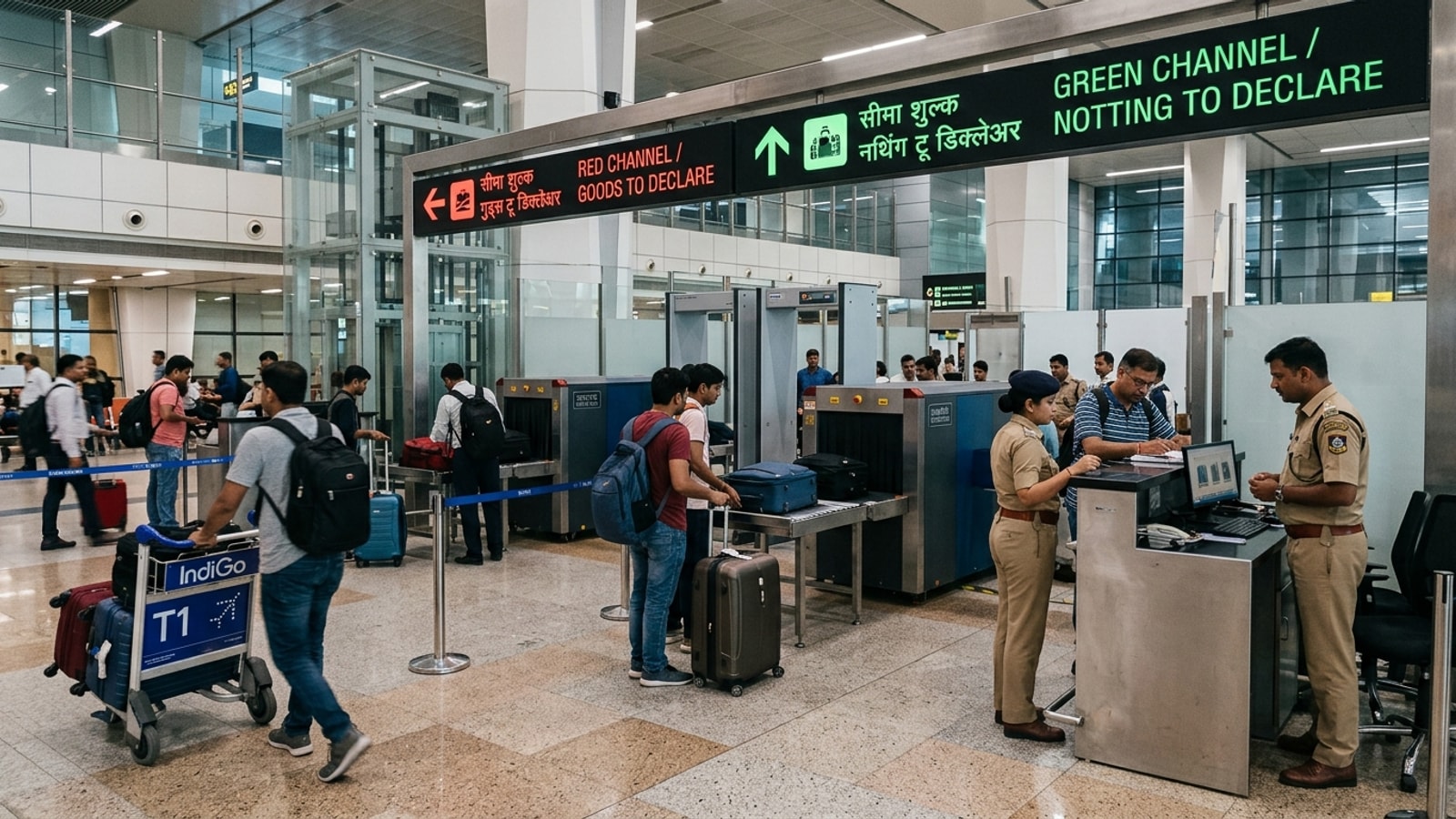
Red Channel vs. Green Channel Clearance Protocols
International arrival halls across Indian airports are structured into two distinct exit routes:
[ INBOUND FLIGHT ARRIVAL ] -> [ IMMIGRATION CHECK ] -> [ BAGGAGE CAROUSEL RETRIEVAL ]

INLINE RADIOLOGICAL SCREENING: Checked luggage is scanned before reaching the carousel

                   CHOOSE CUSTOMS DECLARATION CHANNEL
                    /                                \
                   /                                  \
        [ GREEN CHANNEL ]                      [ RED CHANNEL ]
        - No dutiable goods                    - Dutiable goods (> ₹50,000)
        - No prohibited goods                  - Gold / silver / bullion
        - Within ₹50,000 free cap              - Currency > USD 5,000 cash
        - Max 2L alcohol / 100 cigarettes      - Commercial samples / merchandise
        - Random spot-check screening          - Customs assessment & duty payment
The Green Channel
The Green Channel is an express walk-through exit designated for passengers who have nothing to declare. By walking into this channel, a traveler makes a legally binding statutory declaration that:
- They are carrying no prohibited goods (drones, vapes, narcotics, satellite phones).
- The total value of dutiable goods and gifts does not exceed ₹50,000.
- Alcohol and tobacco quantities comply strictly with the 2-liter and 100-cigarette quotas.
- They are not carrying unexempt gold jewellery, gold coins, or commercial goods.
The Red Channel
Travelers must enter the Red Channel if they carry articles exceeding the duty-free limits, commercial samples, gold bullion, satellite communication gear, or currency exceeding prescribed limits:
- Foreign Currency Declaration: Cash exceeding USD 5,000 (or equivalent) or aggregate foreign exchange (cash plus travelers cheques, bank drafts) exceeding USD 10,000 must be declared on a Currency Declaration Form (CDF).
- Indian Currency (INR): Indian residents returning from abroad are permitted to carry up to ₹25,000 in Indian currency notes. Carrying higher sums requires Reserve Bank of India (RBI) approval.
Automated Baggage Tagging and X-Ray Spot-Checks
Indian Customs operates high-speed dual-energy X-ray scanners that analyze checked luggage as it is offloaded from aircraft cargo containers. If image analysts identify high-density metal (gold), layered electronics, or suspicious liquid containers:
- Customs staff mark the exterior of the bag with specialized chalk codes (such as an 'X' or alphanumeric markers) or affix automated electronic tracking tags.
- When passengers collect these bags and attempt to exit through the Green Channel, customs officers stationed at channel gantries intercept them for secondary screening and physical inspection.
Penalties for False Declarations
Walking through the Green Channel with undeclared dutiable or prohibited articles constitutes an offense under Section 111 of the Customs Act:
- Duty Assessment: Customs duty assessed at 38.5% (or higher specific tariff rates for gold and liquor).
- Section 112 Penalty: Discretionary penalty up to 100% of the duty amount.
- Section 125 Redemption Fine: A fine imposed in lieu of absolute confiscation to redeem the seized merchandise.
- Criminal Prosecution: Under Section 135, smuggling dutiable goods or gold exceeding ₹50,00,000 in value is a cognizable and non-bailable offense leading to arrest and judicial prosecution.
Comprehensive Customs Allowance Summary Table
| Category | Passenger Eligibility | Free Allowance Ceiling | Excess Duty Rate / Enforcement |
|---|---|---|---|
| General Goods / Gifts | Indian resident or resident foreigner (air arrival) | ₹50,000 total fair value | 38.5% standard baggage duty on excess value |
| Laptop Computer | Adult passenger (age 18+) | 1 unit (notebook / PC) | Second unit taxed at 38.5% over ₹50,000 cap |
| Smartphones / iPhones | All passengers | Personal phone exempt; boxed units use ₹50,000 cap | 38.5% on value exceeding ₹50,000; multiple units audited |
| Gold Jewellery (Men) | Resided abroad > 1 year | 20 grams, capped at ₹50,000 value | Fully dutiable if abroad < 1 year; standard gold tariff |
| Gold Jewellery (Women) | Resided abroad > 1 year | 40 grams, capped at ₹1,00,000 value | Fully dutiable if abroad < 1 year; standard gold tariff |
| Gold Coins / Bullion | Short-term tourists | 0 grams | Absolute ban on duty-free entry; 1kg limit for returnees with duty |
| Alcohol & Wine | Adult passengers (age 18+) | 2.0 Liters total volume | Excess subject to 150% duty + cess or confiscation |
| Cigarettes | Adult passengers (age 18+) | 100 sticks | Excess dutiable; commercial quantities seized |
| E-Cigarettes / Vapes | All passengers | 0 units (Banned) | Seizure under PECA 2019; fines and confiscation |
| Consumer Drones | All passengers | 0 units (Prohibited) | Detention and seizure; requires DGFT license |
| Foreign Currency | All passengers | USD 5,000 (cash) / USD 10,000 (total) | Mandatory Red Channel declaration on CDF form |
| Indian Currency (INR) | Indian residents | Up to ₹25,000 per person | Excess detained without prior RBI authorization |
Traveler Logistics Guide
Navigating Indian Customs at major international gateways (Delhi IGI Terminal 3, Mumbai CSMIA Terminal 2, Bengaluru Kempegowda Terminal 2, Chennai, Hyderabad Rajiv Gandhi, and Kochi) is straightforward when following an organized compliance protocol.
Pre-Arrival Digital Customs Declaration via ATITHI
The Central Board of Indirect Taxes and Customs provides the official ATITHI mobile application (available on iOS and Android) to simplify airport customs declarations:
- Download and Profile Setup: Install ATITHI prior to boarding your international departure.
- Flight and Baggage Entry: Enter flight details, passport information, number of checked bags, and declare any dutiable articles, high-value electronics, or foreign currency.
- QR Code Generation: The application calculates estimated duties (if applicable) and generates a secure declaration QR code.
- Terminal Processing: Upon landing, present the digital QR code at dedicated ATITHI customs counters in the arrival hall for rapid document verification and electronic duty payment.
Step-by-Step Customs Terminal Checklist
To avoid delays or penalties at terminal exit points:
- Retain Retail Invoices: Keep all original purchase receipts for electronics, watches, and jewellery purchased abroad in your hand luggage. If customs officers question an item's valuation, presenting an authentic retail invoice prevents officers from using inflated reference pricing tables.
- Inspect Checked Luggage for Chalk Marks: When retrieving bags from the carousel, examine all sides for chalk markings (such as a large white or yellow 'X'). Attempting to wipe off chalk marks in view of surveillance cameras alerts customs officers; proceed directly to the Red Channel if carrying items of value.
- Pack Personal Electronics Openly: Keep your personal laptop, active smartphone, and camera in carry-on luggage where they can be quickly inspected. Packing multiple boxed electronics in checked luggage triggers inline scanner alerts.
- Respect Liquid Volumetric Limits: Ensure that the aggregate volume of spirits, wine, and beer does not exceed 2,000 ml. Do not unseal tamper-evident duty-free bags (STEBs) until reaching your final residential destination.
- Declare Cash When Exceeding Limits: If carrying foreign currency banknotes exceeding USD 5,000 or total financial instruments exceeding USD 10,000, demand a Currency Declaration Form at the Red Channel counter. This documented proof is mandatory when subsequently depositing funds or converting currency in India.
Frequently Asked Questions
Can I bring two iPhones from Dubai to India without paying customs duty?
No. While your primary, active personal phone is considered a personal effect and exempt from duty, a second iPhone (especially if new, unopened, or in retail packaging) is classified as dutiable cargo. Under the Baggage Rules, new electronics must fit within the passenger's ₹50,000 general duty-free allowance. Because new iPhone models retail well above ₹50,000, the second device will be assessed for customs duty at 38.5% on the value exceeding ₹50,000. Attempting to pass both phones through the Green Channel without declaration can result in full duty assessment, penalty fines, and possible confiscation.
How much gold jewellery can an Indian tourist bring back from a vacation in Dubai or Singapore?
Zero grams duty-free. The statutory duty-free gold jewellery allowance (up to 20 grams/₹50,000 for men and 40 grams/₹1,00,000 for women) applies exclusively to passengers who have resided outside India for a continuous period of more than one year. Tourists on short holidays or business trips do not qualify for this exemption. Any gold jewellery purchased during a short overseas stay must be declared at the Red Channel upon arrival and is subject to standard customs duty.
Can I bring a drone into India in my checked luggage if it is for personal photography?
No. The Directorate General of Foreign Trade (DGFT) and the Central Board of Indirect Taxes and Customs strictly prohibit the import of drones (unmanned aerial vehicles) as passenger baggage, regardless of whether the device is for personal recreational photography or commercial use. Any drone found in checked or cabin luggage will be detained and seized by customs authorities at the airport. Importing a drone legally requires prior import authorization from DGFT and equipment approval from the Wireless Planning & Coordination (WPC) wing.
How is the 2-liter duty-free alcohol limit calculated if I buy liquor at both departure and arrival airports?
The 2-liter limit is an aggregate ceiling covering all alcoholic beverages per adult passenger (aged 18 and older). It applies to the combined total volume of alcohol purchased at the overseas departure airport, on board the flight, and at the Indian arrival duty-free shop. For example, if you purchase one 1-liter bottle of whisky in Dubai and one 1-liter bottle of wine at Delhi's arrival duty-free, you have reached your exact legal limit of 2.0 liters. Purchasing any additional volume exceeds the statutory cap and exposes you to customs duties of approximately 150% plus cess or confiscation.