

Quick Summary
- Primary Update: The Customs and Excise Department (C&ED) of Hong Kong strictly enforces border inspection protocols at Hong Kong International Airport (HKIA), imposing an absolute statutory ban on all alternative smoking products (vapes and e-cigarettes), an ultra-narrow cap of only 19 duty-free cigarettes, a 1-litre allowance for spirits exceeding 30% ABV, and a zero-tolerance criminal prohibition on Cannabidiol (CBD).
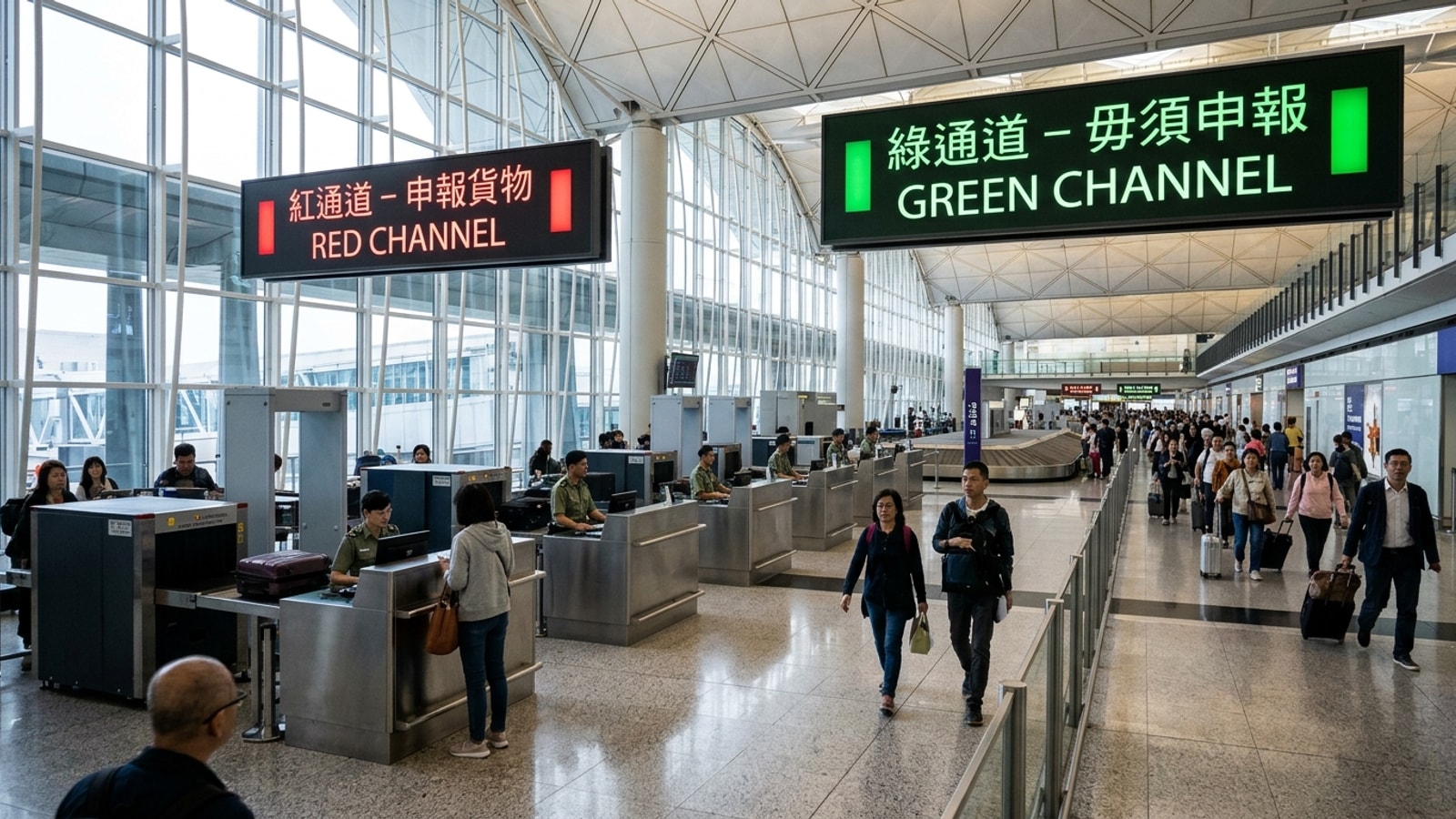
- Transit Impact: International passengers arriving at HKIA Terminal 1 pass through dual Red and Green Channel customs checkpoints. Officers conduct targeted X-ray luggage scanning and secondary baggage searches; carrying undeclared commercial quantities, sealed 20-cigarette packs, or prohibited vaporizers leads to immediate compounding fines starting at HK$2,000, property confiscation, or criminal prosecution.
- Traveler Advice: Never bring e-cigarettes, vape pods, heated tobacco units, or CBD cosmetics into Hong Kong under any circumstances; open any cigarette pack to discard at least one cigarette so you hold no more than 19 sticks before entering the customs hall; and use the Red Channel if carrying physical currency or negotiable instruments totaling HK$120,000 or more.
Hong Kong maintains one of the world's most efficient yet stringently monitored border clearance systems. Administered by the Customs and Excise Department (C&ED) in close coordination with the Department of Health, the Hong Kong Police Force, and the Agriculture, Fisheries and Conservation Department (AFCD), passenger screening at Hong Kong International Airport (HKIA) operates on rigid statutory lines.
For international travelers flying into Chek Lap Kok—including frequent flyers from India, the Middle East, Europe, and Southeast Asia—navigating Hong Kong Customs requires precise knowledge of statutory exemptions and strict local prohibitions. Hong Kong law enforces distinct rules that differ sharply from neighboring Asian hubs. These include a total ban on vaporizers, an unusual 19-cigarette limit designed to prevent duty-free imports of sealed retail packs, and the full classification of Cannabidiol (CBD) alongside narcotics such as heroin and cocaine. Understanding these operational standards ensures a seamless transit through HKIA without falling foul of severe compounding penalties or criminal charges.
The Dual-Channel Clearance Protocol at HKIA
Upon deplaning at HKIA Terminal 1, clearing Automated Passenger Clearance System e-Channels or manual immigration counters, and retrieving checked luggage from the arrival carousels, all passengers proceed toward Customs Clearance immediately prior to entering the public Arrival Halls (Hall A or Hall B).
Hong Kong Customs enforces the standard international dual-channel system:
- The Green Channel ("Nothing to Declare"): Walk through the Green Channel only if your baggage contains no dutiable goods, no items exceeding statutory duty-free concessions, no restricted pharmaceuticals or foods lacking import permits, and zero prohibited articles. Walking into the Green Channel constitutes a legally binding declaration under Hong Kong law that everything in your possession complies fully with import statutes.
- The Red Channel ("Goods to Declare"): Proceed directly to the Red Channel inspection desk if you carry dutiable goods exceeding your personal allowance, commercial merchandise, controlled pharmaceuticals, physical currency or bearer instruments totaling HK$120,000 or more, or any item requiring statutory inspection. Customs officers examine your documentation, calculate applicable excise taxes, and issue official payment receipts.
Luggage Screening and Compounding Penalties
C&ED officers deploy advanced multi-energy X-ray inspection systems and automated baggage anomaly detection. Checked baggage is pre-screened in the subterranean baggage handling facility before reaching the arrival carousels. Flagged bags receive electronic tags or discrete monitoring, directing ramp officers to signal customs inspectors in the arrival hall.
Officers stationed across both channels also conduct random spot-checks and secondary conveyor X-ray scans. Under the Dutiable Commodities Ordinance (Cap. 109), failing to declare dutiable goods or submitting a false or incomplete declaration at the Green Channel constitutes a criminal offense.
For standard minor infractions involving undeclared tobacco or alcohol, customs authorities may offer compounding procedures under the Compounding of Offences Scheme. Under this mechanism, the passenger avoids a formal court trial by paying an on-the-spot composition fine of HK$2,000 plus five times the duty payable on the undeclared items, accompanied by immediate forfeiture of the goods. If the passenger refuses composition, or if the infraction involves commercial scale or prohibited contraband, the case proceeds to the Magistrates' Courts, where penalties reach up to HK$1,000,000 in fines and two years of imprisonment.
Total Prohibition on E-Cigarettes and Alternative Smoking Products
Under the Smoking (Public Health) (Amendment) Ordinance, Hong Kong enforces an absolute prohibition on the import, promotion, manufacture, sale, and commercial possession of Alternative Smoking Products (ASPs).
This statutory ban encompasses:
- Electronic cigarettes and vape pens.
- Heated tobacco products (such as IQOS, glo, and Ploom devices).
- Herbal cigarettes.
- Cartridges, e-liquids, flavor pods, and atomizers, regardless of whether they contain nicotine.
Regulated Category             │ Legal Status & Enforcement Action

Electronic Cigarettes / Vapes  │ Strictly Prohibited (Zero Exemption)
Heated Tobacco Devices & HeatSticks │ Strictly Prohibited (Zero Exemption)
Vape E-Liquids & Pods          │ Strictly Prohibited (Zero Exemption)
Herbal Cigarettes              │ Strictly Prohibited (Zero Exemption)
Maximum Statutory Penalty      │ HK$50,000 Fine & 6 Months Prison
The Personal Use Invariant and Transit Nuance
There is no personal use exemption for incoming travelers. Tourists and visiting business passengers arriving at HKIA with a single disposable vape pen or an open packet of heated tobacco sticks face immediate confiscation and arrest if they attempt to pass customs. Penalties under the ordinance include a fine of up to HK$50,000 and imprisonment for six months.
A critical operational distinction applies to transit passengers:
- Direct Airside Transit Passengers: International passengers connecting between two international flights who remain within the sterile airside transfer area of HKIA, without clearing immigration or collecting checked baggage, are legally exempt from the import offense.
- Landside Transfer Passengers: Any passenger who exits through immigration to collect bags, re-check luggage on separate tickets, or stay at an airport hotel enters Hong Kong customs jurisdiction. At that moment, any vaporizer in their luggage becomes an illegal import. Travelers with landside connections must surrender these items to airline staff or dispose of them before reaching customs control.
The 19-Cigarette Cap and Traditional Tobacco Allowances
Hong Kong enforces one of the most restrictive tobacco allowances globally. Under the Dutiable Commodities Ordinance, incoming passengers aged 18 years or older are permitted to bring into Hong Kong for their own personal use only one of the following quantities of tobacco duty-free:
- 19 cigarettes; OR
- 1 cigar (if carrying more than one cigar, the aggregate weight must not exceed 25 grams); OR
- 25 grams of other manufactured tobacco.
The "One Removed" Operational Reality
Standard commercial cigarette packets sold at duty-free airport outlets or domestic retail stores contain 20 cigarettes. Because the statutory limit is set at exactly 19 cigarettes, an arriving passenger carrying an unopened, sealed 20-cigarette pack exceeds the duty-free concession by exactly one cigarette.
If a passenger walks through the Green Channel with a full, sealed pack of 20 cigarettes without declaring it at the Red Channel, customs officers will intercept them for an undeclared dutiable commodity. Under the compounding scheme, the passenger is liable for the statutory composition penalty: a baseline fine of HK$2,000 plus five times the excise duty on the entire dutiable batch. To avoid this severe penalty, travelers who purchase cigarettes abroad must open the pack and discard at least one cigarette prior to entering the customs inspection hall.
Alcohol Allowances and the 30% ABV Exemption
Hong Kong's excise tax framework on alcoholic beverages is unique. In 2008, the Hong Kong Special Administrative Region government eliminated excise duty on wine and liquor with an alcoholic strength by volume (ABV) of 30% or less measured at 20°C.
As a result, customs rules divide alcohol into two distinct regulatory classes:
1. Spirits Exceeding 30% ABV
For liquor with an alcoholic strength exceeding 30% by volume (such as whisky, gin, vodka, rum, tequila, and high-strength cognacs), passengers aged 18 years or older who hold a valid travel document are granted a duty-free concession of 1.0 litre.
Key conditions governing the 1-litre spirits concession:
- The passenger must be 18 years of age or older.
- The liquor must be strictly for personal consumption.
- If the passenger holds a Hong Kong Identity Card, they must have spent no less than 24 hours outside Hong Kong to claim this concession (this restriction does not apply to foreign visitors holding overseas passports).
Spirits brought in excess of 1.0 litre are subject to an ad valorem excise duty of 100% assessed on the value of the excess volume.
2. Wine, Beer, and Low-Strength Beverages (30% ABV or Less)
Hong Kong imposes zero excise duty on wine, beer, cider, sake, and spirits with an alcoholic strength not exceeding 30% ABV. Arriving travelers may bring reasonable quantities of wine and beer for bona fide personal consumption without paying customs duty and without exhausting their 1-litre spirits allowance.
While there is no formal numerical cap on personal wine or beer, bringing excessive commercial quantities (such as dozens of unmanifested cases) triggers commercial import controls, requiring standard commercial import declarations under the Trade and Industry Department.
Comprehensive Hong Kong Customs Allowances and Penalties Table
The following table summarizes the statutory duty-free thresholds, regulatory restrictions, and enforcement actions applicable at Hong Kong International Airport:
| Item / Category | Statutory Duty-Free Concession | Operational Conditions & Limits | Non-Declaration Penalties |
|---|---|---|---|
| Cigarettes | 19 sticks only | Age 18+; sealed 20-packs exceed limit | Compounding fine HK$2,000 + 5x duty; or HK$1M fine & 2 years prison |
| Cigars | 1 cigar (max 25g if multiple) | Age 18+; personal consumption | Compounding fine HK$2,000 + 5x duty; goods forfeited |
| Manufactured Tobacco | 25 grams | Age 18+; loose pipe or rolling tobacco | Compounding fine HK$2,000 + 5x duty; goods forfeited |
| Spirits (>30% ABV) | 1.0 litre | Age 18+; 100% ad valorem duty on excess | Compounding fine HK$2,000 + 5x duty; seizure of excess |
| Wine & Beer (≤30% ABV) | Unlimited for personal use | 0% excise duty under Hong Kong law | Commercial volume checks if quantity indicates trading |
| E-Cigarettes & Vapes | 0 (Strictly Prohibited) | Total ban on vapes, pods, e-liquids | Confiscation; fine up to HK$50,000 and 6 months prison |
| Cannabidiol (CBD) | 0 (Classified Dangerous Drug) | Total criminal ban; applies to oils, gummies | Drug trafficking: Life imprisonment and HK$5,000,000 fine |
| Currency & CBNIs | No cap; declaration at HK$120,000 | Cash, cheques, traveler's cheques | Fixed penalty HK$2,000; prosecution up to HK$500,000 & 2 years prison |
| Infant Formula (Export) | 1.8 kg (approx. 2 tins) | Applies to departing passengers aged 16+ | Fine up to HK$500,000 and 2 years imprisonment |
| General Personal Effects | All bona fide used articles | Used clothing, laptops, cameras, phones | Free from customs duty and sales tax |
Total Ban on Cannabidiol (CBD) as a Dangerous Drug
Under the Dangerous Drugs Ordinance (Cap. 134), the Hong Kong Government classified Cannabidiol (CBD) as a Dangerous Drug. This regulation places CBD under the exact same statutory schedule as heroin, cocaine, methamphetamine, and cannabis.
This absolute ban creates severe legal exposure for travelers arriving from North America, Europe, Australia, or Southeast Asian countries where CBD is sold openly as an over-the-counter wellness ingredient.
Under Hong Kong law:
- Products containing even trace amounts of CBD—including oils, tinctures, capsules, sleep gummies, pain relief balms, facial serums, shampoos, sodas, and pet treats—are classified as dangerous drugs.
- Bringing any CBD product into Hong Kong constitutes the criminal offense of trafficking in dangerous drugs. Trafficking carries a statutory maximum penalty of life imprisonment and a fine of HK$5,000,000.
- Possession or consumption of CBD without an authorization from the Director of Health carries a maximum penalty of seven years of imprisonment and a fine of HK$1,000,000.
Customs and police officers at HKIA conduct chemical field-testing and laboratory analysis on seized cosmetics, balms, and health supplements. Pleading ignorance of Hong Kong's drug schedule or displaying a foreign medical prescription is not an accepted defense under the Dangerous Drugs Ordinance.
Currency and Bearer Negotiable Instruments Reporting
Under the Cross-boundary Movement of Physical Currency and Bearer Negotiable Instruments Ordinance (Cap. 629), Hong Kong enforces international Financial Action Task Force (FATF) anti-money laundering standards.
Passengers arriving at HKIA carrying physical currency or Bearer Negotiable Instruments (CBNIs) totaling HK$120,000 or more (or its equivalent in foreign currencies such as US Dollars, Euros, British Pounds, or Indian Rupees) must submit a written declaration using the Red Channel.
Key guidelines for CBNI compliance:
- Instruments Covered: Physical cash (banknotes and coins), traveler's cheques, bearer cheques, promissory notes, bearer bonds, and money orders.
- Declaration Form: Travelers must complete Form CED 412 (available at the Red Channel desks and downloadable via the C&ED portal) and hand it to a customs officer.
- Transit Exemption: International air passengers in direct airside transit who do not pass through border immigration controls are exempt from submitting Form CED 412.
- Penalties: Failing to declare or providing false information on CBNIs carries an initial fixed penalty of HK$2,000 for first-time offenders who have not previously committed a currency breach and whose funds are not linked to suspected criminal proceeds. In repeat or severe instances, offenders are prosecuted in court, facing fines up to HK$500,000 and two years of imprisonment.
Controlled Items: Infant Formula, Drones, Medicines, and Food
Beyond tobacco, alcohol, and cash, several specialized regulatory categories impact travelers clearing Hong Kong border controls:
1. Powdered Infant Formula Export Cap
To safeguard local supplies, Hong Kong enforces the Import and Export (General) Regulations on departing travelers. Any person aged 16 or older leaving Hong Kong may carry no more than 1.8 kilograms (equivalent to approximately two standard 900g tins) of powdered formula intended for infants and children under 36 months, unless holding a valid export licence issued by the Director-General of Trade and Industry. Violations lead to fines up to HK$500,000 and two years of imprisonment.
2. Drones and Small Unmanned Aircraft (SUA)
Drones brought into Hong Kong are governed by the Civil Aviation Department (CAD) under the Small Unmanned Aircraft Order (Cap. 448G). Travelers may carry personal consumer drones (such as DJI Mavic or Mini units) in their cabin or checked baggage without a prior import permit.
However, operational use within Hong Kong requires strict compliance:
- Drones weighing between 250 grams and 7 kilograms (Category A2) require operational registration and pilot registration via the CAD Electronic Portal for Small Unmanned Aircraft (eSUA).
- Drones under 250 grams (Category A1) operate without formal registration if flown below 100 feet in unrestricted daylight zones.
- Flying any unmanned aircraft within CAD-designated Restricted Flying Zones—which include Hong Kong International Airport, Chek Lap Kok aerodrome boundaries, military installations, and Victoria Harbour—is strictly prohibited and subject to criminal penalties.
3. Prescription Medications and Controlled Drugs
Under the Pharmacy and Poisons Ordinance and the Antibiotics Ordinance, travelers entering Hong Kong with medications classified as dangerous drugs, antibiotics, or Part 1 poisons (such as strong sleeping sedatives, codeine pain relievers, and psychotropic compounds) must carry them in their personal baggage accompanied by an official doctor's prescription clearly stating the patient's name, clinical condition, and prescribed dosage.
4. Raw Food, Meat, and Poultry Prohibitions
Administered by the Centre for Food Safety (CFS), Hong Kong strictly prohibits the import of raw meat, chilled or frozen poultry, and game without an official health certificate issued by the exporting nation's veterinary authority and a prior CFS permit. Processed and fully cooked meat sealed in commercial retail packaging is generally permitted, provided it does not violate endangered species guidelines.
Traveler Logistics Guide
Navigating customs clearance at Hong Kong International Airport requires adherence to standard operating procedures. Use this step-by-step checklist to ensure a swift, penalty-free border passage.
Step 1: Pre-Departure Luggage Inspection
- Discard all vaping gear: Inspect carry-on backpacks, jacket pockets, and checked bags. Remove and leave behind all e-cigarettes, vape pens, e-liquid pods, and heated tobacco sticks.
- Audit cosmetics and wellness products: Check product ingredient labels on sleep supplements, stress-relief balms, and facial oils. Ensure zero presence of Cannabidiol (CBD), hemp extract, or THC.
- Check cigarette counts: If bringing cigarettes, open the packet and discard at least one stick so that your total count does not exceed 19 individual cigarettes.
Step 2: Arriving at HKIA Terminal 1
- Disembark at your arrival gate and proceed to the Midfield Concourse or Terminal 1 Automated People Mover (APM) train.
- Clear immigration via e-Channel gates (for eligible enrolled visitors, Macau residents, and HKID holders) or foreign visitor inspection lines.
- Descend to the baggage claim hall and locate your assigned carousel (Belts 1 to 14). Collect all checked luggage and verify luggage tags.
Step 3: Determining Your Customs Channel
- Assess your baggage before approaching the exit gates:
- If you carry only used personal belongings, no more than 19 cigarettes, no more than 1.0 litre of hard spirits, zero vapes, zero CBD, and cash below HK$120,000: Choose the Green Channel.
- If you hold more than 19 cigarettes, spirits exceeding 1.0 litre, commercial samples, or cash/cheques totaling HK$120,000 or more: Choose the Red Channel.
Step 4: Red Channel Declaration Execution
- Walk to the Red Channel counter located between the baggage reclaim carousels and Exits A and B.
- Present your passport, boarding pass, and purchase receipts to the C&ED officer.
- For currency declarations, request or present a completed Form CED 412.
- Pay assessed duties on excess alcohol or tobacco using standard payment options: Octopus card, major credit cards (Visa, Mastercard, UnionPay), or Hong Kong Dollar cash. Collect the official revenue receipt before proceeding to the public arrivals hall.
Frequently Asked Questions
Can I bring an unopened pack of 20 cigarettes into Hong Kong?
No. Hong Kong statutory law permits an incoming traveler aged 18 or older to bring only 19 cigarettes duty-free. A standard, sealed commercial retail pack contains 20 cigarettes, which exceeds the legal limit by one cigarette. If you walk through the Green Channel with an unopened pack of 20 cigarettes, customs officers can issue an on-the-spot composition fine of HK$2,000 plus five times the duty owed, or initiate formal court prosecution. To enter legally without declaring at the Red Channel, you must open the pack and discard at least one cigarette before reaching the customs inspection area.
What happens if I accidentally bring an e-cigarette or vape pen into Hong Kong International Airport?
Under the Smoking (Public Health) (Amendment) Ordinance, alternative smoking products—including electronic cigarettes, vape juices, and heated tobacco units—are entirely banned from import. If you enter customs clearance with an e-cigarette, it will be confiscated, and you face arrest with potential fines up to HK$50,000 and six months of imprisonment. However, international passengers who remain within the sterile airside transit area of HKIA for an ongoing flight connection without passing through immigration and customs control are legally exempt from the import prohibition.
How much wine or beer can I bring into Hong Kong duty-free?
Hong Kong eliminated excise duty on wine, beer, and beverages with an alcoholic strength by volume (ABV) of 30% or less in 2008. Arriving travelers may bring reasonable quantities of wine and beer for personal consumption without paying excise taxes and without impacting their 1.0-litre allowance for high-strength spirits. While there is no rigid numerical limit on personal wine, quantities suggesting commercial trade rather than personal use are subjected to commercial import documentation requirements.
Is CBD oil or cream permitted in Hong Kong if purchased with a medical prescription overseas?
No. Since February 1, 2023, Cannabidiol (CBD) has been classified as a Dangerous Drug under Hong Kong's Dangerous Drugs Ordinance, matching the statutory category of heroin and cocaine. Bringing any product containing CBD—including prescription oils, pain relief balms, skincare lotions, and sleep gummies—into Hong Kong constitutes drug trafficking. Foreign medical prescriptions are not recognized as an exemption at border checkpoints. Convictions for importing dangerous drugs carry sentences up to life imprisonment and fines up to HK$5,000,000.
Do I need to declare cash when transiting through Hong Kong without leaving the airport?
No. Arriving passengers who remain in direct airside transit within Hong Kong International Airport and do not clear immigration checkpoints into the Hong Kong Special Administrative Region are exempt from filing Form CED 412. If, however, your transit itinerary requires you to exit through passport control to collect baggage, check in for a separate flight on another carrier, or access a landside transit hotel, you must declare any cash, cheques, or bearer negotiable instruments totaling HK$120,000 or more at the Red Channel.