

Quick Summary
- Primary Update: Indian Customs enforces strict baggage inspection protocols for passengers arriving from Madrid-Barajas (MAD), Barcelona-El Prat (BCN), and Spanish regional hubs under the Baggage Rules 2016 framework for the 2026 travel season.
- Transit Impact: Direct charter and connecting flights via Middle Eastern or European hubs landing at Delhi (DEL), Mumbai (BOM), Bengaluru (BLR), Chennai (MAA), and Hyderabad (HYD) undergo primary baggage X-ray screenings; undeclared Spanish luxury goods, electronics, or prohibited meat items trigger mandatory Red Channel diversion with 38.5% baseline customs duty and statutory penalties.
- Traveler Advice: Adult passengers receive a ₹50,000 General Free Allowance (GFA) plus one personal laptop duty-free; Spanish cured meats (Jamón Ibérico) are strictly prohibited under Indian biosecurity laws, while Spanish wines and cava are capped at 2.0 liters per passenger.
International travelers flying from Spain to India navigate dual border regimes: European Union export procedures overseen by the Spanish Tax Agency (Agencia Tributaria) and Civil Guard (Guardia Civil) at departure terminals, followed by statutory import clearance administered by the Central Board of Indirect Taxes and Customs (CBIC) across Indian international arrival halls.
With Spain standing as one of Europe's premier retail, gastronomic, and tourism corridors, Indian visitors frequently return carrying high-value electronics, designer fashion from Madrid and Barcelona boutiques, Spanish saffron, regional Rioja wines, or Cava. Understanding exact statutory limits, customs valuation mechanisms, and declaration pathways prevents unexpected fiscal penalties, warehouse detentions, or item confiscations upon arrival in India.
2026 Indian Customs Baggage Allowance Framework
Under Rule 3 and Rule 4 of the Indian Baggage Rules 2016 (maintained for the 2026 operating season), passenger allowances depend directly on residency status, duration of overseas stay, and the nature of imported goods. Passengers entering India by air from European points of origin fall under the standard international clearance structure.
| Category / Item Type | Duty-Free Allowance Threshold | Applicable Customs Duty on Excess | Mandatory Documentation / Clearance Channel |
|---|---|---|---|
| General Free Allowance (GFA) | ₹50,000 per adult passenger (Indian resident or tourist of Indian origin) | 38.5% composite duty (35% BCD + 10% SWS) | Green Channel if within cap; Red Channel if exceeded |
| Personal Laptop Computer | 1 laptop unit duty-free (passengers aged 18 and older) under Rule 5 | 38.5% composite duty on second or additional laptops | Green Channel for first unit; Red Channel for second unit |
| Smartphones & Handheld Electronics | 1 personal smartphone exempt; boxed/second units offset against ₹50,000 GFA | 38.5% composite duty on retail value exceeding remaining GFA | Red Channel if total merchandise exceeds ₹50,000 limit |
| Spanish Wines & Cava | Up to 2.0 liters total of alcoholic liquor or wine per adult passenger (aged 18+) | Commercial tariff (~366.5% composite duty) on excess volume | Green Channel (up to 2L); Red Channel for any excess |
| Spanish Saffron (Azafrán) & Olive Oil | Permitted for personal consumption within ₹50,000 GFA | 38.5% duty on excess value; commercial packaging rules apply | Green Channel if within limit; subject to baggage weight caps |
| Gold Jewellery (Male Passenger) | Up to 20 grams, max value ₹50,000 (requires >1 year continuous stay abroad) | 38.5% duty on excess weight/value; standard tariff if under 1 year | Red Channel mandatory declaration |
| Gold Jewellery (Female Passenger) | Up to 40 grams, max value ₹1,00,000 (requires >1 year continuous stay abroad) | 38.5% duty on excess weight/value; standard tariff if under 1 year | Red Channel mandatory declaration |
| Gold Bars, Bullion & Coins | Nil duty-free allowance; strictly dutiable/restricted | 13.75% concessional (eligible NRIs) or 38.5% standard tariff | Red Channel mandatory; requires serial documentation |
| Spanish Cured Meats (Jamón Ibérico, Chorizo) | Strictly prohibited (Zero tolerance under AQCS / DGFT sanitary rules) | Immediate confiscation and destruction; statutory fines | Prohibited item; cannot be imported in passenger baggage |
| Commercial Drones & Quadcopters | Strictly prohibited in passenger baggage (DGFT directive) | Confiscation and Section 112 monetary penalties | Prohibited item; detained at airport customs warehouse |
High-Value Electronics, Laptops, and Smartphone Valuation
Electronics purchased across Spanish retail hubs such as El Corte Inglés, FNAC, or official Apple stores in Madrid (Puerta del Sol) and Barcelona (Passeig de Gràcia) require careful handling relative to Indian customs thresholds.
Rule 5 Laptop Exemption
Under Rule 5 of the Baggage Rules 2016, any passenger aged 18 years or older is entitled to bring one laptop computer (notebook, MacBook, or Windows ultrabook) into India completely free of customs duty. This concession is independent of and additive to the ₹50,000 General Free Allowance.
However, this exemption applies strictly to a single device per eligible traveler. If a passenger carries two laptops (such as a company-issued workstation and a newly purchased personal MacBook), the second device does not qualify under Rule 5. The full assessed value of the second laptop—less any unused portion of the traveler's ₹50,000 GFA—is assessed at the standard composite baggage duty rate of 38.5%.
Smartphones and Secondary Devices
A traveler is permitted one active personal mobile phone carried on their person as a normal personal effect. Any secondary smartphone (such as a new iPhone or Android flagship purchased tax-free in Spain) is classified as dutiable merchandise.
- Unboxed Personal vs. Sealed Units: Carrying a sealed, brand-new phone in retail packaging signals newly acquired merchandise to customs inspection teams. Even if unboxed, if the device was acquired during the trip, its purchase price must be factored into the ₹50,000 GFA.
- Assessment of Duty: If a newly purchased smartphone costs ₹90,000 and the passenger utilizes their entire ₹50,000 GFA against it, the remaining ₹40,000 differential attracts 38.5% customs duty, resulting in a payable duty of ₹15,400.
- No Pooling Across Family Members: Customs allowances cannot be combined. A married couple traveling together cannot pool two individual ₹50,000 allowances to clear a single ₹1,00,000 device duty-free; one passenger's allowance applies up to ₹50,000, and the remaining balance is dutiable.
Spanish Designer Fashion, Luxury Leather, and DIVA VAT Refunds
Spain is renowned for luxury leather goods and designer fashion houses, including Loewe, Balenciaga, and international fashion flagship outlets along Madrid’s Calle de Serrano and Barcelona’s Passeig de Gràcia.
The DIVA Digital Tax-Free System
Non-EU residents departing Spain can reclaim value-added tax (Impuesto sobre el Valor Añadido or IVA), which ranges up to 21% on retail luxury goods. Under Spain’s DIVA (Devolución de Impuestos a Viajeros) system:
- Retailers issue a digital tax-free document bearing a QR barcode.
- Before checking bags at Madrid-Barajas (Terminals 1, 4, or 4S) or Barcelona-El Prat (Terminals 1 or 2), travelers must scan their DIVA QR codes at automated digital kiosks located airside or before security.
- Once validated, travelers collect their cash or credit card refunds from designated refund operators (such as Global Blue or Planet Payment).
Indian Customs Treatment of Spanish VAT Refunds
Indian Customs officers inspect high-value luxury goods arriving from European fashion centers. Travelers must understand the interaction between European VAT refunds and Indian import taxes:
- Duty Assessed on Transaction Value: Customs valuation under Section 14 of the Customs Act 1962 is calculated on the actual invoice value. Presenting an official purchase receipt showing the retail price paid in Spain establishes the baseline valuation.
- Deduction and 38.5% Rate: Designer leather handbags, footwear, and garments exceeding the personal ₹50,000 GFA must be declared at the Red Channel. The excess value is taxed at 38.5%.
- Penalties for Concealment: Attempting to clear designer merchandise through the Green Channel without declaration constitutes an offense under Section 77 and Section 111 of the Customs Act. If discovered during luggage X-ray scans, officers can levy redemption fines (Section 125) and personal penalties (Section 112), effectively doubling the total financial liability.
Spanish Wine, Cava, Saffron, and Food Import Prohibitions
Gastronomy represents a significant component of travel in Spain, but Indian agricultural, biosecurity, and excise regulations enforce strict boundaries on what foodstuffs and beverages can cross the border.
The 2.0-Liter Alcoholic Beverage Cap
Under the General Free Allowance framework, an adult traveler (aged 18 or older) may bring up to 2.0 liters of alcoholic beverages—including Spanish red wine (Rioja, Priorat, Ribera del Duero), fortified wines (Sherry/Jerez), or Spanish sparkling wine (Cava)—duty-free.
- Strict Volume Restriction: The 2.0-liter threshold is an absolute cap per passenger, not per bottle. Three standard 750ml bottles total 2.25 liters, exceeding the statutory quota by 250ml.
- Excess Tariffs: Alcohol carried in excess of 2.0 liters cannot be cleared under standard passenger baggage concessions. It is diverted to commercial tariff classification, which carries an effective composite customs duty of approximately 366.5% (comprising 150% Basic Customs Duty, Agriculture Infrastructure and Development Cess, and statutory surcharges).
- Airline Safety Packaging: All wine and spirits must be transported in checked luggage inside shock-resistant, leak-proof bottle sleeves, complying with airline carriage limits (maximum 5 liters of alcohol between 24% and 70% ABV per traveler).
Spanish Saffron and Olive Oil
- Saffron (Azafrán): High-grade Spanish saffron sealed in commercial tins or blister packs is fully permitted in passenger baggage. As long as the quantities represent personal consumption rather than commercial trading, its value is absorbed under the ₹50,000 GFA.
- Olive Oil: Extra virgin Spanish olive oil is permitted in checked baggage provided it is commercially packaged in leak-proof metal tins or sealed bottles. Due to liquid flight security regulations, it cannot be carried in cabin baggage.
Strict Prohibition on Spanish Cured Meats (Jamón Ibérico)
A critical trap for travelers returning from Spain is the purchase of cured meats, specifically Jamón Ibérico, Jamón Serrano, chorizo, and salchichón.
Under directives from the Animal Quarantine and Certification Services (AQCS), the Directorate General of Foreign Trade (DGFT), and the Food Safety and Standards Authority of India (FSSAI), the import of all foreign uncanned meat and pork products into India via passenger baggage is strictly prohibited to prevent the introduction of African Swine Fever and exotic animal pathogens.
- Vacuum-packed, sliced, or whole legs of jamón are systematically detected by airport X-ray scanners and sniffer dog teams.
- Officers will seize and incinerate the meat products immediately at the passenger's expense.
- No duty payment, waiver, or sanitary quarantine clearance is possible for personal baggage meat imports.
Gold Jewellery, Bullion, and Currency Regulations
Indian Customs maintains stringent surveillance on gold imports to curb tariff evasion and unauthorized bullion inflows.
Gold Jewellery Allowances
To claim duty-free gold jewellery allowances, a passenger must have resided outside India for a continuous period of more than one year:
- Eligible Male Passenger: Permitted up to 20 grams of gold jewellery, with an aggregate value cap not exceeding ₹50,000.
- Eligible Female Passenger: Permitted up to 40 grams of gold jewellery, with an aggregate value cap not exceeding ₹1,00,000.
- Short-Term Tourists: Indian residents returning from vacation or short business trips in Spain who have stayed abroad for less than one year enjoy zero duty-free gold allowance. Any gold jewellery purchased in Spain must be declared in the Red Channel and is subject to standard customs duties.
Gold Coins, Bars, and Bullion
Gold bars, ingots, and minted coins do not qualify for any duty-free allowance, regardless of the passenger’s duration of stay abroad.
- All bullion must be declared upon arrival at the Red Channel.
- Non-resident Indians (NRIs) who have stayed abroad continuously for more than six months can import up to 1 kilogram of gold bars/coins at a concessional tariff rate of 13.75% (plus applicable cesses).
- Ordinary tourists carrying gold bars or coins face standard non-concessional duties (38.5%) or commercial import restrictions. Attempting to pass gold through the Green Channel leads to immediate seizure under Section 110 of the Customs Act and potential criminal arrest under Section 135.
Cash and Currency Thresholds
- Indian Currency (INR): Resident Indian passengers can carry up to ₹25,000 in Indian banknotes into India.
- Foreign Currency (Euros): Travelers may bring foreign currency notes into India without limit. However, a formal Currency Declaration Form (CDF) must be submitted to customs officers if:
- Cash banknotes in foreign currency exceed USD 5,000 (or equivalent in Euros, approx. €4,600).
- The aggregate value of foreign currency (banknotes, traveler's cheques, and foreign drafts) exceeds USD 10,000 (approx. €9,200).
Drones and Restricted Items
Under DGFT Notification No. 54/2015-2020, the import of consumer and commercial drones (unmanned aerial vehicles, quadcopters, and camera drones like DJI Mini or Mavic series) into India via passenger baggage is strictly prohibited.
- Indian Customs does not permit personal baggage clearance for drones purchased in Spain.
- If brought, the drone will be seized or detained under Section 80 of the Customs Act for re-exportation when the traveler departs India, incurring warehouse storage charges.
Traveler Logistics Guide
Navigating the customs clearance pipeline smoothly requires coordinated action before departing Spain and upon touchdown in India.
Step 1: Pre-Departure Processing in Spain
- Validate DIVA Tax-Free Barcodes: Arrive at Madrid-Barajas (MAD) or Barcelona-El Prat (BCN) at least 3.5 hours before flight departure. Locate the DIVA digital validation kiosks before checking in luggage. Scan all tax-free forms to obtain digital approval.
- Pack Goods Appropriately: Place Spanish wines, olive oils, and liquids over 100ml in checked baggage within padded sleeves. Keep laptops, smartphones, high-value luxury jewellery, and cash in your cabin carry-on.
- Retain Original Invoices: Store all retail receipts, DIVA validation slips, and credit card slips in an accessible travel folder or mobile wallet for presentation to Indian Customs.
Step 2: Digital Declaration via the ATITHI App
Before landing in India, download and complete the electronic declaration on the ATITHI Customs mobile application (developed by the Directorate General of Systems and Data Management, CBIC).
- Enter flight details, passport numbers, and declare dutiable items (such as electronics exceeding ₹50,000, secondary laptops, or gold).
- The app generates a declaration QR code that customs officers at Delhi, Mumbai, Bengaluru, Chennai, and Hyderabad can scan immediately, expediting Red Channel clearance.
Step 3: Arrival Channel Selection at Indian Airports
Upon collecting checked baggage from the carousel, passengers proceed toward the clearance hall:
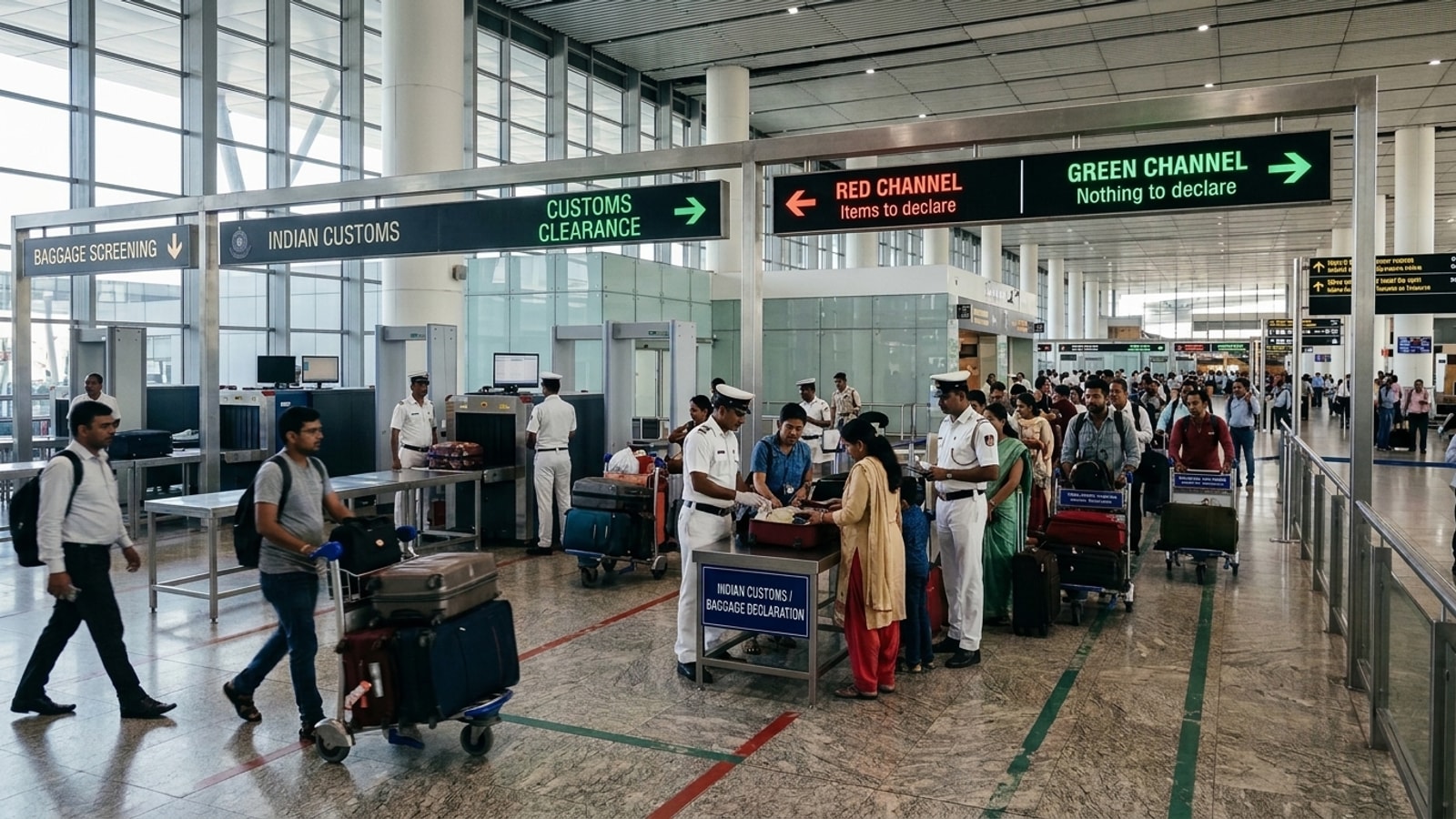
- Green Channel (Nothing to Declare): Permitted only if total overseas purchases fall entirely within the ₹50,000 GFA, alcohol does not exceed 2.0 liters, laptops are limited to one unit, and no prohibited items (such as cured meats or drones) are present.
- Red Channel (Goods to Declare): Mandatory if carrying goods exceeding the ₹50,000 GFA, second laptops, commercial goods, excess alcohol, gold jewellery, or currency exceeding declaration thresholds.
Step 4: Red Channel Assessment and Detention Protocol
- Present your passport, boarding pass, purchase receipts, and ATITHI QR code to the assessment superintendent.
- The officer applies the ₹50,000 GFA deduction to eligible goods and calculates the 38.5% composite duty on the excess value.
- Pay the calculated duty at the nationalized airport bank counter or through approved digital POS terminals (debit/credit card/UPI). Obtain the official customs duty payment receipt (Baggage Receipt).
- Section 80 Detention Receipt: If you carry restricted items (such as a drone or temporary commercial samples) that you do not wish to clear or pay duty on, request detention under Section 80. Customs will issue an official Detention Receipt (DR), storing the item in the airport bonded warehouse until you collect it for re-export upon your next international departure.
Frequently Asked Questions
Can I bring Spanish Jamón Ibérico into India if it is commercially vacuum-sealed?
No. Under Indian Animal Quarantine and Certification Services (AQCS) and DGFT regulations, all personal imports of foreign uncanned meat and pork products are strictly prohibited, regardless of commercial vacuum packaging. Any cured pork or sausage detected during airport X-ray screening will be confiscated and incinerated immediately.
What is the customs duty on an iPhone 16 purchased in Madrid or Barcelona?
Every adult passenger is entitled to a ₹50,000 General Free Allowance (GFA). If an iPhone purchased in Spain costs approximately ₹85,000, the first ₹50,000 is deducted under your GFA (assuming no other dutiable goods are claimed). The remaining balance of ₹35,000 is assessed at 38.5% composite customs duty, resulting in ₹13,475 in payable duty.
How much Spanish wine or Cava can I bring into India duty-free?
Adult passengers (aged 18 and older) are permitted up to 2.0 liters of alcoholic beverages duty-free in their checked baggage. This equates to two standard 750ml bottles (totaling 1.5 liters). If you carry three 750ml bottles (2.25 liters), the excess 250ml cannot be cleared under standard passenger allowances and becomes subject to commercial duties exceeding 360%.
Can my spouse and I combine our ₹50,000 allowances to bring an expensive Spanish luxury watch duty-free?
No. Indian Customs rules explicitly prohibit pooling or combining General Free Allowances across multiple passengers. An individual allowance applies only to goods belonging to and carried by that specific individual. A single item valued at ₹1,00,000 can only receive a single ₹50,000 deduction, leaving the remaining ₹50,000 subject to 38.5% duty.