

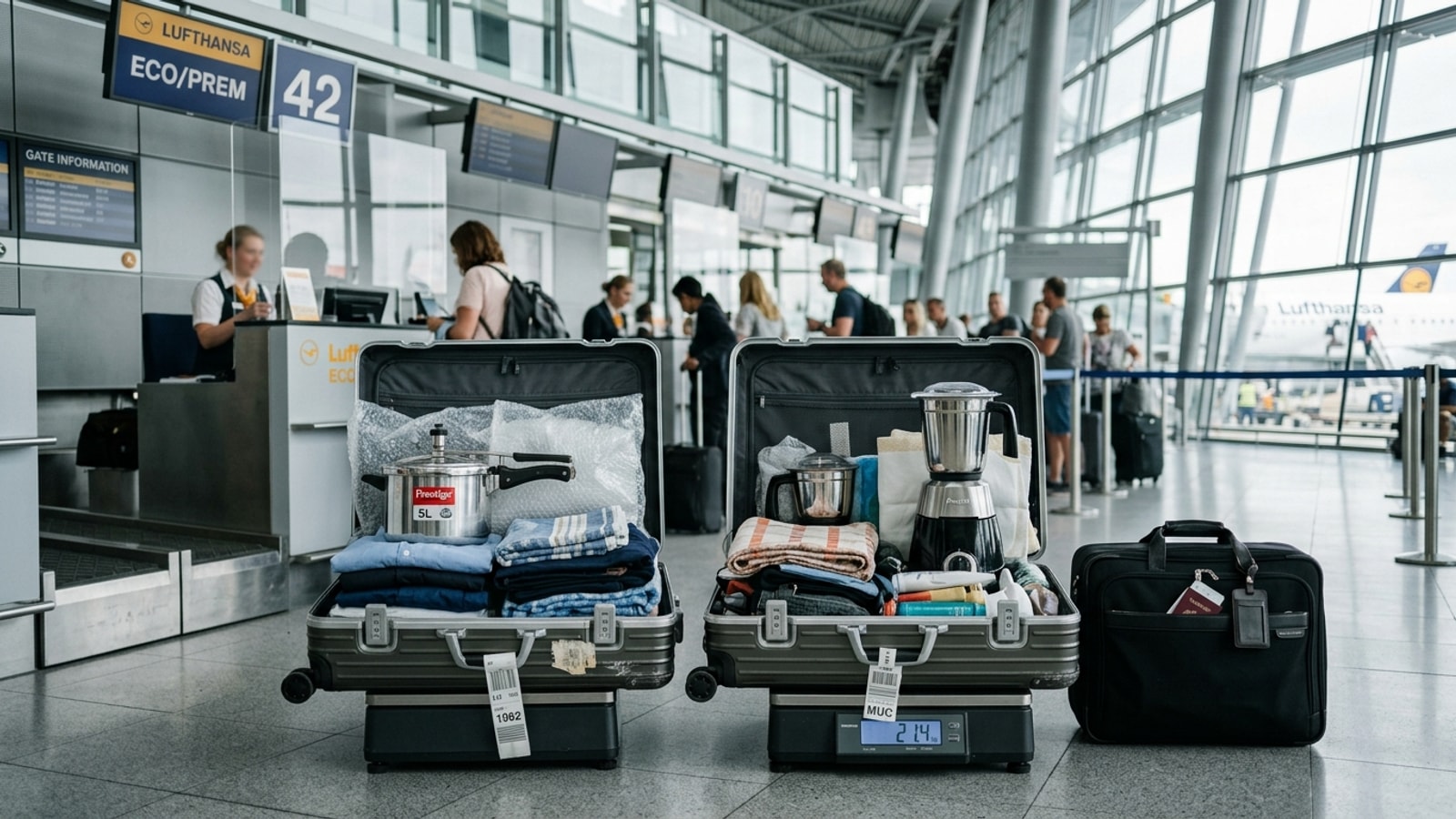
Quick Summary
- Primary Update: Aviation security protocols strictly prohibit pressure cookers, mixer grinder stainless steel jars with blades, and heavy motor units inside passenger aircraft cabins. All primary kitchen appliances must be transported within registered checked baggage.
- Transit Impact: Central Industrial Security Force (CISF) checkpoints at Indian airports confiscate or turn back passengers carrying pressure cookers or mixie jars at the X-ray line. Airlines require passengers to sign a Limited Release Tag (LRT) at check-in, waiving carrier liability for internal mechanical shocks.
- Traveler Advice: Detach pressure cooker vent weights (whistles) and rubber gaskets before packing. Surround mixer grinder bases and jars with three layers of bubble wrap, verify that total bag weight does not exceed the 15 kg domestic limit or 23 kg international slab, and pre-book extra baggage online to avoid airport counter penalties of ₹550 per kilogram.
Transporting kitchen appliances is one of the most frequent logistics challenges for Indian travelers, expatriates, and overseas students relocating abroad. Whether moving to Dubai, London, Toronto, Singapore, or flying domestically between metros like Delhi, Mumbai, and Bengaluru, culinary staples such as Indian mixer grinders (mixies), heavy-gauge pressure cookers, induction cooktops, and electric kettles are routinely packed into travel luggage.
Airport security screening points consistently flag these household devices. Passengers frequently face frustrating delays, bag re-openings, or outright confiscation at Central Industrial Security Force (CISF) security hold areas (SHA) when attempting to carry appliances inside hand luggage.
Aviation safety mandates enforced by the Bureau of Civil Aviation Security (BCAS), the Directorate General of Civil Aviation (DGCA), and the International Civil Aviation Organization (ICAO) apply rigid classifications to electrical appliances, dense metal vessels, and motorized equipment. This guide provides an operational and regulatory breakdown of security restrictions, packaging requirements, airline liability limitations, and baggage fee structures for flying with kitchen appliances in 2026.
BCAS Security Directives: Cabin Prohibitions vs Checked Luggage
Airport screening authorities categorize household kitchen appliances through strict threat assessment filters: potential use as improvised explosive device (IED) enclosures, cutting hazard classification from spinning blades, and radio-opaque visual interference on cabin baggage X-ray monitors.
CABIN HAND LUGGAGE: STRICTLY PROHIBITED      |  CHECKED HOLD LUGGAGE: FULLY PERMITTED
- Pressure Cookers (all metals & capacities) |  - Pressure Cookers (whistle detached)
- Mixer Grinder Jars (fixed steel blades)    |  - Mixer Grinders & Blender Units
- Mixer Grinder Motor Base (heavy magnets)   |  - Induction Cooktops & Hot Plates
- Immersion Heating Rods                     |  - Electric Kettles & Coffee Makers
- Food Processor Discs & Chopper Blades      |  - Air Fryers, Toasters & Microwaves
- Non-detachable Lithium Cordless Blenders   |  - Sandwich Makers & Waffle Irons

SPECIAL REASON: Dense metal shells blind X-ray scanners; blades violate sharp-item
mandates; electromagnetic motor coils present flight deck interference concerns.
1. The Pressure Cooker Cabin Ban Explained
BCAS aviation security circulars explicitly prohibit pressure cookers in passenger cabin baggage across all commercial airports in India.
The rationale is twofold:
- Structural IED Threat Profile: The thick aluminum or stainless steel vessel, locking lid lugs, silicone sealing gasket, and pressure-regulating vent pipe represent the physical anatomy historically associated with improvised explosive devices. Security screeners cannot readily verify hollow metal cavities when packed amidst clothing in hand luggage.
- X-Ray Opacity: The heavy-gauge base of a pressure cooker creates a solid dark silhouette on single-view and dual-view cabin X-ray screening systems. This density blinds the operator from inspecting items positioned behind or underneath the pot, necessitating a physical bag search that causes terminal checkpoint congestion.
Passengers carrying a pressure cooker in hand luggage are turned away at security screening and directed back to the public departures hall to check the item, provided the check-in counters remain open.
2. Mixer Grinders (Mixies) and Blenders: Dual Screening Hazards
Indian mixer grinders present two distinct aviation security violations when placed in carry-on bags:
- Stainless Steel Blades: The blades inside wet grinding, dry grinding, and chutney jars feature honed cutting edges and pointed tips. Under BCAS and IATA dangerous goods frameworks, any fixed or rotating blade is classified as a prohibited sharp weapon inside the passenger cabin.
- Universal Electric Motor Coils: The base unit houses a high-wattage universal electric motor wrapped in dense copper wire coils with permanent magnets. Heavy magnetic assemblies and dense mechanical armatures trigger automated density alarms on cabin X-ray machines.
While some international security agencies allow small motor bases without blades in carry-on luggage, CISF personnel at Indian airports mandate that both the motor base and grinding jars travel exclusively in checked baggage.
3. Induction Stoves, Hot Plates, and Electric Kettles
Induction cooktops feature heavy copper induction coils and ceramic glass surfaces. While not inherently weaponized, their linear dimensions usually exceed the standard cabin baggage sizer frame (55 x 35 x 25 cm). Furthermore, security screeners routinely reject flat electrical heating coils in cabin bags due to wire density. Electric kettles, sandwich makers, and pop-up toasters must also be packed into checked hold luggage.
The Cordless Lithium Blender Paradox
A growing challenge at airport security involves modern cordless personal blenders (such as USB-rechargeable smoothie makers). These devices present a regulatory conflict between two safety rules:
- Lithium-Ion Battery Mandate: International safety regulations require all spare lithium-ion batteries and battery-powered portable electronic devices to travel in cabin baggage to mitigate the risk of cargo-hold battery fires.
- Sharp Objects Prohibition: BCAS and TSA rules strictly ban exposed metal cutting blades from passenger cabins.
If a traveler carries a cordless portable blender where the steel blade is permanently integrated into the battery base, airport security will confiscate the device. The traveler cannot check it into the hold due to the non-removable lithium battery, and cannot carry it into the cabin due to the blade.
Operational Solution: Travelers must purchase modular portable blenders where the blade assembly screws off from the motorized power base. Pack the blade assembly and blending cup inside registered checked baggage, and carry only the motor and lithium battery base in hand luggage.
Appliance Baggage Specifications & Carrier Policies
Major Indian and international carriers enforce specific weight allowances, dimension restrictions, and handling protocols for kitchen appliances checked into aircraft cargo holds.
| Appliance Type | Permitted in Cabin? | Permitted in Checked? | Weight Allowance Impact | Packaging & Handling Requirements |
|---|---|---|---|---|
| Pressure Cooker (3L–10L) | No (100% Banned) | Yes | Counts toward 15kg/23kg slab | Detach whistle and gasket; invert lid into pot; pad with bubble wrap |
| Mixer Grinder Base Unit | No (Security Ban) | Yes | Approx. 3.5kg–5.5kg of allowance | Wrap motor coupling; surround chassis with foam/bubble wrap |
| Mixer Stainless Jars | No (Blade Prohibition) | Yes | Approx. 1.5kg–2.5kg of allowance | Tape lids securely; separate nested jars with corrugated cardboard |
| Induction Cooktop | No (Sizer/X-Ray Ban) | Yes | Approx. 2.0kg–3.5kg of allowance | Original box with styrofoam corners; label with Fragile tag |
| Electric Kettle | No (CISF Restriction) | Yes | Approx. 1.0kg–1.8kg of allowance | Empty water completely; wrap base cord around kettle body |
| Air Fryer / OTG Oven | No (Dimension Limit) | Yes | Approx. 4.5kg–8.0kg of allowance | Must fit within 158cm total linear dimensions (L+W+H) |
| Microwave Oven | No (Dimension Limit) | Yes (Oversize) | Approx. 11.0kg–15.0kg | Requires oversize baggage handling if exceeding linear limits |
| Cordless USB Blender | Base Only (No Blades) | Jars & Blades Only | Minimal (<1.0kg) | Detach blade into check-in; keep battery base in cabin bag |
Carrier Conditions of Carriage & Airline Liability
When checking kitchen appliances, passengers must navigate airline check-in rules regarding delicate electronics and liability waivers.
Limited Release Tags (LRT)
Commercial carriers—including IndiGo, Air India, Akasa Air, SpiceJet, Emirates, Qatar Airways, and Singapore Airlines—classify household electrical appliances as fragile and inherently vulnerable to mechanical stress.
At the baggage drop counter, the customer service agent will attach a Limited Release Tag (LRT) to the luggage containing the appliance. The traveler must sign the back of the LRT, which acknowledges that:
- The item contains fragile electrical or mechanical equipment.
- The outer packaging does not constitute a rigid manufacturer flight case.
- The carrier accepts no financial liability for internal motor displacement, cracked heating elements, chipped plastic chassis, or broken jar handles resulting from normal baggage handling shocks and turbulence.
Carriers remain liable only if the baggage is lost entirely or exhibits catastrophic external crushing caused by ground handling negligence.
Excess Baggage Slabs and Airport Counter Penalties
Kitchen appliances add significant weight to luggage. A standard 750W mixer grinder with three heavy-duty jars weighs between 5.5 kg and 7.5 kg, consuming nearly half of the standard 15 kg domestic check-in allowance.
If a passenger arrives at an Indian airport counter with luggage exceeding the ticketed allowance, airlines charge steep on-the-spot excess fees:
- IndiGo, Akasa Air, SpiceJet: Standard airport counter rate is ₹550 per excess kilogram plus applicable Goods and Services Tax (GST).
- Air India Domestic: ₹550 per excess kilogram plus GST on standard economy fares.
- Pre-Booking Advantage: Passengers who anticipate exceeding weight limits should purchase prepaid baggage online via the airline app at least two hours before departure. Pre-booked 5 kg slabs cost approximately ₹1,900 to ₹2,250, saving up to 35% compared to airport counter penalty rates.
Safe Packaging Protocol: Preventing Cargo-Hold Transit Damage
Luggage traveling in commercial aircraft holds undergoes rapid shifts in ambient pressure, sub-zero cargo hold temperatures, and substantial physical impacts during automated belt conveyor routing and ramp loading. To prevent appliance destruction, travelers should execute the following packing sequence:
1. DISASSEMBLE     | Remove pressure cooker whistles, gaskets, and blender blades.
2. TAPE COUPLINGS  | Secure the rubber/nylon drive teeth on the mixer motor top.
3. BUBBLE WRAP     | Apply 3 layers of 10mm bubble wrap around motor base & jars.
4. NESTED PACKING  | Place jars inside heavy clothing in center of a hard suitcase.
5. INVERT LIDS     | Invert pressure cooker lid inside body to protect handle joints.
6. EXTERNAL LABEL  | Request FRAGILE stickers at check-in; verify bag zipper locks.
Pressure Cooker Packing Architecture
- Remove Vent Weight: Unscrew or detach the pressure regulator weight (whistle). Wrap it in tissue or a small plastic pouch and place it inside the cooker body.
- Remove Rubber Gasket: Detach the rubber or silicone sealing ring. If left installed on an inverted lid under compression, it can deform permanently, destroying the airtight seal.
- Invert Lid: Turn the lid upside down so the handle rests inside the pot cavity rather than protruding outward. Cushion the contact point with a kitchen towel to prevent metal scratching.
- Fill Internal Void: Fill the empty hollow of the pressure cooker with soft clothing, socks, or spice packets to maximize space utilization and provide internal structural rigidity against external crushing.
Mixer Grinder Packing Architecture
- Protect Drive Coupler: The most vulnerable component of a mixer grinder is the plastic or hard-rubber drive teeth coupling located on top of the motor base. Cut a small piece of foam or cardboard and tape it over the coupler to prevent shearing forces from snapping the teeth.
- Double-Box or Hard Shell Luggage: Pack the motor base inside a hard-shell polycarbonate or polypropylene suitcase. Position the heavy motor in the center of the suitcase between layers of jeans, jackets, or towels. Never place a heavy motor against the outer zipper or thin fabric walls of soft duffel bags.
- Jar Separation: Never pack stainless steel jars stacked directly inside one another without padding. Metal-on-metal friction during flight vibrations creates deep surface scratches and can warp jar bases. Insert bubble wrap sheets between nested containers.
- Lid Security: Secure plastic jar lids and rubber gaskets with painters tape or cling wrap so they do not dislodge and crack inside the suitcase.
Traveler Logistics Guide
To ensure smooth transit through security and baggage handling checkpoints, adhere to this operational step-by-step checklist.
Departure Airport Check-in Protocol
- Check Weight at Home: Weigh your suitcase with the packed appliance on a digital luggage scale before leaving for the airport.
- Pre-Book Excess Slabs: If total baggage exceeds 15 kg (domestic) or 23 kg/32 kg (international), buy a prepaid excess baggage voucher on the airline website at least 2 hours prior to scheduled departure.
- Declare at Counter: Inform the check-in agent that your suitcase contains a packaged kitchen appliance (e.g., "Contains a boxed mixer grinder").
- Sign Limited Release Tag: Review and sign the LRT attached to your baggage handle, ensuring you retain the baggage receipt barcode sticker.
- Request Fragile Handling: Ask the counter agent to affix bright red "Fragile / Handle With Care" stickers to all sides of the suitcase.
- Inspect Zippers and Straps: Ensure heavy suitcases are locked with TSA-approved locks or reinforced luggage straps to prevent zipper bursts on airport conveyor belts.
Security Checkpoint Contingency Plan
- Hand Luggage Audit: Double-check that no spare blades, knives, vegetable peelers, or pressure cooker whistles remain in your backpack or cabin trolley.
- Immediate Counter Return: If you mistakenly brought an appliance to the CISF security checkpoint in hand luggage, inform the screening officer immediately. Request permission to exit the security area back to the departure hall check-in desk before your flight's gate closure cutoff (typically 45 minutes prior to domestic departures).
Frequently Asked Questions
Can I carry a pressure cooker in my cabin handbag if the whistle is removed?
No. Bureau of Civil Aviation Security (BCAS) circulars prohibit pressure cookers in cabin baggage regardless of whether the whistle or lid is attached. The metal vessel itself is classified as an opaque security obstruction and potential IED casing threat. Pressure cookers must be transported exclusively in checked baggage.
Is a mixer grinder allowed in Air India or IndiGo checked luggage?
Yes. Both Air India and IndiGo permit mixer grinders, blenders, and food processors in checked baggage. The appliance weight counts toward your standard baggage allowance (15 kg on domestic flights; 23 kg to 32 kg on international itineraries). You will be required to sign a Limited Release Tag at check-in waiving airline liability for internal mechanical damage.
Can I carry an electric kettle or induction cooktop in cabin luggage?
Generally no. While electric kettles and small induction plates do not feature sharp blades, airport security screeners (CISF in India, TSA in the United States) routinely reject them at cabin X-ray checkpoints due to dense heating coils, internal wiring, and size limitations. Pack all cooking plates, kettles, toasters, and sandwich makers in checked luggage.
What happens if I pack a portable rechargeable blender in checked luggage?
If the portable blender contains a non-removable rechargeable lithium-ion battery, airport baggage screening systems will flag your suitcase. Security personnel will open the bag and remove the blender because lithium batteries are barred from aircraft cargo holds due to fire safety mandates. To transport a portable blender, detach the blade cup into checked baggage, and carry the motorized battery base in your cabin hand luggage.