

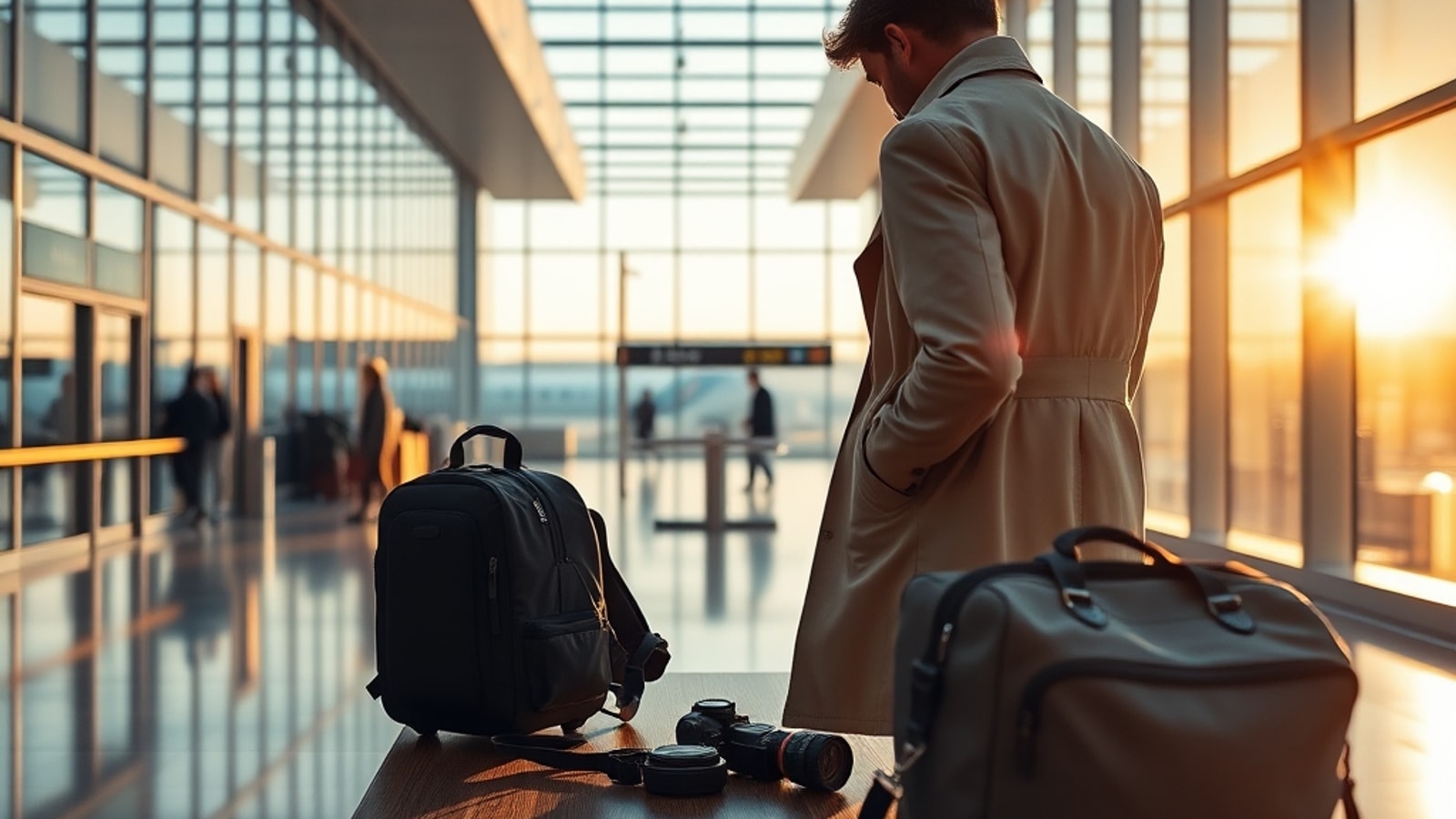
Quick Summary
- Primary Update: Aviation security authorities including the Bureau of Civil Aviation Security (BCAS), TSA, and IATA enforce strict cabin-only carriage mandates for all spare lithium-ion camera batteries, while airline contracts of carriage explicitly disclaim financial liability for fragile optical glass and camera bodies placed in checked hold luggage.
- Transit Impact: Professional camera backpacks and equipment hard cases must fit within standard 7kg cabin baggage limits (55 x 35 x 25 cm) or airline personal item allowances; passengers face baggage gate-check pressure on regional aircraft and strict battery removal orders if forced to gate-check bags.
- Traveler Advice: Always pack camera bodies, expensive lenses, and all spare batteries in a dedicated cabin carry-on; insulate battery terminals to prevent short circuits, carry proof of prior purchase or Indian Customs export certificates for expensive setups, and never place unsealed sensor cleaning solvents in hand luggage.
Traveling with high-end photography gear—ranging from professional DSLR and mirrorless camera bodies to long telephoto primes, cine rigs, and delicate optical elements—involves navigating a strict web of aviation security screening protocols, dangerous goods safety mandates, and rigid airline carry-on allowances. Whether boarding an IndiGo domestic flight in Delhi, connecting to an Emirates international service in Dubai, or transiting Singapore Changi on Singapore Airlines, photographers frequently encounter conflicting advice regarding where camera equipment belongs, how batteries are treated, and how airline gate agents evaluate dedicated camera backpacks.
Understanding the operational boundaries established by the Bureau of Civil Aviation Security (BCAS) in India, the International Air Transport Association (IATA), and civil aviation authorities worldwide prevents equipment damage, baggage gate disputes, and checkpoint confiscations.
Cabin vs Checked Baggage: The Liability and Fragility Reality
A primary operational rule for photographers is simple: camera bodies, optical lenses, and electronic accessories should never be placed in checked luggage.
This directive stems from two structural realities of commercial air travel: mechanical handling hazards and legal liability caps.
                    ┌──────────────────────────────────────────────┐
                    │      PHOTOGRAPHY GEAR TRANSIT MATRIX         │
                    └──────────────────────────────────────────────┘
                                                                   │
         ┌─────────────────────────────────┴─────────────────────────────────┐
         ▼                                                                   ▼
┌─────────────────────────────────┐                         ┌─────────────────────────────────┐
│          CABIN BAGGAGE          │                         │         CHECKED BAGGAGE         │
├─────────────────────────────────┤                         ├─────────────────────────────────┤
│ • DSLR & Mirrorless Bodies      │                         │ • Heavy studio light stands     │
│ • Prime & Telephoto Lenses      │                         │ • Tripods & fluid heads (empty) │
│ • ALL Spare Lithium Batteries   │                         │ • Empty hard cases / Pelican    │
│ • Memory cards & hard drives    │                         │ • Non-battery brackets & plates │
│ • Sensitive optical filters     │                         │      │
│ ⚠️ Subject to 7kg-10kg limit    │                         │ ⚠️ Airline liability excluded   │
│ ⚠️ Terminals taped/insulated    │                         │ ❌ NO spare lithium batteries   │
└─────────────────────────────────┘                         └─────────────────────────────────┘
Airline Liability Exclusions Under the Montreal Convention
Under the Carriage by Air Act and the international Montreal Convention (1999), airline financial liability for lost, damaged, or delayed checked baggage is strictly limited to 1,288 Special Drawing Rights (SDR)—equivalent to approximately ₹1,45,000 to ₹1,50,000 (or roughly $1,700 USD) per passenger. In domestic Indian aviation governed by the Directorate General of Civil Aviation (DGCA) Passenger Charter, airline statutory compensation caps out at ₹20,000 for lost checked baggage unless a higher value was declared at check-in and an extra valuation fee paid.
Every major scheduled airline explicitly excludes fragile items, optical equipment, cameras, lenses, and sensitive electronics from liability in its Conditions of Carriage:
- IndiGo Conditions of Carriage: Excludes fragile items, electronics, and optical gear from checked baggage liability; damages sustained in hold transit remain the passenger's sole financial risk.
- Air India Domestic & International Rules: Advises passengers to keep cameras, photographic optics, and jewelry exclusively in hand luggage.
- Emirates & Singapore Airlines: Exclude delicate electronic systems and optical glassware from checked luggage damage claims.
Mechanical Shock and Atmospheric Pressurization
Baggage conveyor belts, automated sorting chutes, ramp transfer tractors, and baggage-hold cargo handlers subject luggage to substantial mechanical impact and drop forces exceeding 1.5 meters. Delicate lens aperture mechanisms, internal autofocus motors, optical image stabilization (OIS) gyro bearings, and sensor-shift assemblies can easily suffer calibration displacement or structural glass fracturing under rough baggage handling. Furthermore, while aircraft cargo holds are pressurized, temperature fluctuations in unheated cargo compartments during multi-hour high-altitude cruising can induce condensation on internal lens glass elements upon descent into humid climates.
Lithium-Ion Battery Rules: BCAS, IATA, and Airline Mandates
The regulation of lithium-ion camera batteries is governed by IATA Dangerous Goods Regulations (DGR Table 2.3.A) and BCAS safety circulars. Lithium-ion chemistries present an inherent thermal runaway risk if punctured, crushed, or internally short-circuited, making their management at airport security uncompromising.
Battery Type & Watt-Hours (Wh) │ Cabin Allowance      │ Checked Allowance    │ Airline Approval Needed

Installed in Camera Body       │ Allowed              │ Allowed (Turned OFF) │ No
(< 100 Wh, e.g. LP-E6, NP-FZ)  │                      │                      │

Spare Standard Camera Battery  │ Allowed (Reasonable  │ STRICTLY BANNED      │ No
(< 100 Wh, e.g. EN-EL15, BLX-1)│ personal quantities) │                      │

Medium Cine / V-Mount Pack     │ Allowed (Max 2       │ STRICTLY BANNED      │ YES (Airline pre-flight
(100 Wh to 160 Wh)             │ spare packs)         │                      │ authorization required)

Large Production Battery Pack  │ STRICTLY BANNED      │ STRICTLY BANNED      │ Forbidden on passenger
(> 160 Wh)                     │                      │                      │ aircraft (Cargo only)
Installed vs Spare Battery Rules
- Battery Inside Camera Body: A battery properly seated inside a camera body is classified as "Lithium-Ion Batteries Contained in Equipment." It is permitted in cabin baggage. While technically permitted in checked luggage under ICAO/IATA rules provided the camera is completely switched off (not in sleep or standby mode) and protected from accidental activation, airlines and BCAS strongly demand that all cameras remain in cabin baggage.
- Spare Camera Batteries: Any camera battery detached from the camera body (such as spare Canon LP-E6NH, Sony NP-FZ100, Nikon EN-EL15c, or Fujifilm NP-W235 packs) is classified as a "Spare Lithium-Ion Battery." Spare lithium batteries are strictly prohibited in checked baggage worldwide. If CISF baggage screeners at Indian airports or automated baggage inline-screening systems detect spare lithium packs in checked luggage, the bag is flagged, opened, the batteries confiscated, or the luggage offloaded entirely.
Calculating Watt-Hours (Wh) on Camera Batteries
IATA and airline safety limits are based on Watt-hours (Wh), not milliampere-hours (mAh). To calculate Watt-hours:
$$\text{Watt-hours (Wh)} = \frac{\text{Milliampere-hours (mAh)} \times \text{Voltage (V)}}{1000}$$
Standard consumer and professional camera batteries operate well below the 100Wh threshold:
- Sony NP-FZ100: 7.2V $\times$ 2,280 mAh = 16.4 Wh
- Canon LP-E6NH: 7.2V $\times$ 2,130 mAh = 15.3 Wh
- Nikon EN-EL15c: 7.0V $\times$ 2,280 mAh = 16.0 Wh
Because standard camera batteries fall in the 14Wh to 18Wh range, individual travelers are permitted to carry a reasonable quantity for personal use (typically up to 4–6 spare batteries) in their cabin baggage without airline pre-approval.
High-Capacity V-Mount and Gold-Mount Cine Batteries
Videographers flying with professional cinema cameras (RED, ARRI, Blackmagic, Sony FX6/FX9) utilizing V-Mount or Gold-Mount batteries must observe specific tiers:
- Under 100 Wh (e.g., 98Wh micro-packs): Permitted in cabin baggage in reasonable numbers without formal airline approval.
- Between 100 Wh and 160 Wh: Limited to a strict maximum of two spare batteries per passenger, and requires explicit airline prior notification or counter approval at check-in.
- Exceeding 160 Wh: Strictly forbidden from carriage aboard passenger aircraft under IATA DGR and BCAS directives; these must be shipped via certified dangerous goods cargo.
Mandatory Terminal Short-Circuit Protection
BCAS and airport security personnel require that all spare lithium-ion batteries have their electrical contacts protected against short-circuiting. Passengers must transport spare camera batteries in one of three ways:
- Inside the manufacturer's plastic terminal protective snap cover;
- Packed in individual insulated plastic battery cases or heavy-duty ziplock pouches; or
- With non-conductive electrical insulating tape wrapped securely over the metal contact pins.
Airline Cabin Sizer Limits and Camera Backpacks
A frequent operational friction point occurs at the boarding gate, where airline ground staff enforce carry-on baggage dimensions and weight restrictions.
Airline                  │ Main Cabin Bag Allowance    │ Personal Item Allowance  │ Gate Sizer Enforcement

IndiGo                   │ 1 Piece, 7 kg               │ 1 Small Handbag / Laptop │ Strict gate scales;
                         │ (55 x 35 x 25 cm)           │ bag (up to 3 kg)         │ combined weighing common

Air India                │ 1 Piece, 7 kg (Economy) /   │ 1 Personal Item          │ Sizer boxes at check-in;
                         │ 12 kg (Business / First)    │ (fits under front seat)  │ cabin weight monitored

Emirates                 │ 1 Piece, 7 kg (Economy) /   │ 1 Briefcase or garment   │ Strict weighing on full
                         │ 2 Pieces, 7 kg each (Prem)  │ bag in Business / First  │ flights; sizer audits

Singapore Airlines       │ 1 Piece, 7 kg (Economy) /   │ 1 Small item             │ Strict 7kg audit at
                         │ 2 Pieces, 7 kg each (Prem)  │ (40 x 30 x 10 cm)        │ Changi boarding gates

Qatar Airways            │ 1 Piece, 7 kg (Economy) /   │ Handbag or small case    │ Scales at Hamad Int'l
                         │ 2 Pieces, 15 kg (Business)  │ (fits under front seat)  │ transit boarding gates
Dedicated Camera Bags: Carry-On vs Personal Item
Most popular camera backpacks—such as the Peak Design Everyday Backpack (20L/30L), Lowepro ProTactic 450 AW, Shimoda Action X30/X50, and Wandrd PRVKE 31—are designed to fit within the international IATA cabin dimensions of 55 $\times$ 35 $\times$ 25 cm.
However, when loaded with two camera bodies, three f/2.8 zoom lenses, a laptop, and accessories, these bags frequently weigh between 9 kg and 14 kg, exceeding the universal 7kg economy cabin limit enforced across Indian and Asian low-cost and full-service carriers.
To manage this restriction:
- Camera Slings & Holsters as Personal Items: A compact camera holster or sling bag (5L to 10L holding one body and an attached lens) qualifies under most airline policies as a personal item, which must fit under the seat in front of you.
- Heavy Lenses Around the Neck: When airline staff weigh carry-on backpacks at check-in or boarding gates, cameras worn around the neck with a strap are generally treated as personal attire and excluded from the bag's scale weight, provided the passenger safely stows the camera under the seat once aboard.
- Photographer's Vests and Jackets: Heavy lens bodies placed in specialized utility jacket pockets avoid baggage scales legally, as wearable apparel is not subject to scale limits.
Regional Turboprop Aircraft Hazards (ATR 72 and Q400)
Passengers flying on regional routes—such as flights to Leh, Dharamshala, Dehradun, or island sectors operated by ATR 72-600 or Bombardier Q400 turboprops—face severely restricted overhead bin dimensions (often narrower than 45 $\times$ 30 $\times$ 20 cm).
On these flights, ramp staff routinely mandate "gate-checking" (Delivery at Aircraft Side or Ramp Bag Drop). Never surrender a camera backpack with spare lithium batteries into the aircraft hold. If gate-check is unavoidable due to bin physical constraints:
- Inform the airline supervisor immediately that the bag contains optical equipment and lithium batteries.
- Remove all camera bodies, lenses, and batteries into an ultra-compact packable tote bag to keep at your feet.
- Allow only the empty padded backpack shell and non-battery cables to enter the hold.
Airport Security Checkpoint Protocols and Scanner Safety
Security procedures at airport screening gates can introduce anxiety regarding delicate electronic sensors and optical elements.
Camera Bodies (DSLR / Mirrorless)            │ Remove from bag into separate tray at traditional 2D
                                             │ X-ray lanes (CISF / TSA); can remain in bag in 3D CT.

Detached Lenses                              │ Large telephotos (70-200mm+) require separate trays
                                             │ due to dense glass optical elements blocking X-rays.

Digital Camera Sensors (CMOS / CCD)          │ 100% immune to X-ray and CT radiation damage; no
                                             │ degradation of digital sensor components occurs.

Photographic Film (Unexposed)                │ Vulnerable to CT scanners and high-ISO (>800) X-rays;
                                             │ always request manual physical hand-inspection.

Sensor Cleaning Liquid & Swabs               │ Liquids must be $\le$ 100ml in transparent 1-liter bag;
                                             │ highly flammable pure ethanol/ether bases prohibited.
Traditional 2D X-Ray vs Modern 3D CT Scanners
At standard CISF security checkpoints across India (e.g., Delhi T1/T2, Mumbai T1, Chennai, Kolkata), passengers must unpack all electronics larger than a standard smartphone. Place camera bodies and large detached lenses into separate plastic trays alongside laptops. High-density optical glass arrays in professional telephoto lenses can obscure items beneath them on X-ray screens, prompting screeners to order physical bag opening if left packed.
At terminals equipped with modern Computed Tomography (CT) 3D baggage scanners (such as Bengaluru T2, London Heathrow, or Amsterdam Schiphol), electronics and liquids can typically remain inside the backpack unless security personnel specify otherwise.
Do Airport Scanners Damage Digital Camera Sensors?
A persistent myth among photographers suggests that airport baggage X-ray machines damage digital camera sensors or cause dead pixels. This is factually incorrect.
Digital sensors (CMOS and CCD) are solid-state silicon semiconductors. The low-dose ionizing radiation utilized in standard aviation baggage scanners and CT scanners does not alter silicon crystal lattices or degrade sensor pixel performance. Similarly, flash memory storage media (SD, CFexpress, microSD) and solid-state drives (SSDs) are entirely unaffected by airport security X-rays.
Traditional Photographic Film Precautions
While digital sensors are immune, unexposed photographic film is highly sensitive to airport scanners.
- Traditional 2D Cabin X-Rays: Film rated ISO 400 or lower can generally tolerate one or two passes through low-dose cabin scanners without noticeable fogging. High-speed films (ISO 800, 1600, 3200) will suffer visible banding and base fog.
- Modern 3D CT Scanners: CT scanners emit significantly higher, multi-angle radiation doses that can ruin unexposed and exposed film in a single pass, regardless of ISO rating.
- Hand-Inspection Protocol: Always store film in a clear, transparent ziplock bag separate from your main luggage. Present it to CISF or TSA officers at the walk-through gate and politely request a manual physical inspection ("hand-check") to avoid the X-ray machine. Never place photographic film in checked luggage, where high-penetration hold scanners will destroy it.
Sensor Cleaning Solvents and Aerosols
Sensor cleaning liquids contain solvents such as high-purity isopropyl alcohol or methanol.
- Liquid Rules (LAGs): Sensor cleaning bottles are generally 10ml to 30ml, fitting comfortably under the 100ml single-container rule. They must be placed within your transparent, resealable 1-liter plastic liquids bag.
- Flammability Restrictions: Solvents with flashpoints below 60°C are classified as Class 3 flammable liquids. Small personal sensor cleaning solutions under 100ml are widely accepted, but large bottles of industrial isopropyl alcohol or pressurized aerosol canned air dusters are strictly prohibited in cabin baggage and hold luggage under IATA dangerous goods regulations. Use manual rubber rocket blowers instead of compressed air cans.
Traveler Logistics Guide
Navigating domestic and international terminals with expensive photography setups requires systematic operational discipline. Follow this practical checklist:
Indian Customs Export Certificate for Photography Gear
Indian residents traveling abroad with expensive, imported photography equipment (e.g., Sony A1, Canon EOS R5 Mark II, Leica, or premium telephoto lenses) frequently encounter scrutiny at the Red/Green Channels upon return. Indian Customs officials may suspect that high-value cameras were purchased abroad without paying basic customs duties (typically 38.5% on imported personal consumer electronics).
To ensure complete customs clearance without harassment:
- Locate the Customs Duty Counter at Departure: Before passing through immigration at major Indian airports (Delhi T3, Mumbai T2, Bengaluru T2), proceed to the Customs Baggage Office in the departure hall.
- Present Equipment and Invoices: Present your camera bodies, lenses, original purchase invoices (showing GST paid in India), and passport.
- Obtain an Export Certificate: Customs officers will verify the physical serial numbers engraved on your bodies and lenses and issue a signed and stamped Export Certificate.
- Smooth Arrival Clearance: When returning to India, walk through the Green Channel. If stopped by customs screeners, produce the stamped Export Certificate to verify prior domestic ownership.
Frequently Asked Questions
Can I carry a dedicated camera backpack as an extra personal item alongside my 7kg cabin suitcase on IndiGo or Air India?
On standard economy bookings with Indian domestic carriers like IndiGo, SpiceJet, and Akasa Air, the baggage allowance includes one main cabin bag (up to 7 kg) plus one small personal item (such as a laptop bag, small handbag, or compact camera holster) not exceeding 3 kg that must fit under the seat in front of you. A large, full-sized camera backpack (20L to 35L) will be treated as your primary cabin bag, not a secondary personal item. If you carry both a rollaboard suitcase and a full camera backpack, gate agents will require one bag to be checked, incurring excess baggage or gate-check fees. Full-service carriers on international flights (e.g., Emirates, Singapore Airlines, Qatar Airways) adhere to similar rules in Economy, though Business Class tickets permit two full cabin pieces.
Are spare DSLR or mirrorless camera batteries permitted in checked luggage if the terminals are taped?
No. Under BCAS circulars, FAA guidelines, and IATA Dangerous Goods Regulations (DGR Table 2.3.A), all spare lithium-ion batteries are strictly prohibited in checked baggage under all circumstances, regardless of whether the terminals are taped or packed in individual pouches. Taping terminals and using protective cases is a mandatory requirement for carrying them safely inside your cabin baggage. Any checked suitcase found containing spare lithium camera batteries during inline X-ray screening will be flagged for security inspection, and the batteries will be removed and confiscated.
Will airport X-ray or CT security scanners damage digital camera sensors or corrupt memory cards?
No. Digital camera image sensors (both CMOS and CCD technologies) and solid-state flash memory media (SD, CFexpress, microSD cards, and external SSDs) are completely impervious to the radiation dosages utilized in aviation passenger checkpoint scanners. Decades of technical testing confirm that neither traditional 2D baggage X-ray machines nor modern high-intensity 3D Computed Tomography (CT) scanners cause dead pixels, sensor degradation, or digital data corruption. However, traditional unexposed photographic film is highly vulnerable to radiation fogging (particularly in CT scanners) and should always be submitted for physical hand-inspection.
What should I do if an airline gate agent insists on gate-checking my camera bag on a full or regional flight?
Never surrender an intact camera backpack containing sensitive optics and lithium batteries to ground handlers at the aircraft door. Politely explain to the gate supervisor that the bag contains fragile professional optical gear explicitly excluded from airline baggage liability under their Conditions of Carriage, along with lithium-ion batteries that are legally prohibited from the cargo hold under BCAS and IATA dangerous goods mandates. If physical overhead bin space is genuinely unavailable (such as on smaller ATR 72 or Q400 aircraft), deploy a packable nylon tote bag, immediately transfer your camera bodies, lenses, and batteries into the tote to keep beneath the seat at your feet, and allow only the empty padded backpack shell to be checked into the hold.