

Quick Summary
- Primary Update: Commercial airlines enforce two fundamentally different hand luggage systems in 2026: carriers operating separate weight allowances (such as IndiGo, Air India, and Singapore Airlines, which permit a 7kg overhead trolley plus a distinct 3kg personal laptop bag) versus budget operators enforcing strict combined weight ceilings (including VietJet and AirAsia, where the overhead bag and under-seat backpack together must not exceed 7kg total).
- Transit Impact: Overpacked backpacks exceeding under-seat dimensional thresholds (typically 40 x 30 x 10 cm or 40 x 30 x 15 cm) fail gate sizer checks and are reclassified as secondary overhead pieces. Non-compliant travelers face gate penalty fees ranging from ₹550 per kg domestically up to $50 to $70 (₹4,200 to ₹5,800) per piece on international routes.
- Traveler Advice: When flying with both a roller suitcase and a backpack, verify whether your carrier enforces a combined or separate weight ceiling. Ensure the backpack is compressible and fits under the forward seat. Always pack power banks, laptops, and travel documents in the personal item so that if your trolley is gate-checked into the cargo hold, your lithium batteries remain safely in the passenger cabin.
Primary Overhead Bag vs. Under-Seat Personal Item
The modern aircraft passenger cabin is governed by rigid physical geometry. High-density single-aisle jets such as the Airbus A320neo and Boeing 737 MAX seat between 180 and 232 passengers, yet their standard overhead stowage bins can accommodate approximately 100 to 120 rollaboard suitcases placed wheels-first. To prevent gate delays and dangerous cabin congestion, international aviation regulators and airline ground operations partition hand luggage into two distinct operational classes:
- The Primary Carry-On Bag: Designed exclusively for the overhead storage bin. This item is typically a 20-inch to 22-inch rolling trolley suitcase, a large duffel, or an expedition-grade backpack measuring up to 55 x 35 x 25 cm (or 115 linear centimeters) and weighing between 7kg and 10kg depending on the fare tier.
- The Personal Item: Designed strictly to slide underneath the passenger seat directly in front of you. Acceptable items include a slim laptop bag, a compact daypack, a handbag, or a small briefcase measuring no more than 40 x 30 x 10 cm (or up to 40 x 30 x 15 cm on select long-haul carriers), with weight allowances capped between 1.5kg and 5kg.
[ OVERHEAD LOCKER BIN ]  <=== Primary Carry-On Bag
                              - Max: 55 x 35 x 25 cm (115 linear cm)
                              - Weight: 7kg (LCCs) to 10kg/23kg
                              - Hard-shell trolleys, duffels, large packs

[ PASSENGER SEAT ]

[ UNDER-SEAT SPACE ]    <=== Secondary Personal Item
                              - Max: 40 x 30 x 10 cm to 40 x 30 x 15 cm
                              - Weight: 3kg to 5kg (or zero if combined)
                              - Slim laptop bags, small backpacks, totes
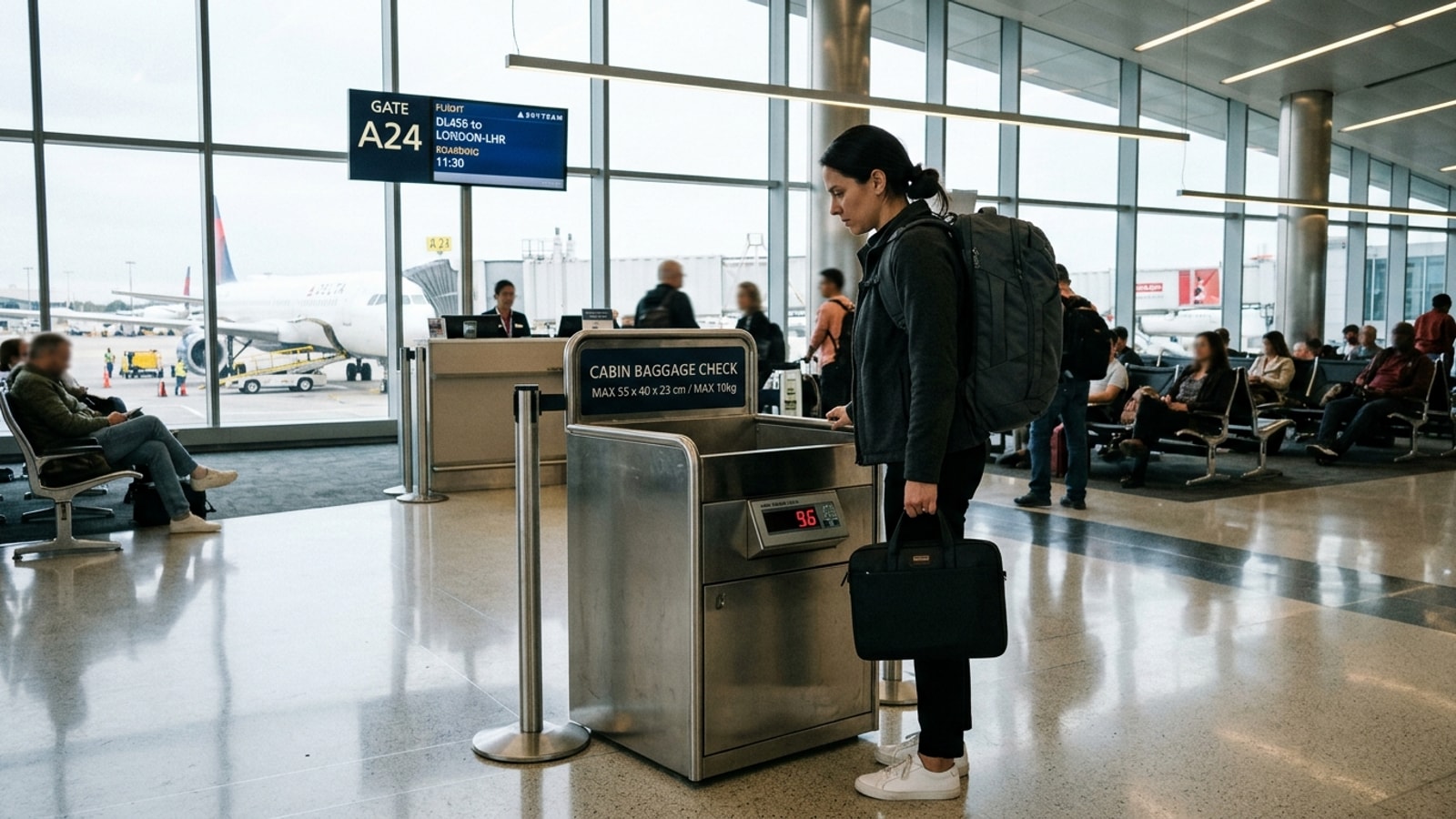
A frequent flashpoint occurs when a passenger attempts to board with both a standard rollaboard suitcase and a full-sized 30-liter to 40-liter backpack. Ground agents at departure gates assess luggage visually before scanning boarding passes. If a backpack cannot slide easily into the under-seat space without obstructing the passenger's legs or extending into the emergency egress path, ground crews will immediately deem it a second overhead bag, triggering mandatory baggage fees or cargo hold consignment.
The Operational Divide: Separate Allowance vs. Strict Combined Weight
Air travelers frequently assume that because IndiGo or Air India permits a laptop bag in addition to a 7kg suitcase, the same rule applies universally on international budget flights. This assumption leads to severe gate penalties. Airlines worldwide adhere to one of three distinct regulatory models:
1. The Two-Piece Separate Allowance Model
Common among Indian domestic airlines and premier international full-service carriers, this policy grants two distinct, unlinked weight quotas:
- IndiGo, Air India, and Akasa Air: Permit one 7kg cabin bag (55 x 35 x 25 cm) for the overhead bin, plus one personal item (laptop bag, handbag, or small backpack) weighing up to 3kg that fits under the seat. Passengers effectively carry up to 10kg of cabin baggage across two items without incurring excess fees, provided neither individual piece exceeds its assigned ceiling.
- Singapore Airlines: Grants Economy passengers one 7kg overhead bag (sum of length, width, and height not exceeding 115 cm) plus one free personal item (max 40 x 30 x 10 cm, up to 3kg) that must fit beneath the forward seat.
- British Airways: Offers the world's most generous commercial cabin baggage policy, allowing one main carry-on suitcase up to 23kg (56 x 45 x 25 cm) plus one laptop bag or handbag up to 23kg (40 x 30 x 15 cm), both included in basic fares.
2. The Strict Combined Weight Model
Standard among Southeast Asian ultra-low-cost carriers (ULCCs) and select regional discount airlines, this framework allows two physical pieces but enforces a single combined weight cap:
- VietJet Air: Permits one primary hand luggage piece (56 x 36 x 23 cm) and one small personal item (40 x 30 x 20 cm), but the total combined weight of both items cannot exceed 7kg. If a traveler carries a 6kg rollaboard and a 3kg laptop backpack, the combined weight is 9kg, resulting in an immediate 2kg excess charge or mandatory hold check at the boarding gate.
- AirAsia: Enforces an identical combined policy. Passengers may carry one cabin bag (56 x 36 x 23 cm) and one small bag (40 x 30 x 10 cm), with the combined weight strictly capped at 7kg. AirAsia offers an "Xtra Carry-on" add-on on select routes permitting up to 14kg combined across two pieces, which must be purchased prior to airport check-in.
- Scoot: Permits two pieces (one cabin bag up to 54 x 38 x 23 cm and one personal item up to 40 x 30 x 10 cm) with a combined weight allowance of 10kg in Economy Class, or 15kg in ScootPlus.
3. The Single-Piece Economy Restriction Model
Select international legacy carriers restrict baseline Economy passengers to a single piece of cabin baggage:
- Emirates: Economy Class passengers are permitted only one piece of carry-on baggage, weighing up to 7kg with dimensions capped at 55 x 38 x 20 cm. Published fare conditions do not grant a separate laptop bag or personal item allowance for Economy tickets. While gate agents at Dubai International Airport (DXB) frequently permit small duty-free purchases or ultra-slim sleeves, boarding with both a rolling suitcase and a separate stuffed backpack breaches Emirates rules and invites gate interception. Premium Economy passengers receive one 10kg piece, while Business and First Class travelers receive two 7kg pieces (a briefcase plus a handbag or garment bag).
Major Airline Cabin Baggage Comparison Matrix
The table below outlines cabin allowances, personal item specifications, weight calculation methods, and gate check penalties across high-volume domestic and international carriers.
| Airline | Overhead Carry-On Allowance | Personal Item / Laptop Allowance | Weight Structure | Can a Backpack Be Personal Item? | Gate Penalty Fee (Overweight / Second Bag) |
|---|---|---|---|---|---|
| IndiGo | 1 pc, 7kg (55 x 35 x 25 cm) | 1 pc, 3kg (under-seat fit) | Separate (10kg total) | Yes, if under 15L & fits under seat | ₹550/kg excess; ₹1,500 gate-check |
| Air India | 1 pc, 7kg (55 x 35 x 25 cm) | 1 pc, 3kg (40 x 30 x 10 cm) | Separate (10kg total) | Yes, slim laptop pack only | ₹550/kg domestic; $15–$30/kg intl |
| Akasa Air | 1 pc, 7kg (55 x 35 x 25 cm) | 1 pc, 3kg (40 x 30 x 10 cm) | Separate (10kg total) | Yes, under-seat fit mandatory | ₹550/kg excess; ₹1,500 gate-check |
| SpiceJet | 1 pc, 7kg (55 x 35 x 25 cm) | 1 pc, 3kg (under-seat fit) | Separate (10kg total) | Yes, small soft-sided pack | ₹550/kg excess; ₹1,500 gate-check |
| Air India Express | 1 pc, 7kg (55 x 35 x 25 cm) | 1 pc, 3kg (Xpress Lite excluded) | Separate (10kg standard) | Yes, must slide under seat | ₹550/kg domestic; ₹1,500 gate fee |
| Emirates | 1 pc, 7kg (55 x 38 x 20 cm) | None in Economy (included in 7kg) | Single piece only | No, must consolidate into single bag | $50–$75 (AED 180–275) gate check |
| Qatar Airways | 1 pc, 7kg (50 x 37 x 25 cm) | 1 pc, 5kg (small handbag/briefcase) | Separate (12kg total) | Yes, slim daypack under seat | $50–$100 per piece at gate |
| Etihad Airways | 1 pc, 7kg (56 x 36 x 23 cm) | 1 pc, 5kg (40 x 30 x 15 cm) | Separate (12kg total) | Yes, if under-seat clearance verified | $60 (AED 220) gate handling fee |
| Singapore Airlines | 1 pc, 7kg (sum max 115 cm) | 1 pc, 3kg (40 x 30 x 10 cm) | Separate (10kg total) | Yes, compact business pack | $40–$70 per piece at boarding gate |
| Thai Airways | 1 pc, 7kg (56 x 45 x 25 cm) | 1 pc, 1.5kg (37.5 x 25 x 12.5 cm) | Separate (8.5kg total) | Only ultra-thin sleeves; packs flagged | $40–$55 / 1,500 THB gate penalty |
| VietJet Air | 1 pc, 56 x 36 x 23 cm | 1 pc, 40 x 30 x 20 cm | Combined (Max 7kg total) | Yes, but weight shared with trolley | $45–$55 (1,000,000–1,300,000 VND) |
| AirAsia | 1 pc, 56 x 36 x 23 cm | 1 pc, 40 x 30 x 10 cm | Combined (Max 7kg total) | Yes, combined scale check enforced | $45–$60 (MYR 200–280) gate charge |
| Scoot | 1 pc, 54 x 38 x 23 cm | 1 pc, 40 x 30 x 10 cm | Combined (Max 10kg total) | Yes, up to 10kg across both | SGD 50–70 gate check penalty |
| British Airways | 1 pc, 23kg (56 x 45 x 25 cm) | 1 pc, 23kg (40 x 30 x 15 cm) | Separate (46kg total) | Yes, yellow tag for under-seat stowage | £65 ($85) cargo hold transfer fee |
| Lufthansa | 1 pc, 8kg (55 x 40 x 23 cm) | 1 pc, 30 x 40 x 10 cm | Separate (8kg + personal item) | Yes, slim pack under forward seat | €60–€90 at Frankfurt/Munich gates |
| Virgin Atlantic | 1 pc, 10kg (56 x 36 x 23 cm) | 1 pc (small pack/handbag) | Separate (10kg + personal item) | Yes, must fit under seat | £65 ($85) gate baggage charge |
Can a Backpack Qualify as a "Personal Item"?
Passengers frequently ask whether an everyday backpack qualifies as a permissible "personal item" alongside their cabin suitcase. The regulatory answer depends entirely on bag volume, frame rigidity, and dimensional compression:
The Under-Seat Clearance Test
Airlines evaluate personal items using a simple physical benchmark: the bag must fit flat underneath the seat directly in front of you without protruding beyond the rear seat leg support.
- Aisle Seats vs. Window Seats: Seat frames vary significantly within modern cabins. Aisle seats and middle seats frequently have electronic boxes (In-Flight Entertainment units or power distribution hardware) mounted underneath, reducing the available clearance by 3 to 5 inches. If your backpack is packed to capacity and cannot be compressed, it will not fit under an aisle seat.
- Bulkhead and Emergency Exit Rows: If you are seated in Row 1 (bulkhead) or the emergency exit rows (typically Rows 12 and 14 on Airbus A320 aircraft), Indian BCAS regulations and global ICAO standards strictly prohibit placing any luggage on the floor during taxi, takeoff, and landing. Both your cabin trolley and your backpack must be placed in the overhead bins. If the overhead bins are full, gate agents will intercept secondary bags before boarding.
The Problem with 30-Liter to 40-Liter "Travel Packs"
Popular travel packs (such as 35L to 40L bags) are engineered to maximize the primary carry-on overhead allowance (55 x 35 x 20 cm). Carrying one of these on your shoulders while wheeling a 20-inch suitcase means you are attempting to board with two full overhead carry-on bags. Gate staff will immediately halt your boarding pass scan and demand payment.
Gate Sizers, Scales, and Spot Checks: How Airlines Enforce Rules
Airlines have automated and humanized cabin baggage enforcement to maximize ancillary revenue and protect departure punctuality:
1. Dedicated Dual Floor Scales at LCC Gates
At hubs like Bangkok Suvarnabhumi (BKK), Kuala Lumpur International (KUL), Singapore Changi (SIN), Hanoi (HAN), and Ho Chi Minh City (SGN), low-cost carriers position portable electronic scales at the jet bridge entrance. Ground staff pull passengers aside and weigh the rolling suitcase and the backpack together. If the digital display reads 7.4kg or higher, boarding passes are withheld until the excess is resolved.
2. The Strict "Wheels and Handles" Sizer Box
Sizer boxes installed at airport gates represent legal volumetric limits. When testing a bag, the sizer includes wheels, collapsible handles, and protruding outer pockets. If your backpack features rigid plastic feet or water bottles stuffed into side mesh pockets that push its width beyond 30 cm, it will jam against the sizer rims and fail the inspection.
3. Punitive Gate Tariffs vs. Pre-Booked Slabs
Airline excess baggage tariffs at boarding gates are structured to penalize non-compliance. In India, checking an extra piece at the check-in counter costs roughly ₹1,500 to ₹2,000 for a pre-booked 5kg slab. At the boarding gate, however, gate agents apply a penalty flat fee of ₹1,500 plus per-kilogram charges of ₹550/kg plus GST. On Southeast Asian carriers, gate-check penalties routinely reach $45 to $60, payable exclusively by international credit card.
Traveler Logistics Guide
To navigate cabin baggage checkpoints without delays, unexpected gate fees, or forced baggage checking, follow this five-step operational checklist.
Step 1: Audit Your Bag Architecture Before Departure
- Inspect Bag Volume: Select an overhead cabin trolley measuring strictly 55 x 35 x 25 cm or smaller. For your personal item, use a 15-liter to 18-liter soft-sided daypack with maximum dimensions of 40 x 30 x 12 cm.
- Avoid Internal Frames: Choose backpacks made of soft nylon or polyester without internal aluminum stays or hard plastic frames. Soft bags compress easily when sliding into gate sizers.
- Measure With Full Packing: Pack your items, zip all compartments, and measure the widest points with a tape measure. Ensure external water bottle holders do not bulge outward past the 30 cm mark.
Step 2: Strategic Weight and Electronics Distribution
- Heavy Items in the Personal Item: If flying airlines with separate allowances (IndiGo, Air India, Singapore Airlines), place heavy electronics, chargers, and tablets into your under-seat backpack to keep your primary overhead suitcase safely under its 7kg ceiling.
- Lithium Battery Placement: Power banks, spare camera batteries, and e-cigarettes are legally barred from cargo holds under BCAS and ICAO regulations. Always pack all power banks and lithium-ion batteries inside your personal under-seat backpack. If ground agents force you to gate-check your suitcase, your batteries remain with you in the cabin.
Step 3: Clear Security Screening with Dual Bags
- Tray Segregation: At Central Industrial Security Force (CISF) checkpoints across Indian airports or international security lanes, extract your laptop, tablet, and power banks from your backpack and place them in an open plastic tray. Place your primary backpack in a second tray, and your rolling suitcase directly on the conveyor belt rollers.
- Keep Essentials Accessible: Ensure your passport, boarding pass, boarding wallet, and medications are stored in an exterior zip pocket of your personal item so you never need to reopen your suitcase in transit.
Step 4: Execute Boarding Gate Consolidation for Strict LCCs
- Prepare for Combined Weigh-Ins: If boarding VietJet, AirAsia, or Scoot, weigh both bags together prior to joining the boarding line.
- Wear Heavy Layers: If your combined weight registers at 8kg or 9kg on a 7kg limit, remove heavy winter jackets, hoodies, or boots and wear them through the gate checkpoint. Garments worn on the human body do not count toward cabin baggage limits.
- The "Single Bag" Merge: If gate agents demand a single carry-on piece (such as on basic Emirates Economy tickets), slide your slim laptop sleeve inside your primary cabin suitcase before reaching the gate scanner. Once through the gate and inside the aircraft jet bridge, you can extract the personal item to place under your seat.
Step 5: On-Board Stowage and In-Flight Protocol
- Under-Seat Orientation: Slide your backpack beneath the seat in front of you with the top handle facing outward toward your feet. This maximizes legroom and ensures fast retrieval.
- Overhead Bin Etiquette: Place your rolling suitcase wheels-in or handles-out into the overhead locker on its side. Never place both your suitcase and your backpack into the overhead bin on full flights; cabin crew will actively remove personal items from overhead lockers and demand that passengers place them at their feet.
Frequently Asked Questions
Can I carry a trolley suitcase and a backpack on IndiGo without paying extra?
Yes, provided both items adhere to IndiGo's distinct dimensional and weight classifications. You are permitted one primary cabin bag (trolley suitcase) weighing up to 7kg with dimensions not exceeding 55 x 35 x 25 cm, plus one personal item (such as a laptop bag, handbag, or small backpack) weighing up to 3kg that fits completely under the seat in front of you. The combined weight across both items can reach 10kg without penalty. However, if your backpack is oversized (exceeding 20 liters) or fails to fit under the seat, ground staff will reclassify it as a second cabin bag, requiring a gate baggage fee of ₹1,500 plus ₹550 per excess kilogram.
Does VietJet weigh my laptop bag and carry-on suitcase together at the boarding gate?
Yes. VietJet enforces a strict combined weight model. Economy Class passengers are permitted one primary cabin bag and one small personal item, but their combined total weight must not exceed 7kg. Ground staff at Hanoi, Ho Chi Minh City, Bangkok, and Indian departure gates systematically place both pieces on electronic scales at the boarding gate. If the combined weight exceeds 7kg, you will be charged steep gate fees ranging from $45 to $55 (1,000,000 to 1,300,000 VND) and your primary suitcase will be sent to the cargo hold.
What happens if my personal backpack is too thick to fit under the seat in front of me?
If your backpack cannot fit underneath the forward seat, it must be stowed in the overhead bin. On fully booked flights where overhead space is restricted, cabin crew and gate agents will not permit a single passenger to occupy two overhead spaces. If you already have a rolling suitcase in the overhead bin, your oversized backpack will be removed from the cabin, tagged with an orange cargo tag, and transferred to the aircraft baggage hold. You will be billed a gate baggage handling charge before boarding is completed.
Is a power bank counted in the 7kg cabin baggage limit, and where should it be stored?
Yes, power banks are weighed as part of your permitted cabin baggage allowance (either inside the 7kg primary bag or within your 3kg personal item). By statutory regulation under BCAS circulars and international air safety rules, power banks and standalone lithium batteries are strictly prohibited in checked cargo baggage due to fire hazards. You must carry all power banks (rated up to 100Wh, or up to 160Wh with airline approval) inside your carry-on luggage. If your trolley is gate-checked at the aircraft door, you must remove all power banks and carry them with you into the cabin.