

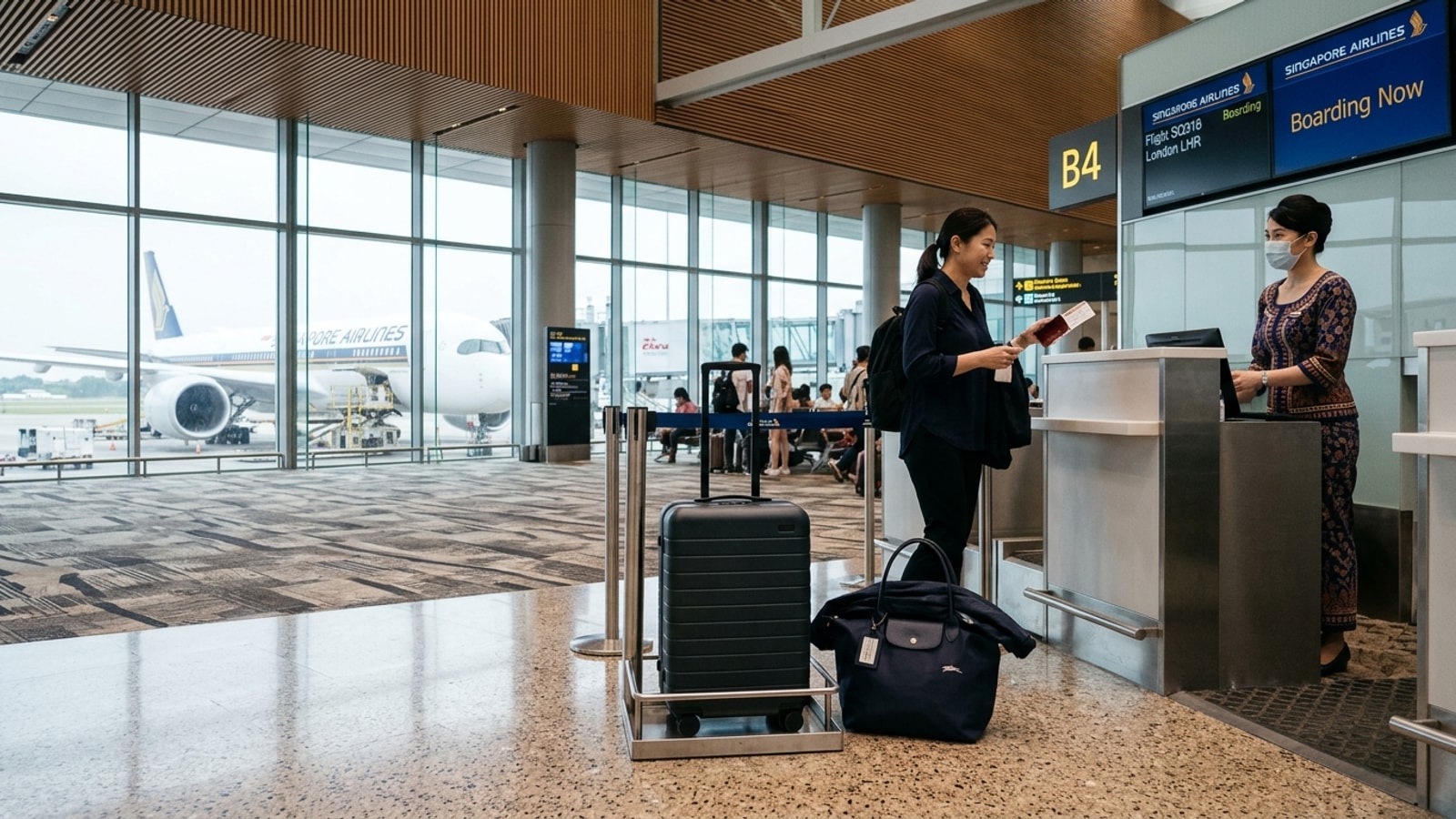
Quick Summary
- Primary Update: Singapore Airlines enforces a strict 7 kg cabin baggage limit for Economy and Premium Economy passengers in 2026, alongside an explicitly regulated secondary personal item (laptop bag, handbag, or camera case) measuring up to 40 x 30 x 10 cm.
- Transit Impact: At Singapore Changi Airport (Terminals 2 and 3) and overseas departure stations, gate staff and decentralized holding-room security checkpoints monitor hand luggage dimensions and weights. Bags exceeding 7 kg or 115 cm total linear dimensions are tagged and relegated to the cargo hold, triggering airport gate excess baggage fees if ticketed checked allowances are exceeded.
- Traveler Advice: Business, First Class, and Singapore Airlines Suites passengers receive two cabin bags up to 7 kg each plus one personal item. Always transport power banks (maximum 100 Wh without prior approval) in cabin baggage, and note that Changi gate-level security confiscates unsealed liquids purchased in transit areas outside secure holding gates.
Singapore Airlines operates a high-capacity global network connecting major commercial hubs across Asia, Europe, North America, and Australia through its primary hub at Singapore Changi Airport (SIN). Connecting key Indian departure airports—including Delhi (DEL), Mumbai (BOM), Bengaluru (BLR), Chennai (MAA), Hyderabad (HYD), and Kochi (COK)—with intercontinental long-haul routes on Airbus A350-900, Boeing 777-300ER, Boeing 787-10, and Airbus A380-800 aircraft, cabin baggage compliance directly impacts turnaround schedules, overhead bin capacity, and boarding efficiency.
Unlike low-cost carriers that charge for overhead carry-on luggage or certain legacy airlines that restrict passengers to a single bag with no separate personal item, Singapore Airlines maintains a generous two-piece cabin policy in Economy Class. However, the airline pairs this policy with strict dimensional limits and weight enforcement at check-in rows and boarding gates.
Cabin Baggage Allowances Across Travel Classes
Singapore Airlines defines carry-on baggage allowances by cabin class. The airline enforces a dimensional limit of 115 cm (length + width + height) for primary cabin pieces, standardizing on 55 x 40 x 20 cm.
| Cabin Class | Primary Cabin Pieces | Maximum Weight per Piece | Maximum Dimensions (L x W x H) | Additional Personal Item Allowed? | Personal Item Maximum Dimensions |
|---|---|---|---|---|---|
| Economy Class | 1 piece | 7 kg (15.4 lbs) | 55 x 40 x 20 cm (sum max 115 cm) | Yes (1 piece free) | 40 x 30 x 10 cm (sum max 80 cm) |
| Premium Economy Class | 1 piece | 7 kg (15.4 lbs) | 55 x 40 x 20 cm (sum max 115 cm) | Yes (1 piece free) | 40 x 30 x 10 cm (sum max 80 cm) |
| Business Class | 2 pieces | 7 kg (15.4 lbs) per piece (14 kg total) | 55 x 40 x 20 cm (sum max 115 cm each) | Yes (1 piece free) | 40 x 30 x 10 cm (sum max 80 cm) |
| First Class & Suites | 2 pieces | 7 kg (15.4 lbs) per piece (14 kg total) | 55 x 40 x 20 cm (sum max 115 cm each) | Yes (1 piece free) | 40 x 30 x 10 cm (sum max 80 cm) |
| Infant Ticket (Under 2 Years) | Nil (Cabin baggage) | Checked allowance applies | Up to 10 kg checked (or 1 piece on US routes) | Yes (Infant food & amenities up to 6 kg) | Plus 1 fully collapsible compact stroller |
Economy and Premium Economy Class: 7kg Primary Bag
Passengers traveling in Economy Class and Premium Economy Class are entitled to carry one primary cabin bag weighing no more than 7 kg (15.4 lbs). The external dimensions—inclusive of wheels, retractable handles, side grips, and external pockets—must not exceed a total linear dimension of 115 cm (45.2 inches). A bag sized at 55 x 40 x 20 cm fits standard overhead compartments on widebody and narrowbody aircraft across the fleet.
If your primary carry-on bag exceeds 7 kg on the check-in scale or at the boarding gate, Singapore Airlines ground agents will require it to be checked into the aircraft hold.
Business Class, First Class, and Suites: Two-Piece Entitlement
Passengers booked in Business Class, First Class, or Singapore Airlines Suites are permitted two distinct cabin bags. Each bag must independently adhere to the 7 kg weight cap and the 115 cm linear dimension limit (55 x 40 x 20 cm). This provides premium flyers with a total carry-on capacity of 14 kg distributed across two pieces, in addition to the standard secondary personal item.
The Additional Free Personal Item Policy
Singapore Airlines permits every passenger, regardless of ticket class, to bring one additional personal item aboard free of charge. This rule is designed for convenience during flight and must not be used to smuggle an extra full-size duffel or roller suitcase into the cabin.
Approved Personal Items
The secondary personal item must fit within maximum dimensions of 40 x 30 x 10 cm (16 x 12 x 4 inches), with a cumulative linear sum not exceeding 80 cm. Approved items include:
- Laptop Bag / Document Briefcase: A slim computer bag or messenger portfolio housing a laptop, tablet, charger, and travel paperwork.
- Ladies' Handbag / Purse: A daily shoulder bag or handbag.
- Camera Bag: A compact DSLR or mirrorless camera case.
- Overcoat, Umbrella, or Walking Stick: Standard outer garments or mobility walking aids.
- Infant Care Bag: Amenities and food for infant care during flight, up to an additional 6 kg.
Under-Seat Stowage Requirement
All additional personal items must be stowed completely beneath the passenger seat immediately in front of you. They cannot be placed in overhead lockers if space is tight, and they cannot obstruct aisle pathways or emergency exit rows. Passengers seated in bulkhead rows or emergency exit rows must place their personal items in the overhead bins during taxi, takeoff, and landing, as floor storage is prohibited by civil aviation safety regulations.
Airport Sizer Box Checks and Changi Gate Enforcement
Singapore Airlines stations metal baggage sizing frames and calibrated scale units throughout check-in concourses and departure gate lounges. At Singapore Changi Airport (SIN), operations are centered primarily in Terminal 2 and Terminal 3.
Changi Decentralized Gate Security Screening
A unique operational feature of Changi Airport Terminals 1, 2, and 3 is decentralized gate-hold room security. Unlike airports where security screening happens at a central checkpoint before travelers enter the retail concourse, Changi screens passengers directly at the individual departure gate holding area.
This layout has direct consequences for cabin baggage management:
- Direct Visual & Dimensional Scrutiny: As passengers pass through the gate security portal 45 to 60 minutes before departure, aviation security staff and Singapore Airlines boarding teams inspect bags for bulk and quantity.
- Physical Sizer Testing: Bags appearing larger than standard cabin trolleys are directed into the metal sizer cage. If the bag does not slide smoothly into the 55 x 40 x 20 cm frame without forced compression, it is rejected from the cabin.
- Scale Weigh-Ins: Spot weight checks are performed on heavy-looking backpacks and carry-on rollers. Hand luggage exceeding 7 kg cannot be split across companions at the gate if companions have already boarded.
Gate Bag Consignment and Airport Excess Baggage Penalty Fees
When a carry-on piece fails the dimensional sizer or weight threshold at the boarding gate, ground staff issue a gate baggage tag and transfer the piece to the aircraft cargo hold via the aerobridge stairs.
Fee Calculation Rules
The cost of gate consignment depends on the passenger's total checked baggage status:
- Unused Checked Allowance Available: If the passenger checked fewer bags or kilograms than their ticketed entitlement (for example, checking only 15 kg out of an allowed 30 kg Economy Standard ticket), the gate-checked bag is absorbed into the remaining allowance without extra charge.
- Checked Allowance Exhausted: If the passenger has already utilized their full checked baggage quota at the initial check-in desk, gate-checking the cabin piece incurs standard airport excess baggage rates.
Singapore Airlines divides excess baggage into geographical route bands. Airport counter and gate excess baggage rates are charged at full rack rates without the 25% pre-booking discount available online.
| Route Band | Geographical Scope | Airport / Gate Excess Fee (Per Kg) |
|---|---|---|
| Band 1 | Flights within Southeast Asia (Singapore, Malaysia, Thailand, Indonesia, Vietnam) | USD $12 / SGD $17 |
| Band 2 | Between Southeast Asia and India, South Asia, Japan, South Korea, Australia | USD $22 / SGD $30 |
| Band 3 | Between Southeast Asia / India and Europe, United Kingdom, Middle East, Africa | USD $42 / SGD $58 |
| Band 4 | Between Southeast Asia / India and Southwest Pacific (New Zealand, Fiji) | USD $38 / SGD $52 |
| USA / Canada Routes | Transpacific routes governed by the Piece Concept (Flights to/from LAX, SFO, JFK, SEA) | USD $150 to $200 per piece (up to 23 kg) |
A passenger traveling from Singapore to London or Frankfurt whose 10 kg carry-on bag is rejected at the gate and who has no remaining checked weight faces a gate excess baggage bill of up to USD $420 (approx. SGD $580). Payment must be settled by credit card directly at the gate counter prior to boarding.
Critical Cabin Baggage Rules: Power Banks, Liquids, and Restricted Items
Singapore Airlines adheres strictly to Civil Aviation Authority of Singapore (CAAS) and International Air Transport Association (IATA) dangerous goods directives. Violating these rules leads to confiscation or denied boarding.
Power Banks and Lithium Batteries: Cabin Only
Spare lithium-ion batteries and portable power banks must remain in cabin baggage. Packing power banks in checked baggage is strictly illegal due to thermal runaway fire hazards in unmonitored cargo holds.
- Up to 100 Watt-hours (Wh): Power banks rated at 100 Wh or less (equivalent to 20,000 mAh at 5V, or 27,000 mAh at 3.7V) are permitted in cabin baggage without prior airline approval. A maximum of 20 spare units per traveler is allowed for personal use.
- 100 Wh to 160 Wh: High-capacity power banks between 100 Wh and 160 Wh require prior written approval from Singapore Airlines. A maximum of 2 spare batteries within this range is permitted per passenger.
- Above 160 Wh: Equipment and battery packs exceeding 160 Wh are completely forbidden on passenger flights.
- Operational Rule: Passengers are prohibited from charging portable power banks using aircraft in-seat power ports during flight. Power banks must also not be left connected to smartphones or laptops unattended in overhead bins.
Changi Gate Liquid Trap: 100ml Rule
All liquids, aerosols, and gels (LAGs) carried into the aircraft cabin must be stored in containers holding 100 ml (3.4 fl oz) or less, packed inside a single transparent, re-sealable 1-litre plastic bag measuring 20 x 20 cm.
Because security screening at Changi Airport Terminals 1, 2, and 3 happens at the boarding gate entrance, any open drinks, takeaway coffees, or water bottles purchased inside the transit terminal shops will be confiscated at gate security. Passengers must finish or discard these drinks before entering the gate holding room, or carry an empty reusable bottle to fill at water drinking fountains located inside the gate lounge after passing the screening checkpoint.
Duty-free alcohol, cosmetics, and perfumes bought at Changi airside retailers must be delivered to the boarding gate in sealed Security Tamper Evident Bags (STEBs) with the purchase receipt clearly visible inside.
Strict Singapore Prohibitions: Vapes and Food Items
- E-Cigarettes and Vapes: Electronic vaporizers, e-cigarettes, vape pens, and related refill liquids are illegal under Singapore law (Tobacco Act). Even if you are an international transit passenger connecting between two flights without clearing immigration, possessing a vape during gate baggage checks can lead to confiscation and hefty fines of up to SGD 2,000 by airport police.
- Dry Coconut (Copra): Copra is classified under IATA regulations as a Class 4.2 dangerous good (flammable solid prone to spontaneous combustion). It is prohibited in both cabin and checked baggage across all flights.
- Ghee and Pickles: Common food items carried by travelers from India must comply with liquid restrictions. Jars of ghee, pickles in oil, and rich gravies exceed the 100 ml LAG threshold and will be discarded at cabin security. These items must be securely packed in leak-proof, hard-shell containers inside checked luggage.
Traveler Logistics Guide
Navigating Singapore Airlines cabin baggage procedures requires disciplined packing and strategic transit planning, especially when connecting at Changi Airport.
Pre-Flight Packing Checklist
- Weigh Primary Carry-On: Ensure your wheeled trolley or travel pack weighs 7.0 kg or less when fully packed.
- Measure Dimensions: Confirm external dimensions do not exceed 55 x 40 x 20 cm (115 cm total linear sum). Include wheels and handles in measurements.
- Pack Personal Item Separately: Use a dedicated laptop bag or compact backpack measuring no more than 40 x 30 x 10 cm. Verify that it fits easily under the seat ahead.
- Organize Power Banks: Place all portable batteries, camera spare cells, and electronic toothbrushes in your personal item so they remain in the cabin. Never place them in checked luggage.
- Seal Liquids Properly: Ensure all liquid toiletries are in containers of 100 ml or less and fit within one 1-litre clear zip bag.
Changi Airport Transit Navigation (T2 and T3)
Singapore Airlines flights arrive and depart across Changi Terminal 2 and Terminal 3:
- Terminal Transfers: Free automated Skytrains operate every 3 to 5 minutes between T2 and T3 on the airside transit level, taking roughly 4 minutes of travel time.
- Time Allocation: Arrive at your departure gate at least 45 to 60 minutes before departure time. Because security screening occurs at the gate entrance, security queues form early.
- Boarding Protocol: Singapore Airlines boards by zones starting with Suites/First Class and PPS Club members, followed by Business Class, Premium Economy, and Economy Class by seat rows (rear to front). Boarding early in your zone ensures overhead bin space near your seat.
Handling Infant Strollers and Wheelchairs
- Compact Folding Strollers: Ultra-compact folding strollers (such as the Babyzen YOYO, GB Pockit, or Bugaboo Butterfly) that fold into standard cabin dimensions (55 x 40 x 20 cm) can be brought into the cabin in place of your standard 7 kg carry-on bag.
- Standard Strollers: Non-collapsible or larger baby strollers must be checked at the check-in counter or gate-checked at the aerobridge. Gate-checked strollers are returned at the arrival aerobridge at select destinations, or transferred to the baggage claim hall.
- Wheelchairs: Manual and electric wheelchairs are carried free of charge in the cargo hold. Passengers with electric wheelchairs must declare battery type (dry-cell, gel, or lithium-ion) to Singapore Airlines at least 48 hours prior to departure.
Frequently Asked Questions
Can I bring both a trolley suitcase and a laptop backpack on Singapore Airlines Economy Class?
Yes. Singapore Airlines permits one primary cabin bag weighing up to 7 kg (55 x 40 x 20 cm) plus one separate personal item (such as a laptop bag, small backpack, or handbag) measuring up to 40 x 30 x 10 cm. The personal item must fit under the seat in front of you.
What happens if my carry-on bag weighs 8.5 kg instead of 7 kg at Changi Airport?
Ground agents or gate security staff may intercept the bag. You will be asked to either repack excess weight into your personal item (if under-seat capacity allows) or check the primary bag into the cargo hold. If your ticketed checked baggage allowance has already been exhausted, you will be charged airport excess baggage rates ranging from USD $12 to $42 per kg depending on your route band.
Can I carry a power bank in my checked suitcase on Singapore Airlines?
No. Power banks and spare lithium batteries are strictly prohibited in checked luggage due to aviation fire safety rules. All power banks (up to 100 Wh without prior approval; 100 Wh to 160 Wh with airline approval) must be carried in your cabin baggage.
Can I take bottled water purchased in Changi duty-free into the aircraft cabin?
Only if the beverage is purchased inside the secure gate holding room after you clear gate-level security screening, or if duty-free liquid purchases are packaged by authorized transit retailers in sealed Security Tamper Evident Bags (STEBs) with the receipt clearly visible. Bottled drinks purchased in the general transit mall will be confiscated at the gate security checkpoint.