

Quick Summary
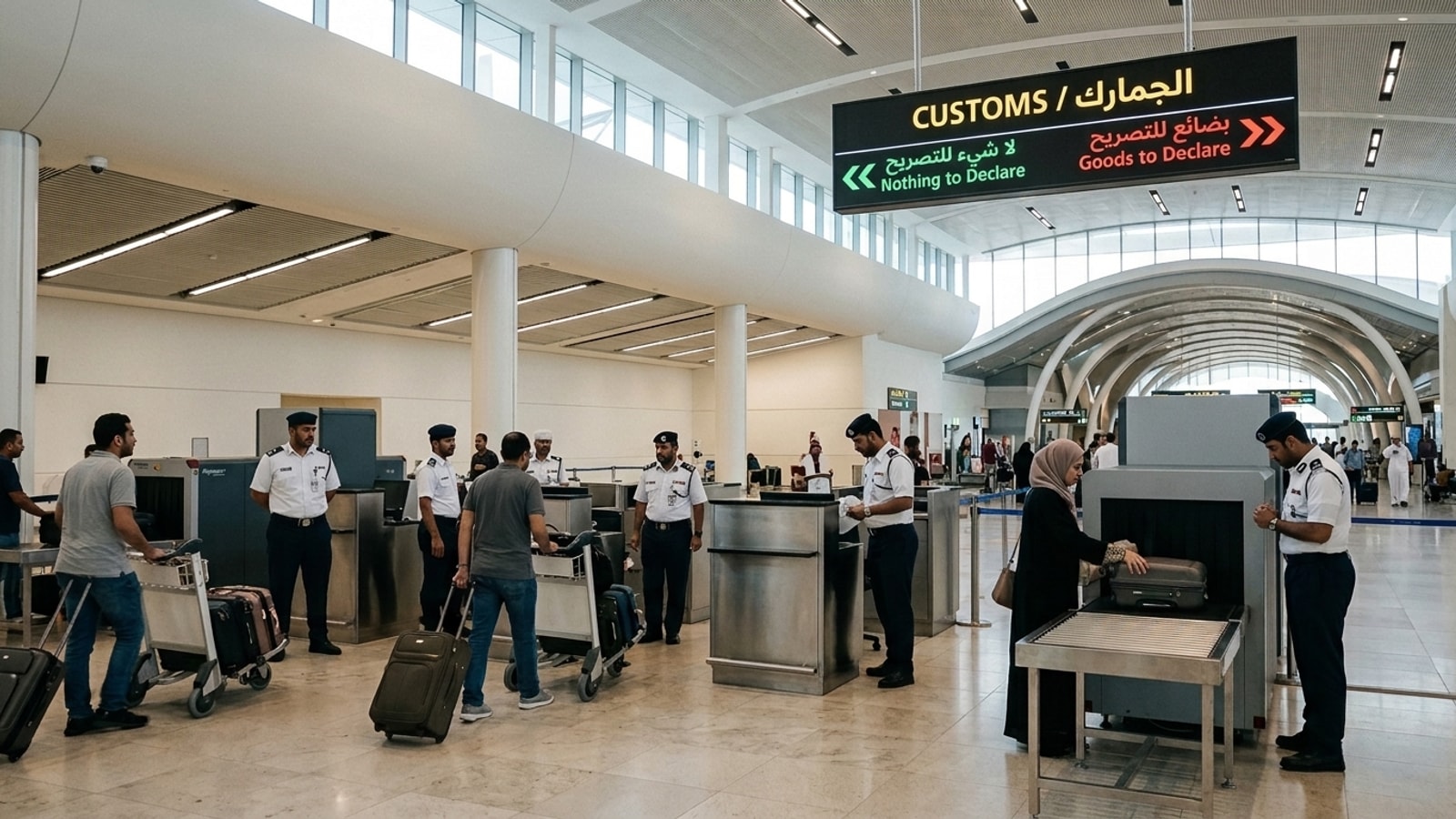
- Primary Update: Bahrain Customs Affairs under the Ministry of Interior enforces updated baggage screening protocols across the central passenger terminal at Bahrain International Airport (BAH), applying strict statutory limits on duty-free imports, controlled pharmaceuticals, and protected national heritage items.
- Transit Impact: Arriving international passengers clearing customs through Green and Red channels encounter inline radiological scanning, sniffer canine units, and mandatory written declarations for physical cash or financial instruments exceeding BHD 10,000.
- Traveler Advice: Non-Muslim passengers aged 18 and older may bring up to 1 liter of spirits or 1 case of beer duty-free, while tobacco is capped at 400 cigarettes; all travelers must strictly avoid carrying unapproved camera drones, cultured pearls, or unprescribed narcotics.
International air travelers arriving at Bahrain International Airport (BAH) in Muharraq pass through a customs clearance system administered by Customs Affairs under the Ministry of Interior. Operating within the statutory framework of the Gulf Cooperation Council (GCC) Common Customs Law and Bahrain Customs Law promulgated by Legislative Decree No. 10 of 2002, border officers enforce precise exemptions for personal baggage alongside zero-tolerance prohibitions against illegal contraband.
Unlike neighboring Saudi Arabia and Kuwait, which enforce absolute statutory bans on alcohol, the Kingdom of Bahrain permits non-Muslim incoming passengers to import limited quantities of alcoholic beverages for personal consumption. However, the border security regime enforces strict controls on controlled medications, consumer camera drones, high-value currency, and cultured pearls—a unique statutory protection designed to safeguard Bahrain's historic natural pearl industry. Navigating these parameters requires an accurate understanding of allowances, declaration thresholds, and terminal inspection workflows.
Statutory Allowances and Duty-Free Thresholds
Bahrain customs regulations establish clear lines between personal effects, gifts, taxable imports, and prohibited goods. Bona fide personal belongings—such as used clothing, toiletries, one primary laptop, a personal tablet, and mobile devices showing evident signs of use—are admitted without customs duties or taxes.
For newly purchased items, souvenirs, and luxury goods carried by incoming passengers, statutory duty-free exemptions apply per adult traveler:
| Item Category | Statutory Duty-Free Allowance | Inspection & Screening Protocol | Statutory Assessment & Penalty for Violations |
|---|---|---|---|
| Spirits & Hard Liquor | Up to 1 Liter (Non-Muslims aged 18+) | X-ray baggage imaging and physical verification at Red Channel | 225% cumulative tariff and excise tax on excess; confiscation if undeclared |
| Beer or Wine | 1 case of beer (max 12 cans/6L) OR 1 bottle of wine | Visual inspection and volumetric check at customs desk | Reclassification as commercial shipment; seizure if over limits |
| Cigarettes | Up to 400 cigarettes (20 packs / 2 cartons) | Physical pack count during terminal exit screening | 100% GCC excise duty assessed on excess volume; commercial confiscation |
| Cigars & Loose Tobacco | Max 50 cigars or 250g loose tobacco | Weighing and commercial packaging scrutiny | Standard GCC customs duty plus 100% excise tax on excess weight |
| Personal Gifts & Merchandise | Total value up to BHD 250 (~$663 USD) | Purchase invoice review and customs price valuation database | 5% standard GCC customs duty assessed on value exceeding BHD 250 |
| Cash & Monetary Assets | Value under BHD 10,000 or foreign equivalent | Spot checks and mandatory Financial Intelligence declaration | Detention under Law No. 4/2001; Public Prosecution referral |
| Prescription Medicines | Maximum 30-day personal maintenance supply | Physical prescription and pharmacy label inspection | Seizure by customs; criminal arrest if classified as prohibited narcotic |
| Consumer Camera Drones | 0 Units (Prohibited without prior permit) | 100% inline baggage tomography flags multi-rotor craft | Immediate airport impoundment by Customs; security investigation |
| Cultured or Artificial Pearls | 0 Units (Absolute Statutory Prohibition) | Gemological scrutiny by Ministry of Industry inspectors | Confiscation, destruction, and criminal referral under Law No. 10/1990 |
Alcohol and Tobacco Allowance Regulations
The Kingdom of Bahrain operates a dual regulatory model for alcoholic beverages based on religious status and statutory age limits.
Spirits, Wine, and Beer Allowances
Under Bahrain Customs directives, incoming passengers may bring alcoholic beverages into the country under strictly defined parameters:
- Eligibility: Only non-Muslim passengers aged 18 and older are legally permitted to import alcoholic beverages in accompanied baggage.
- Volume Limits: Eligible travelers may bring either 1 liter of distilled spirits, or 1 bottle of wine, or 1 case of beer containing no more than 12 cans (up to 6 liters aggregate volume).
- Muslim Travelers: Muslim passengers are prohibited from importing alcohol in any quantity. Attempting to bring alcohol through customs desks results in immediate seizure.
- Excess Quantities: Carrying quantities above the statutory allowance requires clearing the Red Channel. Customs assessors apply the GCC unified tariff and selective excise duty, resulting in a 225% cumulative tax liability. Unmanifested commercial volumes are confiscated.
Tobacco and Nicotine Rules
Adult travelers aged 18 and older may bring personal tobacco products within the following duty-free thresholds:
- Up to 400 cigarettes (2 cartons), or 50 cigars, or 250 grams of loose pipe or shisha tobacco in opened packages.
- Personal electronic cigarette devices and personal vape pods are permitted for accompanied personal use. Commercial quantities or shipments lacking digital tax stamps are impounded under National Bureau for Revenue (NBR) excise mandates.
Absolute Prohibitions: Cultured Pearls, Drones, and Contraband
Bahrain enforces statutory prohibitions on several items that travelers might carry routinely in other jurisdictions.
The Cultured Pearl Import Ban
Bahrain holds a unique position in global customs law regarding pearls. Under Legislative Decree No. 10 of 1990 and executive ministerial regulations, the import, sale, and commercial possession of cultured, farmed, or artificial pearls is strictly illegal.
This statute protects the authenticity and economic heritage of Bahrain's wild natural pearl beds. Customs officers at BAH inspect jewellery and loose beads with specialized gemological equipment.
- Natural pearls set in personal worn jewellery with valid gemological certificates are cleared without issue.
- Loose cultured pearls, farmed pearl necklaces, or uncertified commercial strands are confiscated at the border, and the carrier faces statutory fines and possible legal prosecution.
Consumer Camera Drones and Multi-Rotor UAVs
All unmanned aerial vehicles (UAVs), remote-controlled camera drones (such as DJI Mavic or Mini series), and aerial robotics are classified as controlled security equipment.
- Incoming air passengers cannot bring drones into Bahrain without advance security clearance issued jointly by the Ministry of Interior, the Bahrain Defence Force, and the Bahrain Civil Aviation Affairs (BCAA).
- Drones detected in checked baggage or carry-on luggage during terminal tomography scans are immediately seized and transferred to the Customs Warehouse. Travelers receive a detention receipt to collect the unit upon outbound departure.
Communications and Security Equipment
- Satellite Telephones and Walkie-Talkies: High-frequency transmitters, two-way UHF/VHF radios, and satellite handsets (such as Iridium or Thuraya) require prior equipment approval from the Telecommunications Regulatory Authority (TRA).
- Prohibited Media and Offensive Items: Pornographic media, materials contrary to public morality, publications promoting religious extremism, and counterfeit branded apparel are seized on arrival.
- Weapons and Pyrotechnics: Firearms, realistic replica toys, martial arts items, switchblade knives, fireworks, and handheld laser pointers are strictly prohibited.
Controlled Pharmaceuticals: NHRA Medical Protocols
The National Health Regulatory Authority (NHRA) and the Ministry of Health enforce rigorous oversight on pharmaceuticals entering Bahrain through international gateways.
Travelers entering the Kingdom with daily therapeutic medications must distinguish between standard over-the-counter drugs and controlled substances:
Controlled and Psychotropic Drugs
Bahrain places strict restrictions on narcotics, psychotropic medications, and central nervous system stimulants. Common substances subject to intensive monitoring include:
- Tramadol, Codeine, and related opioid analgesics
- Pregabalin (Lyrica) and Gabapentin
- Benzodiazepines (Alprazolam/Xanax, Diazepam/Valium, Clonazepam)
- Amphetamine derivatives and Methylphenidate (Ritalin/Concerta)
- Zolpidem and prescription sleep aids
Compliance Documentation
To clear customs without risking drug detention under Bahrain's Anti-Narcotics Law:
- Valid Medical Prescription: Carry an original prescription from a licensed physician stating the patient's full legal name, diagnosis, medication trade name, chemical denomination, and daily dosage.
- Medical Attestation: For supplies exceeding 30 days, present a detailed medical report issued within the preceding three months, certified by the prescribing hospital and translated into English or Arabic.
- Quantity Restriction: Visitors are limited to a maximum 30-day supply of controlled medications. Bahrain residents holding a valid Central Population Registry (CPR) card may carry up to a 90-day maintenance supply.
- Original Packaging: All medications must remain in original pharmaceutical manufacturer blister packs or labeled bottles showing the dispensing pharmacy's details.
Financial Declarations and Currency Reporting
Under Law No. 4 of 2001 on the Prevention and Prohibition of Money Laundering and Terrorism Financing, Bahrain enforces strict cross-border currency monitoring.
Incoming and outgoing passengers at Bahrain International Airport must declare physical cash, gold bullion, precious stones, or negotiable financial instruments (including traveler's cheques, endorsed promissory notes, and bearer cheques) if the aggregate value reaches or exceeds:
- Statutory Reporting Threshold: BHD 10,000 (or foreign currency equivalent, approximately $26,500 USD, €24,500 EUR, or ₹22,00,000 INR).
Declarations are completed at the Customs Cash Declaration Counter located inside the arrival baggage reclaim hall before passing the inspection barriers. Travelers must disclose the origin of funds, intended destination, and economic rationale. Failing to report currency exceeding the threshold constitutes a penal infraction resulting in temporary asset impoundment and referral to the Financial Intelligence Directorate (FID).
Traveler Logistics Guide
Navigating customs arrival at Bahrain International Airport is straightforward when travelers prepare documentation and packing arrangements beforehand.
[Arrival Gate / Jet Bridge]
            │
            ▼
[Immigration & E-Gates Inspection]
            │
            ▼
[Baggage Reclaim Hall (Carousels 1–8)]
   *Automated CT In-Line Baggage Screening*
            │
      ┌─────┴─────────────────────────┐
      ▼                               ▼
[Green Channel]                [Red Channel]
"Nothing to Declare"           "Goods to Declare"
- Within allowances            - Cash ≥ BHD 10,000
- No banned items              - Alcohol > 1L (Non-Muslim)
- Personal gifts < BHD 250     - Controlled medications
- Under 400 cigarettes         - Commercial goods / Drones
      │                               │
      ▼                               ▼
[Terminal Exit / Arrivals Concourse / Taxis & Metro Shuttles]
Terminal Clearance Step-by-Step
- Deplaning and Immigration: Arrive at the single-roof passenger terminal of BAH. Follow signage through the arrivals concourse to Passport Control. Eligible GCC citizens, residents, and e-visa holders use automated biometrics e-gates; international visitors queue at staffed immigration desks.
- Luggage Collection: Collect checked bags at Baggage Reclaim Carousels 1 through 8. While baggage transfers from aircraft to carousel, airport handling units route all bags through in-line dual-energy CT scanners. Customs tags or electronic flags are appended to suspicious luggage.
- Channel Selection:
- Green Channel: Proceed here only if your baggage complies fully with statutory duty-free limits, contains no controlled medicines without paperwork, holds no camera drones or cultured pearls, and your physical currency is below BHD 10,000.
- Red Channel: Divert here if you have goods exceeding duty-free allowances, commercial merchandise, cash exceeding BHD 10,000, or items requiring formal inspection and permit validation.
- Spot Scrutiny & Canine Teams: Customs officers stationed at Green Channel exit portals conduct random secondary screenings using mobile conveyor X-ray machines. Canine units trained in detecting narcotics and undeclared currency operate continuously across the hall.
Customs Detention and Temporary Deposit
If you arrive with prohibited electronics (such as a consumer drone) or items requiring import authorization:
- Customs Affairs issues an official Temporary Custody Receipt (Form 80 Deposit).
- The property is securely stored in the Customs Airport Warehouse for up to 30 days.
- You can retrieve the item upon your departure from Bahrain by presenting your flight boarding pass, original passport, and custody receipt at the Departure Customs desk.
Pre-Arrival Checklist for Incoming Travelers
- Check that alcohol is strictly limited to 1 liter of spirits or 1 case of beer, and verify that you are a non-Muslim passenger aged 18+.
- Count tobacco products to ensure you carry no more than 400 cigarettes or 50 cigars.
- Verify that prescription medications are accompanied by an English doctor's certificate and kept in original blister packaging.
- Leave all camera drones, multi-rotor aircraft, and walkie-talkies at home unless you possess pre-approved BCAA/Ministry of Interior permits.
- Inspect jewellery to guarantee that no cultured, farmed, or fake loose pearls are in your luggage.
- Count physical currency, traveler's cheques, and gold bars; if the total reaches BHD 10,000 (~$26,500 USD), complete the official declaration form immediately upon arrival.
Frequently Asked Questions
Can I bring duty-free liquor purchased during a flight layover in Dubai or London into Bahrain?
Yes, provided you are a non-Muslim passenger aged 18 or older. Bahrain allows non-Muslim adult travelers to bring up to 1 liter of spirits, 1 bottle of wine, or 1 case of beer (up to 12 cans) duty-free into the country. If your journey includes a transit stop through Saudi Arabia or Kuwait where alcohol is banned, you must ensure that your luggage remains checked through to Bahrain and is not collected during the layover. Muslim travelers are strictly prohibited from importing alcohol into Bahrain.
What happens if customs officers at Bahrain Airport find a camera drone in my luggage?
If you arrive at Bahrain International Airport with a consumer camera drone (such as a DJI quadcopter) without an advance security permit from the Ministry of Interior and Bahrain Civil Aviation Affairs, customs officers will impound the device on the spot. The drone is logged into the Customs Airport Warehouse, and you are issued a formal detention deposit receipt. You may retrieve the drone when exiting the Kingdom on an outbound international flight upon payment of administrative warehouse handling fees.
Are common prescription painkillers like Tramadol, Codeine, or Xanax permitted?
These pharmaceuticals are classified as controlled psychotropic substances under Bahrain National Health Regulatory Authority (NHRA) regulations. You may bring up to a 30-day personal supply only if you carry an original medical report and a detailed prescription signed by your licensed physician specifying your diagnosis, daily dosage, and treatment timeline. The medicines must remain in their original pharmacy containers. Carrying controlled narcotics without valid medical paperwork leads to confiscation and potential detention under narcotics statutes.
Why is there a strict ban on importing cultured pearls into Bahrain?
The Kingdom of Bahrain enforces Law No. 10 of 1990 to preserve its global standing and cultural legacy as the premier center for natural wild pearls. To prevent the domestic market from being contaminated with cultured, farmed, or artificial pearls, the commercial importation and personal entry of uncertified cultured pearls is strictly forbidden. While travelers may wear authentic natural pearl jewellery or personal heirloom sets with genuine certificates, loose cultured pearls and unverified strands will be seized and destroyed by customs inspection authorities.