

Quick Summary
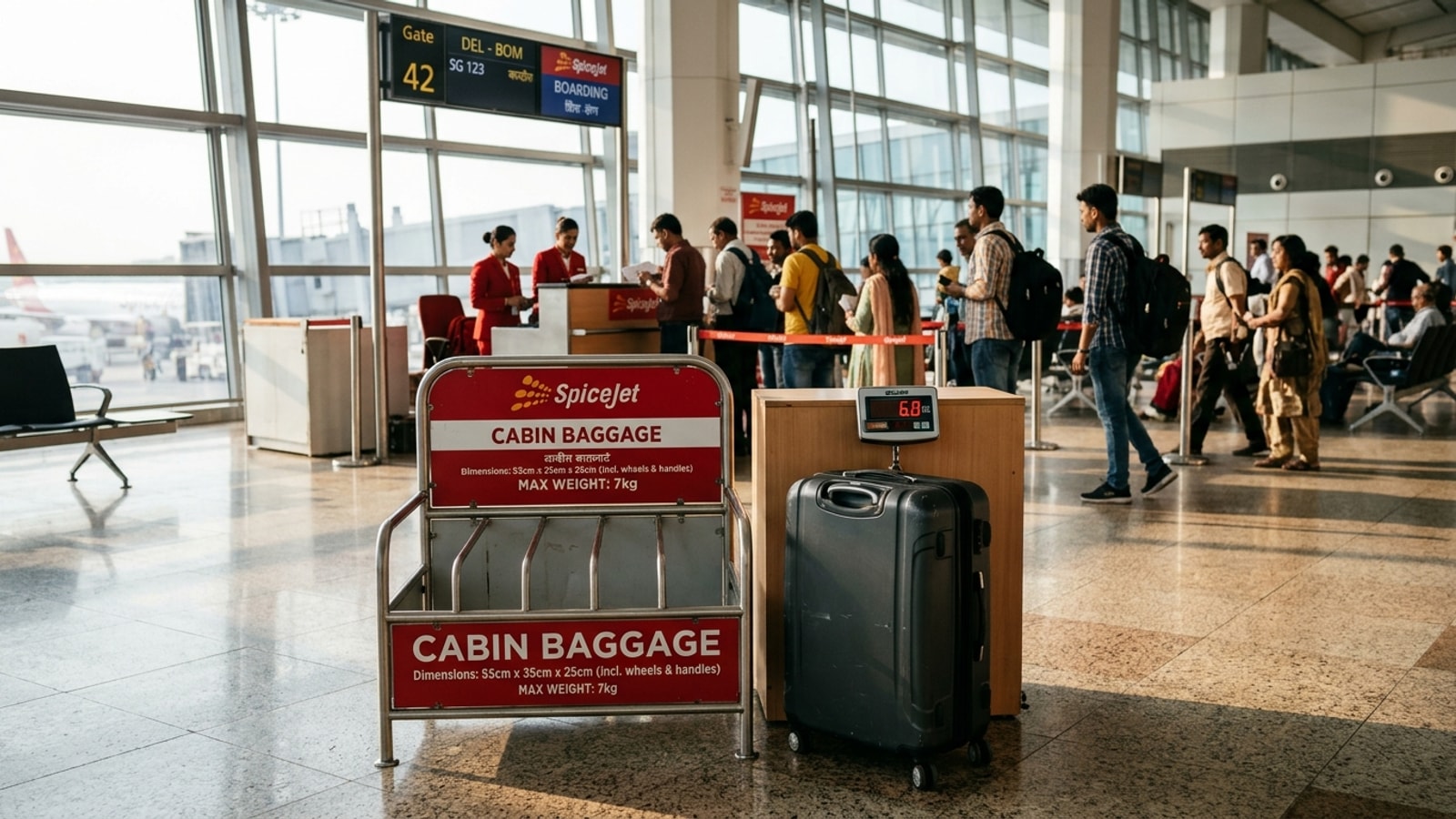
- Primary Update: SpiceJet enforces a strict two-piece carry-on luggage limit across domestic and international operations in 2026. Standard economy passengers may bring one primary cabin bag weighing up to 7 kg (dimensions 55 x 35 x 25 cm for Boeing 737 aircraft; 50 x 35 x 23 cm for Q400 turboprops) plus one compact personal item (laptop bag, handbag, or briefcase) up to 3 kg.
- Transit Impact: Airport boarding gates at core hubs—including Delhi (DEL Terminal 3 & Terminal 1), Mumbai (BOM Terminal 2), Bengaluru (BLR Terminal 1), and Kolkata (CCU)—actively position rigid steel sizer baskets and digital scales. Carry-on bags exceeding the 7 kg limit or measuring outside sizer specifications face gate baggage intercept charges of ₹550 per excess kilogram plus 18% GST (₹649/kg), alongside a ₹1,000 flat gate handling transfer fee.
- Traveler Advice: Passengers flying on regional Q400 aircraft must plan for restricted overhead locker space; bags that easily fit in Boeing 737 bins frequently require aircraft-side valet gate-checking on turboprops. Keep power banks, laptops, prescription medication, and transit documents in your under-seat personal bag, as loose lithium cells are barred from the cargo hold.
SpiceJet operates a mixed fleet comprising Boeing 737-700, 737-800, and 737 MAX 8 jets on metro domestic trunk lines and Middle East routes, alongside De Havilland Canada DHC-8 Q400 turboprop aircraft serving regional and Tier-2 destinations under the UDAN regional connectivity scheme. Because cabin storage geometries differ substantially between narrowbody jets and turboprops, ground personnel systematically inspect hand luggage dimensions and weights before boarding.
Familiarity with physical sizer limits, personal accessory rules, gate penalty schedules, and Bureau of Civil Aviation Security (BCAS) dangerous goods regulations prevents costly boarding intercepts and unexpected baggage offloading.
SpiceJet Cabin Baggage Allowances Across Aircraft Types and Fares
Carry-on baggage allowances on SpiceJet depend on the aircraft type operating the route and the specific fare brand purchased during ticketing.
| Booking Category / Aircraft Type | Primary Cabin Bag Allowance | Primary Bag Maximum Dimensions | Personal Item Allowance | Personal Item Maximum Dimensions | Total Permitted Hand Baggage Weight | Standard Checked Baggage Allowance |
|---|---|---|---|---|---|---|
| SpiceSaver (Boeing 737 Flights) | 1 piece up to 7 kg | 55 x 35 x 25 cm (115 cm total) | 1 laptop bag, purse, or briefcase up to 3 kg | 40 x 30 x 10 cm | 10 kg (split 7 kg overhead + 3 kg under-seat) | 15 kg (Domestic) / 20–30 kg (International) |
| SpiceSaver (Q400 Turboprop Flights) | 1 piece up to 7 kg | 50 x 35 x 23 cm (108 cm total) | 1 small personal accessory up to 3 kg | 40 x 30 x 10 cm | 10 kg (split 7 kg overhead + 3 kg under-seat) | 15 kg (Domestic) |
| SpiceMax (Extra Legroom Fare) | 1 piece up to 7 kg | 55 x 35 x 25 cm (Boeing) / 50 x 35 x 23 cm (Q400) | 1 personal item up to 3 kg | 40 x 30 x 10 cm | 10 kg (Priority boarding included) | 15 kg (Domestic) / 20–30 kg (International) |
| Infant Passenger (Under 2 Years) | 1 baby care bag up to 7 kg | 55 x 35 x 25 cm | Included in accompanying adult personal item | Placed under seat | 7 kg plus 1 free collapsible baby stroller | Nil checked allowance |
The Two-Piece Cabin Rule Details
SpiceJet permits two separate items inside the aircraft cabin per ticketed passenger:
- Primary Overhead Trolley or Duffel Bag (7 kg limit): On Boeing 737 flights, the bag must not exceed 55 cm in length, 35 cm in width, and 25 cm in depth (total linear dimension of 115 cm), including handles, external organizer pockets, and spinner wheels. On Q400 turboprop flights, the depth and length are tighter (50 x 35 x 23 cm). The piece must slide into the overhead bin unaided without excessive force.
- Personal Item (3 kg limit): Passengers are allowed one secondary personal accessory, which can be a slim laptop satchel, a standard ladies handbag, a camera bag, an infant food carrier, or duty-free purchases in a sealed shopping bag. The item must not exceed 40 x 30 x 10 cm and must fit fully under the seat directly in front of the passenger.
If a personal item is an overfilled backpack or duffel that does not fit flat beneath the forward seat frame, ground agents classify it as a second primary carry-on, requiring immediate check-in and associated gate fees.
Metal Sizer Baskets and Boarding Gate Weighing Procedures
SpiceJet deploys branded metal check-sizer baskets and calibrated electronic floor scales at departure concourses, security queue entries, and aerobridge boarding gates across Indian and international airports.
Physical Sizer Frame Inspections
- Boeing 737 Sizer Unit (55 x 35 x 25 cm): Hard-sided spinner suitcases are inserted upright. If extended wheels or top grab handles protrude beyond the outer rim of the steel cage, the bag fails the test.
- Q400 Regional Turboprop Sizer Unit (50 x 35 x 23 cm): Deployed at regional departure gates (such as Delhi T1, Hyderabad, or Jaipur regional gates). Because Q400 overhead bins cannot accommodate wide 22-inch rollers, bags that pass the Boeing sizer may fail the Q400 unit. Oversized rollers are tagged with an orange aircraft-side delivery tag and placed in the rear cargo compartment at the boarding stairs.
- Under-Seat Personal Item Sizer (40 x 30 x 10 cm): Gate staff test personal satchels and backpacks. Bags exceeding 10 cm in thickness cannot clear the floor space beneath standard passenger seats and are barred from cabin stowage.
- Combined Weight Audit: Ground agents frequently place both the primary rolling suitcase and the secondary personal bag on the platform scale together. If the primary bag weighs 6.8 kg and the laptop bag weighs 5.2 kg, the total combined weight of 12.0 kg breaches the 10.0 kg ceiling, resulting in an excess weight assessment.
Gate Penalty Fees and Airport Counter Excess Charges
Passengers with carry-on luggage that exceeds weight or dimension limits at the boarding gate cannot return to the main ticketing concourse. Ground agents issue a gate intercept receipt, tag the luggage for the aircraft hold, and collect the required fee before allowing the passenger to step onto the aerobridge.
| Departure Station / Route Type | Permitted Cabin Allowance | Gate Excess Rate (Per Kg) | Flat Gate Handling / Transfer Surcharge | Total Financial Penalty for 5 kg Excess at Gate |
|---|---|---|---|---|
| Domestic India (All Hubs) | 7 kg + 3 kg personal item | ₹550 / kg (+ 18% GST = ₹649 / kg) | ₹1,000 flat transfer surcharge | ₹4,245 (₹1,000 surcharge + ₹3,245 weight fee) |
| Dubai (DXB) to India | 7 kg + 3 kg personal item | AED 50 / kg | AED 100 flat gate handling fee | AED 350 |
| Bangkok (BKK) to India | 7 kg + 3 kg personal item | THB 450 / kg | THB 900 flat gate handling fee | THB 3,150 |
| Jeddah (JED) to India | 7 kg + 3 kg personal item | SAR 55 / kg | SAR 110 flat gate handling fee | SAR 385 |
Prepaid Baggage Online vs Airport Counter and Gate Penalties
Purchasing extra baggage allowance online before arriving at the airport yields significant savings compared to paying at the check-in desk or boarding gate:
- Prepaid Online Slabs (via SpiceJet App/Website): Additional 5 kg checked allowance costs ₹2,000–₹2,250 when booked at least two hours before departure.
- Airport Check-in Counter Rate: Unbooked excess weight presented at the check-in counter is charged at ₹550 per kg plus 18% GST (₹649 per kg). A 5 kg excess costs ₹3,245.
- Boarding Gate Intercept: Bags caught at the gate incur the ₹550/kg weight charge plus GST plus the mandatory ₹1,000 gate processing fee, pushing the cost for 5 kg to ₹4,245.
BCAS & SpiceJet Banned and Regulated Cabin Items
All departures from Indian airports are screened under Central Industrial Security Force (CISF) directives and Bureau of Civil Aviation Security (BCAS) dangerous goods regulations. SpiceJet flight crews and ground personnel strictly adhere to these protocols.
| Regulated Item / Category | Cabin Hand Luggage Status | Checked Hold Baggage Status | Operational Transport Mandate |
|---|---|---|---|
| Power Banks & Portable Chargers | Permitted (Max 100–160Wh) | Strictly Forbidden | Severe fire risk; loose lithium batteries barred from cargo hold |
| Spare Lithium Batteries | Permitted (Protected terminals) | Strictly Forbidden | Must be in retail casing or taped to prevent short circuits |
| Dry Coconut (Copra) | Strictly Banned | Strictly Banned | Flammable dangerous good prone to spontaneous combustion under pressure |
| Electronic Cigarettes & Vapes | Strictly Banned | Strictly Banned | Completely prohibited across Indian aviation under the PECA 2019 Act |
| Ghee, Pickles & Mustard Oil | Forbidden (>100ml LAG rule) | Permitted (Leak-proof sealed) | Subject to liquid limits in cabin; must be sealed in multi-layer containers for hold |
| Alcoholic Beverages | Forbidden on domestic runs | Permitted (Up to 5L, 24%–70% ABV) | Domestic cabin ban; permitted in checked baggage in original retail bottles |
| Electric Hair Trimmers & Shavers | Permitted (Safety cap on) | Permitted | Permitted in hand luggage; spare safety blades must go into checked baggage |
| Baby Strollers & Prams | Compact cabin or Gate-check | Permitted (Free allowance) | Free delivery at aircraft door upon arrival at destination |
| Musical Instruments (Violin/Guitar) | Permitted (If within 7 kg & 115 cm) | Permitted (Hard flight case) | Large instruments require booking an extra seat ("Seat for Luggage") |
Power Banks and Portable Lithium Batteries
- Cabin Only Requirement: Power banks and loose lithium-ion cells must never be placed inside checked suitcases. When detected by automated inline hold baggage screening (BHS) systems, security officers pull the suitcase, open it, confiscate the power bank, and may offload the luggage from the flight.
- Watt-Hour Ceilings: Power banks rated up to 100 watt-hours (Wh)—representing roughly 27,000 mAh at 3.7V—are permitted in carry-on bags without prior notice. Units between 100Wh and 160Wh require prior airline station supervisor approval. Units exceeding 160Wh are barred from commercial passenger aircraft.
Dry Coconut (Copra) Prohibition
Dried coconut kernel (copra) possesses high concentrations of volatile vegetable oils. Changes in cargo cabin pressure, friction, and temperature make copra prone to self-heating and spontaneous ignition. BCAS regulations and the IATA Dangerous Goods Code ban copra in both cabin luggage and checked baggage. Religious coconuts containing water are similarly barred at airport passenger security screening points because liquid volumes exceed 100 ml.
Ghee, Pickles, and Food Liquids
Clarified butter (ghee), oil-based mango or lime pickles, chutneys, honey, and dairy curries fall under international Liquids, Aerosols, and Gels (LAGs) screening criteria:
- Containers exceeding 100 ml are seized by CISF officers at passenger security gates.
- These food staples must be stowed in checked hold baggage. Use heavy-duty, leak-proof plastic jars, seal the screw lids with electrical or plumbing tape, cushion the jars in bubble wrap, and enclose them inside a heat-sealed or double-zipper plastic bag to prevent oil damage to other baggage.
Domestic and International Alcohol Carriage
- Domestic Operations: Passengers cannot carry alcohol through domestic airport security checkpoints into the passenger cabin. In checked luggage, travelers may carry up to 5 liters of alcohol containing between 24% and 70% alcohol by volume (ABV), provided the bottles are factory-sealed in official retail packaging.
- International Operations: Sealed duty-free bottles purchased at departure terminals in Dubai, Bangkok, or Jeddah can enter the cabin only if enclosed inside an intact Security Tamper-Evident Bag (STEB) with the retail purchase receipt visible within the pouch.
Musical Instruments and Fragile Equipment Handling
Musicians traveling with instruments on SpiceJet have clear pathways to protect delicate gear:
- Small Instruments (Violins, Flutes, Trumpets): Instruments that fit within the standard cabin dimensions (55 x 35 x 25 cm) and weigh under 7 kg may be carried as the passenger's primary hand luggage piece in lieu of a suitcase.
- Large Instruments (Guitars, Cellos, Keyboards): Instruments exceeding 115 cm linear dimensions cannot be placed in overhead bins. Passengers must either purchase an extra passenger seat under SpiceJet's "Seat for Luggage" tariff during flight booking or pack the instrument in an ATA-certified heavy-duty hard flight case for checked hold carriage with a "Fragile" baggage tag.
DGCA Regulations: 24-Hour Cancellation and Delay Compensation
Domestic flights on SpiceJet operate under consumer protection mandates established by the Directorate General of Civil Aviation (DGCA) Passenger Charter:
- 24-Hour Free Look-in Cancellation Window: Under DGCA Civil Aviation Requirements (CAR), travelers who book a ticket directly on SpiceJet's portal may cancel or amend their booking within 24 hours of ticket issuance without paying any cancellation penalty, provided the flight is scheduled to depart at least 7 days after the booking date.
- Flight Delay Refreshments and Meals: When a SpiceJet domestic flight is delayed beyond 2 hours for flights with block times up to 2.5 hours (or beyond 3 hours for longer domestic flights), SpiceJet must provide free tea, coffee, drinking water, and snacks to ticketed passengers at the boarding gate.
- Severe Delays and Free Rescheduling: If a domestic flight is delayed by more than 6 hours beyond its original scheduled departure, SpiceJet must offer either a full cash refund of the ticket fare or alternate flight rebooking at no additional cost.
Traveler Logistics Guide
1. Check-In and Boarding Gate Timelines
- Counter Closure: SpiceJet domestic check-in desks and baggage drop facilities close strictly 60 minutes prior to scheduled flight departure. International counters close 75 minutes prior to departure.
- Boarding Gate Timing: Boarding gates open 45 minutes before departure and shut firmly 20 minutes before takeoff. Passengers arriving with unapproved or oversized carry-on bags less than 20 minutes before departure risk missing the flight due to the time required to re-tag and load baggage into the cargo hold.
2. Sizer Verification Strategy at Departure Terminals
Before entering the CISF security screening lanes at high-volume hubs like Delhi Terminal 3, Mumbai Terminal 2, or Bengaluru Terminal 1:
- Locate the SpiceJet check-sizer basket positioned next to the bag drop row.
- Place your carry-on roller bag into the frame. If the frame jams against exterior wheels or expanded zipper sections, rebalance the load.
- Move heavy electronic adapters, heavy hard drives, power banks, and books into your under-seat 3 kg laptop satchel to lower the rolling bag's scale reading below 7 kg.
3. Traveling with Infants and Mobility Aids
- Baby Pushchairs: Collapsible strollers that fold down into a compact footprint meeting 55 x 35 x 25 cm can be stowed in overhead bins if space permits. Larger umbrella strollers must be tagged at check-in or at the aerobridge gate, handed to ramp agents at the aircraft door, and reclaimed on the jet bridge upon arrival.
- Wheelchairs and Mobility Equipment: Manual and electric wheelchairs are carried free of charge in the aircraft hold in addition to your ticketed baggage allowance. Batteries must be identified during check-in: non-spillable sealed lead-acid or gel batteries can travel in the hold, while lithium-ion wheelchair batteries must be disconnected and carried into the cabin under IATA battery safety directives.
Frequently Asked Questions
Can I carry a laptop bag in addition to my 7 kg trolley on SpiceJet?
Yes. SpiceJet allows passengers to carry one primary cabin bag weighing up to 7 kg (maximum 55 x 35 x 25 cm on Boeing 737s; 50 x 35 x 23 cm on Q400 turboprops) plus one compact personal item weighing up to 3 kg (maximum 40 x 30 x 10 cm), such as a dedicated laptop backpack, lady handbag, or briefcase. The personal accessory must fit completely under the forward seat. If the personal item is a large backpack that cannot fit beneath the seat, gate agents will count both items together against the 7 kg limit and charge gate excess baggage penalties.
What is the fee if my carry-on suitcase weighs 9 kg at the boarding gate?
If your primary hand luggage weighs 9 kg (2 kg over the 7 kg limit) and is intercepted by SpiceJet gate personnel, you will be charged ₹550 per excess kilogram plus 18% GST on domestic routes (₹1,298 for the weight excess). In addition, SpiceJet applies a ₹1,000 flat gate baggage handling fee when a bag must be tagged and transferred to the aircraft cargo hold at the gate, resulting in a total payment of ₹2,298. On international routes from Dubai or Bangkok, per-kilogram gate fees are AED 50 or THB 450 respectively.
Are power banks allowed in checked hold baggage on SpiceJet?
No. Power banks, spare lithium-ion camera cells, and portable charging packs are strictly forbidden in checked hold luggage under BCAS safety mandates and DGCA flight safety regulations. Lithium batteries can experience thermal runaway and present a severe fire hazard in cargo compartments. All power banks (rated up to 100Wh) must be kept in your cabin hand luggage or under-seat personal bag. Any power bank detected in checked baggage during automated inline x-ray screening will be confiscated, and the suitcase may be held back from the flight.
Can I bring homemade ghee, pickles, or sweets in my cabin bag?
Solid dry sweets (such as barfi, laddoos, or dry peda) are permitted in cabin hand luggage. However, ghee, oil-preserved pickles, chutneys, rasgullas, and liquid syrups fall under the international Liquids, Aerosols, and Gels (LAGs) security restriction. Any container exceeding 100 ml will be seized by CISF officers at passenger security checkpoints. To transport ghee or pickles, pack them in heavy-duty leak-proof containers, seal the caps with tape, bubble-wrap them, and place them inside checked hold baggage.