

Quick Summary
- Primary Update: Brussels Airport (BRU) routes all connecting passenger traffic between Pier A (Schengen) and Pier B (Non-Schengen) via the central above-ground Connector building, eliminating legacy tarmac shuttle transfers and underground tunnel bottlenecks.
- Transit Impact: Minimum connection times stand at 50 minutes for intra-pier transfers and 60 minutes for inter-pier connections requiring Belgian Federal Police border checks and centralized security rescreening.
- Traveler Advice: Single-ticket passengers have checked bags automatically transferred, while self-transfer passengers on split tickets must allow at least 150 minutes to clear border control, collect luggage at Level 2 baggage reclaim, and re-check on Level 3.
Brussels Airport (BRU), located in Zaventem 12 kilometers northeast of the Belgian capital, serves as the primary European hub for Brussels Airlines and a pivotal Star Alliance gateway linking transatlantic, African, European, and Middle Eastern flight routes. Unlike multi-terminal sprawl airports that require inter-terminal train systems or perimeter buses, Brussels Airport operates through a single centralized terminal complex anchored by two elongated gate concourses: Pier A and Pier B.
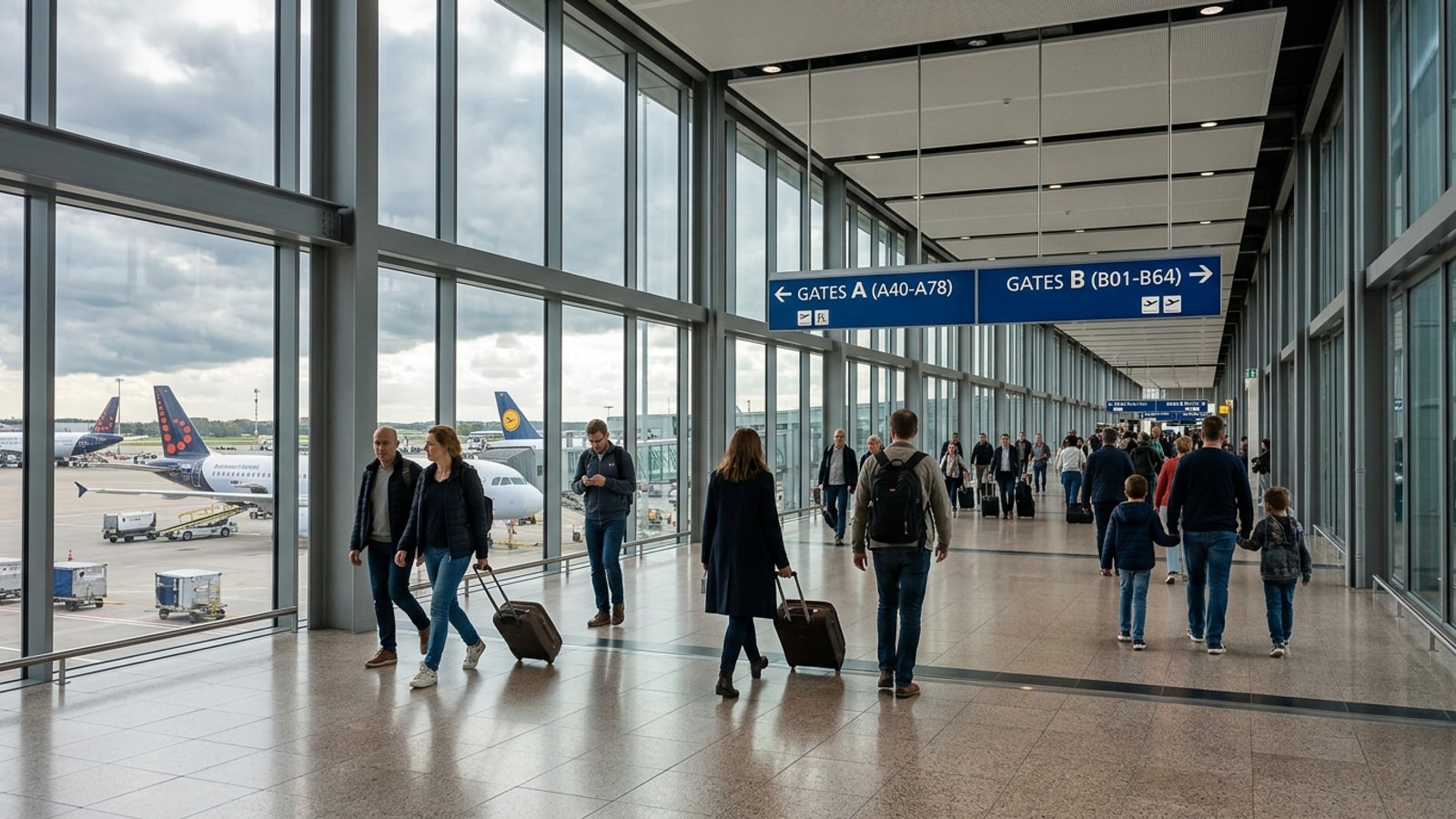
Connecting these two primary piers is the Connector, an expansive architectural glass link opened to streamline passenger transit. For travelers arriving on long-haul routes or connecting between European regional hops, understanding gate divisions, passport control protocols at Belgian Federal Police checkpoints, published Minimum Connection Times (MCT), and strict hold baggage interlining mandates prevents costly misconnections and missed departures.
Terminal Architecture and Concourse Layout
Brussels Airport operates with a vertical passenger processing design paired with horizontal concourse distribution. The Main Terminal houses Railway Station platforms on Level -1, Bus and Shuttle Terminals on Level 0, Baggage Reclaim and Arrivals on Level 2, and Check-in Departures on Level 3. Airside departures branch out into distinct functional sectors:
- Pier A (Gates A21 to A70): Pier A is dedicated primarily to intra-Schengen European flights and domestic feeder services. Stretching over 650 meters, it handles high-frequency departures to destinations in France, Germany, Italy, Spain, Switzerland, and Scandinavia.
- Pier A T-Zone (Gates T61 to T72): Located at the western tip of Pier A, this swing-gate zone functions as a Non-Schengen departure area during morning peak hours (typically 06:00 to 14:00). It is designated specifically for Brussels Airlines long-haul flights departing to sub-Saharan Africa (such as Kinshasa, Kigali, Entebbe, and Dakar) and North America. Passengers enter the T-Zone through a dedicated passport control checkpoint established inside Pier A.
- Pier B (Gates B01 to B40): Pier B serves as the airport's permanent Non-Schengen concourse. It processes international long-haul flights operated by United Airlines, Air Canada, Emirates, Qatar Airways, Etihad, and Hainan Airlines, alongside Non-Schengen European services to the United Kingdom, Ireland, and Turkey.
- The Connector: This glass-enclosed building connects the Main Terminal Departure Hall and Pier A directly to Pier B. It houses Europe's largest consolidated passenger security screening platform, equipped with automated lane return systems and advanced computed tomography (CT) scanners, along with the Belgian Federal Police border control checkpoints.
Moving between Pier A and Pier B does not require landside re-entry or tarmac shuttles. Connecting passengers walk through the Connector via dual-direction travel corridors equipped with moving walkways. Walking from the center of Pier A to the center of Pier B requires roughly 8 to 12 minutes at standard walking speed.
| Transfer Corridor | Route Classification | Typical Walking Time | Required Control Checkpoints | Published Minimum Connection Time (MCT) |
|---|---|---|---|---|
| Pier A to Pier A | Schengen to Schengen | 4–8 minutes | None (Direct Airside Concourse) | 50 Minutes |
| Pier A to Pier A (T-Zone) | Schengen to Non-Schengen (Africa/US) | 6–10 minutes | Outbound Passport Control (Pier A Checkpoint) | 50 Minutes |
| Pier A to Pier B via Connector | Schengen to Non-Schengen | 8–14 minutes | Outbound Passport Control (Connector e-Gates) | 60 Minutes |
| Pier B to Pier A via Connector | Non-Schengen to Schengen | 10–16 minutes | Inbound Passport Control + Transfer Security | 60–70 Minutes |
| Pier B to Pier B | Non-Schengen to Non-Schengen | 5–10 minutes | Origin-Dependent Transit Security | 50 Minutes |
| Landside Self-Transfer (Any) | Split Tickets / Re-check | 15–20 minutes | Baggage Reclaim (L2), Check-in (L3), Full Security | 150 Minutes Recommended |
Passenger Screening and Border Control Logistics
Flight connections at Brussels Airport fall into four operational categories based on origin and final destination borders.
1. Schengen to Schengen Connections (Pier A to Pier A)
Passengers flying between two destinations within the 29-nation Schengen Area (for instance, Madrid to Brussels to Vienna) disembark directly into the Pier A gate hall. No border control or security rescreening applies. Follow electronic flight information displays directly to your connecting gate.
2. Schengen to Non-Schengen Connections (Pier A to Pier B or T-Zone)
When departing the Schengen Area for an intercontinental or non-Schengen destination (such as Berlin to Brussels to New York JFK or London Heathrow), you walk toward Pier B through the Connector, or toward the western end of Pier A if your gate is marked with a "T" prefix.
- Outbound Passport Control: Positioned inside the Connector (for Pier B) or at the entrance to Gates T61–T72 (for the T-Zone).
- Automated e-Gates: Available to European Union, EEA, and Swiss citizens aged 12 and older holding biometric passports, as well as selected registered travelers.
- Manual Border Booths: Non-EU citizens, including travelers on Indian, British, Canadian, and American passports without automated access, undergo physical inspection and Schengen exit stamping by Belgian Federal Police officers.
3. Non-Schengen to Schengen Connections (Pier B to Pier A)
Arriving from outside the Schengen zone (such as New York, Montreal, Delhi, or London) and connecting to a European destination requires entering the Schengen Area at Brussels. Brussels represents your port of initial Schengen entry.
- Inbound Passport Control: Located at the border checkpoint before entering the Connector. Officers verify entry visas (such as a valid Schengen Uniform C Visa or biometric visa waiver), return tickets, hotel bookings, and travel insurance coverage. Passports receive a physical Schengen entry stamp.
- Transfer Security Screening: Because the European Union requires security validation for incoming flights from non-exempt third countries, passengers pass through security screening inside the Connector. Liquid rules apply: liquids exceeding 100ml are prohibited unless purchased at an EU duty-free shop and sealed in an authorized Tamper-Evident Bag (STEB) with the receipt visible.
4. Non-Schengen to Non-Schengen Connections (Pier B to Pier B)
Passengers flying between two non-Schengen destinations (such as London Heathrow to Brussels to Kigali, or Chicago to Brussels to Doha) remain entirely inside Pier B.
- You do not cross Belgian border control and do not receive a passport stamp.
- Passengers arriving from nations recognized under the EU One-Stop Security framework (such as the United States or the UK) proceed directly to their departure gate.
- Arriving from non-exempt origins requires passing transit security screening before entering the Pier B departure concourse.
Traveler Logistics Guide
Connecting through Brussels Airport requires proactive timing and document management. Adhere to the following operational parameters across your journey:
Published Minimum Connection Times (MCT)
Airlines enforce strict Minimum Connection Times at Brussels. Single-ticket reservations booked through airlines automatically conform to these windows:
- Intra-Pier A (Schengen to Schengen): 50 minutes.
- Pier A to Pier B / Pier B to Pier A: 60 minutes (extended to 70 minutes during morning bank rushes from 06:30 to 09:30).
- Intra-Pier B (Non-Schengen to Non-Schengen): 50 minutes.
- If an inward flight delay compresses your remaining connection time below the MCT threshold, contact the Brussels Airlines Transfer Desk in Pier A (near Gate A42) or Pier B (near Gate B15) to receive reissued boarding passes on the next available service.
Through-Checked Baggage vs. Self-Transfer Protocol
- Single-Ticket Journeys: If your entire itinerary is issued under a single booking reference (PNR) across Brussels Airlines, Star Alliance carriers, or interline partners, your checked luggage is transferred between planes automatically. You do not claim bags at Brussels Airport.
- Separate-Ticket Self-Transfers: If you purchased independent tickets on separate airlines (for instance, arriving on Ryanair or Wizz Air and connecting to an international long-haul flight on Qatar Airways or United):
- You must enter Belgium via Belgian Federal Police passport control.
- Take the escalators down to Level 2 Baggage Reclaim to collect your luggage from the assigned carousel.
- Clear Belgian Customs at the Green (Nothing to Declare) or Red (Goods to Declare) exit channels.
- Take elevators or escalators up to Level 3 Departures Hall.
- Check in at your onward carrier's desk and drop your luggage before the bag-drop cutoff (strictly 60 minutes prior to departure for international flights).
- Pass through central security screening at the Connector to enter the departure concourse.
- Allow a minimum self-transfer connection window of 150 minutes (2.5 hours) to absorb queue times.
Belgian Airport Transit Visa (ATV) Mandates
Travelers transiting through Pier B without leaving the international transit area must verify Belgian Airport Transit Visa requirements:
- Nationals of specific non-EU countries (including India, Pakistan, Bangladesh, Nigeria, Ghana, and several African and Asian states) require an Airport Transit Visa (Uniform Visa Type A) even to change planes airside between two non-Schengen flights in Pier B.
- Mandatory Exemptions: You are exempt from the Belgian ATV requirement if you hold a valid visa or residence permit issued by any Schengen member state, the United States, Canada, Japan, or the United Kingdom.
- If your transit involves transferring from Pier B to Pier A to catch a flight to another European country (such as Brussels to Paris or Rome), this is an internal Schengen flight. An Airport Transit Visa is insufficient; you must hold a valid Schengen C Entry Visa.
Terminal Facilities and Accessibility
- Special Assistance: PRM (Passengers with Reduced Mobility) services are provided by PRM Airport Services. Assistance must be booked through your operating airline at least 48 hours prior to flight departure. Electric transfer buggies operate through the Connector.
- Airline Lounges: Brussels Airlines operates "The Loft" flagship lounge in Pier A (across from Gate A42) and "The Sunrise Lounge" at the western end of Pier A / T-Zone. In Pier B, the "Diamond Lounge" serves Star Alliance business class passengers and Priority Pass members near Gate B01.
Frequently Asked Questions
Can I walk between Pier A and Pier B at Brussels Airport without taking a bus?
Yes. All passenger movement between Pier A and Pier B takes place on foot through the Connector building. The Connector is a climate-controlled, glass-enclosed structure featuring moving walkways. The walk takes between 8 and 14 minutes, depending on your arrival and departure gates.
Do I need to go through security again when connecting flights at Brussels Airport?
If you arrive on a Schengen flight and connect to another Schengen flight (Pier A to Pier A), you do not undergo security screening. If you arrive from an international Non-Schengen origin (Pier B) and connect to a Schengen flight (Pier A), or if you arrive from a non-EU security-exempt country, you must complete transit security screening inside the Connector before accessing departure gates.
What happens if I miss my connecting flight at Brussels Airport?
If your journey is booked on a single ticket and an inbound flight delay causes you to miss your connection, the operating carrier is legally obligated to rebook you on the next available flight at no additional charge. Proceed to the nearest Brussels Airlines Service Desk (located near Gate A42 in Pier A and Gate B15 in Pier B). If the delay falls under EU Regulation 261/2004 provisions, you may also be entitled to hotel accommodation, meal vouchers, and cash compensation.
Where do I re-check bags for a self-transfer at Brussels Airport?
For self-transfers on separate tickets, collect your luggage at the Baggage Reclaim hall on Level 2. After passing Belgian Customs, proceed up to Level 3 Departures. Check-in desks and bag-drop counters are arranged alphabetically across rows 1 through 10 in the main departure hall. Check-in desks close strictly 60 minutes before international long-haul departures.