

Quick Summary
- Primary Update: Seoul Incheon International Airport (ICN) operates three passenger handling facilities—Terminal 1 (T1), Concourse A (Satellite), and Terminal 2 (T2)—linked by an automated underground Intra-Airport Transit (IAT) shuttle train airside, and free circular buses alongside AREX rail landside.
- Transit Impact: SkyTeam alliance operations (Korean Air, Delta Air Lines, Air France, KLM) are centered at Terminal 2, while Asiana Airlines, Star Alliance, oneworld, and foreign low-cost carriers operate from Terminal 1 and Concourse A. Traveling airside between T1 and T2 requires riding the underground IAT shuttle train through Concourse A.
- Traveler Advice: Same-terminal international airside transfers require a minimum connection time of 45 to 60 minutes, whereas inter-terminal transfers between T1 and T2 require at least 90 to 120 minutes. Passengers with self-transfer bookings on separate tickets must clear South Korea immigration, collect luggage, pass customs, and take landside transit, requiring a minimum buffer of 180 minutes (3 hours).
Seoul Incheon International Airport (ICN), situated on Yeongjong Island approximately 48 kilometers west of Seoul, ranks among the most critical transpacific and intra-Asian aviation hubs. Serving as the primary interchange for travelers flying between North America, South Asia, Europe, and Australasia, Incheon processes tens of thousands of international transit passengers every day.
Navigating a connection at Incheon demands an exact understanding of its spatial layout: Terminal 1 (T1), the intermediate Concourse A (Gates 101–132), and Terminal 2 (T2). The two main terminal buildings sit approximately 15 kilometers apart by road across the airfield perimeter. Connecting between them requires choosing the correct transit channel based on whether you are traveling on a through-ticketed itinerary airside or completing a self-transfer landside.
Terminal Architecture and Airline Distribution
Incheon organizes flight operations predominantly around airline alliances and home carriers:
| Terminal / Facility | Operating Airlines | Alliance / Business Model | Primary Inter-Terminal Transit Mode |
|---|---|---|---|
| Terminal 1 (T1) | Asiana Airlines, Singapore Airlines, United Airlines, Air India, Lufthansa, ANA, Turkish Airlines, EVA Air, Air Canada, Cathay Pacific, Qatar Airways, American Airlines, British Airways, Emirates, Etihad, Jeju Air, T'way Air, Air Premia | Star Alliance, oneworld, Independent Flag Carriers, Domestic LCCs | Airside IAT Shuttle Train (B1F to Concourse & T2), Free Landside Circular Bus (3F Exit 8), AREX Rail (B1F) |
| Concourse A (Satellite) | VietJet Air, AirAsia, Cebu Pacific, Spring Airlines, Peach Aviation, select international foreign carriers | Foreign Low-Cost Carriers & Select Regional Airlines | Airside IAT Shuttle Train (B1F to T1 or T2) |
| Terminal 2 (T2) | Korean Air, Delta Air Lines, Air France, KLM Royal Dutch Airlines, China Airlines, Garuda Indonesia, Aeromexico, XiamenAir | SkyTeam Alliance Flagship Hub | Airside IAT Shuttle Train (B1F to Concourse & T1), Free Landside Circular Bus (3F Exit 4/5), AREX Rail (B1F) |
[ TERMINAL 1 (T1) ]
Asiana Airlines, Star Alliance, oneworld, Emirates, Domestic LCCs
Airside: Gates 1–50 | AREX Station: Incheon Airport Terminal 1 (B1F)
         |
         |  <=== Airside IAT Shuttle Train (Underground APM, 5 min) ===>
         |  <--- Landside Free Circular Bus (3F Exit 8, 15-20 min) --------->
         |  <=== Landside AREX Express / All-Stop Train (B1F, 6 min) ======>
         v
[ CONCOURSE A (탑승동) ]
Foreign Airlines, Select LCCs (Gates 101–132)
Airside Only (No Landside Road or Train Access)
         |
         |  <=== Airside IAT Shuttle Train (Underground APM, 5-6 min) ===>
         v
[ TERMINAL 2 (T2) ]
Korean Air, Delta Air Lines, Air France, KLM, SkyTeam Hub
Airside: Gates 230–270+ | AREX Station: Incheon Airport Terminal 2 (B1F)
Inter-Terminal Transit Systems: Airside vs. Landside
Selecting the correct transit mechanism at Incheon depends entirely on your baggage status and ticketing arrangement.
1. Airside Intra-Airport Transit (IAT) Shuttle Train
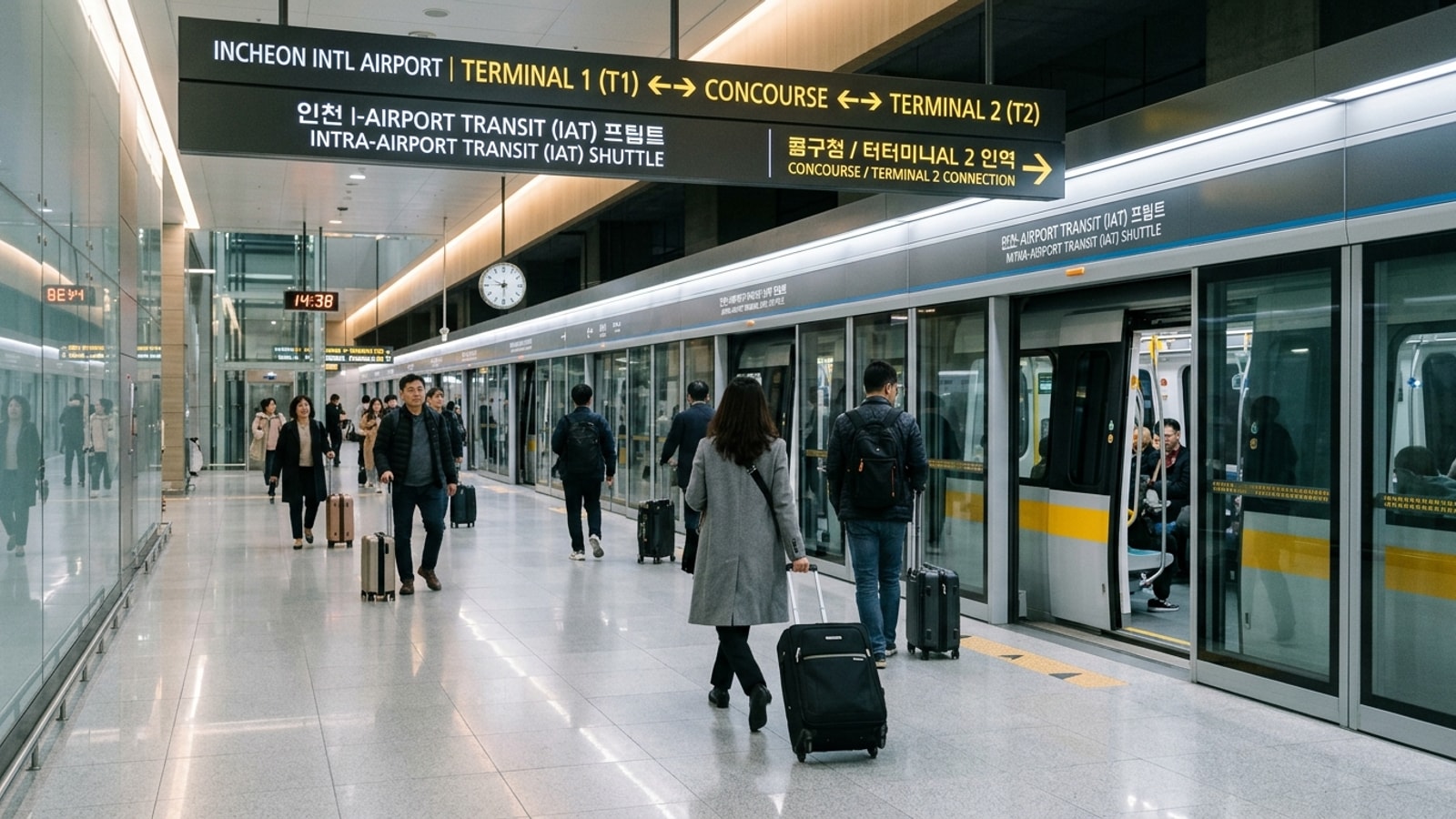
The Intra-Airport Transit (IAT) is an automated, underground people-mover train system operating within the secure airside zone. It connects Terminal 1, Concourse A, and Terminal 2 without requiring passengers to clear South Korean immigration or customs.
- Eligibility: You must hold a valid onward boarding pass (or flight transfer voucher) departing from the connecting terminal, and your checked baggage must be tagged straight through to your final destination.
- Track Geometry: The system operates dual tracks. Line 1 shuttles between Terminal 1 and Concourse A. Line 2 shuttles between Concourse A and Terminal 2. Passengers transferring directly from T1 to T2 ride through the Concourse A transfer node.
- Operating Hours & Frequency: The IAT operates 24 hours a day. Trains depart every 5 minutes during peak daytime hours and every 8 to 10 minutes late at night.
- Travel Time:
- Terminal 1 to Concourse A: Approximately 4 to 5 minutes.
- Concourse A to Terminal 2: Approximately 5 to 6 minutes.
- Terminal 1 to Terminal 2 total transit: Approximately 10 to 12 minutes (excluding transfer security screening queues).
- Security Checkpoints: Before boarding the IAT to your departure terminal, you must pass through an international transfer security checkpoint. Security staff inspect carry-on baggage and enforce strict liquid, aerosol, and gel (LAG) rules (all liquid containers must not exceed 100ml and fit inside a clear 1-liter bag).
- Directional Warning: Follow the green and blue "Transfer / Transit" (환승) signs. Airport staff verify boarding passes at the escalator entrances leading down to the IAT platforms (B1 level). Once you board the train to Concourse or T2, you cannot freely ride back to T1 without specific security personnel escort.
2. Landside Free Circular Shuttle Buses
If your journey requires clearing border control—such as traveling on separate self-transfer tickets, claiming baggage, or accessing landside hotels—Incheon International Airport Corporation provides free circular buses running outside the security perimeter.
- Route Length: The bus traverses the perimeter highway around the active airfield, covering roughly 15 kilometers between T1 and T2.
- Travel Time: 15 to 20 minutes depending on road traffic.
- Frequency & Operating Hours: Every 7 to 10 minutes from 05:00 to 24:00 daily. Night buses operate on reduced schedules between 00:00 and 05:00.
- Boarding Points:
- Terminal 1: 3rd Floor (Departures level), outside Exit 8.
- Terminal 2: 3rd Floor (Departures level), outside Exit 4 and Exit 5.
- Fare: Free of charge; no ticket or boarding pass inspection required.
3. AREX (Airport Railroad Express) Landside Train
The AREX rail line provides an efficient alternative for moving landside between terminals, especially during winter inclement weather.
- Stations: Located in the Transportation Centers (B1 level) of both Terminal 1 and Terminal 2.
- Travel Time: Precisely 6 minutes platform-to-platform.
- Frequency: Every 5 to 12 minutes between 05:20 and 23:50.
- Fare: Approximately 1,050 to 1,100 KRW (roughly $0.80 USD). You can tap a standard Korean transportation card (T-Money, WOWPASS) or purchase a single-journey transit token from automated ticket vending machines.
- Best Use Case: Recommended for passengers transferring between terminals landside who wish to avoid road congestion or winter weather delays.
Minimum Connection Times (MCT) and Operational Buffers
Incheon publishes official Minimum Connection Times for interlining carriers. However, practical transit buffers should account for peak arrival wave congestion and terminal walking distances.
| Connection Scenario | Official MCT | Recommended Real-World Buffer | Baggage & Security Protocol |
|---|---|---|---|
| International to International (T1 to T1, or T2 to T2) | 45 minutes | 75 to 90 minutes | Baggage through-checked; clear airside transfer security; stay on departure level. |
| International to International (T1 to Concourse A) | 60 minutes | 90 minutes | Baggage through-checked; clear transfer security; take IAT shuttle train to Concourse. |
| International to International (T1 to T2, or T2 to T1) | 70 to 90 minutes | 120 minutes (2 hours) | Baggage through-checked; clear transfer security; ride IAT between T1 and T2. |
| Self-Transfer / Separate Tickets (Same Terminal) | 120 minutes | 150 minutes (2.5 hours) | Clear Korea immigration, retrieve luggage, clear customs, re-check at departures counter. |
| Self-Transfer / Separate Tickets (Inter-Terminal: T1 <-> T2) | 150 minutes | 180 minutes (3 hours) | Clear border control, reclaim bags, customs, take shuttle bus/AREX to other terminal, re-check. |
1. Arrive at T1 Gate ---> 2. Follow Green/Blue "Transfer / Transit" (환승) Signage
                                 |
                                 v
3. International Transfer Security Checkpoint (X-ray, Metal Detector, 100ml LAGs)
                                 |
                                 v
4. Descend to B1F IAT Platform ---> Verify Boarding Pass at Train Gate Attendant
                                 |
                                 v
5. Board IAT Shuttle Train (5 min to Concourse, Transfer, 5 min to T2)
                                 |
                                 v
6. Arrive at T2 B1F ---> Ascend Escalators to T2 Departure Concourse (3F)
                                 |
                                 v
7. Verify Gate Monitor ---> Proceed to Connecting Gate (Gates 230–270+)
Baggage Re-Check and South Korea Customs Regulations
Correct handling of checked baggage depends on ticket integration and terminal routing:
Single-Ticket Interline Itineraries
If you booked an itinerary issued under a single booking reference (PNR)—for example, Air India connecting to Delta Air Lines, or Singapore Airlines connecting to Korean Air—your baggage tags indicate your final destination airport code.
- Your luggage automatically transfers between ramp systems across terminals.
- You do not collect baggage at Incheon.
- You do not clear South Korean immigration or customs.
Separate Tickets (Self-Transfer) Baggage Rules
If you purchased two independent tickets (e.g., flying an international legacy carrier into T1 and connecting on an independent low-cost carrier like Jeju Air or T'way Air):
- You must enter South Korea through passport control.
- Proceed to the baggage reclaim carousels and retrieve every checked bag.
- Pass through Korea Customs Service (KCS) inspection.
- Exit into the public arrivals lobby.
- Board the free circular shuttle bus (3F Exit 8 at T1) or the AREX train (B1F) to your departure terminal.
- Check in at the airline counter and drop bags before the strict 60-minute international cut-off window.
South Korea Customs Limits and Quarantine Restrictions
When clearing customs on a self-transfer or landside layover, incoming travelers are subject to Korea Customs Service regulations:
- General Duty-Free Allowance: Up to $800 USD in personal purchases.
- Alcohol: Up to 2 bottles (combined volume up to 2 liters, with total value under $400 USD).
- Tobacco: Up to 200 cigarettes (1 carton).
- Perfume: Up to 100 ml.
- Agricultural & Meat Bans: South Korea Animal and Plant Quarantine Agency strictly prohibits meat, processed meat products (beef jerky, sausages, pork rinds), and fresh fruits. Failure to declare meat items triggers mandatory on-the-spot fines ranging from 5,000,000 to 10,000,000 KRW ($3,700 to $7,400 USD).
South Korea Transit Visa Rules and TWoV Exemptions
Understanding immigration entry permissions is vital if your connection requires passing through the border:
Airside Sterile Transit (No Visa Required)
Travelers of all nationalities—including Indian passport holders—can transit airside at Seoul Incheon within 24 hours without a South Korean visa or K-ETA, provided they:
- Remain strictly inside the international airside transit area.
- Hold a confirmed onward boarding pass or reservation departing within 24 hours.
- Have luggage checked through to their final destination.
South Korea 30-Day Transit Without Visa (B-2 TWoV Facility)
Travelers whose nationalities generally require a South Korean visa (such as Indian citizens) can clear immigration into South Korea without a visa for up to 30 days under the B-2 Transit Without Visa program if they meet the following conditions:
- Hold a valid visa or permanent residency for the United States (including Guam and Saipan), Canada, Australia, or New Zealand.
- Are transiting through South Korea en route to or returning from one of these four countries (e.g., Delhi to Seoul to Los Angeles, or Vancouver to Seoul to Mumbai).
- Hold a confirmed onward flight ticket departing South Korea within 30 days.
- Have no record of criminal activity or immigration violations in South Korea.
Warning · Operational AdvisoryIf you hold an Indian passport without a valid visa for the US, Canada, Australia, or New Zealand, you cannot pass through border control for a self-transfer on separate tickets. You will be denied boarding at your origin airport if your booking requires collecting baggage landside at Incheon without a South Korean entry visa.
Transit Amenities, Nap Zones, and Free Transit Tours
Incheon provides some of the world's most extensive passenger amenities for extended layovers:
1. Airside Nap Zones and Free Showers
- Nap Zones: Located on the 4th Floor of both Terminal 1 (near Gates 25 and 29) and Terminal 2 (near Gates 231 and 268). Features leather recliner loungers, dim lighting, and power outlets.
- Free Transit Showers: Operating daily from 07:00 to 20:00 on the 4th floor of T1 and T2. Free for transit passengers holding onward boarding passes, complete with complimentary towel and toiletry kits.
2. Free Incheon Airport Transit Tours
For passengers with layovers exceeding 3 hours who are eligible to enter South Korea, the Incheon International Airport Corporation and Korea Tourism Organization operate complimentary guided transit tours.
- Destinations: Gyeongbokgung Palace, Insadong, Songdo Central Park, Sinpo Traditional Market, and Yonggungsa Temple.
- Registration Desks: Terminal 1 (1st Floor near Exit 8 or 2nd Floor transfer counter); Terminal 2 (1st Floor near Exit 3 or 2nd Floor transfer area).
- Requirements: Valid passport, boarding passes, and South Korean entry eligibility (visa, K-ETA, or B-2 TWoV exemption).
3. Transit and Capsule Hotels
- Airside Transit Hotels: Walkerhill operates the Incheon Airport Transit Hotel airside inside Terminal 1 (4F, Gate 11) and Terminal 2 (4F, Gate 252). No immigration clearance is required.
- Landside Capsule Hotels: The "Darakhyu" capsule hotel operates landside in both Terminal 1 (Transportation Center 1F) and Terminal 2 (Transportation Center B1F).
Traveler Logistics Guide
Follow this operational blueprint to complete your Incheon transfer smoothly.
Step-by-Step Airside Transfer Checklist (T1 <-> T2)
- Deplane and Seek Signage: Exit the jetbridge and look for bright green/blue "Transfer / Transit" (환승) signs. Avoid descending to immigration or baggage claim.
- Transfer Desk (If Missing Boarding Pass): If you do not hold an onward boarding pass, visit the airline transfer desks located on the 2nd and 4th floors of T1 or T2 before heading to security.
- Pass Transfer Security: Place liquids (strictly under 100ml in a 1L bag), laptops, and tablet computers into inspection trays. Show your onward boarding pass and passport.
- Take the IAT Train:
- Follow signs down to the B1 level IAT shuttle train station.
- Show your boarding pass to security staff at the escalator access gate.
- Board the train. If traveling from T1 to T2, ride through the Concourse stop to the terminal station.
- Ascend to Gate Concourse: Arrive at T2, take the escalators up to the 3rd Floor departure gate area, locate your gate on the overhead flight information display, and head to your boarding area.
Step-by-Step Landside Self-Transfer Checklist (Separate Tickets)
- Clear Border Immigration: Follow "Arrivals" (입국) signs to passport control. Present your passport, arrival card (or pre-approved K-ETA / B-2 qualification), and onward ticket.
- Collect Checked Baggage: Proceed to the baggage carousel indicated on the arrival screens and reclaim all bags.
- Clear Customs: Submit your paper declaration or scan your electronic declaration QR code at the customs checkpoint.
- Transfer Terminals:
- Shuttle Bus: Ascend to the 3rd Floor (Departures). Exit through Exit 8 at T1 (or Exits 4/5 at T2) and board the free circular bus (15–20 min ride).
- AREX Train: Head to the B1 level Transportation Center. Buy an AREX ticket or tap your T-Money card to ride 6 minutes to the other terminal.
- Re-Check Baggage: Head to your departing airline's check-in row on the 3rd Floor. Check in and drop luggage before the 60-minute departure cut-off.
Frequently Asked Questions
Can I travel between Terminal 1 and Terminal 2 without passing through immigration?
Yes. International passengers with confirmed onward tickets connecting between Terminal 1 and Terminal 2 on single or interlined itineraries can transfer airside using the underground Intra-Airport Transit (IAT) shuttle train. You remain inside the sterile international transit zone, pass through a transfer security screening, and do not clear South Korean border control or customs.
Can I walk between Terminal 1 and Terminal 2 at Incheon Airport?
No. There is no pedestrian walkway between Terminal 1 and Terminal 2. The terminals are separated by approximately 15 kilometers of airfield, runways, and cargo infrastructure. You must take the underground IAT shuttle train airside (free, 10–12 minutes total transit), or use the free circular shuttle bus (15–20 minutes) or the AREX rail line (6 minutes, ~1,100 KRW) landside.
How much connection time do I need for a self-transfer on separate tickets at Incheon?
You should reserve a minimum buffer of 3 hours (180 minutes). A self-transfer requires passing through South Korean border immigration, waiting for and retrieving checked bags at the carousel, clearing customs, taking the shuttle bus or AREX train to the other terminal, and checking in at the departures counter before the strict 60-minute international cut-off window.
Can Indian passport holders transit through Incheon Airport without a visa?
Indian passport holders can transit airside at Incheon for up to 24 hours without any visa or K-ETA, as long as they stay inside the sterile transit zone on a single through-ticket. If an Indian traveler needs to enter landside (for a self-transfer or extended layover), they can enter visa-free for up to 30 days under the B-2 Transit Without Visa (TWoV) program only if they hold a valid visa or permanent residency for the United States, Canada, Australia, or New Zealand and are traveling to or from that country. Otherwise, an advance South Korean visa is required to clear immigration.