

Quick Summary
- Primary Update: Indian Railways operates Suvidha Express trains (typically identified by five-digit numbers beginning with '82' or tagged as Suvidha specials) on high-demand festive and seasonal corridors, using a five-tier dynamic fare algorithm that scales ticket prices up to 3 times the base Tatkal rate as available berths decrease.
- Transit Impact: Suvidha tickets carry a strict cancellation policy: passenger-initiated cancellations finalized at least 6 hours prior to scheduled train departure (or before first chart preparation) yield a flat 50% refund of the total fare, while cancellations within 6 hours or post-charting yield zero refund. Waiting list (WL) tickets are never issued—only confirmed and RAC berths are available.
- Traveler Advice: Book Suvidha inventory within the earliest 20% tier to avoid paying escalated multi-tier surcharges. Never rely on senior citizen, student, or disability concessions because Suvidha trains legally enforce 100% full adult fares across all passenger categories, and always initiate cancellations before the 6-hour cutoff to avoid total fare forfeiture.
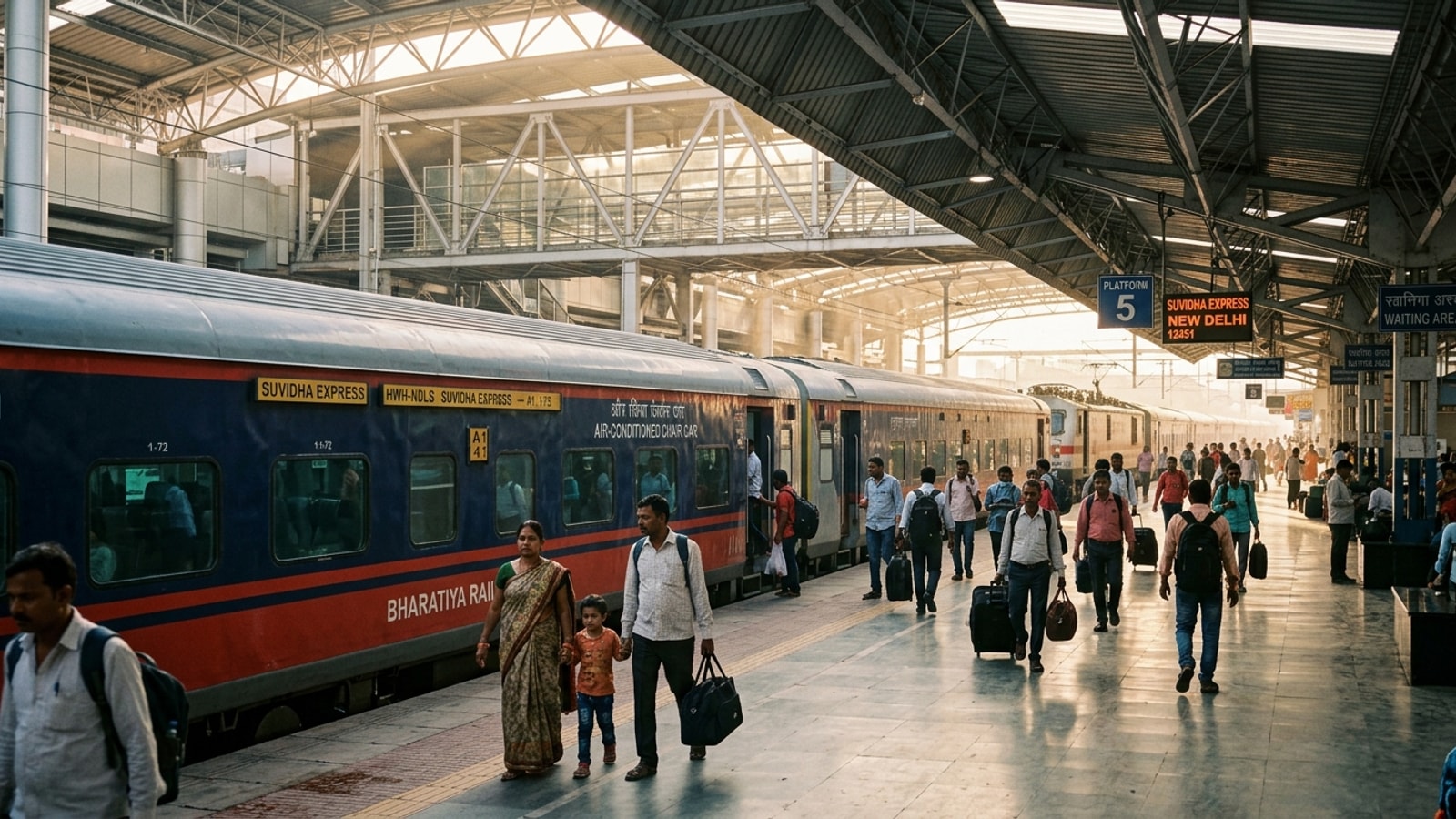
During peak travel periods—including Diwali, Chhath Puja, Durga Puja, Holi, and the summer holiday season—demand across Indian Railways trunk corridors routinely outstrips scheduled passenger train capacity. To absorb this surge without letting unauthorized touts corner scarce seats, the Ministry of Railways operates Suvidha Express services. Administered through the Centre for Railway Information Systems (CRIS) and ticketed across the Indian Railway Catering and Tourism Corporation (IRCTC) portal, Suvidha trains run under a distinct commercial framework that contrasts sharply with regular Mail/Express and standard Special trains.
For everyday travelers, booking a Suvidha service requires careful attention to ticketing rules. Unlike standard trains where cancellation fees follow fixed rupee deductions per passenger class, Suvidha reservations penalize last-minute changes heavily, impose strict cancellation cutoffs, disallow waitlisted travel, and discard all statutory fare concessions. Understanding these operational mechanics prevents unexpected financial losses and ensures smooth transit across India's busiest railway corridors.
The Operational Mandate of Suvidha Express Trains
Indian Railways originally framed the Suvidha commercial scheme under Railway Board Commercial Circular No. 33 of 2015, subsequently refining the framework to serve as a high-density, dynamic-pricing relief system. Suvidha trains operate primarily on heavy-demand routes linking major metropolitan gateways—such as New Delhi, Mumbai CSMT, Howrah, Bengaluru City, and Chennai Central—with high-traffic regional centers including Patna, Gorakhpur, Muzaffarpur, Varanasi, and Lucknow.
Identifying Suvidha Trains in PRS and IRCTC
- Rake Numbering Convention: Suvidha trains generally carry five-digit train numbers starting with the prefix 82xxx (for example, 82355/82356 or 82653/82654). During select holiday phases, select festival specials running with 0-series numbers are also gazetted under Suvidha fare rules.
- Portal Display: On the official IRCTC web portal and the IRCTC Rail Connect app, these trains are explicitly badged with the train name containing "SUVIDHA" or "SUVIDHA EXP".
- Priority Routing: Suvidha trains run with high operational priority across railway zones, matching the transit times and rake configurations of Superfast or Rajdhani/Duronto express rakes.
The 5-Tier Dynamic Fare Architecture
The core operational mechanism distinguishing Suvidha trains from standard services is an automated dynamic pricing model structured around five tiered inventory slabs. Rather than using fixed distance-based telescopic fares, Suvidha pricing fluctuates based on remaining seat capacity.
Base Fare Formulation
The baseline fare for the first block of tickets on a Suvidha train does not start at standard Mail/Express rates. Instead, the minimum entry fare is pegged directly to the base fare plus the standard Tatkal charges applicable to that travel class.
Total accommodation in each class (Sleeper, AC 3-Tier, AC 2-Tier, AC First Class, or AC Chair Car) is partitioned into five equal slabs representing 20% of total berth inventory:
Inventory Slab      |  Berth Availability Block  |  Base Fare Multiplier Calculation

Slab 1 (Base Tier)  |  First 20% of Total Berths |  1.0x Base Fare (Normal Fare + Tatkal Charge)
Slab 2              |  21% to 40% of Berths      |  1.5x Base Fare
Slab 3              |  41% to 60% of Berths      |  2.0x Base Fare
Slab 4              |  61% to 80% of Berths      |  2.5x Base Fare
Slab 5 (Peak Tier)  |  81% to 100% of Berths     |  3.0x Base Fare (Statutory Maximum Cap)
Statutory Surcharges and Non-Reversible Pricing
- Additional Charges: On top of the dynamically computed base fare, IRCTC levies mandatory ancillary charges:
- Reservation Fee: Applied per passenger based on class.
- Superfast Surcharge: Applied where average speeds qualify the service as Superfast.
- Goods and Services Tax (GST): A statutory 5% GST is assessed on all air-conditioned classes (AC First, 2A, 3A, 3E, and CC). GST does not apply to non-AC Sleeper class.
- Optional Catering: Where catering is offered on premium rakes, meal charges are added during checkout.
- Upward Ratchet Rule: Suvidha fares are strictly unidirectional. Once bookings advance into a higher bracket (for instance, Slab 3 at 2.0x base fare), ticket prices do not step backward to Slab 2 if prior passengers cancel their reservations. Vacated inventory is sold at the prevailing highest slab or the active market rate.
Quotas, Waitlists, and Concession Invariants
Suvidha trains enforce restrictive ticketing policies designed to maximize revenue and minimize operational friction at boarding stations.
Confirmed and RAC Accommodation Exclusivity
- Zero Waiting Lists: Suvidha Express services do not issue waitlisted tickets (WL). Under CRIS ticketing parameters, only Confirmed (CNF) berths and a limited allocation of Reservation Against Cancellation (RAC) seats are sold.
- Regret Status: Once the designated RAC quota is fully booked, the PRS engine returns an immediate "REGRET" status. Passengers cannot purchase waitlist tickets hoping for confirmation during chart preparation.
Complete Concession Ban
Indian Railways provides dozens of statutory fare concessions on standard trains, but Suvidha trains carry a strict, blanket prohibition on all concessions:
- Senior Citizens: No fare discount is granted under any circumstances.
- Divyangjan (Persons with Disabilities): Concession codes and companion discounts are invalid on Suvidha trains.
- Students, Patients, and War Widows: Standard medical, educational, and gallantry concessions cannot be applied.
- Full Adult Fares Mandatory: Every passenger traveling on a Suvidha train pays 100% of the calculated dynamic adult fare for their chosen class.
Child Ticketing Rules on Suvidha Services
Ticketing rules for children aged 5 to 11 on Suvidha trains adhere to standard Indian Railways child fare amendments, modified by dynamic pricing:
- If a separate berth or seat is requested for a child between 5 and 11 years of age, the ticket is charged at the full adult dynamic fare (100% of base fare multiplier plus all fees).
- If no separate berth is opted, the basic fare is calculated at half the dynamic base rate, though full reservation fees and GST apply.
- Children under 5 years of age travel free without an allocated berth.
Exclusion from Auto-Upgradation and Vikalp
- No Auto-Upgradation: The free PRS automatic berth upgradation facility (such as moving Sleeper passengers to vacant 3AC berths) is completely disabled for Suvidha trains.
- No Vikalp Alternate Accommodation: Passengers cannot opt into the Vikalp scheme to transfer their booking to alternative trains running on the same corridor.
The 50% Cancellation Penalty and Strict 6-Hour Refund Cutoffs
The single largest source of passenger grievance regarding Suvidha trains stems from cancellation deductions. Unlike regular Indian Railways tickets, where cancellation fees follow fixed slabs (such as ₹240 for 1AC, ₹200 for 2AC, ₹180 for 3AC, and ₹120 for Sleeper when cancelled over 48 hours in advance), Suvidha tickets enforce a percentage-based penalty.
Cancellation More Than 6 Hours Before Departure
- Flat 50% Fare Deduction: When a confirmed or RAC Suvidha ticket is cancelled at least 6 hours before the scheduled departure of the train from its originating station (or before the preparation of the First Reservation Chart, whichever occurs earlier), the refund amount is strictly 50% of the total fare paid.
- Loss of Dynamic Component: The 50% penalty applies to the gross fare—including the dynamic multiplier, reservation fee, and superfast surcharge. If a passenger paid ₹4,000 for a dynamically priced 2AC ticket, Indian Railways retains ₹2,000, refunding only ₹2,000 to the original payment method.
Cancellation Within 6 Hours of Departure: Zero Refund
- Total Fare Forfeiture: If a Suvidha ticket is cancelled within 6 hours of scheduled departure, or after the First Reservation Chart is generated, no refund is granted (0% refund).
- RAC Tickets Included: Unlike standard trains where RAC passengers can cancel up to 30 minutes before departure to retain a refund minus clerkage, Suvidha RAC tickets cancelled within the 6-hour window forfeit 100% of the fare.
Cancellation Timing Window               |  Ticket Status   |  Refund Amount Granted

More than 6 Hours Before Dep / Pre-Chart |  Confirmed (CNF) |  50% of Total Fare Paid
More than 6 Hours Before Dep / Pre-Chart |  RAC             |  50% of Total Fare Paid
Within 6 Hours of Scheduled Dep          |  Confirmed (CNF) |  0% (Zero Refund / Complete Loss)
Within 6 Hours of Scheduled Dep          |  RAC             |  0% (Zero Refund / Complete Loss)
After First Reservation Chart Locks      |  Any Status      |  0% (Zero Refund / Complete Loss)
Exceptions: Securing 100% Full Refunds via Online TDR Filing
Indian Railways provides specific consumer protection clauses where Suvidha passengers are entitled to a full 100% refund without the 50% deduction. These exceptions apply only when operational failures originate from the railway administration:
1. Train Cancelled by Indian Railways
If a Suvidha Express is cancelled by the railway administration due to fog, severe weather, track maintenance, or operational exigencies:
- E-Tickets: The full ticket amount (100% of base fare, dynamic surcharge, reservation fee, and GST) is credited automatically to the user's booking account without requiring manual intervention or TDR filing.
- Counter PRS Tickets: Passengers can claim a full cash refund across any computerized PRS counter within 72 hours of scheduled departure.
2. Train Delayed by More Than 3 Hours
If the Suvidha service is running late by more than 3 hours at the passenger's journey boarding station:
- Passengers who decide not to travel are eligible for a full 100% refund with zero clerkage fee deductions.
- Mandatory Procedure: For e-tickets, the passenger must file a Ticket Deposit Receipt (TDR) through the IRCTC portal before the actual departure of the train from their boarding station, selecting the reason: "Train Late More Than Three Hours and Passenger Not Traveled".
- If the train departs before the TDR is submitted, the passenger forfeits all refund rights.
3. AC System Failure in Air-Conditioned Coaches
In the event that the air conditioning plant fails en route and railway technicians cannot restore cooling:
- The passenger must obtain an official AC Failure Certificate issued by the onboard Train Ticket Examiner (TTE) or Coach Attendant.
- The passenger must file an online TDR within 72 hours of reaching their destination, submitting the TTE endorsement to claim a refund of the fare difference between the AC class paid and standard Sleeper class.
Comparison: Suvidha vs. Special Fare vs. Tatkal vs. Premium Tatkal
Passengers frequently confuse Suvidha Express trains with Special Fare (0-series) trains, standard Tatkal (CK), and Premium Tatkal (PT). The following structured comparison clarifies their fundamental operational differences:
| Feature / Metric | Suvidha Trains (82xxx) | Special Fare Trains (0xxxx) | Premium Tatkal (PT) | Standard Tatkal (CK) |
|---|---|---|---|---|
| Pricing Model | 5 Slabs (1.0x to 3.0x base Tatkal) | Fixed flat special fare or dynamic | Dynamic pricing on 50% Tatkal pool | Fixed base fare + standard Tatkal fee |
| Advance Reservation Window | Up to 30 or 60 days (08:00 AM) | Up to 60 or 120 days (08:00 AM) | 1 day prior (10:00 AC / 11:00 Non-AC) | 1 day prior (10:00 AC / 11:00 Non-AC) |
| Waiting List Allowed? | No (Only CNF and RAC issued) | Yes (GNWL / RLWL issued) | No (Only confirmed berths issued) | Yes (TQWL issued) |
| Concessions Allowed? | No (Zero concessions permitted) | No (Full adult fares apply) | No (Zero concessions permitted) | No (Zero concessions permitted) |
| Cancellation Refund (>6 hrs) | Flat 50% refund of gross fare | Standard railway cancellation slabs | Zero refund (0%) on confirmed tickets | Zero refund (0%) on confirmed tickets |
| Cancellation (<6 hrs / Chart) | Zero refund (0%) | Zero refund (within 4 hrs / chart) | Zero refund (0%) | Zero refund (0%) |
| Auto-Upgradation Scheme | Disabled | Applicable on select rakes | Disabled | Disabled |
| Mandatory Photo ID | Original ID required for all travelers | One passenger ID required per PNR | Original ID required for all travelers | One passenger ID required per PNR |
Identity Verification and Section 138 Penalties Onboard
Because Suvidha Express tickets command significant fare premiums, Indian Railways enforces rigorous ticket inspection protocols to curb ticket resale and impersonation.
Mandatory Identification Rules
- All Travelers Must Carry ID: Unlike standard PRS bookings where only one passenger on a multi-passenger ticket must produce original identification, Suvidha regulations require every passenger listed on the reservation manifest to carry a valid, government-approved original photo ID.
- Permitted Documents: Acceptable identity documents include:
- Aadhaar Card (physical card, m-Aadhaar mobile app, or DigiLocker verified credential).
- Passport.
- Voter Identity Card.
- Driving License issued by a state RTO.
- PAN Card.
- Photo-laminated Student ID issued by recognized educational institutions.
- Nationalized Bank Passbook bearing a clear photograph.
- Official Photo ID issued by Central or State Government bodies.
Legal Penalties for Non-Compliance
If any passenger on a Suvidha ticket cannot present an original identity document during ticket examination by the onboard TTE:
- The passenger's reservation is declared invalid on the spot.
- Under Section 138 of the Railways Act, 1989, the individual is treated as traveling without a valid ticket.
- The TTE is mandated to assess the full fare for the journey from the originating station plus a statutory penalty fine. Failure to pay warrants eviction from the coach and handover to the Railway Protection Force (RPF) at the subsequent junction.
Traveler Logistics Guide
Navigating Suvidha Express reservations requires proactive planning, particularly regarding booking timing and cancellation deadlines.
+---------------------------------------------------------------------------------------------------+
|                                 SUVIDHA BOOKING & CANCELLATION TIMELINE                           |
+---------------------------------------------------------------------------------------------------+
|  [T - 30 to 60 Days]   ----->   [Booking Progresses]   ----->   [T - 6 Hours]   ----->   [Departure]
|      BOOKING OPENS                  SLABS ADVANCE              CANCELLATION CUTOFF       NO REFUND
|   - 08:00 AM IST release       - 1.0x -> 1.5x -> 2.0x          - Last call for 50%       - Zero refund
|   - First 20% at Slab 1        - Fares never drop back           refund on CNF/RAC       - TDR only for
|   - RAC quota active           - Regret when RAC fills         - Charting begins           late trains
+---------------------------------------------------------------------------------------------------+
1. Booking Strategy: Securing Lower Slabs
- Monitor Opening Dates: Suvidha trains open for reservation at 08:00 AM IST on their designated Advance Reservation Period (ARP) date—frequently 30 days prior to the journey date, though specific festival notifications may extend this to 60 days.
- Inspect the Pricing Slab Before Payment: On the IRCTC booking screen, review the fare breakdown carefully. If the ticket cost reflects Slab 1 (base Tatkal rate), proceed immediately. If high demand has pushed pricing into Slab 4 (2.5x) or Slab 5 (3.0x), compare the total cost against domestic flight tickets or premium bus options operating on the same route.
- Confirm Quota Availability: Ensure your status shows
CNForRAC. If the train displaysREGRET, do not refresh repeatedly expecting waitlists to open, as CRIS does not generate waitlists for Suvidha services.
2. The Cancellation Decision Matrix
If your travel itinerary becomes uncertain, evaluate your cancellation timing against the strict 6-hour threshold:
- Before the 6-Hour Mark: Calculate your 50% recovery value. For example, if you paid ₹3,200 for a 3AC berth, cancelling before 6 hours guarantees ₹1,600 returned to your account.
- After the 6-Hour Mark: Cancellations processed at 5 hours and 59 minutes before departure forfeit 100% of the money. If you miss the 6-hour mark, cancelling the ticket voluntarily via IRCTC yields ₹0.
- Retaining Boarding Rights: If you are within the 6-hour window and cannot get a refund, you maintain full legal boarding rights up until departure. You may still complete the journey or gift the travel window to an immediate family member via an official station transfer (subject to Chief Reservation Supervisor approval 24 hours prior).
3. Step-by-Step TDR Filing for Delayed Services
If your Suvidha train is delayed by more than 3 hours at your boarding station and you choose not to board:
- Open the IRCTC website (
irctc.co.in) or the IRCTC Rail Connect app before the train departs your station. - Navigate to My Account > My Transactions > Booked Ticket History.
- Select your Suvidha PNR and click File TDR.
- Choose the reason: "Train Late More Than Three Hours and Passenger Not Traveled".
- Submit the request and note the TDR reference number. CRIS validates the operational delay against National Train Enquiry System (NTES) logs and credits a full 100% refund to your originating payment account.
Frequently Asked Questions
Why do IRCTC Suvidha trains only refund 50% of the ticket fare upon cancellation?
Indian Railways structured Suvidha Express services under a distinct commercial framework designed to curb speculative bookings during peak travel rushes and ensure high seat utilization on relief rakes. Under Railway Board Commercial Circular No. 33 of 2015, passenger-initiated cancellations finalized at least 6 hours prior to scheduled train departure (or prior to first chart preparation) refund exactly 50% of the gross fare paid, while the remaining 50% is retained as railway cancellation charges. If cancelled within 6 hours of departure, zero refund is granted.
Can senior citizens, students, or persons with disabilities claim fare concessions on Suvidha trains?
No. Suvidha Express services operate under a blanket prohibition against all statutory passenger fare concessions. Senior citizens, Divyangjan (persons with disabilities), students, medical patients, war widows, and accredited journalists must pay 100% of the active adult dynamic fare. No quota concessions or subsidized rates can be applied under the Passenger Reservation System for these services.
What happens if a Suvidha train is cancelled by Indian Railways or delayed by over 3 hours?
If Indian Railways cancels a Suvidha train due to operational reasons, weather, or track maintenance, e-ticket passengers receive an automatic 100% refund of the full fare (including dynamic surcharges, reservation fees, and GST) with no deduction or TDR filing required. If the train is running late by more than 3 hours at the boarding station and the passenger decides not to travel, they must file an online Ticket Deposit Receipt (TDR) before the actual departure of the train to obtain a full 100% refund.
Can I book a waiting list ticket on a Suvidha train if all confirmed and RAC berths are full?
No. Suvidha trains do not issue waiting list (WL) tickets. The Passenger Reservation System is programmed to issue only Confirmed (CNF) berths and a small quota of Reservation Against Cancellation (RAC) seats. Once the RAC capacity is exhausted, the train status automatically switches to "REGRET", preventing any further waitlist purchases.