

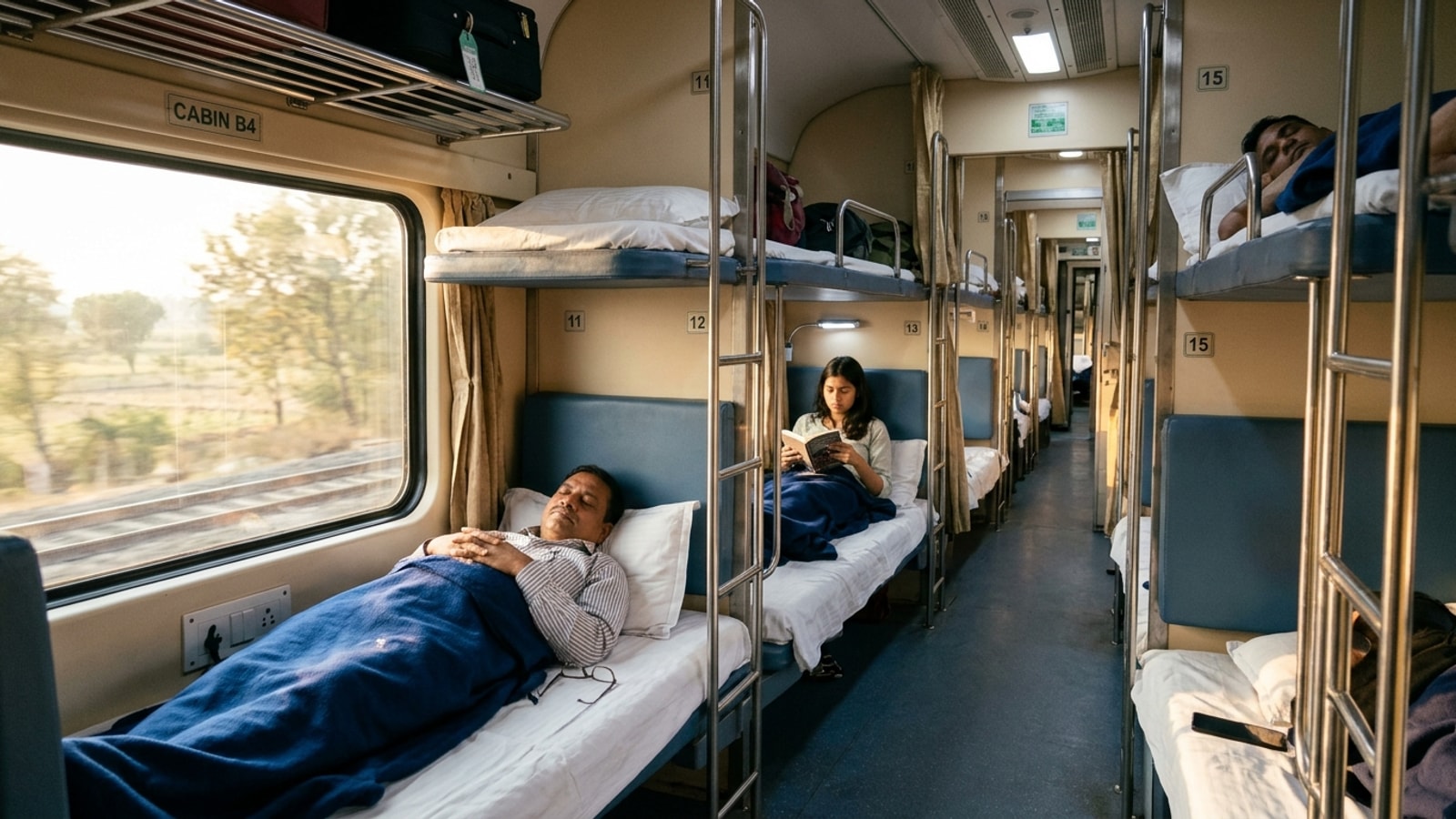
Quick Summary
- Primary Update: Indian Railways operates an automated, zero-cost seat upgradation scheme that elevates confirmed passengers to the next higher travel class (such as Sleeper to 3AC, or 3AC to 2AC) whenever higher-tier berths remain vacant at chart preparation time.
- Transit Impact: Upgrades occur strictly during First Reservation Chart generation (typically 4 hours prior to train departure). The vacated lower-class berths are immediately reallocated to waitlisted passengers of that class, clearing congestion without split-booking penalties.
- Traveler Advice: No fare difference is charged for auto-upgrades, and cancellation penalties remain tied to your original booked class. However, passengers requiring specific lower berths (senior citizens, medical travelers) should uncheck the auto-upgradation box during booking to avoid randomized upper-berth placement in higher coaches.
When booking train tickets through the Indian Railway Catering and Tourism Corporation (IRCTC) portal, mobile application, or Passenger Reservation System (PRS) passenger counters across India, travelers routinely encounter the checkbox labeled "Consider for Auto Upgradation." Governed by commercial guidelines established by the Railway Board and engineered by the Centre for Railway Information Systems (CRIS), this feature serves as an automated yield-management and passenger-welfare tool across the national rail network.
The system addresses a recurring operational imbalance: premium air-conditioned coaches often depart with vacant inventory while high-demand Sleeper and 3-Tier AC coaches accumulate extensive waitlists. By systematically promoting confirmed passengers to vacant higher-class berths at zero additional cost, Indian Railways optimizes train capacity, elevates the passenger experience, and unlocks lower-tier inventory for waitlisted travelers. Understanding how the algorithm selects beneficiaries, what rights passengers retain regarding bedrolls and cancellations, and why certain travelers deliberately opt out is vital for every rail passenger.
How the Auto-Upgradation Mechanism Functions
The IRCTC auto-upgradation mechanism operates entirely without human intervention through CRIS central database routines. The process executes exclusively when the First Reservation Chart is prepared at the train's originating station or remote charting node—typically 4 hours before scheduled departure (or at 20:00 IST the preceding evening for trains departing prior to 14:00 IST).
[Executive Class (EC)]      <--- Vacant Berths Filled by Confirmed AC Chair Car (CC)
[AC First Class (1AC)]      <--- Vacant Berths Filled by Confirmed AC 2-Tier (2AC)
[AC 2-Tier (2AC)]           <--- Vacant Berths Filled by Confirmed AC 3-Tier (3AC / 3E)
[AC 3-Tier (3AC / 3E)]      <--- Vacant Berths Filled by Confirmed Sleeper Class (SL)

* RESULTING BENEFIT:
Vacated lower berths immediately absorb General Waiting List (GNWL) / RAC passengers!
The Single-Tier Step Rule
The algorithm enforces a strict single-step progression. Passengers cannot skip intermediate classes regardless of vacancy:
- Sleeper Class (SL) can only be upgraded to AC 3-Tier (3AC) or AC 3-Tier Economy (3E).
- AC 3-Tier (3AC) can only be upgraded to AC 2-Tier (2AC).
- AC 2-Tier (2AC) can only be upgraded to AC First Class (1AC).
- AC Chair Car (CC) can only be upgraded to Executive Class (EC).
- Second Sitting (2S) can only be upgraded to AC Chair Car (CC) where train composition permits.
A passenger booked in Sleeper Class cannot jump directly to 2AC or 1AC. However, the system frequently executes "cascade upgrades." If 2AC has empty berths and 3AC has a waitlist, confirmed 3AC passengers move up to 2AC, opening 3AC berths that are subsequently populated by confirmed Sleeper passengers. The resulting open Sleeper berths then confirm waitlisted Sleeper travelers.
Eligibility Criteria & PNR Integrity Rules
Not every booked traveler qualifies for an automatic seat upgrade. CRIS programming enforces rigorous screening parameters to ensure fairness and prevent booking exploitation.
1. Booking Status Prerequisite
Only passengers holding Confirmed (CNF) status at the moment of chart preparation qualify. Passengers holding Reservation Against Cancellation (RAC) or Waiting List (WL) status cannot receive an auto-upgrade directly to a higher class. Their movement is restricted to taking over the seats vacated by upgraded confirmed passengers within their own booked class.
2. Fare Type Requirements
Auto-upgradation applies to full-fare paying tickets, including general quota and Tatkal bookings. However, tickets booked under concession passes, railway duty passes, Member of Parliament quotas, or free military warrants are excluded from the auto-upgradation pool.
3. PNR Integrity and Group Allotment
One of the most rigid constraints in the algorithm is the preservation of Passenger Name Record (PNR) integrity. If a single PNR contains four passengers, the system will upgrade the party only if four vacant berths exist simultaneously in the higher class.
The software will never split a PNR. If a higher class has only two vacant berths available, a family of three or four on a single ticket will be bypassed entirely. Instead, the algorithm searches for smaller party sizes (a PNR with two passengers or a solo traveler) that matches the exact vacancy count.
IRCTC Auto-Upgradation Class Matrix & Entitlements
The following structured table outlines the class-by-class progression, onboard amenities, and financial terms governing upgraded tickets:
| Booked Class | Upgraded Class | Fare Difference Charged | Bedroll / Linen Entitlement | Catering Surcharge | Cancellation Fee Basis |
|---|---|---|---|---|---|
| Second Sitting (2S) | AC Chair Car (CC) | ₹0 (Free) | Not applicable | Standard CC menu rates apply if opted | Charged at 2S rate (₹60 flat) |
| Sleeper Class (SL) | AC 3-Tier (3AC / 3E) | ₹0 (Free) | Full complimentary bedroll set | Standard AC menu rates apply if opted | Charged at SL rate (₹120 flat) |
| AC 3-Tier (3AC) | AC 2-Tier (2AC) | ₹0 (Free) | Full complimentary bedroll set | Included or standard as per train type | Charged at 3AC rate (₹180 flat) |
| AC 2-Tier (2AC) | AC First Class (1AC) | ₹0 (Free) | Full complimentary 1AC linen set | Premium 1AC service protocols | Charged at 2AC rate (₹200 flat) |
| AC Chair Car (CC) | Executive Class (EC) | ₹0 (Free) | Not applicable | Upgraded EC meal tray in Shatabdi | Charged at CC rate (₹180 flat) |
Cancellation Charges and Refund Rights on Upgraded Berths
A major concern among train travelers is how cancellation fees are assessed once an upgrade is granted. Indian Railways commercial rules explicitly safeguard the passenger against higher penalties:
The Original Fare Invariant
Under Railway Board Commercial Rules, cancellation charges are calculated strictly on the fare of the original booked class, not the higher upgraded class.
For example, if a traveler books a Sleeper Class ticket costing ₹450 and receives an automated upgrade to a 3AC coach (where the normal fare might be ₹1,200), the cancellation penalty remains tied to Sleeper Class rules:
- Cancellation more than 48 hours before departure: A flat cancellation fee of ₹120 per passenger is deducted (the standard Sleeper rate), rather than the ₹180 fee applicable to 3AC.
- Cancellation within 48 to 12 hours: 25% of the original Sleeper fare is deducted (subject to the minimum flat fee).
- Cancellation between 12 and 4 hours (prior to chart preparation): 50% of the original Sleeper fare is deducted.
Post-Charting Cancellation and TDR Rules
Because auto-upgradation occurs during chart preparation, any cancellation after the upgrade has taken place falls under post-charting rules:
- Confirmed e-tickets cannot be cancelled online once the first chart is generated.
- If the upgraded passenger chooses not to travel, they must file an online Ticket Deposit Receipt (TDR) before the train's scheduled departure from their boarding station.
- If a train is cancelled by Indian Railways, or runs delayed by more than three hours and the passenger elects not to travel, a full 100% refund of the original fare paid is processed via TDR without deduction of clerkage charges.
Why Certain Travelers Should Opt Out
While receiving a complimentary upgrade to an air-conditioned coach appears universally advantageous, seasoned travelers frequently uncheck the "Consider for Auto Upgradation" box for several practical reasons:
The Berth Reallocation Risk
When CRIS reallocates an upgraded passenger to a higher class, the seat assignment algorithm prioritizes vacancy matching over personal berth preferences. A senior citizen who specifically requested and secured a Lower Berth in Sleeper Class might be assigned an Upper Berth or Side Upper Berth in 3AC.
Because climbing into an upper berth in an AC coach can be difficult for elderly passengers or those with joint conditions, travelers prioritizing guaranteed lower berths should uncheck the auto-upgradation box during ticket booking.
Separation of Multi-PNR Groups
When large families or tour groups book tickets across two or three separate PNRs, opting into auto-upgradation carries the risk of splitting the group. If one PNR contains two passengers and gets upgraded to 2AC while the second PNR with four passengers remains in Sleeper Class, the party will be scattered in separate coaches throughout the journey.
Traveler Logistics Guide
Navigating an upgraded journey requires adhering to specific verification and boarding protocols to prevent unauthorized occupancy disputes onboard.
Step 1: Pre-Departure Status Verification
- Automated SMS Notification: Once the First Reservation Chart locks, IRCTC dispatches an automated SMS to the registered mobile number indicating your new coach and berth details (e.g., "PNR 2418901234: Passenger P1 upgraded from S4/21 to B2/43").
- Online PNR Tracking: If you do not receive an SMS, check your 10-digit PNR status on the official IRCTC web portal, the IRCTC Rail Connect app, or send an SMS formatted as
PNR <10-digit number>to139. - Online Reservation Charts Portal: Visit
contents.irctc.co.inor the "Charts / Vacancy" tab on the IRCTC homepage. Enter the train number and boarding station to view the final physical coach layout and confirm your name on the upgraded manifest.
Step 2: Boarding and Onboard Etiquette
- Proceed Directly to the Upgraded Coach: Do not attempt to board your original coach or occupy your previous berth. The moment the upgrade processes, your old seat is legally transferred to a waitlisted passenger whose ticket now bears your previous berth number.
- Digital Ticket Presentation: Present your original electronic reservation slip (ERS), virtual reservation message (VRM), or booked ticket SMS alongside an accepted government photo ID (Aadhaar, Passport, PAN Card, Voter ID, or Driving License).
- TTE Handheld Terminal (HHT) Sync: Train Ticket Examiners carry digital HHT tablets synchronized with the CRIS charting server. The conductor's screen reflects your upgraded berth assignment automatically; you do not need an endorsed physical printout from the station booking office.
Step 3: Bedroll & Catering Collection
- Linen Distribution: In 3AC, 2AC, and 1AC coaches, the coach attendant will distribute standard sanitized bedroll kits (two bedsheets, one pillow with slip, and one blanket) at no added fee.
- Pantry Meals: If traveling on trains with prepaid catering (Rajdhani, Shatabdi, or Duronto Express), inform the onboard pantry staff of your upgraded seat number so your meal preference is routed to the correct coach.
Frequently Asked Questions
Do I have to pay any additional fare or GST if my Sleeper ticket is upgraded to 3AC?
No. Indian Railways auto-upgradation is completely free of charge. You do not pay the difference in base fares, reservation charges, superfast surcharges, or Goods and Services Tax (GST). Your journey in the higher class is fully honored against the fare paid on your original booking.
Can RAC or waitlisted passengers be auto-upgraded directly to a higher class?
No. CRIS software algorithms restrict auto-upgrades exclusively to confirmed (CNF) passengers. Waitlisted and RAC passengers cannot bypass their booked tier into a higher travel class. However, RAC and waitlisted passengers benefit directly from the scheme: as confirmed passengers move upward into vacant AC coaches, their vacated lower berths are immediately transferred to RAC and waitlisted travelers within that same class.
If my ticket is upgraded from Sleeper to 3AC and I cancel it, what cancellation fee applies?
Cancellation penalties are assessed based on your original booked class. If you cancel an upgraded Sleeper-to-3AC ticket prior to charting deadlines, you pay the flat Sleeper cancellation charge (₹120) or applicable percentage of the Sleeper fare, rather than the higher ₹180 fee assigned to 3AC cancellations.
Why did my PNR not get upgraded even though vacant berths were visible in 3AC?
Auto-upgradation requires an exact match between available vacant berths and the number of passengers listed on your single PNR. If a higher class has only two open berths and your PNR contains three or four travelers, the system skips your booking to preserve group integrity, awarding the upgrade to a matching 2-passenger or solo-passenger PNR instead. Furthermore, passengers who unchecked the auto-upgradation box or booked under concession passes are automatically bypassed.