

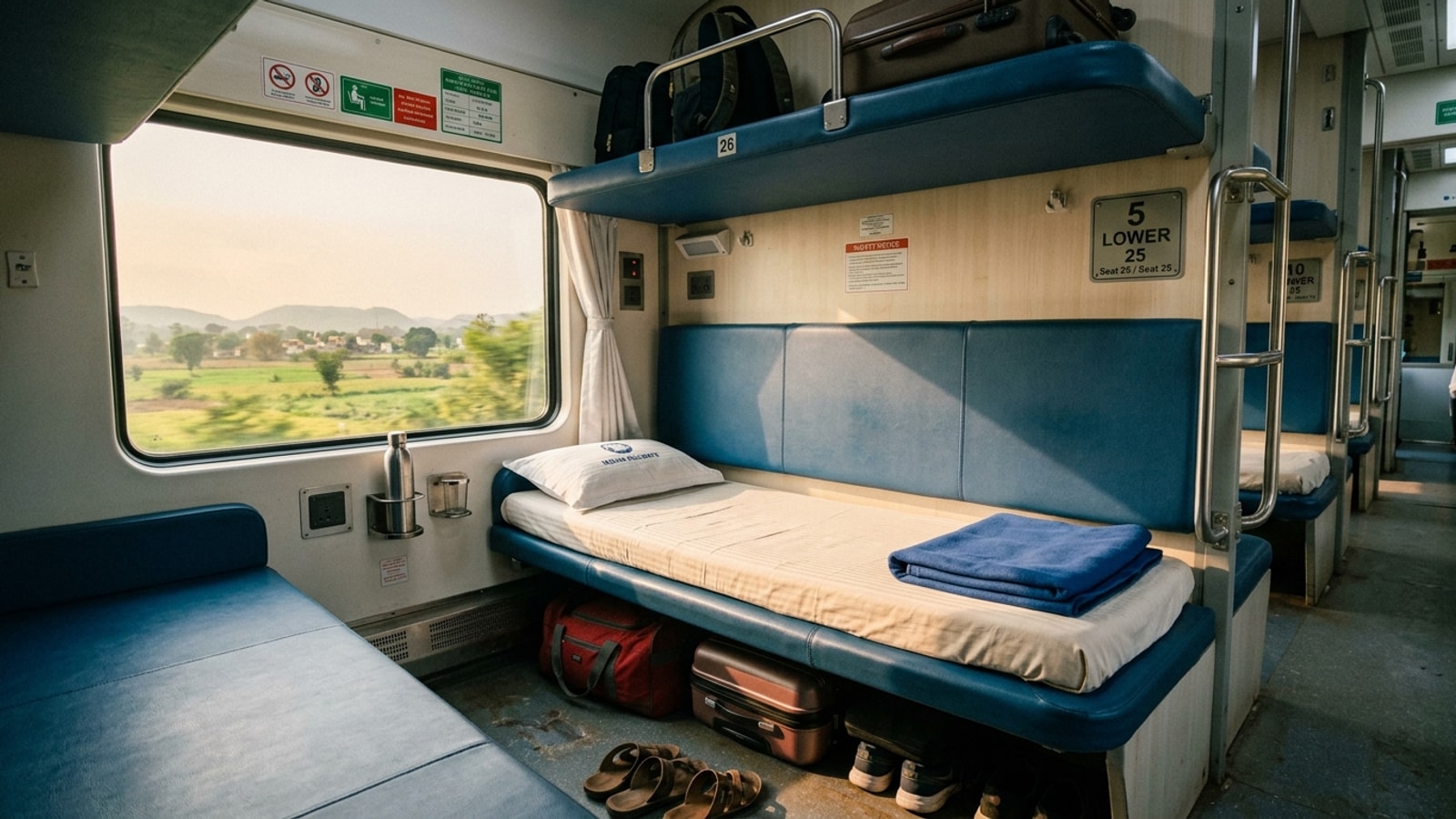
Quick Summary
- Primary Update: Indian Railways reserves designated Lower Berth Quota (SS Quota) berths across Sleeper, AC 3 Tier, AC 3 Economy, and AC 2 Tier coaches specifically for male passengers aged 60 and above, female passengers aged 45 and above, and pregnant women travelling solo or in pairs.
- Transit Impact: Up to 6 to 7 lower berths per coach in Sleeper and 3 to 5 in AC classes are ring-fenced from the general booking pool; combining an eligible senior citizen with an ineligible passenger on the same PNR disqualifies the entire reservation from the SS quota.
- Traveler Advice: Book senior citizens on separate PNRs to trigger the Lower Berth Quota, utilize the "Book only if at least one lower berth is allotted" filter with caution, and carry valid government age proof or medical fitness certificates to protect your allotment from TTE penalty reassignment.
Securing a lower berth on Indian Railways is one of the most critical logistical concerns for elderly travelers, passengers with limited mobility, and expecting mothers. Climbing the narrow metal ladders to access middle or upper berths poses physical hazards, particularly during nighttime train motion. To address this mobility challenge, the Railway Board and the Centre for Railway Information Systems (CRIS) maintain specific reservation parameters within the computerized Passenger Reservation System (PRS).
Despite these statutory safeguards, thousands of passengers encounter disappointment during ticket booking, receiving upper or middle berths despite entering senior citizen age profiles. These outcomes stem from misunderstandings regarding how the Lower Berth Quota operates, strict solo-traveler conditions, and the mathematical limits of coach-specific berth pools. This operational manual outlines the exact eligibility requirements, quota limits, algorithmic assignment steps, daytime seating conventions, and onboard Traveling Ticket Examiner (TTE) reassignment rights for 2026 journeys.
Statutory Eligibility Criteria and Age Limits
The Lower Berth Quota—coded as SS Quota within the IRCTC reservation system—is distinct from the General Quota (GN). While any passenger can request a lower berth as a general seating preference, the SS Quota ring-fences a dedicated pool of lower berths exclusively for passengers meeting specific legal criteria.
1. Senior Citizens (Male Passengers)
- Age Qualification: Male travelers must be 60 years of age or older on the exact date of journey commencement.
- Proof Requirement: An original government-issued photo identity card bearing the passenger's full date of birth (such as an Aadhaar Card, Passport, Voter ID Card, or Driving License) must be produced for physical verification during onboard ticket checks.
2. Senior and Solo Female Passengers
- Age Qualification: Female travelers qualify for the Lower Berth Quota starting at 45 years of age.
- Policy Intent: Indian Railways lowered the threshold for women to provide ergonomic comfort and enhanced personal security for women traveling alone or without family assistance.
3. Expecting Mothers (Pregnant Women)
- Age Qualification: Pregnant women of any age are legally eligible to claim the Lower Berth Quota.
- Counter Booking Protocol: When purchasing tickets at physical computerized PRS reservation counters, pregnant passengers must present a medical certificate issued by a registered medical practitioner confirming their pregnancy and journey fitness.
- Online IRCTC Protocol: Travelers booking through the IRCTC portal select the Lower Berth/Senior Citizen Quota dropdown. Expecting mothers must carry an authentic physical copy of their obstetrician certificate throughout the journey to present upon inspection by the TTE.
The Group Booking Disqualification Trap
The single most frequent reason eligible senior citizens fail to secure a lower berth is the group booking disqualification rule.
The PRS algorithm enforces strict party-size constraints to prevent misuse of the SS Quota:
- Maximum Two Eligible Passengers: The Lower Berth Quota can only be selected if the booking contains a maximum of two eligible passengers (e.g., two passengers who are both males 60+ or females 45+).
- Immediate Disqualification with Mixed Age Groups: If a PNR includes an eligible senior citizen (e.g., a 68-year-old grandfather) alongside an ineligible traveler (e.g., a 34-year-old son or a 12-year-old grandchild), the IRCTC system automatically blocks or disables the Lower Berth Quota.
- Reversion to General Quota: If forced through under General Quota, the algorithm attempts to seat the group together in the same bay or compartment. If a lower berth is unavailable in an open bay with adjacent seats, the algorithm assigns middle, upper, or side upper berths to keep the family in close proximity, rather than separating the senior citizen into an isolated lower berth elsewhere in the coach.
To ensure an elderly relative receives a lower berth, families should book the senior citizens on an independent PNR under the Lower Berth Quota, while booking accompanying adult family members on a separate PNR.
Lower Berth Quota Allocation Matrix by Coach Class
The Railway Board mandates a fixed number of lower berths per coach under the Lower Berth Quota across all express, mail, Superfast, Rajdhani, and Duronto rakes.
| Coach Class / Type | Lower Berth Quota (SS) per Coach | Typical Total Berths in Coach | Eligibility Threshold | CRIS Booking Priority & Rules |
|---|---|---|---|---|
| Sleeper Class (SL) | 6 to 7 Lower Berths | 72 or 80 Berths | Men 60+, Women 45+, Pregnant | Max 2 eligible travelers per PNR; high demand pool |
| AC 3 Tier (3A) | 4 to 5 Lower Berths | 64 or 72 Berths | Men 60+, Women 45+, Pregnant | Ring-fenced from general pool; auto-assigned first |
| AC 3 Economy (3E) | 4 to 5 Lower Berths | 80 or 83 Berths | Men 60+, Women 45+, Pregnant | Compact bays; high physical need for floor-level berths |
| AC 2 Tier (2A) | 3 to 4 Lower Berths | 46 or 54 Berths | Men 60+, Women 45+, Pregnant | Generous legroom; lowest step height into berth |
| AC First Class (1A) | No fixed SS quota | 18 to 24 Berths | Discretionary allotment | Allotted during manual chart preparation by CRS |
| Executive / AC Chair Car | Window / Aisle Priority | 56 to 78 Seats | No dedicated berth quota | Ergonomic seating priority near coach doors |
Note: In trains running with fewer than normal coach compositions, quota counts are scaled proportionally by the zonal division.
Computerized Auto-Allocation Logic in General Bookings
Even when tickets are booked under the General Quota (GN) rather than the specialized SS Quota, the CRIS reservation software includes an automated lower berth prioritization filter for senior travelers:
- Automatic Logic: When passenger details show an age of 60+ (male) or 45+ (female), the ticketing engine prioritizes any unreserved lower berth in the General Quota pool, provided the passenger travels solo or with another senior citizen.
- The "Choice" Checkbox Risk: During online checkout, IRCTC offers passenger reservation conditions:
- Option 1: Book only if at least one lower berth is allotted.
- Option 2: Book only if two lower berths are allotted.
- Operational Consequence: Selecting these conditions acts as a hard filter. If all general and quota lower berths have been taken, the booking engine will immediately abort the transaction without issuing tickets. If the train is filling rapidly, aborting can result in losing waitlist priority. Use this option only if travel is entirely contingent on securing a bottom berth.
Daytime Seating vs Nighttime Sleeping Hours Rule
Holding a confirmed lower berth does not grant exclusive ownership of that space throughout the entire journey. Indian Railways operates under clear regulatory standards regarding daytime seating rights:
- Nighttime Sleeping Hours (22:00 to 06:00):
- Between 22:00 (10:00 PM) and 06:00 (6:00 AM), the lower berth passenger is entitled to lie down and sleep undisturbed.
- Middle berths must be raised only during this designated window.
- Daytime Seating Hours (06:00 to 22:00):
- Between 06:00 (6:00 AM) and 22:00 (10:00 PM), middle berths must be folded down flat against the compartment partition.
- Passengers assigned to the middle and upper berths possess a statutory right to sit on the lower berth alongside the lower berth passenger.
- The lower berth occupant cannot demand that middle or upper berth passengers vacate the lower seat during these hours.
- Mutual Courtesy for Infirm Passengers:
- Railway guidelines instruct onboard ticket staff to assist elderly, unwell, or pregnant passengers who need to rest during daytime hours by requesting neighboring passengers to accommodate them through mutual agreement.
Onboard TTE Powers, Handheld Terminals (HHT), and Vacant Berth Reallocation
When a senior citizen fails to obtain a lower berth at the time of booking and is assigned a middle or upper berth, they are not entirely without options on the day of travel.
Railway Board Directives on Handheld Terminals (HHT)
All Traveling Ticket Examiners operate digital Handheld Terminals synchronized via cellular data networks to the central PRS:
- No-Show Detection: When a passenger holding a confirmed lower berth fails to board at their originating station, the TTE marks them as absent on the HHT after the train passes the next scheduled stop (or 10 minutes post-departure).
- Reallocation Authority: Under Railway Board directives on passenger comfort, TTEs hold explicit discretionary authority to shift an onboard senior citizen, physically challenged passenger, or expectant mother from an upper or middle berth to the newly vacant lower berth.
- Sequence of Upgrades: The HHT system prioritizes vacant full berths for RAC (Reservation Against Cancellation) passengers. However, before an RAC passenger takes physical possession of an unassigned lower berth, the TTE can execute an in-coach berth swap: moving the senior citizen into the vacant lower berth and placing the upgraded RAC passenger into the vacated middle or upper berth.
Current Status of Senior Citizen Fare Concessions (2026)
A point of frequent confusion among rail travelers is the relationship between berth allocation quotas and passenger fare concessions:
- Concession Status: Financial fare concessions (previously offering a 40% discount for men aged 60+ and a 50% discount for women aged 58+) that were suspended in March 2020 remain discontinued across all regular mail, express, and premium train services.
- Quota Preservation: The discontinuation of monetary subsidies did not eliminate the Lower Berth Quota. The allocation of lower berths under the SS Quota and CRIS computerized auto-assignment logic remains fully functional and legally binding across all zonal railways.
Traveler Logistics Guide
Pre-Booking Checklist on IRCTC
- Verify Exact Age: Ensure passenger ages match government identity documents. Even a one-day discrepancy below age 60 (for men) or 45 (for women) causes the system to reject the SS Quota.
- Isolate Eligible Travelers: Limit the reservation to a maximum of two passengers who both meet the age or pregnancy criteria. Book other family members on a separate transaction.
- Select the Correct Quota: On the IRCTC search interface, switch the dropdown from
GENERALtoLOWER BERTH/SR.CITIZEN. - Choose Berth Preference: Explicitly mark
Lower Berthunder passenger preferences. - Decide on Booking Conditions: Use "Book only if at least one lower berth is allotted" only when alternative travel arrangements (such as flights or taxis) are viable if lower berths are exhausted.
Medical Document Protocol for Expecting Mothers
- Obtain an official certificate from an obstetrician/gynecologist within 30 days of the travel date.
- The certificate must include the doctor's registration number, clinic stamp, patient name, expected delivery date, and a statement declaring the patient fit for rail transit.
- Carry two physical photocopies alongside the digital file on your smartphone.
Onboard TTE Engagement Protocol
If an elderly relative receives an upper or middle berth despite best efforts:
- Board Immediately: Proceed to your booked coach and locate your assigned middle or upper berth. Do not occupy an empty lower berth without authorization.
- Locate the Coach Conductor / TTE: Approach the TTE as soon as ticket verification commences in your coach.
- State the Medical or Age Need: Present the passenger's age proof or medical certificate calmly and request: "Please consider our senior traveler for any lower berth vacancy created by a no-show passenger before final chart adjustments."
- Coordinate Mutual Seat Exchanges: If the train is completely full, speak courteously with the passenger assigned to the lower berth in your compartment. Most fellow passengers willingly trade lower berths for middle berths when traveling in proximity to infirm elderly travelers.
Frequently Asked Questions
Why did I not receive a lower berth despite selecting the lower berth preference for a 65-year-old traveler?
Selecting a berth preference in the General Quota does not guarantee allotment; it merely registers a preference with the algorithm if a berth is unreserved. If you booked under the General Quota on a high-demand route where lower berths were already taken, or if you booked the senior citizen on the same PNR with a younger family member, the system could not access the specialized SS Quota. To guarantee quota access, book under the LOWER BERTH/SR.CITIZEN quota with a maximum of two eligible travelers per PNR.
Can a husband aged 62 and a wife aged 48 book together under the Lower Berth Quota?
Yes. Because the male passenger is over 60 years old and the female passenger is over 45 years old, both travelers satisfy the statutory age requirements. Under Indian Railways rules, up to two eligible passengers can travel together under the Lower Berth Quota on a single PNR. If berths are available in that coach's SS quota pool, both will be assigned lower berths.
Can a TTE reassign an empty lower berth to an elderly passenger with an upper berth?
Yes. Under Railway Board operational instructions, TTEs have the administrative power to facilitate berth swaps for elderly, disabled, or pregnant passengers traveling on upper or middle berths when lower berths become vacant due to non-boarding or cancellation. While the digital Handheld Terminal (HHT) automatically offers vacant berths to RAC ticket holders, the TTE can assign the vacant lower space to the senior passenger and place the RAC traveler in the vacated upper berth.
What should a traveler do if an upper-berth occupant refuses to sit down during the day?
Under official Indian Railways rules, middle berths must remain folded flat between 06:00 and 22:00. Occupants of both middle and upper berths are legally entitled to sit on the lower berth during daytime hours. If an upper-berth occupant demands to sleep or causes an obstruction during the day, or conversely, if a lower-berth passenger refuses to allow middle/upper passengers to sit upright, travelers should request the intervention of the train ticket examiner (TTE) or coach attendant to enforce the 06:00 to 22:00 daytime seating rule.