

Quick Summary
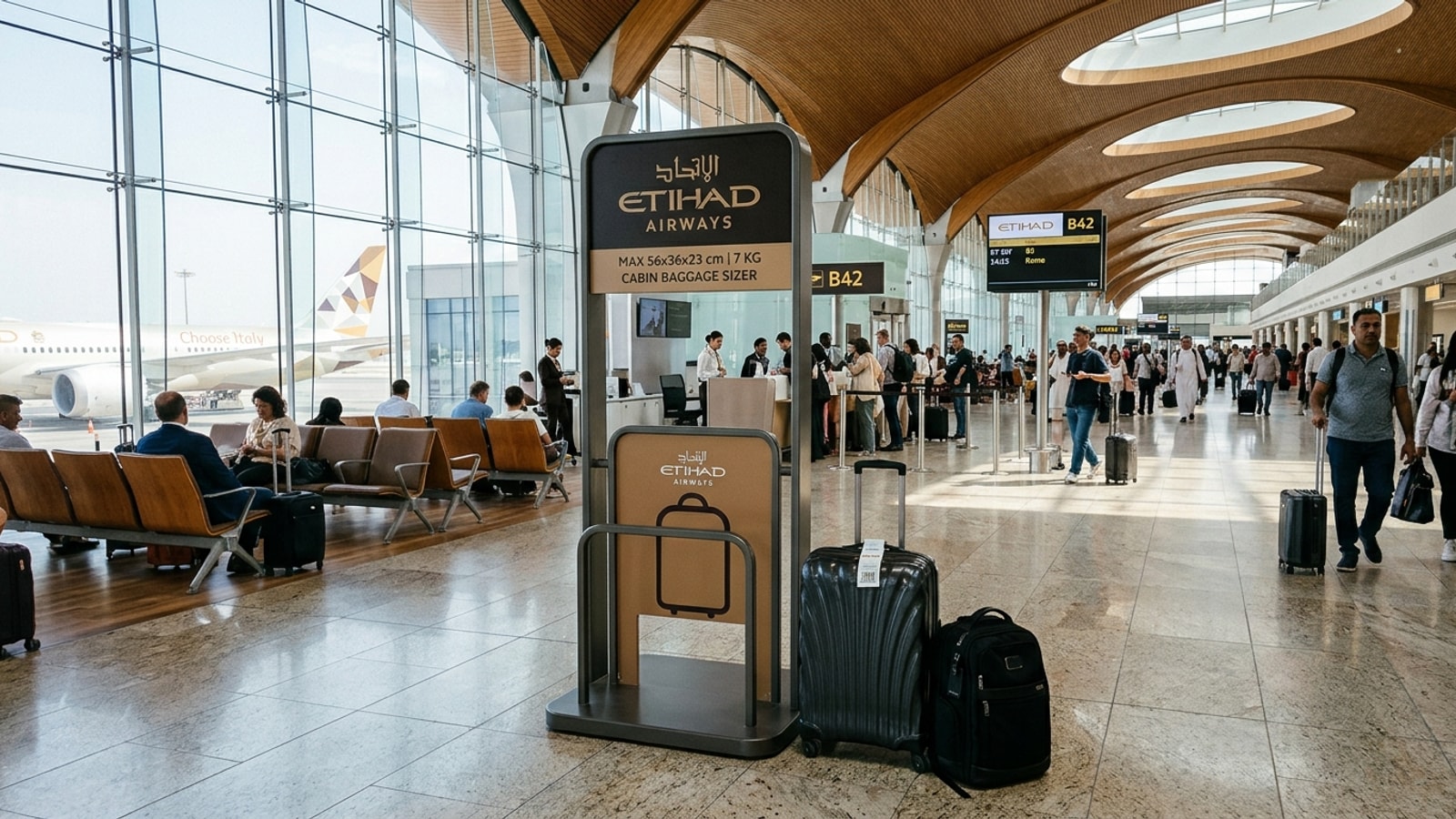
- Primary Update: Etihad Airways maintains a two-piece carry-on framework for Economy Class passengers across its global network in 2026. Travelers are entitled to one cabin bag up to 7 kg (56 x 36 x 23 cm) plus one complimentary personal item up to 5 kg (39 x 23 x 19 cm), offering a combined hand luggage allowance of 12 kg across two distinct pieces.
- Transit Impact: Check-in areas, security zones, and boarding gates at Zayed International Airport (AUH Terminal A) and global outstations enforce dimensional and weight compliance with rigid metal sizer units and scales. Bags exceeding allowance thresholds are intercepted at the boarding gate and checked into the hold, incurring gate excess penalties ranging from $60 to $175 per piece or standard per-kilogram route rates if checked allowances are exhausted.
- Traveler Advice: Unlike neighboring Gulf carriers that enforce strict single-bag limitations in economy, Etihad allows a dedicated laptop bag or small backpack alongside a cabin trolley. Passengers transiting Abu Dhabi to the United States must clear US CBP Preclearance in Terminal A, requiring full cabin baggage re-screening and strict adherence to TSA tamper-evident seal rules for duty-free liquids.
Etihad Airways operates extensive flight operations linking the Indian subcontinent, Southeast Asia, Australasia, Europe, and North America through its hub at Abu Dhabi Zayed International Airport (AUH Terminal A). With high passenger volume across Indian gateways including Delhi (DEL), Mumbai (BOM), Bengaluru (BLR), Hyderabad (HYD), Chennai (MAA), Kochi (COK), and Ahmedabad (AMD), understanding cabin baggage limits prevents unexpected delays and expensive gate surcharges.
While regional competitor Emirates mandates a strict single-piece restriction for Economy Class travelers, Etihad provides a distinct policy structure. Economy passengers flying with Etihad are permitted both a primary cabin bag and an independent personal item, provided both pieces remain strictly within published weight and dimension thresholds.
Cabin Baggage Allowances Across Travel Classes
Hand luggage entitlements on Etihad Airways flights are defined by the ticketed class of travel. Dimensional restrictions remain standardized across all widebody Boeing 787 Dreamliner, Boeing 777, Airbus A350-1000, and Airbus A380 aircraft, as well as narrowbody Airbus A320 and A321 fleets.
| Travel Class | Primary Cabin Bags | Maximum Weight (Primary) | Primary Dimensions (L x W x H) | Personal Items | Maximum Weight (Personal Item) | Personal Item Dimensions (L x W x H) | Total Cabin Weight Limit |
|---|---|---|---|---|---|---|---|
| Economy Class | 1 bag | 7 kg (15.4 lbs) | 56 x 36 x 23 cm | 1 item | 5 kg (11 lbs) | 39 x 23 x 19 cm | 12 kg (26.4 lbs) |
| Business Class | 2 bags | 12 kg (26.4 lbs) combined | 56 x 36 x 23 cm each | 1 item | 5 kg (11 lbs) | 39 x 23 x 19 cm | 17 kg (37.4 lbs) |
| First Class | 2 bags | 12 kg (26.4 lbs) combined | 56 x 36 x 23 cm each | 1 item | 5 kg (11 lbs) | 39 x 23 x 19 cm | 17 kg (37.4 lbs) |
| Infant Ticket (Under 2 Years) | 1 bag | 5 kg (11 lbs) | 56 x 36 x 23 cm | Nil | Included in main bag | Nil | 5 kg plus 1 pushchair/stroller |
Economy Class: The Two-Piece Rule Breakdown
Economy Class travelers receive a total cabin baggage capacity of 12 kg distributed across two distinct pieces:
- Primary Cabin Bag (7 kg maximum): This piece may consist of a wheeled trolley suitcase, duffle bag, or rucksack. The total exterior dimensions must not exceed 56 cm in length, 36 cm in width, and 23 cm in height. These dimensions explicitly incorporate protruding wheels, top and side carry handles, and exterior expansion zipper pockets. The bag must fit inside the overhead storage lockers without physical force.
- Personal Item (5 kg maximum): Passengers may carry one supplementary accessory, such as a laptop briefcase, ladies handbag, small daypack, or duty-free shopping bag. The maximum permitted dimensions are 39 cm in length, 23 cm in width, and 19 cm in height. This item must be placed completely under the passenger seat directly in front during taxi, takeoff, and landing phases.
Premium Cabin Entitlements: Business and First Class
Passengers booked in Business Class and First Class receive an expanded allocation. These travelers may bring two primary cabin bags with an aggregate weight not exceeding 12 kg, with each piece respecting the standard 56 x 36 x 23 cm dimensional envelope. Additionally, premium travelers are entitled to one personal item weighing up to 5 kg (39 x 23 x 19 cm), yielding a combined hand luggage allowance of 17 kg across three items.
Infant Carry-On Provisions
Travelers flying with an infant booked on a lap fare (without a separate assigned seat) are allocated one additional cabin bag weighing up to 5 kg (56 x 36 x 23 cm) for infant food, sterilization supplies, and care essentials. In addition to this carry-on bag, parents may check one fully collapsible stroller, pushchair, or infant carrycot free of charge. If the stroller folds down to standard cabin dimensions (such as IATA-approved pocket-folding strollers), it may be brought inside the passenger cabin subject to available locker space; otherwise, it must be surrendered at the aircraft boarding door for delivery at the aircraft bridge upon arrival.
Metal Sizer Boxes and Gate Check Enforcement
Etihad ground staff utilize standardized metal sizer boxes and digital baggage scales at check-in halls, transfer security desks, and departure gates across Abu Dhabi Zayed International Airport (AUH Terminal A) and global outstations.
Sizer Dimensions and Operational Checks
- Primary Sizer Basket: Measures exactly 56 x 36 x 23 cm. The bag must slide easily into the frame. Bags with hard-shell corners, rigid expanded zippers, or oversize spinner wheels that resist entry will fail the sizer test.
- Personal Item Sizer Basket: Measures 39 x 23 x 19 cm, calibrated to mirror the under-seat clearance on Airbus and Boeing aircraft.
- Pre-Boarding Spot Checks: Ground crews at AUH Terminal A boarding bridges actively inspect boarding queues. Passengers carrying bulky overstuffed backpacks or rolling bags that appear overweight are pulled aside for immediate scale verification.
Airport Gate Excess Fees and Penalties
When hand luggage fails weight or dimensional checks at the departure gate, it cannot travel inside the aircraft cabin. Ground staff attach cargo hold baggage tags, and the bag is routed directly down to the aircraft hold.
Fee Structure for Gate-Checked Baggage
The fee assessed at the boarding gate depends directly on the passenger ticket type and whether their ticketed checked baggage allowance has already been exhausted.
| Route Sector | Status of Checked Allowance | Gate Handling Procedure | Gate Penalty Fee (Approximate) |
|---|---|---|---|
| GCC & Middle East | Checked allowance remaining | Bag counted toward existing ticket allowance | Complimentary (if under total kg/piece limit) |
| GCC & Middle East | Checked allowance exhausted | Intercepted at gate, sent to cargo hold | AED 220–300 ($60–$82) per piece |
| Indian Subcontinent (to/from AUH) | Checked allowance remaining | Bag counted toward weight allowance | Complimentary (if under ticketed weight) |
| Indian Subcontinent (to/from AUH) | Checked allowance exhausted | Intercepted at gate, sent to cargo hold | $25–$35 per excess kg |
| Europe & United Kingdom | Checked allowance remaining | Bag tagged to hold | Complimentary (within piece/weight limit) |
| Europe & United Kingdom | Checked allowance exhausted | Intercepted at gate, sent to cargo hold | €75–€120 ($80–$130) per piece / excess slab |
| United States & Canada (Piece Concept) | Checked allowance exhausted | Intercepted at gate, sent to cargo hold | $150–$175 per additional piece (up to 23 kg) |
Warning · Operational AdvisoryBoarding gate penalty fees are substantially higher than online prepaid baggage rates. If your cabin bag weighs 10 kg instead of the allowed 7 kg, ground handling agents will not allow you to distribute the excess weight to fellow passengers at the boarding gate. Pre-booking additional checked weight via the Etihad website or mobile app up to 30 hours before departure saves up to 30% to 65% compared to airport counter and gate rates.
Special Items, Dangerous Goods, and Cabin Restrictions
Civil aviation safety regulations enforced by the UAE General Civil Aviation Authority (GCAA), India's Bureau of Civil Aviation Security (BCAS), and international transport bodies dictate strict rules on what can and cannot be carried inside the cabin on Etihad flights.
1. Power Banks and Portable Lithium Batteries
- Cabin Only: All spare lithium-ion batteries and power banks must be carried in cabin baggage. They are strictly forbidden inside checked cargo luggage under all circumstances.
- Watt-Hour Thresholds: Power banks up to 100 watt-hours (Wh) (approximately 20,000 mAh to 27,000 mAh at 3.7V) are permitted without prior operator approval, up to a typical limit of 2 units per traveler. Units between 100 Wh and 160 Wh require explicit prior approval from Etihad dangerous goods desk. Power banks exceeding 160 Wh are completely prohibited on passenger aircraft.
- Protective Measures: Terminals must be insulated against short circuits with taped poles or individual protective pouches. Power banks must not be used to charge electronic devices during taxi, takeoff, or landing.
2. Personal Grooming Appliances and Trimmers
Electric beard trimmers, hair straighteners, and cordless styling devices containing rechargeable lithium batteries are permitted in cabin baggage. Hair straighteners powered by butane gas cartridges are subject to strict limitations: only one unit per traveler is allowed in the cabin, and spare gas cartridges are strictly banned from both cabin and checked baggage.
3. Dry Coconut (Copra): Strictly Prohibited
In compliance with worldwide aviation cargo safety standards, dry coconut (copra) is classified as a flammable solid liable to spontaneous combustion. It is strictly banned in both cabin luggage and checked luggage across all Etihad flights. Ground security screeners at Indian and Gulf airports routinely confiscate copra during X-ray checks.
4. Ghee, Pickles, and Traditional Food Items
- Cabin Limitations: Ghee, cooking oils, liquid pickles, sauces, chutneys, and dairy pastes are classified under Liquids, Aerosols, and Gels (LAGs). In hand luggage, they are strictly limited to containers of no more than 100 ml each, housed within a single 1-litre clear resealable plastic bag. Containers larger than 100 ml (even if partially filled) are confiscated at security checkpoints.
- Checked Alternative: To transport jars or tins of ghee and oil-based pickles, package them inside checked luggage. They must be wrapped in heavy bubble wrap, sealed in double airtight leak-proof polythene bags, and positioned within rigid suitcases to prevent rupture under cargo hold pressure changes.
5. Musical Instruments
Small musical instruments (such as violins, flutes, or violas) may be brought aboard as your primary cabin bag, provided the instrument case does not exceed 56 x 36 x 23 cm and 7 kg in weight. For larger instruments (such as guitars or cellos) that exceed cabin sizer dimensions, passengers must either purchase an extra passenger seat (cabin baggage seat) by contacting Etihad reservations in advance or consign the instrument to the cargo hold in a heavy-duty flight case.
US Preclearance Protocol at AUH Terminal A
A distinctive feature of traveling to the United States on Etihad Airways is the dedicated US Customs and Border Protection (CBP) Preclearance facility located in Zayed International Airport Terminal A.
Passengers traveling from Indian stations (or other outstations) connecting in Abu Dhabi to US destinations—including New York (JFK), Chicago (ORD), Washington D.C. (IAD), and Boston (BOS)—clear US immigration, customs, and agriculture inspections directly in Abu Dhabi before boarding the flight.
Operational Hand Luggage Rules for US Preclearance
- Secondary Security Check: Before entering the US Preclearance lounge, all hand luggage undergoes full US TSA-standard security screening, including mandatory removal of laptops, tablets, and large electronics.
- Duty-Free Alcohol and Perfume Restrictions: Any duty-free liquids, aerosols, or gels purchased at departure airports in India or outside the AUH secure zone exceeding 100 ml must be packaged in an intact, certified Secure Tamper-Evident Bag (STEB) with the retail purchase receipt clearly visible inside. Duty-free goods that do not satisfy TSA preclearance tamper regulations will be confiscated.
- Agricultural Restrictions: Food items carried in cabin baggage, including fresh fruits, vegetables, meat products, plants, and seeds, are strictly prohibited from entry into the United States and must be declared and surrendered at the Abu Dhabi preclearance agricultural checkpoint.
Traveler Logistics Guide
Navigating baggage rules efficiently ensures a seamless journey across Etihad's global network. Follow this practical checklist when preparing for departure:
Pre-Departure Packing Strategy
- Weigh Before Heading to the Airport: Use a digital luggage hook scale to weigh your rolling suitcase (maximum 7 kg) and personal laptop backpack (maximum 5 kg) separately. Ensure the combined hand luggage does not exceed 12 kg.
- Consolidation Preparedness: While Etihad allows two pieces, keep enough space in your primary cabin bag to insert your personal item if you encounter an exceptionally strict gate check or full overhead bins on high-density regional connecting flights.
- Critical Belongings: Keep your passport, transit visas, hotel confirmations, prescription medications (with doctor's script), expensive jewelry, and power banks exclusively in your under-seat personal item. If your primary trolley is checked at the gate due to full lockers, your essential valuables remain with you in the cabin.
Terminal Directions at Abu Dhabi (AUH Terminal A)
- Arrival and Transfer Security: Arriving connecting passengers follow signs toward "Flight Connections." Baggage screeners at transfer checkpoints verify liquid compliance (100 ml limit).
- Gate Allocation: Boarding gates at Terminal A feature spacious waiting lounges. Gate sizers are located at the entrance to each boarding jetbridge. Ground boarding starts 45 minutes prior to departure and closes strictly 20 minutes before pushback.
- US Flights: Passengers bound for US destinations must arrive at the US Preclearance portal at least 90 minutes before scheduled departure time to allow adequate time for agricultural review, biometric scanning, and cabin bag screening.
Frequently Asked Questions
Can I carry a laptop backpack in addition to my 7kg trolley on Etihad?
Yes. Etihad Airways explicitly permits Economy Class passengers to carry one primary cabin bag up to 7 kg (56 x 36 x 23 cm) and one personal item up to 5 kg (39 x 23 x 19 cm). A standard laptop backpack, handbag, or briefcase qualifies as a personal item, provided it fits completely under the passenger seat in front of you. This allows a combined allowance of 12 kg across two items.
What happens if my carry-on bag is heavier than 7 kg at the boarding gate?
If your primary cabin bag exceeds 7 kg or fails the metal sizer dimensions at the departure gate, ground staff will intercept the bag and tag it for the cargo hold. If your ticketed checked baggage weight allowance is already exhausted, you will be required to pay an airport gate penalty fee ranging from $60 to $175 (or local currency equivalent), which must be settled before boarding.
Are power banks allowed in checked luggage on Etihad?
No. Power banks and spare lithium batteries are strictly prohibited in checked hold baggage on all Etihad flights due to fire safety regulations. All power banks must be carried in your cabin baggage, must not exceed 100 Wh (or up to 160 Wh with prior airline authorization), and must be protected against accidental activation.
Can I carry homemade ghee and pickles in my hand luggage?
No. Ghee, cooking oils, and liquid or semi-solid pickles are classified as liquids and gels under aviation security rules. In hand luggage, they are subject to the 100 ml maximum container limit. To transport larger quantities, pack them securely in checked luggage using heavy cushioning and sealed, leak-proof plastic bags to protect against pressure-related leaks.