

Quick Summary
- Primary Update: Under Bureau of Civil Aviation Security (BCAS) dangerous goods directives and International Air Transport Association (IATA) Table 2.3.A regulations, wireless Bluetooth speakers containing rechargeable lithium-ion batteries must travel in cabin baggage (hand luggage) and are strictly regulated or prohibited in cargo hold luggage due to in-flight thermal runaway hazards.
- Transit Impact: Dual-purpose Bluetooth speakers equipped with USB charge-out ports (power-bank features) face an absolute ban in checked baggage across Indian and international carriers; units exceeding 100Wh require prior airline approval, while mains AC-powered soundbars without batteries must travel in checked baggage due to overhead bin sizer limits.
- Traveler Advice: Keep portable Bluetooth speakers inside your 7kg cabin carry-on, tape down or lock physical power switches to prevent accidental activation, remove larger speakers for individual X-ray bin inspection at security checkpoints, and pack domestic soundbars in original padded packaging with fragile tags.
Traveling with personal audio equipment has become a standard requirement for holidaymakers, business travelers, and digital content creators. Whether packing a compact pocket speaker such as a JBL Clip, a mid-sized portable speaker like a Marshall Emberton or Bose SoundLink, a high-output party cylinder such as a JBL Charge, or a television soundbar for home relocation, passengers regularly encounter strict regulatory scrutiny at airport security checkpoints.
The intersection of rechargeable lithium-ion battery chemistry, electronic amplification circuits, and high-strength permanent magnets makes audio equipment a focal point for aviation security authorities. In India, the Bureau of Civil Aviation Security (BCAS) and Central Industrial Security Force (CISF) enforce rigorous screening protocols. Globally, the International Civil Aviation Organization (ICAO) and IATA classify battery-powered portable electronic devices (PEDs) under strict dangerous goods provisions designed to prevent catastrophic cargo hold fires. Understanding the exact boundary between cabin carry-on allowances and checked hold baggage is necessary to avoid confiscation, baggage offloading, and missed departures.
Speaker Power Chemistry: Battery vs AC Mains Audio Equipment
The legal classification of an audio speaker depends on its primary power architecture. Airport screening protocols divide audio systems into two distinct operational groups:
1. Battery-Powered Wireless Speakers (Cabin Baggage Only)
Modern portable Bluetooth speakers operate on integrated rechargeable lithium-ion or lithium-polymer cells. Under ICAO and BCAS Technical Instructions for the Safe Transport of Dangerous Goods by Air, lithium batteries present an acute risk of thermal runaway if crushed, short-circuited, or subjected to uncontrolled internal defects.
In a pressurized passenger cabin, flight attendants and flight crew possess specialized Halon fire extinguishers, water-dousing protocols, and thermal containment bags to suppress battery flare-ups immediately. In contrast, an undetected battery fire inside a cargo hold can overwhelm automated fire suppression systems. Consequently, BCAS and global airlines mandate that portable Bluetooth speakers with built-in batteries should be carried in cabin hand luggage rather than checked baggage.
2. The Power-Bank Dual-Function Trap
A major operational trap for air travelers involves popular wireless speakers featuring reverse USB power delivery (such as the JBL Charge series, Anker Soundcore Motion series, and Sony SRS lines). Because these units can charge external smartphones, airport security screeners and automated Inline Baggage Handling Systems (BHS) classify them as standalone power banks.
Under BCAS Order No. 04/2016 and IATA Dangerous Goods Regulations Table 2.3.A, standalone power banks are strictly prohibited in checked hold luggage across all commercial aviation operations. If a passenger checks a suitcase containing a dual-function speaker, high-density X-ray scanners (Level 3 and Level 4 CTX machines) will flag the bag. Security staff will either summon the passenger to the basement baggage inspection room or hold the bag from loading onto the aircraft, forcing the flight to depart without the traveler's luggage.
3. Mains AC-Powered Soundbars and Desktop Monitors (Checked Luggage Permitted)
Home theater soundbars, studio monitor speakers, and desktop computer speakers designed to operate exclusively via alternating current (wall sockets) contain no internal lithium batteries. Because they lack flammable battery chemistry, these systems are fully permitted inside checked hold baggage. However, because standard soundbars measure between 75 centimeters and 120 centimeters in length, they exceed the standard 55 x 35 x 25 cm cabin bag sizer dimensions enforced by IndiGo, Air India, Emirates, and British Airways, disqualifying them from overhead locker carriage.
Watt-Hour Limits and Battery Slabs for Audio Equipment
Battery capacity in aviation safety is calculated in Watt-hours (Wh), not milliampere-hours (mAh). If a speaker manufacturer only lists the mAh rating on the technical specification label, multiply the milliampere-hours by the nominal voltage (V) and divide by 1,000:
$$\text{Watt-hours (Wh)} = \frac{\text{Capacity (mAh)} \times \text{Nominal Voltage (V)}}{1000}$$
| Audio Equipment Category | Typical Examples | Battery Capacity (Wh) | Cabin Baggage Status | Checked Hold Status | Security Clearance Rules |
|---|---|---|---|---|---|
| Micro / Pocket Speaker | JBL Clip 4, Bose SoundLink Micro, Sony SRS-XB100 | 2.5 Wh – 10 Wh | Permitted (Counts to 7kg) | Highly Discouraged | Must be fully switched off if checked |
| Standard Portable Speaker | JBL Flip 6, Marshall Emberton II, UE Boom 3 | 15 Wh – 28 Wh | Permitted (Counts to 7kg) | Forbidden if power-bank capable | Remove from backpack at CISF tray screening |
| Power-Bank Speaker | JBL Charge 5, Anker Motion Boom Plus | 27 Wh – 50 Wh | Permitted (Counts to 7kg) | Strictly Prohibited (Treated as Power Bank) | Must be carried in cabin; cannot be gate-checked |
| High-Power Boombox | JBL Boombox 3, Sony XG500, Tribit StormBox Blast | 70 Wh – 98 Wh | Permitted (Within 7kg / 10kg limit) | Strictly Prohibited | Large units must fit under seat or in overhead bin |
| Semi-Pro Party Speaker | JBL PartyBox 110, Bose S1 Pro+ | 36 Wh – 72 Wh | Permitted (If size fits sizer) | Forbidden with installed battery | Excess size requires cargo hold dispatch without battery |
| Commercial Event Speaker | Soundboks 4, JBL PartyBox 310/710 | > 100 Wh to AC-only | Pre-approval required if 100–160 Wh | AC versions allowed in cargo; >160 Wh banned | Systems >160 Wh forbidden on passenger aircraft |
| Television Soundbar | Bose Smart Soundbar, Sonos Beam, Sony HT-S20R | AC Only (No Battery) | Prohibited (Exceeds 55cm sizer) | Permitted (Fragile Tag & bubble wrap) | Pack in reinforced box; counts toward 15kg/23kg slab |
| Subwoofer Unit | Passive / Active AC Subwoofer Box | AC Only (No Battery) | Prohibited (Weight & Dimension) | Permitted (IATA Mag-check exempt) | Screened for magnetic flux density at cargo terminal |
Under standard IATA guidelines:
- Batteries Under 100Wh: Allowed in cabin baggage without airline pre-notification. A passenger may carry up to 15 personal electronic devices across their travel gear.
- Batteries Between 100Wh and 160Wh: Permitted in cabin baggage only with formal airline dangerous goods approval prior to check-in (maximum 2 units per passenger).
- Batteries Exceeding 160Wh: Completely forbidden from passenger aircraft under all circumstances.
Magnetic Compass Interference Regulations (IATA Packing Instruction 953)
Audio speakers reproduce sound through electromagnetic motor structures consisting of permanent ferrite or neodymium magnets bonded to voice coils. Aviation safety authorities impose strict limits on magnetic field leakage under IATA Dangerous Goods Regulations Section 3.9.2.2 and Packing Instruction 953.
Unshielded, powerful magnetic fields can deflect the aircraft's magnetic compass, gyroscopic instruments, and navigational sensors if loaded near avionic bulkheads. By regulation:
- Any package that produces a magnetic field strength sufficient to cause a compass deflection of more than 2 degrees at a distance of 2.1 meters (producing a field strength greater than 0.00525 Gauss at 4.6 meters) is classified as Class 9 Magnetized Material (UN 2807).
- Consumer-grade Bluetooth speakers, domestic soundbars, and consumer subwoofers are manufactured with self-shielding magnetic circuits or acoustic dampening that keep magnetic flux well below this threshold.
- Large concert-grade line-array subwoofers, unshielded 15-inch neodymium woofers, or raw speaker drivers being shipped in hold luggage must undergo magnetic shielding certification before commercial baggage acceptance.
Airline Operational Policies: IndiGo, Air India, Emirates, and Global Carriers
While the foundational dangerous goods baseline is governed by BCAS and IATA, major international carriers enforce distinct cabin size, gate check, and excess baggage weight policies:
IndiGo Airlines
IndiGo strictly adheres to BCAS Circular No. 05/2017. All portable Bluetooth speakers must be accommodated within the single 7kg cabin baggage allowance (maximum dimensions: 55 x 35 x 25 cm), plus an optional small personal item such as a laptop bag or handbag (maximum 3kg).
- If a passenger carries a larger speaker such as a JBL Boombox, its weight will count toward the 7kg limit.
- IndiGo gate agents enforce rigid sizer boxes at boarding gates across Delhi (DEL), Mumbai (BOM), Bengaluru (BLR), and regional airports. Overweight hand bags incur an airport gate excess baggage fee of ₹550 per kilogram or a mandatory gate bag check-in charge of ₹1,500.
- However, if the gate agent attempts to check the bag into the cargo hold, the passenger must physically remove the Bluetooth speaker and carry it by hand into the cabin.
Air India and Air India Express
On Air India domestic and long-haul international flights, economy class passengers receive a 7kg cabin allowance (8kg on selected international segments) with linear dimensions not exceeding 115 cm.
- Bluetooth speakers are permitted in the cabin provided power buttons are shielded against accidental startup.
- For passengers transporting home soundbars in checked luggage, Air India Express and mainline Air India accept the item within the passenger's standard checked baggage allowance (15kg domestic, 23kg or 30kg international piece/weight systems).
- If the soundbar box exceeds standard linear dimensions (158 cm total L+W+H), an oversized baggage surcharge of ₹1,000 to ₹3,000 applies domestically, or $100 to $150 on long-haul routes.
Emirates, Qatar Airways, and Etihad
Gulf carriers operate stringent dangerous goods monitoring at Dubai International (DXB), Doha Hamad International (DOH), and Abu Dhabi Zayed International (AUH).
- Passengers may carry compact Bluetooth speakers in their 7kg economy cabin baggage.
- Emirates and Qatar Airways security staff will confiscate any wireless speaker found in checked baggage if the unit features an integrated USB output capable of power-bank operation.
- Soundbars checking into the hold must be wrapped in heavy bubble wrap or packed inside original polystyrene styrofoam boxes. Gulf carriers do not accept liability for unboxed electronic audio equipment checked under a standard baggage claim tag without a signed Limited Release Tag (LRT).
Singapore Airlines, British Airways, and Lufthansa
European and Southeast Asian carriers permit portable speakers in cabin luggage, provided they fit within overhead lockers or underneath the seat in front.
- If a basic speaker without power-bank features is checked into the hold, Lufthansa and British Airways require that the unit be completely powered down (not in sleep or standby mode) and protected from unintentional activation by a physical switch guard or hard travel case.
Traveler Logistics Guide
To navigate airport security checkpoints smoothly without delays, damage, or confiscation, travelers should follow this practical logistics protocol:
Pre-Departure Packing Protocol
- Identify the Power Source: Look at the technical label on the back or bottom of your audio device. If it displays an input voltage of 100–240V AC without mention of an internal mAh or Wh battery, it is a mains-powered unit permitted in checked luggage. If it features a battery rating (e.g., 3.7V, 5200mAh) or USB charging port, it must travel in your cabin bag.
- Prevent Accidental Activation: Ensure the power switch cannot be turned on during turbulence or handling. For push-button speakers (like JBL or Sony), pack the unit inside a molded hard-shell EVA travel case. Alternatively, cover the power button with a thick coin taped over the switch with electrical insulation tape.
- Carry Supporting Documentation: For larger portable boombox units (between 50Wh and 100Wh), download the manufacturer's technical spec sheet showing the battery Wh rating to present to CISF or airport screening officers if questioned.
- Prepare Soundbars for Checked Hold Transit: If checking a television soundbar, retain the original retail box with internal molded styrofoam endcaps. Wrap the exterior box in protective shrink-wrap film at the airport terminal wrapping kiosk, and request bright fluorescent "FRAGILE" stickers at the airline check-in counter.
Airport Security Screening Procedures
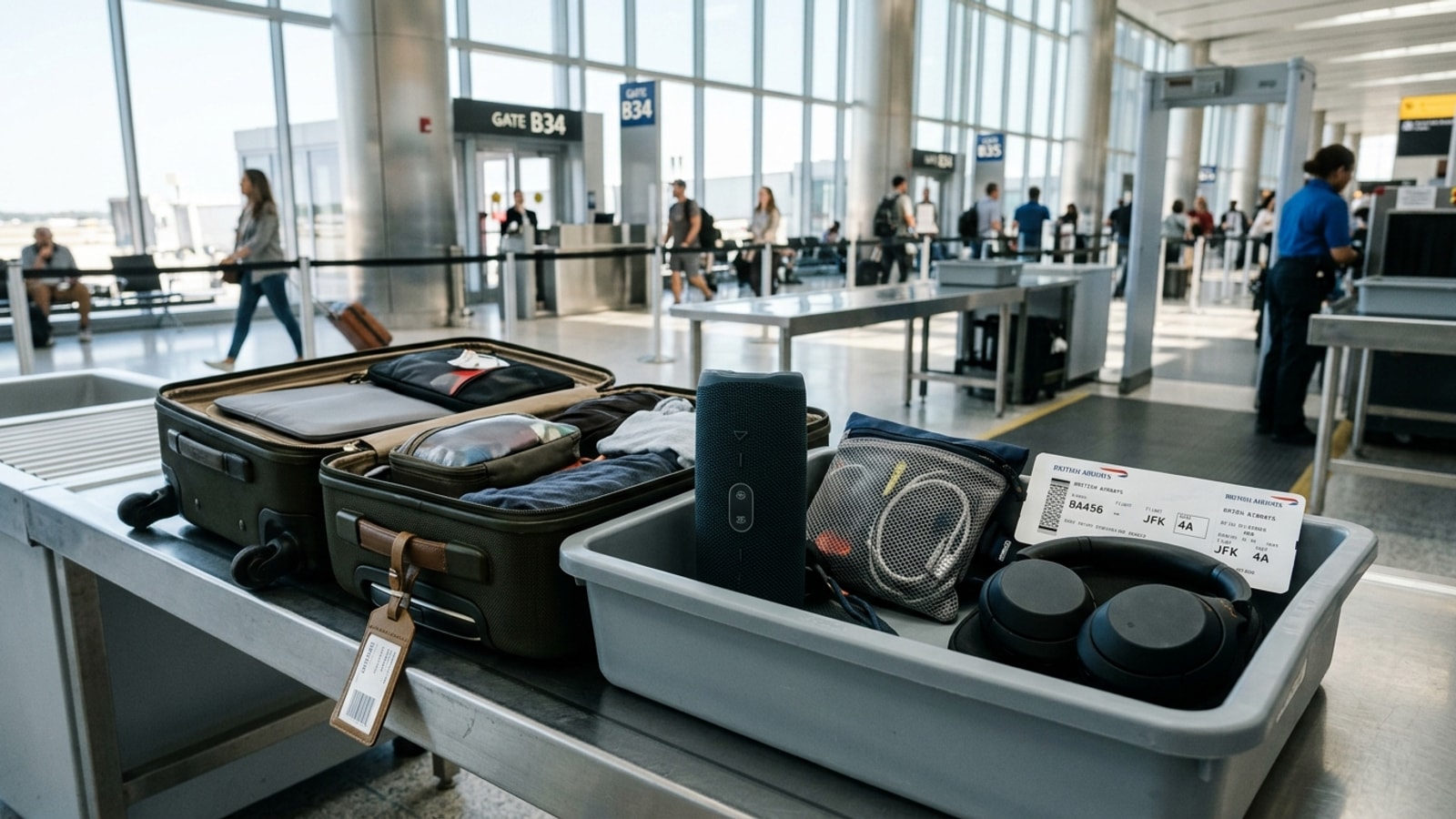
- Domestic Indian Hubs (CISF Checkpoints): When approaching Central Industrial Security Force X-ray baggage belts at Indian airports, remove portable Bluetooth speakers larger than a standard smartphone from your carry-on bag and place them into an individual security tray, alongside laptops and tablets. Dense speaker magnet assemblies and lithium battery cylinders obscure items underneath them on X-ray screens, triggering manual bag searches if left packed inside your rucksack.
- International Gateways (TSA and CATSA Checkpoints): In the United States and Canada, TSA officers require electronics larger than a standard smartphone to be placed in separate screening bins unless traveling through designated TSA PreCheck lanes.
What to Do If Checked Baggage Is Flagged by Inline Security
If you inadvertently leave a Bluetooth speaker with power-bank capabilities inside your checked suitcase:
- Airport Public Announcements: Listen attentively for your name being called over the public address system in the departures terminal, or monitor SMS notifications from your airline.
- Inline Baggage Room Inspection: At hubs like Delhi T3, Mumbai T2, or Bengaluru T2, security will direct you to an airside security elevator leading to the Inline Baggage Screening room (Level 4 inspection).
- Physical Key Verification: You will be required to unlock your suitcase in front of security personnel, extract the speaker, and transfer it into your hand luggage. If the flight is near departure time and you cannot be reached, ground handlers will offload your suitcase to prevent flight delay, leaving your luggage behind at the origin airport.
Frequently Asked Questions
Can I carry a JBL or Bose Bluetooth speaker in my checked suitcase?
No, packing portable Bluetooth speakers in checked luggage is strongly discouraged and frequently illegal. Most modern portable speakers (including the entire JBL Charge, Flip, and Bose SoundLink lines) contain rechargeable lithium-ion batteries. Furthermore, models featuring USB output ports are legally classified as power banks, which are strictly banned from checked aircraft holds under BCAS Order No. 04/2016 and IATA DGR Table 2.3.A. Pack your portable speaker inside your hand luggage to ensure compliance.
Does a Bluetooth speaker count toward the 7kg cabin baggage limit?
Yes. Portable Bluetooth speakers carried into the passenger cabin are weighed as part of your standard 7kg hand luggage allowance (or 8kg/10kg depending on your airline). Heavy portable boombox units weighing between 3kg and 6kg will consume the vast majority of your cabin allowance, leaving limited space for clothing and personal laptops. Measure and weigh your cabin rucksack before leaving home to avoid steep gate baggage penalties.
Can I carry a home television soundbar in the cabin as hand luggage?
No. Standard television soundbars range from 75 cm to 110 cm in length. Commercial airline cabin sizers permit maximum item dimensions of 55 x 35 x 25 cm (total linear dimensions of 115 cm). A soundbar will not fit inside standard overhead lockers or under the passenger seat. Because soundbars operate on mains AC power and do not contain lithium batteries, they should be securely bubble-wrapped, labeled with fragile tags, and checked into the aircraft hold.
What happens if security discovers a speaker with a battery exceeding 100Wh?
If your portable sound equipment contains a lithium battery rated between 100Wh and 160Wh (such as professional battery-powered PA systems), you must declare it to your airline during check-in to secure dangerous goods authorization. If the battery capacity exceeds 160Wh, the device is completely banned from commercial passenger aircraft under international aviation safety regulations and cannot be carried either in the cabin or in the cargo hold.