

Quick Summary
- Primary Update: Air China enforces one of the strictest hand-luggage limits among global network carriers, mandating a 5kg (11 lbs) weight ceiling per carry-on piece for Economy Class, while First Class and Business Class passengers receive two pieces weighing up to 8kg (17.6 lbs) each.
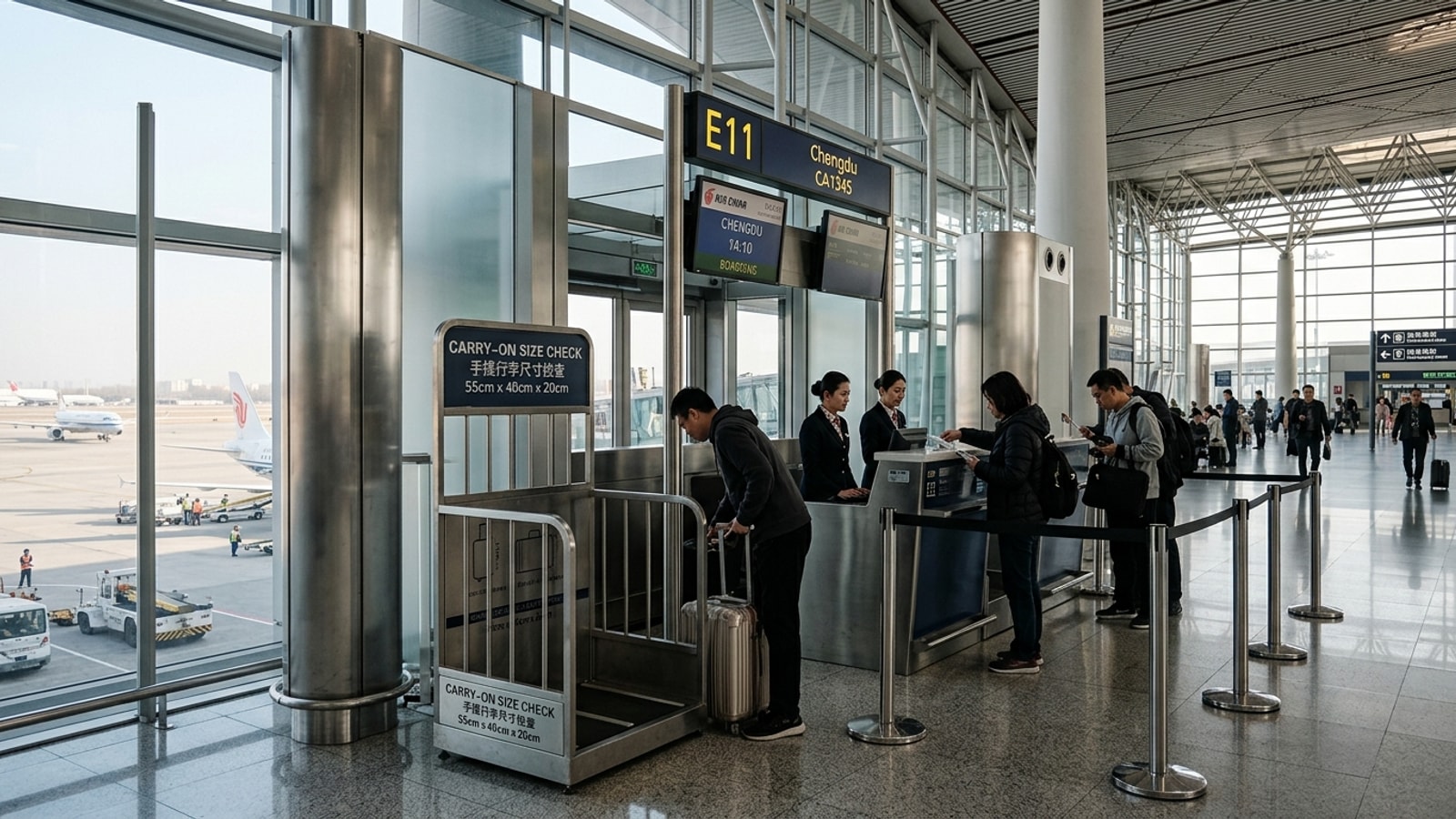
- Transit Impact: Ground handling staff at primary hubs—Beijing Capital (PEK Terminal 3), Beijing Daxing (PKX), Shanghai Pudong (PVG), and Chengdu Tianfu (TFU)—actively audit carry-on pieces using metal sizer frames (55 x 40 x 20 cm) and portable scales, redirecting non-compliant bags to the aircraft cargo hold with gate excess fees ranging from 300 CNY (
$42 USD) to 1,000 CNY ($140 USD).- Traveler Advice: Verify that your rolling luggage does not exceed the shallow 20 cm (7.8 inch) depth limit, keep laptop backpacks slim enough to stow under the seat ahead, and ensure all portable power banks are carried in hand luggage with factory-printed capacity ratings under 100Wh to satisfy Civil Aviation Administration of China (CAAC) security mandates.
Air China, the flag carrier of the People's Republic of China and a core member of Star Alliance, operates an extensive global network linking mainland commercial centers with Europe, North America, the Asia-Pacific region, and the Middle East. Headquartered in Beijing, the airline manages dense international operations from Beijing Capital International Airport (PEK Terminal 3) and Beijing Daxing International Airport (PKX), alongside major international outstations at Shanghai Pudong (PVG) and Chengdu Tianfu (TFU).
Because Air China operates widebody aircraft such as the Boeing 777-300ER, Boeing 787-9, and Airbus A350-900 on high-density long-haul and regional routes, overhead locker space fills rapidly. To preserve cabin safety, maintain orderly boarding sequences, and adhere strictly to Civil Aviation Administration of China (CAAC) civil aviation flight directives, Air China enforces rigid hand luggage parameters. Travelers transitioning from Western or Gulf carriers frequently discover that Air China's Economy cabin weight allowance is significantly lower than standard international norms.
2026 Cabin Baggage Allowances: Weight Limits and Sizer Dimensions
Air China maintains a structured tier system based on ticketed travel class. The foundational distinction centers on the Economy Class cabin allowance, which permits only 5kg (11 lbs) for the primary carry-on piece.
Passengers holding Economy Class tickets may bring one standard carry-on bag with a maximum weight of 5kg (11 lbs) and maximum physical dimensions of 55 x 40 x 20 cm (21.6 x 15.7 x 7.8 inches), including all external fixtures such as wheels, telescoping handles, and side pockets. Passengers traveling in First Class or Business Class receive an expanded allocation of two standard pieces, each permitted to weigh up to 8kg (17.6 lbs), within the same 55 x 40 x 20 cm dimensional envelope.
The table below outlines the authorized baggage limits, dimensional parameters, and personal item rules across all passenger service classes:
| Travel Class | Standard Carry-On Pieces | Max Weight per Piece | Max Dimensions (L x W x H) | Personal Item Allowance | Max Cumulative Cabin Allocation |
|---|---|---|---|---|---|
| Economy Class | 1 Piece | 5 kg (11 lbs) | 55 x 40 x 20 cm (21.6 x 15.7 x 7.8 in) | 1 Piece (under-seat fit: briefcase, handbag) | 5 kg primary piece + 1 under-seat item |
| Premium Economy (Selected Aircraft) | 1 Piece | 5 kg (11 lbs) | 55 x 40 x 20 cm (21.6 x 15.7 x 7.8 in) | 1 Piece (under-seat fit: briefcase, handbag) | 5 kg primary piece + 1 under-seat item |
| Business Class | 2 Pieces | 8 kg (17.6 lbs) | 55 x 40 x 20 cm (21.6 x 15.7 x 7.8 in) | 1 Piece (under-seat fit: briefcase, handbag) | 16 kg across 2 pieces + 1 under-seat item |
| First Class | 2 Pieces | 8 kg (17.6 lbs) | 55 x 40 x 20 cm (21.6 x 15.7 x 7.8 in) | 1 Piece (under-seat fit: briefcase, handbag) | 16 kg across 2 pieces + 1 under-seat item |
| Infant (Without Seat) | 0 Pieces (Cabin bag) | Nil | N/A | Fully collapsible stroller or infant cot | Checked at aircraft door / boarding ramp |
Dimensional Constraints: The 20cm Thickness Barrier
A frequent pitfall for international passengers flying Air China is the 20 cm (7.8 inch) depth restriction. While numerous European and American carriers allow hand luggage depths of 23 cm (9 inches) or 25 cm (10 inches), Air China strictly bounds exterior thickness at 20 cm. Standard hardshell carry-ons engineered for European or North American domestic routes frequently fail Air China's steel sizer frames if the front compartments or expandable expansion zippers are packed full.
The sum of the three dimensions must not exceed 115 cm (45.2 inches). Ground staff at PEK, PKX, and PVG evaluate bags against the sizer box before granting jet bridge entry:
- The luggage must enter the metal sizer frame smoothly without compression or mechanical forcing.
- Wheels and handles must sit inside the frame perimeter.
- Bulging soft-sided duffel bags that exceed 20 cm in cross-section are intercepted and rejected.
Under-Seat Personal Item Specifications
In addition to the primary carry-on luggage piece, Air China allows passengers to carry one small personal item free of charge. This accessory must fit under the seat directly in front of the passenger.
Authorized personal items include:
- A slim laptop bag, notebook sleeve, or compact business briefcase
- A lady's handbag, purse, or small day satchel
- A camera shoulder bag or binocular case
- An umbrella, walking cane, or prescribed orthopedic crutches
- An infant care satchel containing milk powder, feeding bottles, and diapers required during flight duration
- Reading material or a small coat / overcoat for in-flight comfort
Backpacks used as personal items must remain compact. Overstuffed hiking packs or large multi-compartment travel daypacks that cannot slide beneath the seat pan will be classified as a primary cabin bag, causing travelers in Economy to exceed their single-piece allocation.
Boarding Gate Audits, Sizer Checkpoints, and Gate Penalty Fees
Air China ground personnel enforce hand baggage rules at two distinct operational stages: the initial check-in / boarding pass issuance desk and the boarding gate jet bridge podium.
At terminal check-in counters across mainland hubs, agents verify the weight of hand luggage during passenger document checks. Approved cabin pieces receive a distinct colored paper tag labeled "Cabin Baggage" (随身携带物品). At departure gates, gate agents scan boarding queues for untagged, heavy, or distended bags. Handheld electronic luggage scales and static steel sizers stationed directly beside the ticket reader turnstiles are employed to audit travelers.
When a bag exceeds the 5kg limit in Economy or cannot slide into the 55 x 40 x 20 cm sizer, staff revoke cabin carriage permission. The bag is issued an involuntary cargo baggage tag and sent down to the aircraft hold. Because the baggage check takes place at the departure gate rather than the pre-security check-in desk, standard prepaid excess discounts do not apply; instead, passengers are assessed an immediate gate penalty fee.
The table below summarizes typical gate check surcharge structures across Air China's global sectors:
| Route Sector | Operational Action at Gate | Gate Surcharge / Penalty | Accepted Payment Methods |
|---|---|---|---|
| Domestic Flights within Mainland China (e.g., PEK-PVG, PKX-CAN, TFU-PEK) | Involuntary cargo transfer; collection at destination arrivals carousel | 300 to 450 CNY (~$42–$63 USD) per bag | Alipay, WeChat Pay, China UnionPay, local debit |
| Regional East Asia (e.g., Beijing to Tokyo Haneda, Seoul Incheon, Taipei Taoyuan) | Ramp tag attached; bag routed to aircraft cargo hold | 500 to 750 CNY (~$70–$105 USD) per piece | Visa, Mastercard, China UnionPay, JCB |
| South & Southeast Asia (e.g., Beijing / Chengdu to Delhi, Karachi, Bangkok, Singapore) | Involuntary hold check; boarding pass updated | 600 to 850 CNY (~$85–$120 USD) per piece | Major international credit cards, UnionPay |
| Long-Haul Intercontinental (Europe, North America, Australia, New Zealand) | Involuntary cargo transfer; routed to final baggage claim | 800 to 1,000+ CNY (~$112–$140+ USD) per piece | Major credit cards (Visa, Mastercard, Amex); no cash |
At international departure gates, gate staff do not handle physical cash transactions. All surcharges must be cleared electronically using a payment card or verified digital payment wallet prior to boarding. Passengers who fail or refuse to settle gate excess fees are denied aircraft entry under standard international carriage contracts.
CAAC Lithium Battery Regulations and In-Cabin Safety Mandates
The Civil Aviation Administration of China (CAAC) enforces some of the most stringent dangerous goods safety directives in global commercial aviation. Lithium-ion batteries and portable power banks present acute thermal runaway risks and are subject to uncompromising inspections at Chinese airport security checkpoints and boarding gates.
Power Bank Watt-Hour (Wh) Ceilings
Under CAAC safety orders, power banks and standalone lithium-ion batteries are strictly forbidden inside checked baggage. They must be carried exclusively inside cabin hand luggage, subject to the following technical parameters:
- Under 100 Watt-Hours (Wh) / Up to ~20,000 mAh: Passengers may carry personal power banks without prior airline approval, provided the units are designed for personal electronic equipment.
- Between 100 Wh and 160 Wh / ~20,000 to 32,000 mAh: Permitted up to a strict maximum of two units per passenger. However, the traveler must declare these units at the Air China check-in counter and obtain an airline dangerous goods approval slip.
- Exceeding 160 Wh / Over 32,000 mAh: Prohibited on all passenger flights. Airport security checkpoints will seize and destroy non-compliant batteries.
- Legible Factory Markings Required: Every power bank must possess clear, permanently engraved or factory-printed specifications indicating its rated energy capacity in Watt-hours (Wh) or voltage (V) and milliampere-hours (mAh). Hand-written labels, worn-off serial numbers, or modified third-party battery packs are confiscated immediately during pre-flight security screening.
Warning · Operational AdvisoryCharging electronic devices using a power bank is strictly prohibited throughout the entire flight on Air China aircraft. Power banks must remain powered off and stored inside your personal bag during taxi, takeoff, cruising, and landing.
Smart Bags and Electronic Luggage
Luggage units fitted with integrated battery packs, GPS trackers, or electric motorized wheels ("smart bags") must have removable battery mechanisms:
- The lithium battery must be detached prior to boarding and transported in the cabin.
- If a passenger is forced to gate-check a smart bag due to full overhead bins, the battery must be removed at the gate desk and carried by hand into the passenger cabin.
- Smart bags with non-removable lithium batteries exceeding 0.3g lithium metal or 2.7Wh lithium-ion are barred from both checked and carry-on transport.
Liquids, Aerosols, and Gels (LAGs)
On international departures from mainland China, as well as transit transfers via Beijing or Shanghai:
- Liquid containers must not exceed 100 ml (3.4 fl oz) each.
- All containers must fit inside one transparent, re-sealable plastic bag with a maximum capacity of 1 liter.
- On domestic flights within mainland China, general personal beverages are prohibited through security checkpoints; however, passengers may purchase drinks inside the secure airside departures concourse and bring them onboard.
- Duty-free liquids, liquors, and cosmetics purchased at airside shops must remain sealed inside official Security Tamper-Evident Bags (STEBs) with receipt slips clearly visible.
Traveler Logistics Guide
Navigating Air China's hand luggage framework requires tactical planning, particularly when connecting through high-volume Chinese international hubs.
flowchart TD
    A["Pre-Trip Packing: Adhere to 55x40x20cm & 5kg Limit"] --> B["Battery Audit: Verify Power Banks Under 100Wh with Legible Labels"]
    B --> C["Airport Check-In: Document Verification & Cabin Tag Issued"]
    C --> D{"Luggage Exceeds 5kg at Counter?"}
    D -- Yes --> E["Pay Prepaid Excess Baggage Rate & Check Piece"]
    D -- No --> F["Receive Blue/Yellow Cabin Tag & Clear Security"]
    F --> G["Boarding Gate: Secondary Sizer & Scale Verification"]
    G --> H{"Passes 55x40x20cm Sizer & Cabin Allocation?"}
    H -- Yes --> I["Board Aircraft: Stow Primary in Locker, Personal Under Seat"]
    H -- No --> J["Pay Heavy Gate Fee (300-1,000 CNY) & Cargo Hold Check"]
Pre-Departure Preparation Checklist
- Select an Ultralight Rolling Case: Standard hardshell rollaboards frequently weigh between 2.8kg and 3.5kg empty. When flying Air China Economy, an empty 3.2kg case leaves only 1.8kg for your actual belongings before violating the 5kg threshold. Consider using an ultralight soft-sided case (under 1.8kg) or a structured travel backpack.
- Audit Outer Dimensions: Use a tape measure to confirm the exterior depth does not exceed 20 cm. Do not utilize expandable perimeter zippers, as expanding a case to 24 cm guarantees it will jam in Air China gate sizers.
- Relocate Heavy Electronics to the Personal Item: Keep your laptop, charger brick, tablet, and camera equipment inside your personal briefcase or under-seat shoulder bag. Since ground staff prioritize weighing the primary overhead suitcase, keeping dense electronics in the personal accessory preserves the 5kg allowance of your rolling bag.
Hub Transit Strategies: PEK, PKX, and PVG
- Beijing Capital International Airport (PEK - Terminal 3): Terminal 3 is vast. Moving between international gates (T3-E) and domestic departures (T3-C) requires taking the automated terminal transit train. Allow at least 2.5 hours for international-to-domestic transfers, as you must collect checked bags, clear customs, and re-check luggage at domestic desks.
- Beijing Daxing International Airport (PKX): Daxing features a centralized hub-and-spoke layout designed to minimize walking times, with maximum walk distances to furthest gates under 8 minutes from the central atrium. Air China operates select international and domestic flights from PKX; verify your departure terminal carefully, as PEK and PKX are situated over 65 kilometers apart on opposite sides of Beijing.
- Shanghai Pudong International Airport (PVG - Terminal 2): Air China operates international flights from Terminal 2. Security screening queues at PVG Terminal 2 can experience high congestion during peak morning (07:00–09:30) and evening banks (18:00–21:00); arrive at least 3 hours before long-haul international flights.
Elite Frequent Flyer Privileges
Members of Air China PhoenixMiles and the broader Star Alliance network receive priority handling benefits that assist with cabin baggage logistics:
- PhoenixMiles Platinum / Gold & Star Alliance Gold: Entitled to priority check-in counters, Star Alliance Gold lounge access, and Priority Boarding (Group 1 / Group 2). Boarding ahead of general Economy groups ensures immediate access to empty overhead bins directly above your allocated seat.
- Checked Allowance Relief: While elite status does not officially increase the 5kg per-bag cabin weight ceiling in Economy Class, Star Alliance Gold cardholders receive one additional complimentary checked bag (up to 23kg in Economy or 32kg in Business), making it advantageous to check secondary luggage free of charge rather than struggling with tight cabin limits.
Frequently Asked Questions
Does Air China strictly weigh carry-on baggage at the airport?
Yes. Air China ground staff at Beijing Capital (PEK), Beijing Daxing (PKX), Shanghai Pudong (PVG), and Chengdu Tianfu (TFU) regularly weigh hand luggage at check-in desks and boarding gates. Bags that exceed the 5kg limit for Economy Class are not permitted into the cabin and are sent to the cargo hold with gate excess fees applied.
Can I bring a laptop bag and a rolling suitcase on an Air China flight?
Yes. Economy Class travelers are permitted one primary carry-on bag (up to 5kg, max dimensions 55 x 40 x 20 cm) plus one small personal item, such as a laptop bag, briefcase, or handbag. The personal item must fit under the seat directly in front of you.
What are the power bank rules for Air China flights?
Power banks must be transported in hand luggage and cannot be placed in checked baggage. Batteries rated up to 100Wh (approximately 20,000mAh) are permitted without prior notice. Batteries between 100Wh and 160Wh require airline desk approval (maximum 2 units per person). Units exceeding 160Wh, or units lacking legible manufacturer capacity markings, are strictly confiscated by security. Using power banks to charge devices during the flight is forbidden.
What payment methods are accepted for gate-check baggage fees?
At mainland Chinese hubs, gate fees can be paid using Alipay, WeChat Pay, China UnionPay, and domestic bank cards. At international outstations, major credit cards (Visa, Mastercard) are accepted. Cash is not accepted at boarding gate podiums.