

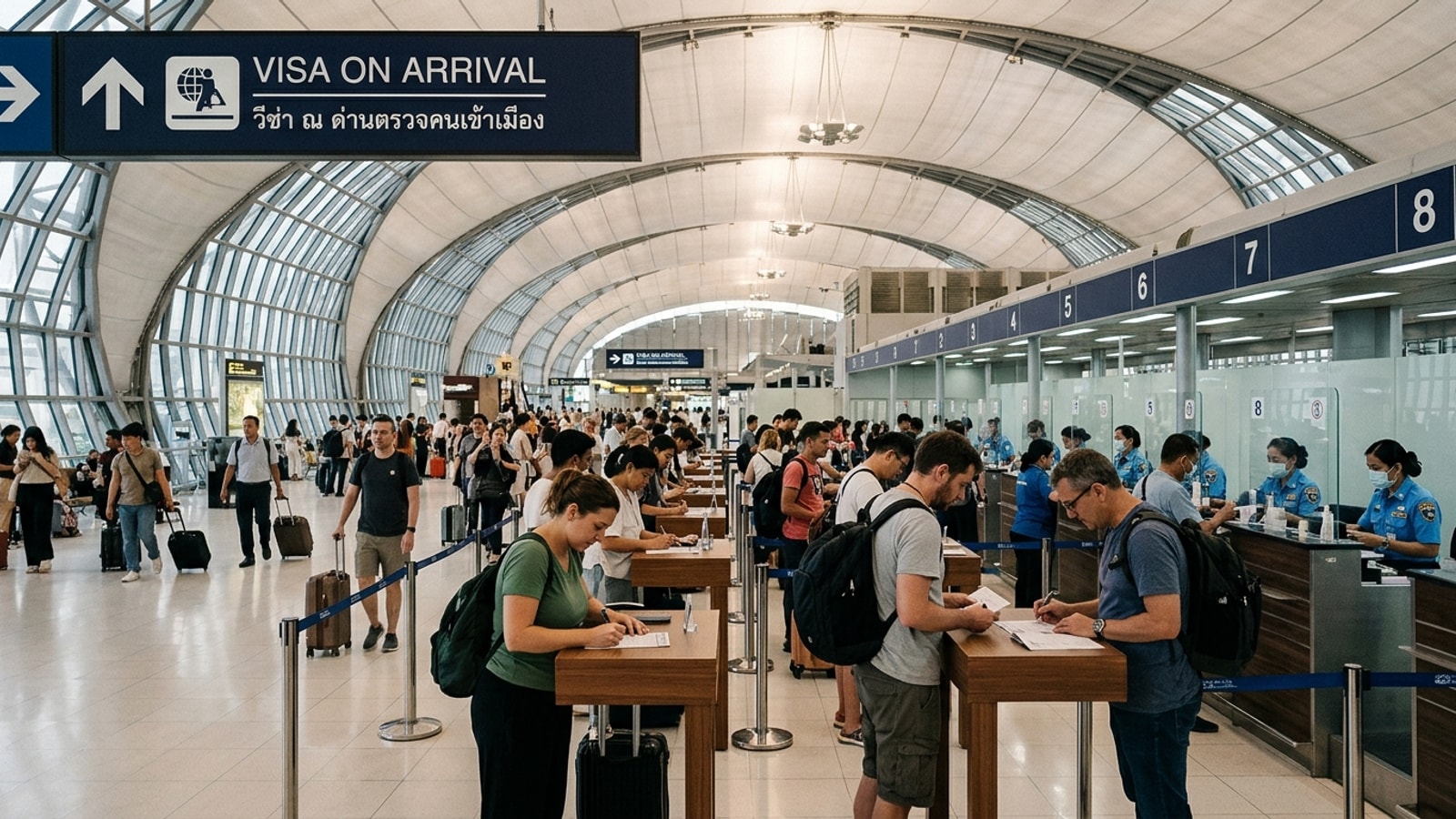
Quick Summary
- Primary Update: Thailand maintains its statutory Visa on Arrival (VoA) framework under Section 12 of the Immigration Act B.E. 2522, granting eligible Indian passport holders up to 15 days of stay for tourism upon payment of a 2,000 THB fee.
- Transit Impact: Arriving passengers at Bangkok Suvarnabhumi (BKK), Don Mueang (DMK), and Phuket (HKT) must submit a physical TM.88 application form, an exact 4x6 cm photograph, confirmed return airfare within 15 days, and proof of funds in cash before proceeding to immigration passport control.
- Traveler Advice: While Indian citizens qualify for Thailand's unilateral 60-day visa exemption scheme, travelers utilizing the statutory VoA pathway must carry physical Thai Baht cash for the 2,000 THB standard fee or 2,200 THB express processing lane. Eligible visa-exempt tourists should avoid the VoA signage lines entirely to prevent paying unnecessary counter fees.
Navigating international arrival halls in Thailand requires an accurate understanding of the legal distinctions between entry categories. For Indian passport holders, the Visa on Arrival (VoA) represents a long-standing statutory provision codified under Thai immigration law. Administered by the Immigration Bureau of the Royal Thai Police across 48 designated international checkpoints, the VoA facility allows qualifying travelers arriving by air to obtain temporary entry authorization on the spot without pre-arranging a consular sticker or an electronic visa.
However, airport transit realities and evolving visa policies create practical hurdles for Indian flyers. At major international gateways—most notably Bangkok Suvarnabhumi Airport (BKK), Bangkok Don Mueang International Airport (DMK), and Phuket International Airport (HKT)—overhead arrival signage prominently points all non-resident travelers toward "Visa on Arrival" desks. Understanding exact documentation mandates, the TM.88 form, cash inspection thresholds, photo dimensions, and the choice between standard and express lanes prevents costly processing delays or denied entry at the border.
Statutory Visa on Arrival vs. 60-Day Exemption: Core Differences
A frequent point of confusion among Indian travelers is distinguishing between the statutory 15-day Visa on Arrival and the administrative 60-day visa exemption scheme. Under bilateral agreements and temporary executive decrees, Thailand periodically extends fee-exempt 60-day entry privileges to Indian tourists. However, the statutory Visa on Arrival under the Immigration Act B.E. 2522 remains an active legal pathway for travelers who do not fall under exemption decrees, who have exhausted exemption frequency caps, or who require explicit VoA status.
The operational parameters of the VoA pathway are strictly defined by law:
- Permitted Stay: The Visa on Arrival grants a single entry valid for a maximum stay of 15 days, counting the day of entry as Day 1. Unlike standard tourist visas, this 15-day permission is legally non-extendable, except under acute medical circumstances supported by an official physician's certificate.
- Statutory Fee Structure: The standard VoA application fee is 2,000 THB per passport. In addition, major arrival checkpoints operate an authorized Fast-Track or Express Lane charging 2,200 THB (which includes a 200 THB administrative expedite surcharge).
- Currency Rule: All fees must be settled exclusively in physical Thai Baht (THB) cash. Credit cards, debit cards, Unified Payments Interface (UPI), and foreign currency notes are not accepted at the payment windows.
- Mandatory Return Ticket: Immigration officers strictly enforce an outbound ticket requirement. The return or onward flight must depart Thailand within 15 calendar days from the date of touchdown. Itineraries showing a departure on Day 16 or later result in immediate application rejection.
The table below contrasts the statutory Visa on Arrival against the 60-Day Visa Exemption and the standard Consular Tourist Visa (TR):
| Category / Parameter | Statutory Visa on Arrival (VoA) | 60-Day Visa Exemption | Consular Tourist Visa (TR) |
|---|---|---|---|
| Governing Law / Basis | Section 12, Immigration Act B.E. 2522 | Ministry of Interior Executive Decree | Standard Consular / e-Visa System |
| Permitted Initial Stay | Maximum 15 calendar days | Maximum 60 calendar days | Maximum 60 calendar days |
| In-Country Extension | Non-extendable (Strict 15-day cap) | Extendable by 30 days (TM.7; 1,900 THB) | Extendable by 30 days (TM.7; 1,900 THB) |
| Application Fee | 2,000 THB regular / 2,200 THB express | 0 THB (Completely free) | ₹2,500 to ₹3,000 consular fee |
| Payment Mode | Physical Thai Baht cash only | Not applicable | Online payment gateway / VFS bank draft |
| Required Application Form | Form TM.88 (Visa on Arrival) | Thailand Digital Arrival Card (TDAC) | Form TM.13 / Official e-Visa portal |
| Photo Requirements | 1 photo (4x6 cm, white background, < 6 mo) | Digital biometric capture at border gate | 1 photo (3.5x4.5 cm or 4x6 cm upload) |
| Outbound Ticket Window | Confirmed flight within 15 days | Confirmed flight within 60 days | Confirmed flight within 60 days |
| Minimum Cash Proof | 10,000 THB/person or 20,000 THB/family | 20,000 THB/person or 40,000 THB/family | Bank statements / 3 months liquid proof |
| Processing Location | Airport airside counter prior to immigration | Standard Passport Control e-gates/lanes | Pre-approved before boarding in India |
Mandatory Documentation Checklist for Form TM.88
Before approaching the Visa on Arrival processing desks, Indian passengers must organize their application folder. Airlines operating direct flights from Delhi, Mumbai, Bengaluru, Chennai, Kolkata, and Hyderabad (such as IndiGo, Air India, Thai Airways, and Thai AirAsia) inspect these credentials during check-in at Indian departure terminals.
Every applicant must present the following mandatory documents:
- Original Indian Passport: Must have at least 30 days of validity remaining from the date of arrival for VoA (though Thai authorities strongly recommend six months of validity to prevent airline boarding denials). The passport booklet must contain at least two completely blank visa pages for the entry stamp and visa foil.
- Completed Form TM.88: The physical "Application for Visa on Arrival" form. Copies are freely available on desks in front of the VoA inspection counters, but travelers can also download, print, and fill out the form in advance to save time.
- Compliant Passport Photograph: Exactly one 4x6 cm color photograph taken within the last six months against a plain white background. Standard Indian passport photos measuring 3.5x4.5 cm or US-style 2x2 inch squares do not fit the official TM.88 photo box and are frequently turned away by desk clerks, forcing travelers into on-site photo booth lines.
- Confirmed Outbound Flight Itinerary: A printed physical copy of a confirmed, non-transferable return flight ticket departing Thailand within 15 days of arrival. Open-ended reservations, standby tickets, or itineraries departing to land borders without confirmed onward air transport are strictly inadmissible.
- Verifiable Accommodation Booking: Printed hotel vouchers, hostel booking confirmations, or a registered residential address covering the duration of the 15-day stay. If staying with friends or family, an invitation letter along with a copy of the host's Thai ID card or house registration (Tabien Baan) is required.
- Proof of Living Expenses (Cash Verification): Physical cash amounting to at least 10,000 THB per individual traveler or 20,000 THB per family unit. Equivalent amounts in convertible currencies—such as 300 USD, 280 EUR, or 25,000 INR in clean banknotes—are accepted during spot checks, but digital bank account statements on mobile phones and physical credit cards are not officially recognized substitutes for cash at the verification window.
Traveler Logistics Guide
Navigating the arrival concourses at Thailand's primary international hubs requires careful execution to avoid excessive queues, unfavorable currency exchange rates, and improper queue alignment.
Suvarnabhumi Airport (BKK) Step-by-Step Navigation
Bangkok's Suvarnabhumi Airport handles the vast majority of long-haul and regional arrivals from India. Aircraft dock along Concourses C, D, E, F, or G, all leading into the central Level 2 International Arrivals concourse:
- Disembarkation and Terminal Walk: Follow the moving walkways toward the central transfer core. Overhead signage directs passengers toward "Immigration" and "Visa on Arrival".
- Identifying the VoA Desks: The Visa on Arrival counters are centrally located on Level 2, situated between the intersections of Concourse D-East and Concourse D-West.
- The 60-Day Exemption Caution: If you are traveling under the bilateral 60-day visa exemption, do not stop at the Visa on Arrival desk. Massive overhead blue signboards announce "Visa on Arrival", but visa-exempt Indian travelers must walk straight past these desks directly to the main Immigration Passport Control halls (Immigration 1, 2, or 3). Lining up at the VoA counter when you are eligible for visa-free entry wastes 60 to 90 minutes and incurs unnecessary costs.
- Currency Exchange and ATM Access: If using the VoA facility and lacking Thai Baht cash, do not clear border control. Two currency exchange booths operated by Siam Commercial Bank (SCB) and Kasikornbank (K-Bank), along with international ATM machines, sit directly in front of the VoA document inspection queue. However, note that airport airside currency exchange rates carry an unfavorable spread of 5% to 8% compared to city rates, and Thai ATMs levy an unavoidable 220 THB foreign card surcharge per withdrawal transaction.
- Photo Booth Facilities: Travelers who do not carry a 4x6 cm photograph will find automated photo booths located adjacent to the TM.88 distribution desks. The booths charge 200 to 300 THB for a strip of compliant instant prints, payable in exact cash.
- Queue Selection (Regular vs. Express): The VoA area divides into two distinct queues:
- Regular Lane (2,000 THB): The standard processing line. Wait times vary significantly between 45 minutes and 2.5 hours, depending on bank arrivals from South Asia and East Asia.
- Express / Fast Track Lane (2,200 THB): Positioned on the extreme right of the VoA area. Paying the additional 200 THB cash surcharge grants immediate document validation, dedicated passport stamping, and average clearance times under 15 minutes.
- Baggage Collection and Customs: Once the VoA stamp is placed in your passport, walk through the dedicated VoA immigration exit turnstiles down to Level 1 Baggage Claim belts to retrieve your luggage before proceeding through the Green (Nothing to Declare) or Red (Goods to Declare) customs channels.
Don Mueang International Airport (DMK) Layout
Don Mueang Airport primarily services low-cost carriers such as Thai AirAsia. Arriving at Terminal 1:
- Passengers disembark into the international arrival pier and walk toward the centralized passport control hall.
- The Visa on Arrival counters are situated on the left side of the hall, immediately preceding the primary immigration booths.
- DMK operates smaller photo facilities and fewer currency exchange booths than BKK, making it imperative that flyers arriving at Don Mueang land with pre-printed 4x6 cm photos and pre-exchanged Baht notes.
- The express lane at DMK is intermittent during late-night hours; travelers arriving between 01:00 and 05:00 should anticipate utilizing the standard 2,000 THB queue.
Completing the TM.88 Application Form Without Errors
Immigration desk clerks will reject incomplete forms and send passengers to the back of the queue. Observe the following execution rules when filling out Form TM.88:
- Name Order: Print your family name (surname) and given names exactly as they appear in the Machine Readable Zone (MRZ) at the bottom of your passport bio-page.
- Flight Details: Enter the inbound flight code (e.g.,
6E 1053orTG 316) and the confirmed outbound flight code. - Address in Thailand: Never write generic answers like "Hotel in Bangkok". Write the complete registered name and address of your accommodation, including street number and district (e.g., "Centara Grand at CentralWorld, 999/99 Rama 1 Road, Pathumwan, Bangkok 10330").
- Signature: Sign the bottom declaration by hand. The signature must match the signature stamped inside your passport booklet.
Overstay Penalties and Extension Limitations
A critical legal invariant governing the statutory Visa on Arrival is its strict 15-day non-extendable validity. Travelers often assume that because standard tourist visas can be prolonged at local immigration offices, the VoA permits similar flexibility.
Under Section 35 of the Immigration Act B.E. 2522:
- No Discretionary Extension: Local Immigration Bureau offices (such as Chaengwattana in Bangkok or the Phuket Town Immigration Office) cannot grant a 30-day extension on a 15-day Visa on Arrival stamp. If an applicant files Form TM.7 requesting an extension on a VoA entry, the application is systematically refused.
- Refusal Grace Stamp: Upon formal refusal of an extension, immigration officers issue an order to depart Thailand within seven days, stamping a 7-day departure window into the passport upon payment of a non-refundable 1,900 THB fee.
- Statutory Overstay Fines: Overstaying a Visa on Arrival incurs an administrative fine of 500 THB per day, up to a statutory ceiling of 20,000 THB. Fines must be paid in cash at the airport immigration departure gate.
- Blacklisting Thresholds: Overstaying beyond 90 consecutive days triggers a mandatory one-year ban from entering Thailand. Overstays exceeding one year incur a three-year entry ban, while apprehensions by immigration police outside the airport result in five-year or ten-year bans depending on the duration of unauthorized presence.
Frequently Asked Questions
Can I pay the 2,000 THB Visa on Arrival fee with an Indian credit card or foreign currency?
No. The Visa on Arrival cashiers at Suvarnabhumi, Don Mueang, and Phuket airports strictly refuse credit cards, debit cards, digital payments, and foreign currencies. You must pay exactly 2,000 THB (or 2,200 THB for the express lane) in physical Thai Baht cash. Currency exchange counters and international ATMs are available directly in front of the VoA area prior to border control, but ATM withdrawals incur a mandatory 220 THB local fee plus bank forex markups.
Do Indian tourists currently eligible for the 60-day visa exemption need to queue for a Visa on Arrival?
No. If you are entering Thailand under an active 60-day visa exemption scheme for Indian citizens, you do not require a Visa on Arrival and do not pay the 2,000 THB fee. You should bypass the Visa on Arrival counters entirely and proceed directly to the standard Immigration Passport Control lines with your passport, boarding pass, and submitted Thailand Digital Arrival Card (TDAC) details.
What happens if my return flight ticket departs 16 days after my arrival date?
Your Visa on Arrival application will be denied at the document screening window. The statutory VoA framework limits stays to a strict maximum of 15 days. Thai immigration officers examine the departure date on your confirmed airfare before issuing the payment token. If your stay exceeds 15 days, you must either rebook your return flight to fall within the 15-day limit or apply in advance for a standard 60-day Tourist Visa.
Can I use standard Indian passport-sized photos for the TM.88 form?
No. Standard Indian passport photos measure 3.5x4.5 cm, and US-style visa photos measure 2x2 inches (5x5 cm). Thai immigration regulations require an exact 4x6 cm photograph taken within the last six months on a white background. Submitting non-standard dimensions will lead to document rejection at the pre-screening counter, requiring you to use the airport's automated photo booths for 200 to 300 THB.