

Quick Summary
- Primary Update: China Southern Airlines enforces an 8kg (17.6 lbs) carry-on weight ceiling per bag across all passenger classes, permitting one primary piece for Economy and Premium Economy, and two separate 8kg pieces for Business and First Class travelers.
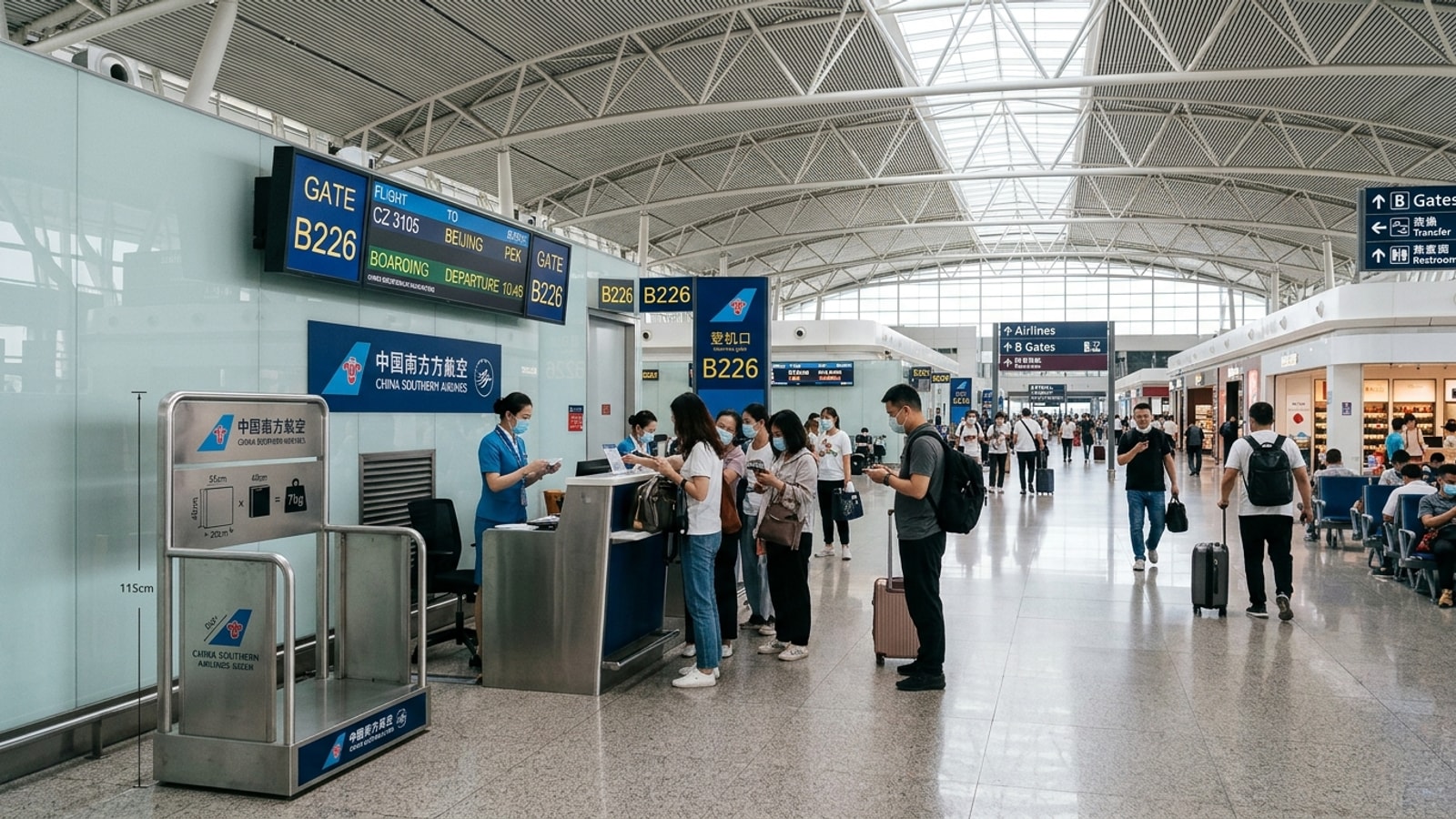
- Transit Impact: Ground handling teams at primary dual hubs—Guangzhou Baiyun (CAN Terminal 2) and Beijing Daxing (PKX)—strictly enforce the carrier's 55 x 40 x 20 cm exterior dimension limit using metal sizer frames and scale checks, dispatching oversized bags to cargo holds with gate-check surcharges starting at 300 CNY (
$42 USD) on domestic routes and reaching 1,200 CNY ($170 USD) on long-haul routes.- Traveler Advice: Pay close attention to the shallow 20 cm (7.8 inch) depth profile on rolling cases, pack lithium power banks strictly under 100Wh inside cabin bags with clearly legible manufacturer labels, and stow heavy electronic accessories inside your personal item to remain within the 8kg overhead limit.
China Southern Airlines stands as the largest commercial airline in Asia by fleet volume and passenger throughput. With primary operational mega-hubs anchored at Guangzhou Baiyun International Airport (CAN Terminal 2) and Beijing Daxing International Airport (PKX), the carrier connects hundreds of mainland Chinese cities with key global hubs across Southeast Asia, Europe, North America, the Middle East, and Australasia.
Operating high-capacity widebody aircraft including the Airbus A350-900, Boeing 787-8, Boeing 787-9, and Boeing 777-300ER alongside extensive narrowbody Airbus A320neo and Boeing 737 fleets, passenger cabin storage experiences heavy utilization. To preserve cabin egress routes, maintain on-time departures, and comply with binding Civil Aviation Administration of China (CAAC) flight safety mandates, China Southern rigorously enforces cabin luggage restrictions. Passengers unfamiliar with mainland Chinese airline practices often find the carrier's combination of an 8kg weight limit and strict 20 cm depth boundary more stringent than the looser allowances common among European or North American legacy carriers.
2026 Cabin Baggage Allowances: Weight Limits and Sizer Dimensions
China Southern establishes clear tier boundaries based on ticket cabin class. Unlike carriers that permit unlimited weight as long as a bag fits overhead, China Southern caps each cabin piece at exactly 8kg (17.6 lbs).
Economy Class and Premium Economy Class passengers are entitled to bring one standard carry-on bag weighing up to 8kg, with maximum outer dimensions of 55 x 40 x 20 cm (21.6 x 15.7 x 7.8 inches), encompassing wheels, handles, and external side pockets. Business Class and First Class passengers receive an elevated allowance of two distinct carry-on pieces, each subject to the same 8kg weight ceiling and 55 x 40 x 20 cm dimensional profile, yielding a cumulative overhead allowance of 16kg.
The structured table below details the cabin baggage allocations, physical dimensional limits, and under-seat accessory rules across all ticket classes:
| Passenger Service Class | Standard Carry-On Pieces | Max Weight per Piece | Max Outer Dimensions (L x W x H) | Personal Item Allowance | Total Cabin Baggage Allocation |
|---|---|---|---|---|---|
| Economy Class | 1 Piece | 8 kg (17.6 lbs) | 55 x 40 x 20 cm (21.6 x 15.7 x 7.8 in) | 1 Piece (under-seat fit: briefcase, handbag) | 8 kg primary bag + 1 under-seat item |
| Premium Economy Class | 1 Piece | 8 kg (17.6 lbs) | 55 x 40 x 20 cm (21.6 x 15.7 x 7.8 in) | 1 Piece (under-seat fit: briefcase, handbag) | 8 kg primary bag + 1 under-seat item |
| Business Class | 2 Pieces | 8 kg (17.6 lbs) | 55 x 40 x 20 cm (21.6 x 15.7 x 7.8 in) | 1 Piece (under-seat fit: briefcase, handbag) | 16 kg across 2 bags + 1 under-seat item |
| First Class | 2 Pieces | 8 kg (17.6 lbs) | 55 x 40 x 20 cm (21.6 x 15.7 x 7.8 in) | 1 Piece (under-seat fit: briefcase, handbag) | 16 kg across 2 bags + 1 under-seat item |
| Infant Without Seat | 0 Pieces (Standard bag) | Nil | N/A | 1 Fully collapsible stroller or infant carrycot | Checked at aircraft boarding door / ramp |
The 20cm Depth Threshold and Sizer Box Audits
The single most common compliance failure encountered by international travelers flying China Southern is the 20 cm (7.8 inch) depth threshold. Standard international rollaboards manufactured for North American or European domestic carriers commonly measure 23 cm (9 inches) or 25 cm (10 inches) in depth. When placed inside China Southern's static metal sizer frames at Guangzhou Baiyun or Beijing Daxing, these deeper bags fail to slide into the slot.
The cumulative linear dimension (length + width + height) must not exceed 115 cm (45.2 inches). Gate personnel apply three physical tests:
- The suitcase must slide freely into the steel test frame without requiring excessive force, compression, or zipper strain.
- External hardware—including multi-directional spinner wheels, side handles, and base studs—must remain entirely within the boundaries of the sizer.
- Expandable zip sections must remain completely closed; unzipping an expansion gusset typically adds 4 to 5 cm of depth, triggering an automatic sizer rejection.
Personal Item Guidelines and Under-Seat Stowage
Alongside the primary cabin bag, China Southern permits each ticketed passenger to carry one compact personal accessory at no additional charge. This item must fit comfortably beneath the passenger seat directly ahead.
Permitted personal accessories include:
- A slim laptop sleeve, compact computer briefcase, or padded tablet satchel
- A lady's handbag, purse, or small daily shoulder bag
- A compact camera pouch or optical binocular case
- An umbrella, walking stick, or medically certified orthopedic crutches
- An infant feeding bag containing milk powder, baby food, and necessary hygiene supplies for the flight
- Duty-free merchandise purchased inside the secure airport departure zone, packaged within a sealed shopping bag
Large hiking rucksacks, multi-day backpacks, and bulky duffel bags cannot be classified as personal items. If an accessory cannot slide under the seat pan, gate staff will treat it as a second primary carry-on, resulting in an immediate excess baggage violation for Economy passengers.
Departure Gate Audits, Interception Protocols, and Excess Surcharges
China Southern implements a dual-stage baggage audit framework across its flight network. Initial inspections occur at check-in desks, while secondary screenings take place at boarding gate jet bridges.
At terminal check-in counters across mainland airports, check-in agents weigh carry-on pieces alongside checked luggage. Compliant cabin bags receive an official green or white paper tag indicating authorized cabin carriage. At the boarding gate, staff conduct visual and physical spot checks using portable digital scales and stationary metal sizer frames stationed next to the automated turnstiles.
When a carry-on exceeds the 8kg threshold or fails the 55 x 40 x 20 cm dimensions, boarding agents revoke cabin clearance. The bag receives an expedited ramp luggage tag and is transferred directly to the aircraft cargo hold. Because this interception occurs post-security at the boarding gate, discounted online prepaid baggage rates cannot be applied. Passengers are required to pay immediate airport gate excess fees before boarding the aircraft.
The table below outlines typical gate-check surcharge ranges across China Southern's domestic, regional, and intercontinental network:
| Flight Sector | Operational Gate Procedure | Gate Excess Fee / Penalty | Accepted Payment Methods |
|---|---|---|---|
| Domestic Mainland China (e.g., CAN-PKX, PKX-SHA, CAN-CTU) | Involuntary cargo hold check; collect at destination baggage carousel | 300 to 450 CNY (~$42–$63 USD) per bag | WeChat Pay, Alipay, China UnionPay, domestic debit |
| Regional Asia-Pacific (e.g., Guangzhou to Tokyo, Seoul, Bangkok, Singapore) | Gate-tagged; sent down cargo ramp | 500 to 750 CNY (~$70–$105 USD) per piece | Visa, Mastercard, China UnionPay, WeChat Pay |
| Central & South Asia (e.g., Guangzhou / Urumqi to Delhi, Islamabad, Almaty, Tashkent) | Cargo hold transfer; boarding pass updated | 600 to 850 CNY (~$85–$120 USD) per piece | Major international credit cards, UnionPay |
| Intercontinental Long-Haul (Europe, North America, Australia, New Zealand) | Involuntary cargo transfer; routed to final baggage claim | 800 to 1,200 CNY (~$112–$170 USD) per piece | Visa, Mastercard, American Express; strictly cashless |
Gate podiums operate on a strictly cashless basis. Travelers must settle all penalty charges using accepted digital payment apps or credit cards. Passengers who decline or are unable to pay the gate fee will be offloaded from the flight under standard carriage conditions.
CAAC Lithium Battery Regulations and Safety Directives
Because China Southern operates under the regulatory jurisdiction of the Civil Aviation Administration of China (CAAC), aircraft cabin safety directives regarding hazardous materials and lithium-ion power packs are strictly enforced.
flowchart TD
    A["Evaluate Power Bank Capacity"] --> B{"Rating Under 100Wh (~20,000mAh)?"}
    B -- Yes --> C["Permitted in Cabin Luggage (Max 2 Units)"]
    B -- No --> D{"Rating Between 100Wh and 160Wh?"}
    D -- Yes --> E["Requires Counter Declaration & Airline Approval Slip"]
    D -- No --> F["Exceeds 160Wh (~32,000mAh): Strictly Prohibited"]
    C --> G["Verify Permanent Factory Watt-Hour Markings"]
    E --> G
    G --> H{"Markings Clearly Legible?"}
    H -- Yes --> I["Carry into Passenger Cabin (Never in Checked Baggage)"]
    H -- No --> J["Immediate Confiscation by Airport Security"]
    I --> K["Rule: Strictly Do Not Charge Devices During Flight"]
Power Bank Capacity Thresholds and Verification Rules
Under CAAC safety directives, power banks and standalone lithium-ion batteries are prohibited from checked baggage. They must be transported exclusively within cabin luggage under the following terms:
- Up to 100 Watt-Hours (Wh) / Approx. 20,000 mAh: Passengers may transport up to two personal power banks without prior airline notification, provided each unit is intended for personal electronic devices.
- From 100 Wh to 160 Wh / Approx. 20,000 to 32,000 mAh: Permitted up to a strict limit of two units per passenger, but travelers must declare the items at the China Southern check-in counter to obtain a physical dangerous goods authorization form.
- Above 160 Wh / Over 32,000 mAh: Banned from all commercial passenger aircraft. Airport security officers will seize non-compliant units at security screening checkpoints.
- Permanent Factory Markings: Every portable battery pack must feature clear, factory-printed or laser-engraved capacity specifications detailing Watt-hours (Wh) or voltage (V) and milliampere-hours (mAh). Batteries with rubbed-off labels, handwritten notes, or non-certified casing will be confiscated on the spot.
Warning · Operational AdvisoryCAAC flight safety rules strictly forbid using power banks to recharge mobile phones, tablets, or laptops while aboard China Southern aircraft. Power banks must remain completely switched off and stored in personal bags throughout taxi, takeoff, cruise, and landing.
Smart Luggage Requirements
Smart suitcases equipped with integrated charging ports, electric propulsion motors, or GPS trackers are subject to specific safety checks:
- The lithium battery must be easily detachable by the passenger without specialized tools.
- The removed battery pack must be carried into the passenger cabin.
- If overhead bins fill up and an agent orders a gate check, the passenger must detach the lithium battery pack at the gate and bring it onboard by hand.
- Smart bags with non-removable lithium batteries are barred from transport across China Southern flights.
Liquids, Aerosols, and Gels (LAGs) Policy
On international departures and transit itineraries passing through Guangzhou or Beijing:
- Liquid containers must not exceed 100 ml (3.4 fl oz) individually.
- All containers must fit inside a single transparent, resealable plastic pouch with a maximum capacity of 1 liter.
- For domestic segments within mainland China, personal beverages cannot pass through security screening; passengers must purchase drinks within the secure departures concourse.
- Duty-free liquor, perfume, and cosmetic purchases must remain sealed in tamper-evident security bags (STEBs) with proof-of-purchase receipts clearly visible.
Traveler Logistics Guide
Successfully managing your cabin baggage on China Southern flights requires attention to detail, particularly when transiting major Chinese mega-hubs.
Pre-Flight Preparation Checklist
- Verify Empty Luggage Weight: Traditional hardside rolling suitcases often weigh between 2.7kg and 3.4kg empty. On an 8kg Economy allowance, an empty 3.2kg bag leaves only 4.8kg for your packed items. Selecting an ultralight softside suitcase or a structured travel backpack under 1.8kg maximizes your usable packing weight.
- Measure Exterior Dimensions with External Fixtures: Measure your bag from the floor to the top handle, and verify that depth does not exceed 20 cm. Compression straps can help keep soft-sided duffels within allowable limits.
- Shift Dense Electronics to Your Personal Item: Place your laptop, charging brick, power adapters, camera bodies, and books into your under-seat briefcase or backpack. Airport staff primarily weigh the rolling suitcase destined for overhead bins, so keeping dense electronics in your personal accessory helps keep your primary suitcase under the 8kg limit.
Mega-Hub Transit Blueprints: Guangzhou Baiyun (CAN) and Beijing Daxing (PKX)
- Guangzhou Baiyun International Airport (CAN - Terminal 2): Terminal 2 serves as China Southern's global headquarters. International-to-domestic transfers require passengers to collect checked baggage, clear customs inspection, and re-check bags at domestic transit counters on Level 3. Allow a minimum connection buffer of 2 hours and 30 minutes. If you have an oversized carry-on that was gate-checked on an incoming flight, confirm with ground staff whether it will be delivered at the jet bridge or directed to the domestic baggage hall.
- Beijing Daxing International Airport (PKX): China Southern operates extensive domestic and international services from PKX. Daxing features a centralized terminal structure where gate piers radiate from a central hall, keeping walking times to any departure gate under 8 minutes. For international arrivals connecting to domestic sectors, designated transit corridors streamline document checks, but carry-on luggage sizers are stationed at each security transition point.
Sky Pearl Club Elite Privileges
Members of China Southern's Sky Pearl Club frequent flyer program gain valuable operational conveniences that simplify baggage logistics:
- Sky Pearl Gold and Platinum Members: Enjoy dedicated First/Business Class check-in counters, priority security lanes at select hubs, and Priority Boarding (Group 1 / Group 2). Boarding early ensures dedicated access to empty overhead locker space directly above your seat row.
- Checked Allowance Additions: While elite tier status does not increase the 8kg per-bag cabin weight ceiling, Sky Pearl Gold members receive one additional complimentary checked bag (up to 20kg or 32kg depending on route and class), making it practical to check heavier belongings for free rather than risking gate sizer penalties.
Frequently Asked Questions
Does China Southern strictly weigh carry-on bags at the boarding gate?
Yes. China Southern ground handling agents at Guangzhou Baiyun (CAN), Beijing Daxing (PKX), Shanghai Pudong (PVG), and key international outstations routinely check carry-on weight and dimensions. Scales and metal sizer frames are placed directly beside boarding gates. Bags that exceed the 8kg limit or the 55 x 40 x 20 cm envelope are intercepted and checked into the cargo hold, with gate penalty surcharges applied.
Can I bring both a rolling suitcase and a laptop backpack into the cabin?
Yes. Economy and Premium Economy passengers are allowed one primary carry-on suitcase (up to 8kg, max dimensions 55 x 40 x 20 cm) plus one small personal accessory, such as a laptop bag, small backpack, or handbag. The personal item must fit under the seat directly in front of you and must not obstruct aisle walkways.
What are China Southern's specific rules for carrying power banks?
All power banks must be packed in carry-on baggage; they are strictly forbidden in checked luggage. Power banks with a capacity up to 100Wh (approximately 20,000mAh) are permitted without prior notice. Units between 100Wh and 160Wh require counter approval from the airline (up to two units per traveler). Power banks over 160Wh, or units with worn, unreadable factory capacity markings, will be seized by airport security. Recharging personal electronic devices during flight is strictly prohibited by CAAC regulations.
How much does it cost if my carry-on bag is gate-checked?
Gate fees vary by destination. For domestic flights within mainland China, gate-check penalties generally range between 300 and 450 CNY ($42–$63 USD). On regional international flights across Asia, fees typically range from 500 to 750 CNY ($70–$105 USD). On long-haul intercontinental routes to Europe, North America, or Australasia, gate surcharges range from 800 to 1,200 CNY (~$112–$170 USD). Gate podiums accept major credit cards and mobile payment apps like WeChat Pay and Alipay, but do not accept cash.