

Quick Summary
- Primary Update: Indian passport holders traveling to South Korea for tourism, sightseeing, or visiting acquaintances must secure an advance C-3-9 Ordinary Tourist Visa via the official Korea Visa Application Center (KVAC); South Korea does not issue Visas on Arrival for Indian nationals, and India is excluded from K-ETA eligibility.
- Transit Impact: Applications are distributed across strict consular jurisdictions (New Delhi Embassy, Mumbai Consulate General, Chennai Consulate General). Passports are returned without physical stickers; travelers print a digital Visa Grant Notice from the official Korea Visa Portal.
- Traveler Advice: Maintain a minimum 6-month verifiable liquid bank balance of ₹1,50,000 to ₹3,00,000 stamped and signed on every page by the bank branch, provide Income Tax Returns (ITR-V) with acknowledgment for 1–2 assessment years, and lodge dossiers 15 to 20 working days before scheduled flights.
Indian passport holders planning leisure trips to South Korea in 2026 navigate a structured, consular-driven entry framework governed by the Ministry of Justice (MOJ) of the Republic of Korea. Unlike Southeast Asian destinations that offer visa waivers or automated electronic travel authorizations, South Korea requires Indian nationals to submit a physical paper dossier through designated Korea Visa Application Centers (KVAC) managed in partnership with VFS Global and official consular service providers.
Understanding jurisdiction boundaries, mandatory financial solvency benchmarks, exact document formatting, and paperless electronic visa retrieval prevents costly processing delays and application refusals.
Understanding South Korea C-3-9 Visa Regulations for Indian Citizens
The standard entry authorization for tourism, family visits, transit, and short-term leisure stays up to 90 days is classified as the C-3-9 Ordinary Tourist Visa. Key legal and operational parameters include:
- No Visa on Arrival (VoA): Indian citizens arriving at Seoul Incheon International Airport (ICN), Gimpo International Airport (GMP), or Gimhae International Airport (PUS) without an approved visa or eligible transit waiver are refused entry at the gate and placed on immediate return flights.
- K-ETA Ineligibility: The Korea Electronic Travel Authorization (K-ETA) is strictly reserved for nationals of 112 visa-exempt or visa-waiver countries. India is not a visa-waiver partner nation; therefore, Indian citizens cannot apply for or travel on a K-ETA. Any third-party website claiming to sell South Korea e-Visas or K-ETAs to Indian tourists is fraudulent.
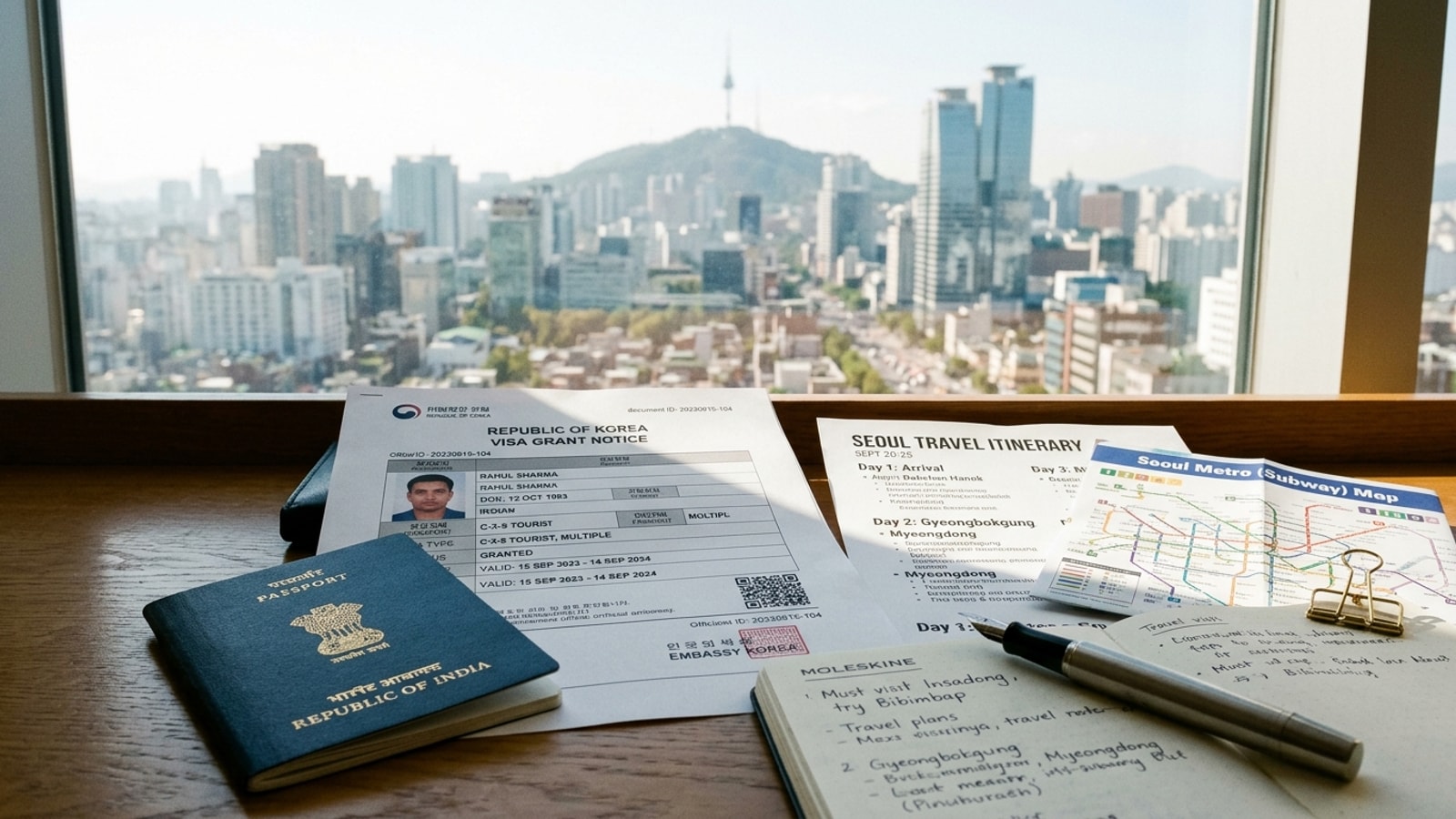
- Paperless Visa Grant Notice: In compliance with Ministry of Justice regulations enacted to streamline border processing, South Korean diplomatic missions no longer affix physical visa label stickers inside passports. Once an application is approved, the consular mission updates the central immigration database, and applicants download and print an official Visa Grant Notice directly from the Korea Visa Portal (
visa.go.kr). - Validity and Stay Allowances:
- Single Entry C-3-9: Valid for 90 days from the date of issue, permitting a single continuous stay of up to 90 days (standard leisure grants typically authorize 30 to 90 days depending on itinerary scope).
- Double Entry C-3-9: Valid for 6 months from issue date, permitting two distinct entries with stays of up to 30 days per entry.
- Multiple Entry C-3-9: Issued for 1, 3, or 5 years, allowing multiple stays of up to 30 or 90 days per entry. Five-year multi-entry visas are reserved for eligible categories, including frequent travelers holding prior OECD visas, graduates of accredited higher education institutions, or professionals meeting specific statutory income thresholds.
Consular Jurisdictions and KVAC Application Centers
The Embassy and Consulates General of the Republic of Korea maintain strict geographical jurisdiction rules across India. Applicants must lodge their files at the KVAC center assigned to their official state of residence:
1. KVAC New Delhi (Embassy of the Republic of Korea Jurisdiction)
- Facility: Korea Visa Application Center, Mezzanine Floor, Shivaji Stadium Metro Station, Baba Kharak Singh Marg, Connaught Place, New Delhi 110001.
- Coverage: Delhi NCR, Haryana, Punjab, Rajasthan, Uttar Pradesh, Uttarakhand, Himachal Pradesh, Jammu & Kashmir, Ladakh, Chandigarh, Bihar, Jharkhand, Odisha, West Bengal, and all Northeastern states (Assam, Meghalaya, Manipur, Mizoram, Nagaland, Tripura, Arunachal Pradesh, Sikkim).
- Sub-Center: KVAC Kolkata operates as a document collection and biometric submission point, forwarding files to the Embassy in New Delhi.
2. KVAC Mumbai (Consulate General in Mumbai Jurisdiction)
- Facility: Korea Visa Application Center, Urmi Axis Building, Famous Studio Lane, Dr. E. Moses Road, Mahalaxmi, Mumbai 400011.
- Coverage: Maharashtra, Gujarat, Goa, Madhya Pradesh, Chhattisgarh, and the Union Territories of Daman, Diu, Dadra and Nagar Haveli.
3. KVAC Chennai (Consulate General in Chennai Jurisdiction)
- Facility: Korea Visa Application Center, Alwarpet / Anna Salai commercial zones, Chennai.
- Coverage: Tamil Nadu, Karnataka, Kerala, Andhra Pradesh, Telangana, and the Union Territory of Puducherry.
Residency Verification Rule: Consular officers enforce a 6-month continuous residency requirement. If an applicant’s passport was issued outside the center’s territorial jurisdiction (for instance, a passport issued in Lucknow submitted at KVAC Mumbai), the applicant must furnish proof of local residence, such as a registered rental agreement, employer transfer letter, bank statement showing local branch address, or electricity bill covering the preceding 6 months.
South Korea C-3-9 Visa Fee Schedule and Processing Timelines
The following statutory fee table reflects consular tariffs, administrative service charges, and optional fulfillment fees applicable across KVAC centers in 2026:
| Visa Category / Service Item | Consular Fee (KRW / INR) | KVAC Service Charge | Total Payable (INR) | Standard Processing Time | Permitted Stay Duration |
|---|---|---|---|---|---|
| Single Entry C-3-9 (Up to 90 Days) | KRW 40,000 (~₹3,200) | ₹1,380 | ~₹4,580 | 10–14 Working Days | Up to 90 Days (Single Visit) |
| Double Entry C-3-9 | KRW 70,000 (~₹5,600) | ₹1,380 | ~₹6,980 | 10–14 Working Days | Up to 30 Days Per Entry (6-Month Validity) |
| Multiple Entry C-3-9 (1 to 5 Years) | KRW 90,000 (~₹7,200) | ₹1,380 | ~₹8,580 | 10–15 Working Days | 30–90 Days Per Entry (Multi-Year Validity) |
| Optional Passport Courier Return | N/A | ₹450 – ₹550 | ₹450 – ₹550 | 2–3 Days Transit | Doorstep Delivery via Secure Courier |
| SMS Tracking & Alerts | N/A | ₹150 – ₹200 | ₹150 – ₹200 | Real-Time | Automated SMS Status Notifications |
Note: Consular fees in Indian Rupees fluctuate based on official quarterly currency exchange rates set by the Ministry of Foreign Affairs. Payment modes at KVAC include Demand Draft, Debit/Credit Card, and UPI depending on the specific center.
Mandatory Document Checklist for Indian Applicants
Every C-3-9 visa submission requires a complete, verified dossier. Missing documents or unstamped printouts trigger immediate rejection or consular return.
1. Primary Identity and Application Records
- Original Passport: Valid for at least 6 months beyond the intended departure date from South Korea, containing at least 2 blank visa pages. Previous expired passports must be submitted if containing prior international travel stamps.
- Official Visa Application Form: The 5-page Ministry of Justice Form 17 must be completed in English without corrections or white ink. Every field must contain factual data; fields that do not apply must be marked "N/A" rather than left blank. The declaration must carry the applicant's signature matching the passport bio-page.
- Passport Photograph: One recent passport-size color photograph (3.5 cm x 4.5 cm) taken within the last 6 months against a pure white background. The face must occupy 70% to 80% of the frame. White shirts, colored contact lenses, and non-religious headwear are prohibited.
2. Travel Itinerary and Lodging Proof
- Personal Cover Letter: Signed letter outlining the purpose of visit, travel dates, companion details, funding responsibility, and an explicit commitment to depart before visa expiry.
- Day-by-Day Itinerary: A realistic schedule indicating daily tourist activities, sightseeing destinations (e.g., Gyeongbokgung Palace, N Seoul Tower, Haeundae Beach Busan), and internal transport arrangements.
- Confirmed Accommodation Bookings: Hotel reservation vouchers corresponding to each day of the proposed itinerary in South Korea, displaying the applicant’s name, hotel contact number, and address.
- Flight Reservations: Round-trip flight itinerary indicating confirmed dates and flight numbers. Consulates advise against purchasing non-refundable confirmed tickets until the visa grant notice is secured.
3. Financial Solvency and Proof of Funds Benchmarks
Financial documentation receives rigorous scrutiny from consular officers assessing whether applicants possess adequate funds and maintain strong economic ties to India:
- Original Bank Statements: Personal savings account statements covering the preceding 6 months. Each page must bear the official round bank stamp and signature of the authorized bank branch official. Digital statements generated online are accepted only if they contain verifiable cryptographic digital verification seals or bank branch endorsement.
- Balance Benchmark: A minimum closing liquid balance of ₹1,50,000 to ₹3,00,000 per traveler is recommended for standard short stays (7–10 days). For family applications, the primary sponsor should maintain ₹3,50,000 to ₹5,00,000.
- No Sudden Unexplained Deposits: Large lump-sum transfers credited shortly before statement generation without clear documented origins (such as property sale, gratuity, or loan disbursement) trigger financial suspicion and visa refusals.
- Income Tax Returns (ITR): Form ITR-V with official e-filing acknowledgment receipts for the last 1 to 2 Assessment Years (AY).
- Employment Documentation:
- Salaried Employees: Original Leave Sanction Letter / No Objection Certificate (NOC) on company letterhead signed by HR or an authorized manager with corporate seal and phone extension; salary slips for the last 3 to 6 months; copy of corporate identity card.
- Self-Employed / Business Proprietors: Certificate of Incorporation / GST Registration Certificate, Company Memorandum of Association (MOA) or Partnership Deed, 6-month company bank statements stamped by the bank, and company ITR-V for the past 2 years.
- Retired Individuals: Pension payment order (PPO), retirement proof, and pension bank account statements.
- Students & Minors: Bonafide student certificate from school or university, parental sponsorship letter, parent’s bank statements and ITR-V, applicant’s birth certificate, and non-accompanying parent consent affidavit on non-judicial stamp paper.
Traveler Logistics Guide
Navigating the operational lifecycle of a South Korea tourist visa requires adherence to strict practical protocols before departure and upon arrival at Korean border terminals.
Step 1: Submitting at the Korea Visa Application Center (KVAC)
- Collate original documents and photocopies strictly according to the consular checklist order.
- Visit the assigned KVAC center during operational submission windows (typically 09:00 to 12:00 for individual submissions). While appointments can be scheduled online via the KVAC web portal, walk-in submissions are accommodated during morning intake hours.
- Pay consular and center service charges at the payment counter. Retain the official payment receipt bearing your unique KVAC Application Reference Number.
Step 2: Tracking and Downloading the Visa Grant Notice
- Track processing progress on the Korea Visa Portal (
www.visa.go.kr) under Check Application Status > Check Application Status & Print. - Select "Diplomatic office" in the application type field, enter your passport number, applicant's full English name as spelled in the passport, and date of birth (YYYY-MM-DD).
- When the status changes from "Application Received" and "Under Review" to "Approved", click the "Visa Grant Notice" button.
- Download the PDF and print at least two crisp copies on standard A4 paper (black-and-white or color is acceptable). Verify that all personal data, passport numbers, permitted stay duration (e.g., 90 days), and validity dates are printed legibly.
Step 3: Airline Check-In and TIMATIC Verification
- Present your physical Indian passport and printed Visa Grant Notice at the departure airline counter in India (or transit airport).
- Airline ground staff verify your entry clearance via IATA TIMATIC using your passport number and the electronic visa registration record.
- Keep the printed Visa Grant Notice in your carry-on luggage for accessibility during boarding and transit.
Step 4: Arrival Clearance at Incheon International Airport (ICN)
- Upon landing at Terminal 1 or Terminal 2, follow signs toward Arrivals / Immigration (외국인 입국심사).
- Complete the physical yellow Korea Arrival Card distributed during flight or available at entry writing desks before immigration booths (unless pre-cleared via electronic digital portals).
- Present your passport, printed Visa Grant Notice, and Arrival Card to the Korean Immigration Service (KIS) border officer.
- Place your index fingers on the digital fingerprint scanner and look directly into the biometric facial capture camera.
- The officer scans your passport against the MOJ database and hands you a printed Entry Confirmation Slip detailing your permitted period of stay and departure deadline. Retain this slip with your passport throughout your stay in Korea.
Step 5: Customs Clearance and Prohibited Items
- After collecting checked luggage from baggage carousels, proceed through Customs.
- Duty-Free Allowances: Foreign visitors can import goods valued up to USD 800 duty-free, plus 1 bottle of alcoholic beverage (maximum 1 liter and value under USD 400), 200 cigarettes, and 60 milliliters of perfume.
- Currency Reporting: Travelers carrying foreign currency or negotiable monetary instruments exceeding USD 10,000 (or equivalent in INR/KRW) must complete a written customs declaration at the Customs counter.
- Strict Prohibitions: Raw meat products, fresh fruits, vegetables, seeds, plants, narcotics, firearms, and unapproved medications containing pseudoephedrine or codeine are strictly banned and subject to heavy fines at Korean ports of entry.
Frequently Asked Questions
Can Indian passport holders get a Visa on Arrival or K-ETA in South Korea?
No. Indian passport holders cannot obtain a Visa on Arrival at any South Korean airport or seaport. Furthermore, India is not eligible for K-ETA (Korea Electronic Travel Authorization). All Indian tourists must apply for a C-3-9 Ordinary Tourist Visa through the official Korea Visa Application Center (KVAC) prior to travel.
How much minimum bank balance is required for a South Korea tourist visa from India?
Consular authorities recommend maintaining a closing balance of at least ₹1,50,000 to ₹3,00,000 for an individual traveler planning a 7 to 10-day trip. The balance must be supported by 6 months of steady transaction history without sudden, unexplained cash deposits. Every page of the 6-month statement must carry an authentic bank branch stamp and manager signature.
Is a physical visa sticker stamped inside the passport for South Korea?
No. In accordance with Ministry of Justice directives, physical visa label stickers have been abolished for all visitor categories. Approved applicants receive a digital authorization recorded in the central immigration network and must print out a paper "Visa Grant Notice" from the official Korea Visa Portal (visa.go.kr) to present at airport check-in and border control.
Who is eligible for a 5-year multiple-entry South Korea C-3-9 tourist visa?
Indian nationals may qualify for a 5-year multiple-entry C-3-9 visa if they satisfy specific consular criteria: individuals who have previously visited South Korea; holders of valid or previously utilized visas from OECD nations (such as the US, UK, Canada, Australia, or Schengen Area); permanent government officials; graduates of recognized prestigious universities; or individuals demonstrating an annual taxable income exceeding ₹8,00,000 as reflected on official ITR-V filings.
Can Indian passport holders transit through Seoul Incheon Airport without a visa?
Indian passport holders can transit airside through Seoul Incheon International Airport (ICN) without a visa for up to 24 hours provided they remain within the international transit area of the airport and hold confirmed onward boarding passes to a third country. Additionally, travelers holding valid physical visas or permanent residence permits for the United States, Canada, Australia, or New Zealand who are transiting through South Korea en route to or from those countries may qualify for the 30-day B-2-1 visa-free transit facility, subject to immigration inspection.