

Quick Summary
- Primary Update: Manila Ninoy Aquino International Airport (MNL/NAIA) operates four physically separate passenger terminal complexes situated around the runway perimeter without an automated train link, requiring transiting passengers to use complimentary airside shuttles, landside buses, or elevated NAIA Expressway taxis.
- Transit Impact: Arriving international passengers connecting to domestic flights across the Philippines must clear Bureau of Immigration inspection, reclaim all checked baggage for Bureau of Customs clearance, and manually re-check luggage at their onward departure terminal.
- Traveler Advice: Allocate a strict minimum of 3 to 4 hours for inter-terminal transfers (such as Terminal 1 to Terminal 3 or Terminal 3 to Terminals 2 and 4), utilize official Grab booths or yellow airport metered taxis via the NAIA Expressway (NAIAX) when connection windows are tight, and file your electronic eTravel arrival declaration prior to boarding.
Manila Ninoy Aquino International Airport (IATA: MNL, ICAO: RPLL) serves as the primary international gateway to the Republic of the Philippines. Spread across the boundaries of Pasay City and Parañaque City within Metro Manila, the airport handles over 45 million passengers annually across four separate passenger terminals. Managed under a landmark public-private modernization concession by the New NAIA Infrastructure Corp (NNIC), the airport is undergoing comprehensive infrastructure overhauls to streamline terminal operations and passenger flows.
Connecting through NAIA presents unique operational challenges that differ substantially from single-roof mega-hubs. The four terminals are situated on opposite sides of the active dual-runway intersection (Runway 06/24 and Runway 13/31). Because no automated people mover (APM), underground rail link, or sterile pedestrian walkway connects the buildings, moving from one terminal to another requires navigating internal apron perimeter roads or entering Metro Manila’s congested public thoroughfares. Passengers transiting through Manila to popular island destinations like Boracay, Cebu, Palawan, and Siargao must understand the precise transit mechanisms, realistic minimum connection times, and mandatory customs re-check regulations.
Terminal Architecture and Airline Distribution
The four passenger terminals at NAIA function as independent facilities with separate roadway entrances, check-in halls, security checkpoints, and baggage claim areas.
                      [ Terminal 4 (Domestic Turboprops) ]
                         Aurora Boulevard / Tramo
                                    ▲
                                    │
                                    │ (Domestic Road / 2.5 km)
                                    ▼
  [ Terminal 2 (PAL Domestic) ] ───────── [ Runway Intersection ] ───────── [ Terminal 3 (Cebu Pac / Intl) ]
     MIA Road / Centennial                                                     Andrews Ave / Newport City
               ▲                                                                          ▲
               │                                                                          │
               │ (Perimeter Road / 1.5 km)                                                │ (NAIAX / 5.2 km)
               ▼                                                                          │
  [ Terminal 1 (Foreign Airlines) ] ──────────────────────────────────────────────────────┘
     Ninoy Aquino Avenue
Terminal 1 (Ninoy Aquino Terminal)
Terminal 1 is the original international passenger terminal, located on Ninoy Aquino Avenue.
- Flight Scope: Operates almost exclusively long-haul and regional foreign international flag carriers.
- Key Airlines: Emirates, Qatar Airways, Saudia, Kuwait Airways, Gulf Air, Oman Air, Turkish Airlines, Korean Air, Asiana Airlines, EVA Air, China Airlines, Japan Airlines, Singapore Airlines (select services), Malaysia Airlines, and United Airlines (Guam and select transpacific flights).
- Facilities: Multi-level international departures and arrivals halls, Bureau of Immigration counters, duty-free retail, airline lounges, and a dedicated airside transfer lounge.
Terminal 2 (Centennial Terminal)
Constructed in 1998 to mark the Philippine centennial, Terminal 2 sits along MIA Road between Terminal 1 and Terminal 4.
- Flight Scope: Functions primarily as the dedicated domestic fortress hub for Philippine Airlines (PAL) and its regional subsidiary, PAL Express.
- Key Airlines: Philippine Airlines (domestic services to Cebu, Davao, Iloilo, Bacolod, Kalibo, Caticlan/Boracay, Puerto Princesa, and other regional airports).
- Layout: Wing-shaped single-building architecture featuring North Wing and South Wing boarding gates. International Philippine Airlines flights operate between Terminal 1 and Terminal 2 depending on ongoing NNIC route rationalization programs.
Terminal 3 (NAIA Terminal 3)
Terminal 3 is the largest, most modern, and highest-capacity terminal at NAIA, situated on Andrews Avenue opposite Newport City.
- Flight Scope: Houses both domestic and international operations across low-cost and full-service carriers.
- Key Airlines: Cebu Pacific (main domestic and international hub), AirAsia Philippines (domestic and regional international), Cathay Pacific, All Nippon Airways (ANA), Delta Air Lines, United Airlines (San Francisco nonstop), Qantas, KLM Royal Dutch Airlines, Singapore Airlines, and Etihad Airways.
- Layout: Four-level complex with basement parking, Level 1 arrivals, Level 2 airline offices, Level 3 departures check-in hall, and Level 4 retail and dining promenade. Directly connected to Newport World Resorts through the Runway Manila enclosed air-conditioned pedestrian footbridge.
Terminal 4 (Manila Domestic Passenger Terminal)
Known locally as the Old Domestic Terminal, Terminal 4 is a single-story facility on Aurora Boulevard.
- Flight Scope: Dedicated strictly to domestic turboprop operations and short-runway island hops.
- Key Airlines: Cebgo (Cebu Pacific ATR-72 turboprop fleet), AirSWIFT (direct island service to El Nido Lio Airport), and Sunlight Air.
- Layout: Compact terminal with ground-level boarding gates, apron bus transfers, and limited waiting lounge space.
Inter-Terminal Transit Systems: Shuttles, Taxis, and Grab
Transferring between NAIA terminals requires selecting the appropriate transportation method based on your ticketing structure, arrival status, and baggage possession.
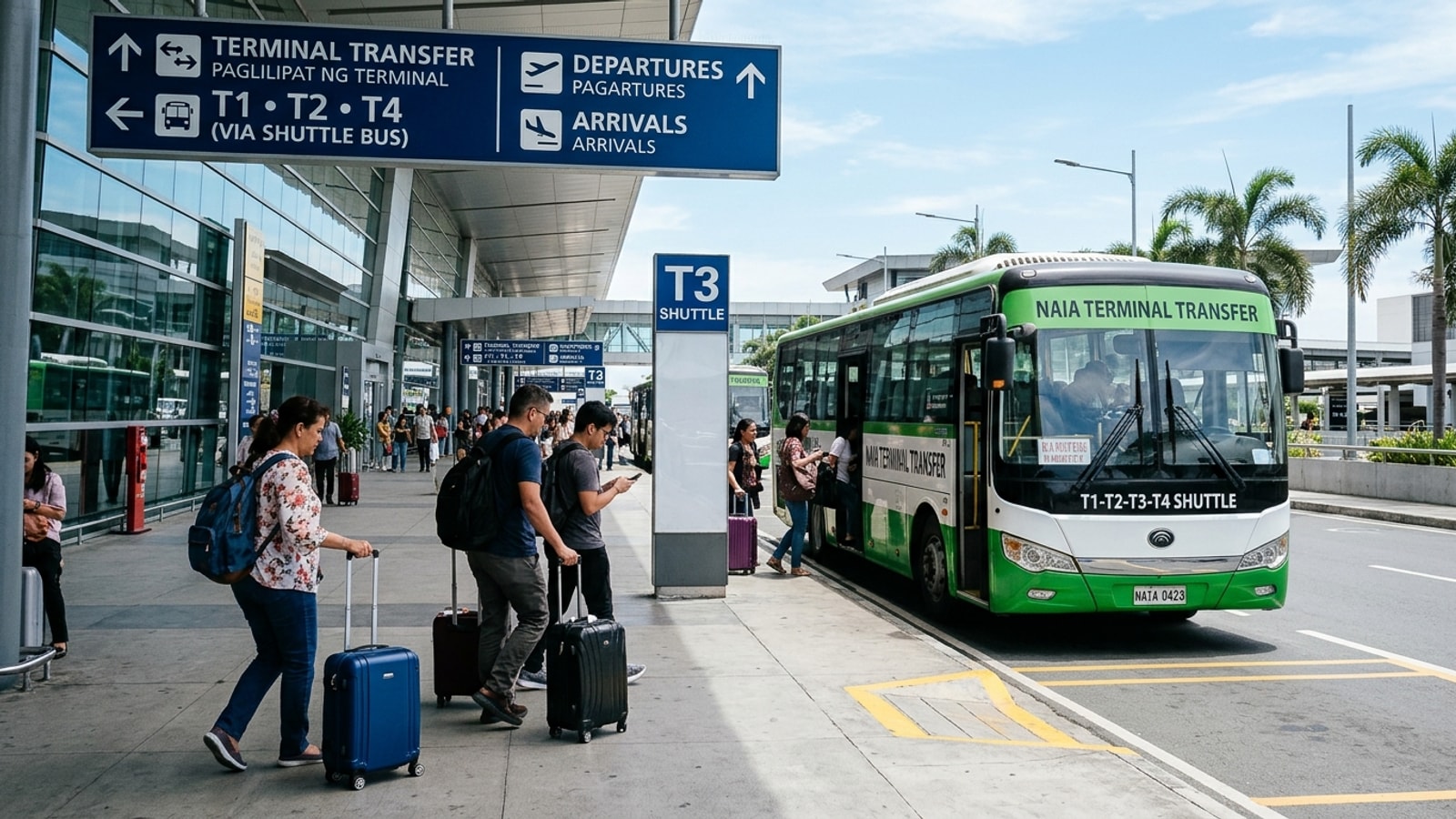
1. Airside Inter-Terminal Shuttle Bus (Free for Ticketed Transfer Passengers)
The Manila International Airport Authority (MIAA) and NNIC operate a complimentary airside transfer shuttle that travels on the internal airport service roads behind the security perimeter.
- Eligibility: Available strictly to passengers holding a confirmed connecting flight ticket (boarding pass or e-ticket itinerary) departing from another NAIA terminal within 24 hours.
- Operating Hours: Operates 24 hours daily, 7 days a week.
- Frequency: Buses depart every 30 to 45 minutes. Departures are coordinated with inbound flight banks.
- Route: Connects Terminal 1, Terminal 2, and Terminal 3 via the airport tarmac and apron perimeter roadway.
- Tarmac Delays: Because the shuttle crosses active aircraft taxiways, buses must yield right-of-way to taxiing aircraft. Transit time between terminals ranges from 15 to 25 minutes depending on aircraft traffic.
- Terminal Transfer Desk Access:
- Terminal 1: Follow "Flight Transfer" signage on the arrivals level to the Transfer Desk near Baggage Carousel 1.
- Terminal 2: Transfer desk located near the baggage claim exit corridor.
- Terminal 3: Proceed to the Transfer Desk on Level 1 (Arrivals), adjacent to the international baggage reclaim hall exit.
2. Landside MIAA / NNIC Airport Shuttle Bus
For self-connecting travelers or passengers who must exit the secure area, the airport authority runs landside shuttle buses.
- Eligibility: Open to all passengers and airport employees. A nominal fee of ₱20 PHP applies to non-connecting passengers, though it is free upon presenting a valid boarding itinerary.
- Route: Loops externally between Terminal 1, Terminal 2, Terminal 4, and Terminal 3.
- Transit Duration: 25 to 55 minutes. Because this bus travels along public streets (Andrews Avenue, Tramo, Domestic Road, and MIA Road), it is heavily vulnerable to Metro Manila road congestion during rush hours (07:00–10:00 and 16:30–20:30).
3. NAIA Expressway (NAIAX) and Taxis
When connection times are compressed, utilizing an elevated highway taxi provides the most dependable transit.
- The NAIAX Corridor: The elevated NAIA Expressway links Terminal 1, Terminal 2, and Terminal 3 directly, bypassing congested ground-level intersections. Traveling via NAIAX between Terminal 3 and Terminal 1 or 2 typically takes 8 to 15 minutes.
- Toll Fees: The NAIAX toll costs ₱35 to ₱45 PHP. Drivers will add this toll to your metered or app fare; always keep small Philippine Peso cash notes ready.
- Yellow Airport Metered Taxis: Accredited airport taxis painted bright yellow station themselves directly outside each terminal arrival exit. Flag-down rate is ₱70 PHP, with metered distance increments. A typical yellow taxi transfer between terminals costs ₱180 to ₱300 PHP including toll.
- White Regular Metered Taxis: Available on outer curbsides and departure decks. While slightly cheaper (flag-down ₱45 PHP), some drivers refuse to use the meter or demand inflated flat rates. Insist on meter activation before entering.
4. GrabCar Ride-Hailing Service
Grab is widely regarded as the safest, most transparent ground transportation option at NAIA.
- Grab Booking Hubs: Dedicated, staffed Grab booths operate at:
- Terminal 1: Curbside Arrivals, Bay 5.
- Terminal 2: Curbside Arrivals, Bay 4.
- Terminal 3: Level 1 Arrivals, Curbside Bays 11 and 12, as well as an indoor Grab Kiosk opposite carousel exit gates.
- Terminal 4: Curbside pick-up area directly outside the exit doors.
- Booking Mechanics: You can book directly on your personal Grab mobile app using airport Wi-Fi or local cellular data, or approach an agent at the official Grab booth who will dispatch a driver for you. Fares are locked upfront (typically ₱200 to ₱450 PHP depending on dynamic surge pricing, plus NAIAX toll fees).
Inter-Terminal Transit Logistics Matrix
The operational table below outlines connection pathways, transit modes, average travel durations, security requirements, and realistic minimum connection times across Manila Ninoy Aquino International Airport:
| Transfer Pathway | Primary Transport Mode | Road / Apron Distance | Average Transit Duration | Peak Traffic Delay Buffer | Security & Customs Requirement | Minimum Connection Time (MCT) |
|---|---|---|---|---|---|---|
| Intra-Terminal 3 (Domestic to Domestic) | Foot / Escalators | 200–600 m | 5–10 mins | None | Security re-screen at domestic gate | 60–75 mins |
| Intra-Terminal 3 (Intl to Domestic) | Foot / Baggage Reclaim | 400–800 m | 45–60 mins | Immigration lines | Immigration + Customs + Re-check | 120–150 mins |
| Terminal 1 to Terminal 2 (Intl to PAL Domestic) | Airside Shuttle / Yellow Taxi | 1.8 km | 10–15 mins | 20–30 mins (landside) | Full Customs + Baggage Re-check | 180 mins (3.0 hrs) |
| Terminal 1 to Terminal 3 (Foreign Intl to Cebu Pac/Intl) | NAIAX Taxi / Airside Shuttle | 5.2 km | 12–25 mins | 35–50 mins (ground roads) | Full Customs + Baggage Re-check | 210 mins (3.5 hrs) |
| Terminal 2 to Terminal 3 (PAL Domestic to Cebu Pac/Intl) | Airside Shuttle / NAIAX Taxi | 4.8 km | 15–25 mins | 30–45 mins (landside) | Standard Domestic Baggage Drop | 180 mins (3.0 hrs) |
| Terminal 3 to Terminal 4 (Intl Arrival to Turboprop Island) | Airport Shuttle / Grab / Taxi | 3.6 km | 15–30 mins | 40–50 mins (Tramo rush) | Full Customs + Baggage Re-check | 240 mins (4.0 hrs) |
| Terminal 2 to Terminal 4 (PAL Domestic to Cebgo/AirSWIFT) | Landside Taxi / Shuttle | 2.2 km | 10–18 mins | 25–35 mins (MIA Rd rush) | Re-check bags at T4 check-in | 150 mins (2.5 hrs) |
| Self-Transfer on Separate Tickets (Any Terminal Pair) | NAIAX Taxi / GrabCar | 2.0–6.0 km | 20–35 mins | 45–60 mins | Full Landside Re-check & TSA | 240–300 mins (4–5 hrs) |
Connection Protocols and Baggage Rules
Transiting through NAIA requires strict compliance with Philippine border protection protocols. Baggage transfer procedures depend on whether your journey involves international segments.
[ International Arrival at NAIA (T1 or T3) ]
                    │
                    ▼
       [ Bureau of Immigration Inspection ]
                    │
                    ▼
     [ Baggage Reclaim Hall (Carousels) ] ◄── MANDATORY: Collect all checked luggage
                    │
                    ▼
        [ Bureau of Customs Inspection ] ◄── Clear Green (Nothing to Declare) or Red Channel
                    │
       ┌────────────┴────────────┐
       ▼                         ▼
[ Same-Ticket Transit Desk ]   [ Self-Transfer / Separate Tickets ]
- Hand bags to transfer counter  - Take bags landside to Taxi/Grab/Shuttle
- Board Airside Shuttle Bus      - Travel via NAIAX to Departure Terminal
       │                         - Check in at departure hall counters
       │                         - Pass final security checkpoint
       ▼                         │
       └─────────────────────────┼──────────────────────────┐
                                                            ▼
                                               [ Board Connecting Flight ]
1. Inbound International to Domestic Connection (Mandatory Customs Re-Check)
This is the most common connection pathway for travelers arriving from international hubs and transferring to domestic islands.
- Regulatory Requirement: Under Philippine Bureau of Customs (BOC) administrative orders, NAIA does not permit sterile automatic luggage transfer from international flights to domestic flights. All baggage must be inspected at the first port of entry into the Philippines.
- Step 1: Disembark your international flight and proceed to the Bureau of Immigration primary inspection counters. Present your passport, boarding pass, and confirmed digital eTravel QR code.
- Step 2: Proceed to the baggage claim carousel and collect all checked suitcases and boxes.
- Step 3: Exit through the Bureau of Customs clearance checkpoint. If you have nothing to declare, proceed through the Green Channel.
- Step 4:
- If on an interline ticket (e.g., PAL to PAL domestic): Turn toward the inter-terminal transfer desk immediately outside customs. Agents will tag your bags for the domestic segment and escort you to the complimentary airside transit bus.
- If on separate tickets (e.g., Emirates into T1, connecting to Cebu Pacific out of T3): Exit to the public arrival curbside with your bags, hail a yellow metered taxi or Grab, take the NAIAX to your onward terminal, and check in at the departures hall.
2. Inbound Domestic to Outbound International Connection
When flying from a domestic island airport (e.g., Caticlan, Cebu, or Davao) to Manila to catch an outbound international flight:
- Single-Ticket / Interline Bookings: If your flights are booked under a single itinerary on Philippine Airlines or partner airlines with baggage interline agreements, your bags are checked through to your final international destination at your origin airport. You will receive both boarding passes upon departure. At NAIA, deplane, follow transfer signage to the airside shuttle desk, and board the bus directly to your international departure terminal without collecting your luggage.
- Separate Tickets (Low-Cost Carriers): Cebu Pacific, AirAsia, Cebgo, and AirSWIFT operate strictly point-to-point networks. If your outbound flight is on a separate booking, you must collect your luggage from the domestic carousel at NAIA, take landside transport to your international terminal, and complete check-in, customs declaration, and immigration exit procedures.
3. Electronic Travel Declaration (eTravel System)
All passengers arriving in the Philippines—both foreign nationals and Filipino citizens—must complete the official Philippine eTravel registration online (etravel.gov.ph) within 72 hours prior to arrival.
- The system generates an individual QR code (green for approved clearance, red for secondary manual inspection).
- Keep a digital screenshot or printed copy on your mobile device; immigration officers scan this code before stamping your passport.
- Failure to complete eTravel prior to arrival leads to significant delays at airport Wi-Fi registration kiosks.
Traveler Logistics Guide
Navigating Manila Ninoy Aquino International Airport smoothly requires practical preparation and awareness of airport facilities.
Terminal Directions and Transfer Steps
Transferring from Terminal 1 to Terminal 3 (Foreign Airline to Cebu Pacific / ANA / Delta)
- Deplane at Terminal 1 and follow overhead signs through international arrival corridors to the Bureau of Immigration hall.
- Clear passport control, proceed downstairs to the baggage reclaim area, and collect all checked baggage from the assigned carousel.
- Pass through the Bureau of Customs checkpoint.
- If traveling on a single through-ticket with an approved transfer tag, locate the MIAA Transfer Lounge near Carousel 1 to board the internal airside shuttle.
- If traveling on separate bookings, exit the customs hall to the arrivals curbside. Walk to Bay 5 to board a GrabCar or proceed to the Yellow Metered Taxi stand.
- Instruct the driver to take the NAIA Expressway (NAIAX) directly to Terminal 3 Departures. Expect a travel time of 10 to 18 minutes.
- Alight at Terminal 3 Level 3 (Departures). Pass initial entrance security, locate your airline check-in row, drop your bags, and clear departure immigration.
Transferring from Terminal 3 to Terminal 2 or Terminal 4 (Cebu Pacific / Foreign Carrier to PAL or Island Turboprops)
- Clear arrivals and customs on Terminal 3 Level 1.
- If departing from Terminal 4 on Cebgo or AirSWIFT, note that Terminal 4 is located on Aurora Boulevard and does not have an airside boarding bridge.
- Book a GrabCar from Bay 11/12 or hire a Yellow Metered Taxi.
- Drivers heading to Terminal 4 will navigate Andrews Avenue and Domestic Road. During rush hours, allocate at least 35 to 45 minutes for this 3.6-kilometer road journey.
- Arrive at Terminal 4 at least 2 hours prior to scheduled departure, as check-in counters close strictly 45 minutes before departure.
Ground Transportation Checkpoints and Scam Avoidance
- Avoid Unaccredited Solicitations: Do not accept rides from touts or dispatchers approaching you inside the terminal halls offering "fixed VIP private car transfers." These drivers frequently demand exorbitant rates ranging from ₱1,500 to ₱3,500 PHP for simple terminal transfers.
- Official Yellow Taxi Procedure: Approach the uniformed dispatcher at the yellow taxi booth curbside. The dispatcher will hand you a slip containing the taxi plate number, driver name, and passenger complaint hotlines. Keep this slip. Ensure the driver turns on the dashboard meter immediately upon departure.
- Cash and Small Change: While Grab allows credit card billing through the app, yellow taxi drivers often lack change for large bank notes (₱1,000 PHP). Carry small denominations (₱20, ₱50, and ₱100 PHP) to pay fares and expressway tolls cleanly.
Connectivity, Currency, and Amenities
- Airport Wi-Fi: Free public Wi-Fi ("@NAIA-Free-WiFi") is accessible throughout all four terminals for up to two hours per device.
- Local SIM Cards and eSIMs: Official Smart Communications and Globe Telecom kiosks are positioned immediately outside the customs exit doors in Terminals 1, 2, and 3. Tourist SIM packages and digital eSIM activations are processed on-site.
- Currency Exchange and ATMs: International arrival halls at Terminals 1 and 3 feature multiple bank-operated currency exchange counters (BDO, Bank of the Philippine Islands, Landbank) and international ATMs accepting Visa, Mastercard, Plus, and Cirrus networks.
- Luggage Storage (Left Baggage): Terminal 3 provides a secure luggage deposit service operated by "Protectabag / Luggage & More" located on Level 1 (Arrivals) near the parking structure entrance. This service is ideal for travelers with long layovers wishing to visit Newport World Resorts or central Manila without luggage.
Frequently Asked Questions
Can I walk between terminals at Manila Ninoy Aquino Airport (NAIA)?
No. Walking between terminals at NAIA is neither practical nor permitted. The four terminals are isolated complexes separated by active airport runways, secure taxiways, and high-speed multi-lane perimeter thoroughfares without contiguous pedestrian sidewalks. The only walkable connection is between Terminal 3 and Newport World Resorts via the elevated Runway Manila pedestrian footbridge. To move between any two airport terminals, you must take an authorized airport shuttle bus, yellow metered taxi, or GrabCar.
How much time do I need to transfer between Terminal 1 and Terminal 3 at NAIA?
You should budget a minimum connection time of 3.5 to 4 hours. While the physical drive along the elevated NAIA Expressway takes only 10 to 18 minutes, the end-to-end transfer requires clearing arrival immigration (20–45 minutes), waiting for baggage offloading (25–45 minutes), clearing customs (10 minutes), queuing for transport (15–30 minutes), transiting between terminals, and completing departure check-in and security screening at Terminal 3 prior to counter cutoffs.
Do I have to collect my luggage in Manila before flying to Boracay, Cebu, or Palawan?
Yes. Philippine Bureau of Customs regulations require all passengers arriving on international flights to collect their checked luggage at their first port of entry in the Philippines (NAIA). You must carry your luggage through customs inspection in Terminal 1 or Terminal 3. Once cleared, you can hand your bags to the domestic transfer counter (if traveling on a through-ticket on partner airlines) or manually carry them to your domestic departure terminal for check-in.
Is the airport shuttle bus free between terminals at NAIA?
The airside MIAA/NNIC transfer shuttle bus is completely free for passengers who hold a confirmed onward flight ticket departing from another NAIA terminal within 24 hours. Present your passport and onward boarding pass or e-ticket itinerary at the transfer desk inside the arrivals hall to receive boarding clearance. The landside shuttle bus operating on public perimeter roads is also free for connecting flight ticket holders, while a nominal fare of ₱20 PHP applies to unticketed individuals.