

Quick Summary
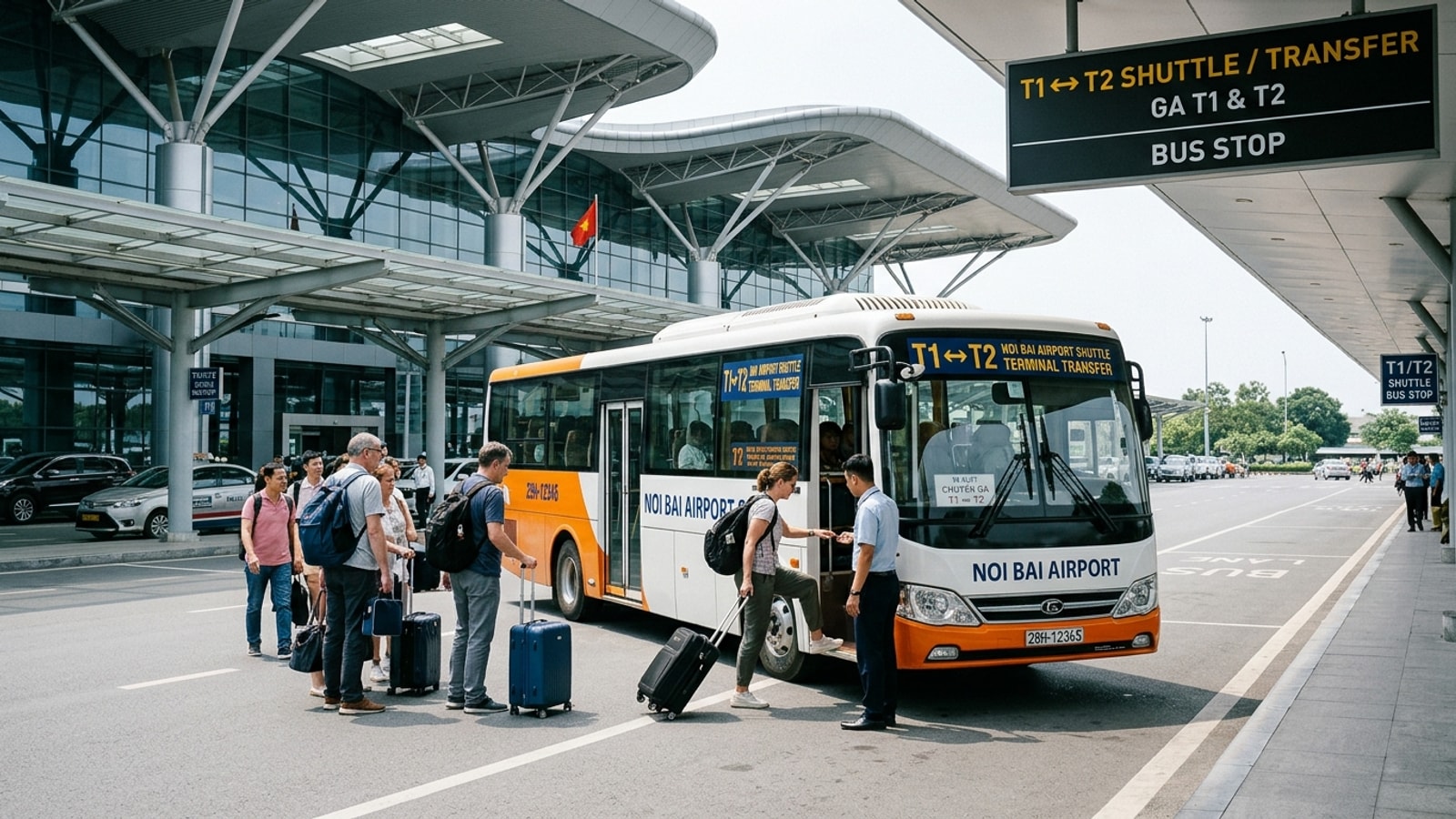
- Primary Update: Hanoi Noi Bai International Airport (HAN) separates domestic flights (Terminal 1) and international operations (Terminal 2) into two distinct complexes located 850 meters apart, linked by a dedicated free electric shuttle bus operating every 10 to 15 minutes.
- Transit Impact: Because no airside transfer corridor exists between Terminal 1 and Terminal 2, all travelers connecting between domestic and international flights must cross landside border control, collect checked baggage, and re-check bags at their connecting terminal.
- Traveler Advice: Maintain a minimum connection buffer of 2.5 to 3 hours for international-to-domestic transfers, secure an approved Vietnam e-Visa prior to departure, and avoid roadside private taxi touts soliciting inflated transfer fares outside arrival doors.
Hanoi Noi Bai International Airport (IATA: HAN, ICAO: VVNB), operated by the Airports Corporation of Vietnam (ACV), serves as northern Vietnam's premier aviation hub and a vital international crossroads. Situated in the Soc Son District approximately 28 kilometers north of central Hanoi, Noi Bai processes heavy transfer traffic linking international services from India, Southeast Asia, East Asia, Europe, and the Middle East with high-frequency domestic flights to Da Nang, Ho Chi Minh City, Nha Trang, Phu Quoc, Hue, and Da Lat.
Navigating flight connections at Noi Bai requires an understanding of terminal geography and customs regulations. Unlike airports that house operations under a single roof or feature an automated airside people mover, Noi Bai maintains complete physical separation between its domestic terminal (Terminal 1) and international facility (Terminal 2). Transferring between domestic and international flights requires clearing border control, entering Vietnamese sovereign territory landside, using dedicated exterior transit shuttles, and re-checking luggage.
Terminal Layout and Airline Operations
Noi Bai Airport distributes flight operations across two large passenger terminals situated on opposite sides of the central airport apron and ring road network.
[ Terminal 1: Domestic ] <==== 850m Free Electric Shuttle Bus (8-12 min) ====> [ Terminal 2: International ]
Floor 1: Domestic Arrivals & Bag Claim                                           Floor 1: Int'l Arrivals, Customs & Shuttles
Floor 2: Domestic Check-in & Security                                            Floor 2: Int'l Transfer Desk & Immigration
Lobby E: VietJet Domestic Check-in                                               Floor 3: Int'l Departures & Check-in Islands
Floor 3: Airline Offices & Lounges                                               Floor 4: Airline VIP Lounges & Restaurants
Terminal 1: Domestic Flights
Terminal 1 handles all scheduled domestic passenger flights within Vietnam:
- Floor 1 (Ground Level): Domestic arrival hall, baggage reclaim carousels, arrival exit gates, hotel information counters, and the designated curbside bus bay for the free inter-terminal shuttle bus (outside Lobby A, Gates 15 to 18).
- Floor 2: Domestic departure concourse featuring check-in rows and security screening checkpoints for Vietnam Airlines, Pacific Airlines, Bamboo Airways, and Vietravel Airlines.
- Lobby E (Wing E): An expanded domestic wing connected to the central T1 building via an enclosed interior walkway. Lobby E contains dedicated check-in counters (counters 101 through 138) and specialized security screening lanes primarily assigned to VietJet Air domestic flights.
- Floor 3: Administrative airline offices, service facilities, and domestic contract lounges.
Terminal 2: International Flights
Terminal 2 is a modern four-level glass-and-steel facility opened to process all international flight arrivals and departures:
- Floor 1 (Ground Level): International arrival hall, 8 baggage reclaim carousels, Vietnam Customs clearance checkpoints with mandatory baggage X-ray scanners, currency exchange booths, local SIM card retailers, and curbside transport columns. The free electric shuttle bus to Terminal 1 boards curbside at Columns 16 to 18.
- Floor 2: International transfer desk for sterile international-to-international connections, health quarantine desks, and the primary immigration arrival hall (passport control).
- Floor 3: International departures concourse featuring 96 check-in counters organized across 4 island clusters (A/B, C/D, E/F, and G/H), exit customs inspection, outbound passport control, central security screening, duty-free retail, and boarding gates 20 through 36.
- Floor 4: Premium airline lounges—including the Vietnam Airlines Lotus Lounge and the NIA Business Lounge—alongside dining outlets and airline operations centers.
- Serving Carriers: Vietnam Airlines (international routes), VietJet Air (international services), Air India, IndiGo, Singapore Airlines, Emirates, Qatar Airways, Thai Airways, Scoot, AirAsia, Malaysia Airlines, Korean Air, Asiana Airlines, EVA Air, China Airlines, Cathay Pacific, Starlux, Turkish Airlines, and Air France.
Inter-Terminal Transfer Mechanics: The Free NIA Shuttle Bus
Moving between Terminal 1 and Terminal 2 cannot be completed on foot. Walking along the highway link (Vo Nguyen Giap access corridor) is strictly prohibited by airport security due to multi-lane high-speed traffic, security fencing, and an absence of continuous pedestrian sidewalks.
Travelers must rely on airport-sanctioned vehicular connections. The primary and most efficient option is the official free airport shuttle bus operated by Noi Bai International Airport.
| Transfer Feature | Free NIA Shuttle Bus (Electric / Standard) | Curbside Taxi / Ride-Hailing (Grab / Be) |
|---|---|---|
| Route Path | T1 Lobby A (Gates 15–18) ⇄ T2 Curbside (Columns 16–18) | Dedicated passenger pick-up lanes |
| Operating Hours | 06:00 to 23:30 (Day) / 23:30 to 06:00 (Night) | 24 hours daily |
| Service Frequency | Every 10–15 minutes (Day); every 20–30 minutes (Night) | On-demand (app wait 3–8 minutes) |
| Travel Duration | 8 to 12 minutes | 5 to 7 minutes |
| Cost | 100% Free of charge | VND 30,000 – VND 50,000 (~$1.20 – $2.00 USD) |
| Baggage Capacity | Dedicated interior floor luggage racks | Standard car trunk limits |
| Ticketing Requirement | None (Show connecting flight ticket if requested) | App fare or metered meter payment |
How to Board the Shuttle Bus at Terminal 2 (International to Domestic)
- After clearing Vietnam border control, collecting luggage from carousels, and passing through customs X-ray inspection, exit into the public arrival hall on Floor 1.
- Turn right and walk out through the terminal sliding glass doors toward the exterior curbside pick-up lanes.
- Locate Columns 16, 17, and 18 along the west curb. Bright yellow-and-blue airport signage displays "Free Shuttle Bus to T1" (Xe buýt nối chuyến T1).
- Board the electric or low-floor transit bus. Staff assist with loading wheeled suitcases into the onboard luggage pens.
How to Board the Shuttle Bus at Terminal 1 (Domestic to International)
- Upon collecting domestic luggage on Floor 1, exit the baggage hall into Lobby A.
- Exit through the central glass doors toward the curbside pick-up area between Gates 15 and 18.
- Wait at the sheltered shuttle bus shelter marked "Free Shuttle Bus to T2" (Xe buýt nối chuyến T2).
- The shuttle departs directly for the Terminal 2 departures ramp or arrival curb, taking approximately 10 minutes.
Warning · Operational AdvisoryUnlicensed freelance touts operate aggressively outside Floor 1 arrival doors at both terminals, offering "fast VIP shuttles" or "terminal transfers" for VND 200,000 to VND 500,000 ($8 to $20 USD). Firmly bypass these solicitors and proceed directly to the official free NIA shuttle bus stop.
Minimum Connection Times (MCT)
Meeting flight connection windows at Noi Bai requires realistic planning tailored to specific routing profiles.
| Connection Scenario | Inbound Terminal | Outbound Terminal | Baggage Status | Recommended MCT |
|---|---|---|---|---|
| Int'l to Domestic (Self-Transfer) | T2 (Int'l) | T1 (Domestic) | Reclaim & Re-drop | 150 – 180 minutes |
| Int'l to Domestic (Single Ticket) | T2 (Int'l) | T1 (Domestic) | Clear Customs & Transfer | 150 minutes |
| Domestic to Int'l (Self-Transfer) | T1 (Domestic) | T2 (Int'l) | Reclaim & Check-in | 150 minutes |
| Domestic to Int'l (Single Ticket) | T1 (Domestic) | T2 (Int'l) | Through-Checked | 120 minutes |
| Int'l to Int'l (Single Ticket) | T2 (Int'l) | T2 (Int'l) | Through-Checked | 75 – 90 minutes |
| Int'l to Int'l (Split Ticket / LCC) | T2 (Int'l) | T2 (Int'l) | Reclaim & Re-check | 180 minutes |
International to Domestic Connections (T2 to T1)
This profile demands the longest buffer. International arriving flights frequently touch down in congested banks during mid-morning and late-evening windows. Arriving travelers must negotiate:
- Immigration Queues: 30 to 50 minutes during peak hours at T2 passport control.
- Baggage Delivery: 20 to 30 minutes from aircraft docking to carousel presentation.
- Customs Inspection: 5 to 10 minutes for mandatory hand baggage and checked bag X-ray scanning.
- Bus Transfer: 15 to 25 minutes (combining wait interval and transit driving time).
- Domestic Check-in Cutoff: Strict 45-minute pre-departure bag drop closure at Terminal 1.
- Security Screening: 15 to 20 minutes at T1 domestic security gates.
Allowing anything under 2.5 hours on separate tickets introduces severe operational risk of missed departures.
International to International Connections (T2 to T2 Airside)
Passengers transiting between two international destinations on a single through-ticket (such as London to Bangkok via Hanoi on Vietnam Airlines) do not exit landside.
- Upon disembarking at Terminal 2, follow overhead green signage for "Transfer / Nối Chuyến" on Floor 2.
- Present passport and onward boarding pass at the dedicated airside transfer desk.
- Pass through the dedicated transit security screening checkpoint.
- Take the escalators directly up to Floor 3 international departures. This sterile airside transfer can be completed comfortably within 45 to 60 minutes, provided bags are checked through to the final destination.
Mandatory Baggage Re-Check and Customs Rules
Understanding Vietnam customs regulations is essential for every transiting passenger.
[ International Flight Lands at T2 ]
                 │
                 ▼
[ Pass Health Quarantine & Passport Control (Floor 2) ]
                 │
                 ▼
[ Collect ALL Checked Baggage at Carousels (Floor 1) ]
                 │
                 ▼
[ Pass Mandatory Vietnam Customs X-Ray Belts ]
                 │
                 ▼
[ Exit to Curbside Floor 1 ──> Free Shuttle Bus to T1 ]
                 │
                 ▼
[ Check-in Bags at Airline Desks in T1 (Floor 2 / Lobby E) ]
General Customs Protocol for Domestic Transfers
The General Department of Vietnam Customs mandates that all goods and baggage entering Vietnam from an international destination must undergo border customs clearance at the first port of entry.
Even if a passenger holds a single interline ticket issued by Vietnam Airlines where bags were tagged through to Da Nang or Ho Chi Minh City at origin, the passenger must physically retrieve every checked bag at Hanoi Terminal 2, roll it through the customs inspection checkpoint, and re-drop it at the domestic transfer desk or at Terminal 1. Luggage is never automatically transferred airside from an international flight to an onward domestic flight.
Low-Cost Carrier Policies (VietJet Air)
VietJet Air operates extensive domestic and international services from Noi Bai but functions primarily on a point-to-point commercial model.
- VietJet does not offer automated baggage transfers between domestic and international itineraries, even when both segments are booked on VietJet.
- Passengers holding separate bookings must clear border immigration, collect their bags, board the free shuttle bus to Terminal 1, proceed to Lobby E, and complete check-in at the domestic bag drop desks.
- VietJet enforces a strict 45-minute domestic check-in closure. Missing this window results in ticket cancellation and forfeiture.
Entry Visa Rules: Why Transfers Require an e-Visa
A critical legal pitfall for foreign travelers transiting Hanoi is the regulatory requirement for Vietnamese entry documentation.
Because Terminal 1 is exclusively domestic and located landside outside the international customs border, any passenger transferring from Terminal 2 to Terminal 1 must enter Vietnamese territory.
Important · Regulatory Mandate
- Travelers holding passports that require a visa for Vietnam (including Indian, US, Australian, and Canadian citizens) MUST possess an approved Vietnam e-Visa before boarding their initial flight to Hanoi if their itinerary involves an onward domestic flight.
- Airlines will deny boarding at origin if a passenger booked on a domestic connecting flight lacks a valid Vietnam e-Visa or qualifying visa exemption.
- There is no "sterile domestic airside transit" at Noi Bai. You cannot access Terminal 1 without passing through Vietnamese border control.
Airside transit without a visa is permitted only when all of the following conditions are met:
- Both arriving and departing flights are international and operate exclusively out of Terminal 2.
- The layover duration does not exceed 24 hours.
- The passenger holds confirmed boarding passes and through-checked baggage to their third-country destination.
- The passenger does not step outside the sterile transit area on Floor 2 and Floor 3 of Terminal 2.
Traveler Logistics Guide
Step-by-Step: Connecting from Terminal 2 (Int'l) to Terminal 1 (Domestic)
- Disembark and Follow Signs: Follow the arrivals pathway on Floor 2 toward "Immigration / Nhập Cảnh".
- Clear Border Control: Present your passport, printed Vietnam e-Visa (or visa waiver paperwork), and arrival boarding pass to the immigration officer.
- Reclaim Baggage: Descend to Floor 1 baggage reclaim. Check display screens for your designated carousel (Carousels 1 through 8).
- Clear Customs: Place all bags—including carry-on backpacks—on the Vietnam Customs conveyor belts for X-ray scanning. Exit through the sliding doors into the public arrival hall.
- Locate Transport: Turn right and proceed outside to Columns 16–18. Look for the blue-and-yellow "Free Shuttle Bus" sign.
- Ride to Terminal 1: Board the free shuttle bus (travel time: 8–12 minutes).
- Locate Check-in:
- For Vietnam Airlines, Bamboo Airways, and Vietravel Airlines, take the escalator to Floor 2 Departures.
- For VietJet Air, follow the covered bridge walkway directly into Lobby E (counters 101–138).
- Check Bags & Clear Security: Drop bags before the 45-minute cutoff, clear domestic security screening, and proceed to your gate.
Step-by-Step: Connecting from Terminal 1 (Domestic) to Terminal 2 (Int'l)
- Arrive at T1: Disembark your domestic flight and follow signs to the Floor 1 domestic baggage claim hall.
- Collect Checked Luggage: Retrieve bags from the carousel (allow 15–25 minutes).
- Exit to Curbside: Walk out through Lobby A exit doors (Gates 15 to 18).
- Board Free Shuttle Bus: Board the designated bus to Terminal 2.
- Ascend to Departures: Alight at Terminal 2 and take elevators or escalators up to Floor 3 Departures.
- Check-in & Bag Drop: Locate your airline's check-in island (Islands A through H). Check-in counters close 50 to 60 minutes prior to international departure.
- Clear Outbound Controls: Pass through Vietnam Customs export declaration, passport control, and international aviation security. Proceed to boarding gates 20 to 36.
Connectivity, Cash, and Essentials at Noi Bai
- Wi-Fi Access: Free public Wi-Fi (
@NoiBai Airport Free Wi-Fi) is available across both terminals. Authentication requires opening a mobile browser window and clicking through the splash portal. - Local SIM Cards: Kiosks from Viettel, Vinaphone, and Mobifone operate on Floor 1 of Terminal 2 just past customs. Tourist eSIMs and physical SIMs cost approximately VND 250,000 to VND 350,000 ($10 to $14 USD) with unlimited data packages.
- ATMs and Currency Exchange: Authorized bank exchange counters (Vietcombank, BIDV, Techcombank) sit on Floor 1 of Terminal 2. ATMs dispensing Vietnamese Dong (VND) accept Visa, Mastercard, and UnionPay cards.
- Left Luggage Services: Secure luggage storage operates on Floor 2 of Terminal 2 (East Wing) and Floor 1 of Terminal 1 for travelers with long daytime layovers wishing to visit Hanoi city center.
Frequently Asked Questions
Can I walk between Terminal 1 and Terminal 2 at Hanoi Noi Bai Airport?
No. Walking between Terminal 1 and Terminal 2 is strictly prohibited and physically hazardous. The terminals are separated by approximately 850 meters of active highway ramps and ring roads without continuous sidewalks or pedestrian crossings. Passengers must utilize the official free electric shuttle bus or a licensed metered taxi.
Do I need a visa to transfer between flights at Hanoi Airport?
If your connecting flight is a domestic service departing from Terminal 1 (such as a flight to Da Nang, Phu Quoc, or Ho Chi Minh City), yes. You must enter Vietnamese sovereign territory to transfer between terminals, which requires an approved Vietnam e-Visa or qualifying visa exemption. If you are connecting between two international flights within Terminal 2 on a single ticket with bags checked through, you remain in the sterile airside transit zone and do not need a visa for layovers under 24 hours.
Does VietJet Air automatically transfer my bags between domestic and international flights?
No. VietJet Air does not provide interline or automated baggage transfer services between domestic and international flights. Travelers flying VietJet must clear border control, reclaim all checked baggage at Terminal 2 or Terminal 1, transfer via the free shuttle bus, and complete check-in and bag drop afresh at the connecting terminal before the strict 45-minute domestic or 50-minute international cutoff.
Where exactly does the free shuttle bus stop at Terminal 1 and Terminal 2?
At Terminal 1 (Domestic), the free shuttle bus stops on Floor 1 (Arrivals level) outside Lobby A between Gates 15 and 18. At Terminal 2 (International), the bus boards on Floor 1 (Arrivals level) along the curbside pick-up lanes at Columns 16, 17, and 18. The buses are clearly marked with airport transit signage in Vietnamese and English.