

Quick Summary
- Primary Update: Denver International Airport (DEN) connects its central Jeppesen Terminal and three isolated island concourses (A, B, and C) through a 24/7 underground Automated Guideway Transit System (AGTS) train and an elevated pedestrian skybridge linking the terminal directly to Concourse A.
- Transit Impact: Domestic-to-domestic flight connections between all concourses occur airside without exiting security; arriving international travelers clear U.S. Customs and Border Protection at Concourse A, collect checked luggage, and must clear TSA re-screening before boarding connecting flights.
- Traveler Advice: Allocate at least 45 minutes for intra-concourse domestic transfers on United Airlines (Concourse B) or Southwest Airlines (Concourse C), 60 to 75 minutes for inter-concourse transfers requiring the AGTS train, and a minimum of 90 to 120 minutes for inbound international flight connections.
Denver International Airport (DEN) operates as the primary commercial air hub of the American Rocky Mountain region and ranks among the busiest flight hubs globally. Spanning 53 square miles, the airfield serves as the premier Mountain West connecting fortress for United Airlines and represents the largest operational base for Southwest Airlines. Thousands of passengers pass through DEN daily on tight itineraries linking the Pacific Northwest, California, the Midwest, and Europe.
Navigating flight connections at DEN requires a firm grasp of the facility's linear layout. All check-in desks, ticketing halls, and baggage claims are concentrated inside the iconic tent-roofed Jeppesen Terminal, while flight gates are spread across three parallel island structures: Concourse A, Concourse B, and Concourse C. Connecting between these facilities depends almost entirely on the subterranean Automated Guideway Transit System (AGTS), with specific rules governing passenger security status, international immigration clearances, and baggage routing.
Terminal Architecture and Concourse Layout
Denver International Airport relies on a centralized landside terminal connected to three detached airside concourses positioned parallel to each other across the aircraft taxiways.
 [ Jeppesen Terminal ] (Level 5 Baggage Claim | Level 6 Ticketing & Security)
          │
          ├────────────────────────┐
          │ (Underground AGTS)     │ (Elevated Skybridge Walkway)
          ▼                        ▼
    [ Concourse A ]  (Gates A24-A87 | International Arrivals FIS)
          │
          │ (Underground AGTS Only - No Pedestrian Walkway)
          ▼
    [ Concourse B ]  (Gates B11-B95 | United Airlines Hub Exclusive)
          │
          │ (Underground AGTS Only - No Pedestrian Walkway)
          ▼
    [ Concourse C ]  (Gates C23-C67 | Southwest Airlines & Alaska Airlines)
Jeppesen Terminal
Jeppesen Terminal handles all landside passenger operations.
- Level 6: Houses airline ticket counters, passenger drop-off zones, and consolidated Transportation Security Administration (TSA) screening checkpoints (West Checkpoint, East Checkpoint, and the Bridge Checkpoint).
- Level 5: Accommodates domestic and international baggage claim carousels, passenger pick-up lanes, rental car shuttles, taxi stands, and the RTD A-Line commuter rail platform connecting directly to Denver Union Station.
Concourse A (Gates A24 to A87)
Concourse A is the only concourse physically linked to Jeppesen Terminal by both the underground train and an elevated pedestrian skybridge. It houses 60 departure gates and the Federal Inspection Services (FIS) facility for international arrivals.
- Operating Airlines: American Airlines, Delta Air Lines, Frontier Airlines, Allegiant Air, Sun Country Airlines, and international long-haul carriers including Lufthansa, British Airways, Air France, Edelweiss Air, Aeromexico, Volaris, WestJet, Icelandair, and Air Canada.
Concourse B (Gates B11 to B95)
Concourse B is the largest concourse at DEN, spanning 72 gates dedicated exclusively to United Airlines and United Express regional operations.
- Access: Accessible strictly via the underground AGTS train. There are no pedestrian tunnels or bridges connecting Concourse B to any other concourse or to the main terminal.
- Amenities: Features multiple United Club locations in the East and West wings, alongside the United Club Fly grab-and-go lounge near Gate B60.
Concourse C (Gates C23 to C67)
Concourse C contains 57 gates located farthest north from Jeppesen Terminal.
- Operating Airlines: Dominated by Southwest Airlines, with Alaska Airlines also operating scheduled departures from the facility.
- Access: Accessible exclusively through the underground AGTS train.
Transit Systems: AGTS Train vs. Pedestrian Skybridge
Connecting between the terminal and concourses involves two distinct transit mechanisms: the automated subterranean train and the terminal-to-Concourse A pedestrian bridge.
Automated Guideway Transit System (AGTS)
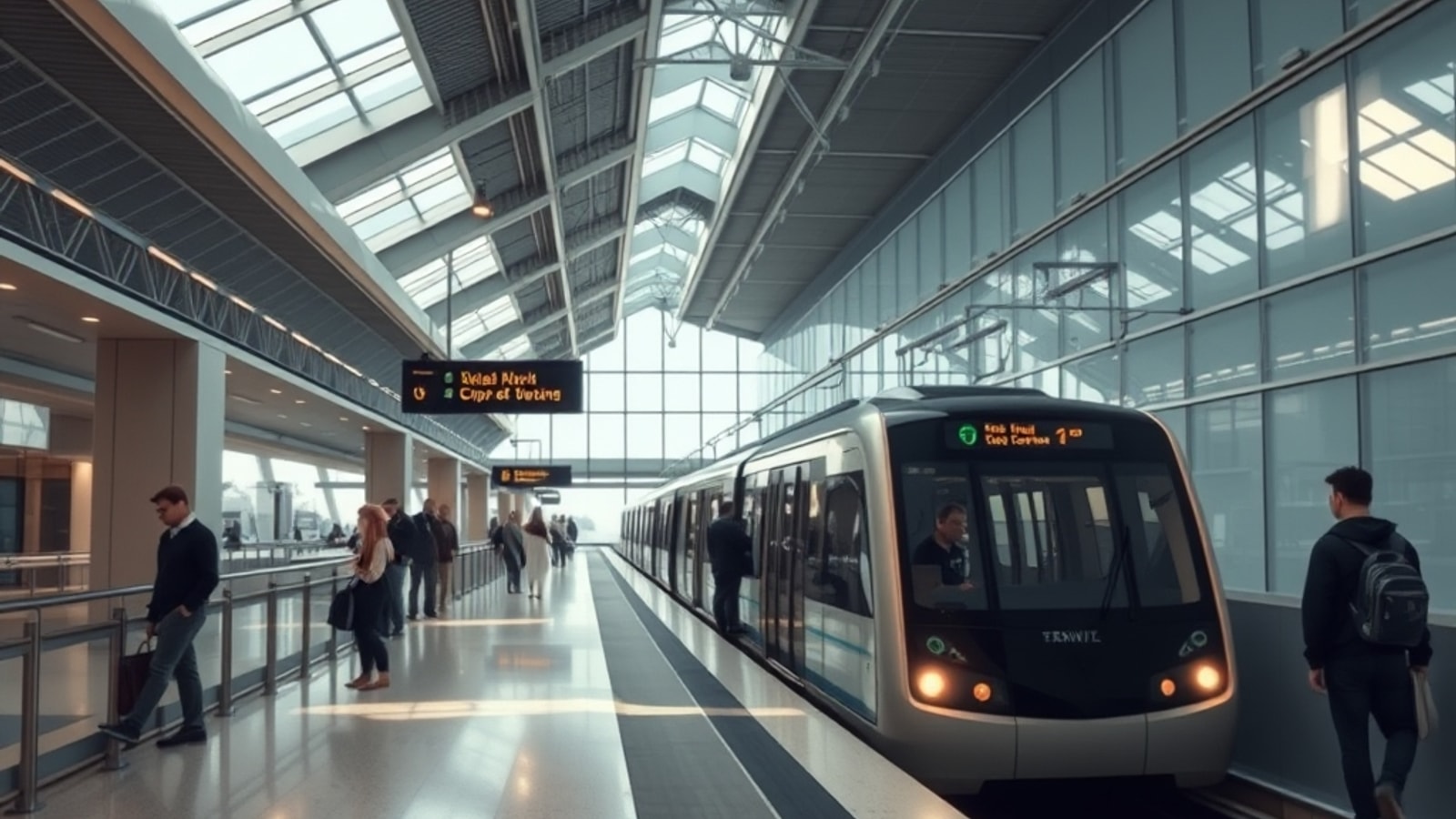
The AGTS—commonly designated "The Train to the Gates"—operates in subterranean tunnels beneath the terminal and concourses.
- Operating Hours & Frequency: Operates 24 hours a day, 365 days a year, with automated trains departing every 2 to 3 minutes during peak hours and every 4 to 5 minutes during overnight periods.
- Transit Duration: Travel from Jeppesen Terminal takes approximately 3 minutes to Concourse A, 5 minutes to Concourse B, and 7 to 8 minutes to Concourse C. Traveling between adjacent concourses (such as A to B, or B to C) takes roughly 2 minutes of rail transit.
- Airside Location: The train platforms sit within the sterile airside perimeter. Once passengers clear security screening in Jeppesen Terminal and take the escalators down to the central train platform, they remain inside the secure zone. Transferring between Concourses A, B, and C on the train does not require exiting to landside or re-clearing security.
Concourse A Pedestrian Skybridge
The Concourse A Skybridge is a 365-foot glass-enclosed elevated walkway extending from Level 6 of Jeppesen Terminal over an active aircraft taxiway into the second level of Concourse A.
- Accessibility: Passengers can walk directly from the Bridge Security Checkpoint on Level 6 into Concourse A in 5 to 8 minutes.
- Operational Limitation: The bridge connects only Jeppesen Terminal to Concourse A. Passengers needing to reach Concourse B or Concourse C cannot walk; they must board the AGTS train at the center core of Concourse A or the main terminal.
Inter-Concourse Transit Logistics Matrix
The following operational matrix outlines transit times, transport modes, security obligations, and recommended minimum connection times across Denver International Airport:
| Connection Route | Transit Mechanism | Transit Time | Operating Frequency | Security Screening Status | Minimum Connection Time (MCT) |
|---|---|---|---|---|---|
| Within Concourse B (United to United) | Moving walkways / Foot | 5–15 mins | Continuous | No screening (Airside) | 40–45 mins |
| Within Concourse C (Southwest to Southwest) | Moving walkways / Foot | 5–12 mins | Continuous | No screening (Airside) | 40–45 mins |
| Concourse B to Concourse A (United to Delta/American/Frontier) | AGTS Train | 8–12 mins | Every 2–3 mins | No screening (Airside) | 55–60 mins |
| Concourse C to Concourse B (Southwest to United) | AGTS Train | 8–12 mins | Every 2–3 mins | No screening (Airside) | 55–60 mins |
| Concourse B/C to Concourse A (Domestic to Outbound Intl) | AGTS Train | 10–15 mins | Every 2–3 mins | No screening (Airside) | 60–75 mins |
| Concourse A Intl Arrival to Domestic Concourse B/C | Foot + FIS + AGTS | 45–75 mins | Every 2–3 mins | Mandatory TSA Re-screening | 90–120 mins |
| Terminal Level 6 to Concourse A | Skybridge Walkway | 5–8 mins | Continuous | TSA Checkpoint at Bridge | 45–60 mins |
| Separate Tickets (Self-Transfer with Luggage) | Baggage Claim + AGTS | 60–90 mins | Every 2–3 mins | Full Landside Re-check & TSA | 150–180 mins |
Minimum Connection Times (MCT) and Transfer Protocols
Connection feasibility at DEN depends directly on ticket structure, arriving flight origin, and baggage arrangements.
[Domestic Inbound Flight] ──► Deplane at Gate ──► Walk to AGTS Train ──► Ride to Departure Concourse ──► Board Connecting Flight
                                              (Zero Security Screening Required)

[International Inbound Flight] ──► Deplane Concourse A ──► US CBP Immigration ──► Collect Luggage ──► Clear Customs
                                                                                                        │
    Board Next Flight ◄── Gate ◄── AGTS Train ◄── Clear TSA Re-Check ◄── Re-Check Luggage at Bag Drop ◄─┘
1. Domestic-to-Domestic Connections (Single Ticket)
Passengers arriving on a domestic flight and departing on another domestic flight with boarding passes already issued remain airside throughout their journey.
- Intra-Concourse Connections: If arriving and departing within the same concourse (e.g., United mainline arriving at Gate B20 and connecting to United Express at Gate B84), walk along the concourse using the high-speed moving walkways. Allow 40 to 45 minutes to account for deplaning delays.
- Inter-Concourse Connections: When connecting from Concourse B (United) to Concourse A (American/Delta/Frontier) or Concourse C (Southwest), proceed to the center atrium of the concourse, descend the escalators to the AGTS station, and board the train toward your destination concourse. Upon arrival, ride the escalators up to the concourse gate level. Minimum connection window: 55 to 60 minutes.
2. Domestic-to-International Connections (Single Ticket)
The United States does not conduct exit passport control. Passengers arriving from a domestic point of origin on United or partner airlines and connecting to an outbound international departure departing Concourse A (e.g., Lufthansa to Frankfurt or United to London Heathrow) simply take the AGTS train to Concourse A and walk to the departure gate. Checked bags are transferred automatically between interline partners. Recommended connection window: 60 to 75 minutes.
3. International-to-Domestic Connections (Inbound via Concourse A)
All commercial international arrivals without prior U.S. border pre-clearance process through the Federal Inspection Services (FIS) facility located on the lower level of Concourse A.
- Follow overhead signage along the sterile arrivals corridor to U.S. Customs and Border Protection (CBP) passport control.
- Clear passport control using Global Entry, Mobile Passport Control (MPC), or general passenger processing lanes.
- Retrieve all checked baggage from the dedicated international arrival carousels in the FIS hall.
- Pass through customs inspection.
- Exit customs into the connecting baggage re-check area and drop luggage onto the airline transfer conveyor belt.
- Pass through the dedicated TSA security screening checkpoint located immediately adjacent to the FIS exit.
- Descend to the Concourse A AGTS station to board the train toward Concourse B (United) or Concourse C (Southwest), or take the elevator up to Concourse A gates.
- Standard MCT: 90 minutes. During peak afternoon international arrival banks (14:00 to 18:00), travelers should preserve a 120-minute connection buffer.
4. Self-Transfers on Separate Tickets
Travelers booking two unconnected itineraries (such as an incoming Frontier flight on Concourse A followed by a separate Southwest departure on Concourse C with checked baggage) must perform a landside transfer:
- Deplane and take the AGTS train south to Jeppesen Terminal.
- Collect checked bags from the carousel on Level 5.
- Ascend to Level 6 ticketing to check luggage with the departing airline before the baggage cutoff window (typically 45 to 60 minutes before departure).
- Re-enter security through the West or East TSA Checkpoints.
- Take the AGTS train out to your departure concourse.
- Recommended Window: Allocate at least 150 to 180 minutes for separate-ticket connections.
Traveler Logistics Guide
Navigating Denver International Airport efficiently requires strategic planning around security lines, ground movement, and airline baggage agreements.
Step-by-Step Inter-Concourse Movement Guide
- Exiting the Aircraft: Check airport flight displays or airline mobile apps immediately upon deplaning to confirm the departure concourse and gate of your onward flight. Gate reassignments happen frequently during weather holds.
- Reaching the Train: Head toward the center core of your arrival concourse (near Gate A34 in Concourse A, Gate B38 in Concourse B, or Gate C34 in Concourse C). Take the escalators or elevators down two levels to the AGTS boarding platform.
- Boarding the Train: Train announcements indicate the next stop. For Concourse B or C, board trains heading north. For Jeppesen Terminal or Concourse A, board trains heading south.
- Arriving at Your Gate: Concourse B and Concourse C are exceptionally long, stretching nearly half a mile from end to end. If your departure gate is at the far perimeter (such as B11 or B95), allow an extra 8 to 10 minutes of walking time from the central train escalators.
Ski and Snowboard Baggage Handling
Denver serves as the gateway to major Colorado ski resorts, resulting in immense volumes of oversized baggage during winter and spring.
- Baggage Delivery Locations: Oversized ski and snowboard bags do not arrive on standard baggage carousels. They are offloaded at specialized oversized baggage claim counters located on Level 5 of Jeppesen Terminal adjacent to carousels 5 and 6 (West side) and carousels 13 and 14 (East side).
- Airline Interlining: If flying on a single interline ticket, ski equipment is automatically transferred between connecting flights. However, passengers transferring to regional shuttle operators or separate domestic carriers must claim equipment at Level 5 before proceeding.
Winter Weather Ground Holds and De-Icing Delays
Denver experiences frequent heavy snowfall and freezing temperatures from October through April.
- During severe winter storms, inbound aircraft often face de-icing pad queues upon landing or holding patterns aloft, eroding connection buffers.
- If an inbound delay reduces your connection window below 30 minutes, speak immediately with an airline gate agent upon deplaning or use the carrier's mobile app to initiate automatic rebooking before rushing to the train.
Frequently Asked Questions
Do I need to clear security again when transferring between concourses at Denver Airport?
No. If you are transferring between domestic flights on Concourse A, Concourse B, and Concourse C, all three concourses are connected airside via the subterranean AGTS train. You do not exit the secure perimeter to ride the train between concourses. The only connecting passengers required to re-clear TSA security are arriving international passengers clearing customs in Concourse A and self-transfer passengers on separate tickets who must exit to Level 5 baggage claim.
Can I walk between Concourse B and Concourse C, or between Concourse A and Concourse B?
No. There are no pedestrian tunnels or walkways connecting Concourse A to Concourse B, or Concourse B to Concourse C. The subterranean AGTS train is the only physical transit link between the concourses. The only pedestrian walkway in the entire airport is the elevated Skybridge connecting Jeppesen Terminal Level 6 to Concourse A.
How long does it take to travel from Jeppesen Terminal to Concourse C?
Riding the AGTS train from Jeppesen Terminal to Concourse C takes approximately 7 to 8 minutes of rail transit time. Factoring in escalator descent in the terminal, train platform wait times (2 to 3 minutes), and the escalator ascent at Concourse C, budget roughly 12 to 15 minutes of total transit time from the terminal security exit to the center of Concourse C.
What happens to my checked luggage during an international layover at Denver Airport?
If arriving on an international flight from an overseas origin without U.S. border pre-clearance, you must collect your checked bags in the Concourse A customs hall after clearing immigration, regardless of your final destination. After clearing U.S. customs, drop your bags at the airline connection transfer desk located right outside the exit door, pass through TSA re-screening, and board the AGTS train to your domestic gate. If you are traveling on an outbound flight from a domestic U.S. city through Denver to an international destination on a single ticket, your bags are checked through to your final destination automatically.