

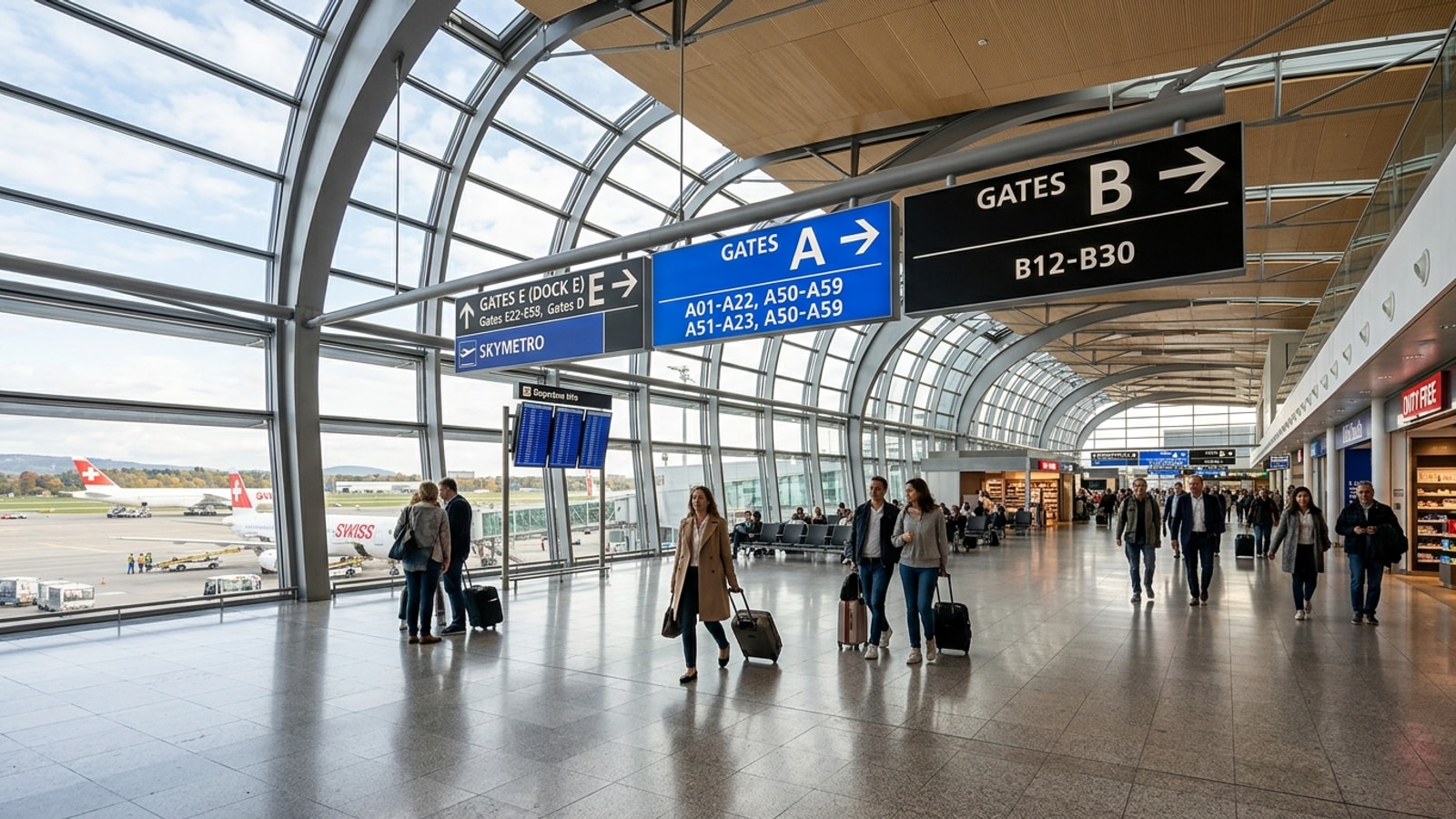
Zurich Airport (IATA: ZRH, ICAO: LSZH; German: Flughafen Zürich), situated 13 kilometers north of central Zurich in Kloten, serves as the primary intercontinental gateway for Switzerland and the central connecting hub for Swiss International Air Lines (SWISS) and the Star Alliance global network. Known for Swiss engineering precision and compact operational layout, Zurich Airport is renowned for having one of the shortest published Minimum Connection Times (MCT) among major European hubs, with connections scheduled as tightly as 40 minutes.
However, navigating a tight transfer between intercontinental widebody flights and regional intra-European routes requires precise familiarity with the airport's three distinct gate zones (Docks A, B/D, and E), the underground automated Skymetro shuttle, Swiss border control checkpoints, and mandatory transit security screening. A missed connection at Zurich can disrupt intercontinental travel days, particularly during peak morning arrival banks when flights from North America, Asia, and Africa touch down simultaneously.
This operational guide provides step-by-step transfer blueprints, terminal layouts, border control rules, security screening protocols, luggage policies, and transit layover logistics for passengers transiting through Zurich Airport.
Quick Summary: Zurich Airport Transit Essentials
- Primary Gate Complex: Central Airside Center connects to Dock A (Schengen gates A01–A86), Dock B/D (Schengen B01–B43 and non-Schengen D01–D18), and Dock E (non-Schengen midfield satellite E16–E67).
- Skymetro People Mover: Underground cable shuttle links the main Airside Center to Dock E in 2.5 minutes, departing every 3 minutes.
- Official Minimum Connection Time (MCT): 40 minutes for Star Alliance online transfers; 45 to 60 minutes recommended for Non-Schengen to Schengen connections.
- Security & Border Clearance: Non-Schengen arrivals must clear central transit security; passengers continuing into Schengen must clear Swiss Federal Border Police (Kantonspolizei Zürich) immigration control.
- Luggage Through-Check: Bags checked through on a single booking pass directly to final destinations; international-to-international and non-Schengen to Schengen transit passengers do not collect bags at Zurich.
1. Terminal Layout and Gate Distribution
Zurich Airport features a unified terminal concept organized around a central hub rather than physically separated, disconnected passenger terminals. All departing and transferring passengers move through the Airside Center, an expansive glass atrium completed by Grimshaw Architects, which sits directly above the central landside train station and shopping complex.
       [ Dock A: Gates A ] (Schengen Only)
               ^
               | (Pedestrian Skybridge / Corridors)
               v
      +-----------------------------------------+
      |             AIRSIDE CENTER              |
      |   - Central Duty Free & Dining          |
      |   - Transfer Desks & Flight Monitors    |
      |   - Schengen Passport Control (Level 1) |
      +-----------------------------------------+
          /                                 \
         v                                   v
[ Dock B/D: Gates B & D ]          [ Skymetro Subterranean Station ]
- Level 0: Gates B (Schengen)                      |
- Level 1: Gates D (Non-Schengen)                  | (1.1 km Cable Tunnel, 2.5 min)
                                                   v
                                       [ Dock E: Gates E ] (Midfield Satellite)
                                       - All Intercontinental Non-Schengen
                                       - Transit Security Screening
Dock A (Gates A01 to A86)
- Operational Scope: Exclusively Schengen flights operated by SWISS, Edelweiss, Lufthansa, Austrian Airlines, Brussels Airlines, and SAS.
- Physical Connection: Connected directly to the Airside Center via wide, flat pedestrian concourses. Passengers walk directly between gate areas without taking trains or clearing security screening.
- Key Features: SWISS Business and Senator Lounges A, SWISS Alpine Lounge, duty-free retail, family services, and quiet seating alcoves.
Dock B / Concourse D (Gates B01–B43 & D01–D18)
- Operational Scope: A dual-purpose flexible finger dock.
- Level 0 (Gates B): Dedicated to Schengen flights.
- Level 1 (Gates D): Dedicated to non-Schengen short- and medium-haul flights (e.g., United Kingdom, Ireland, Turkey, Balkan nations, and North Africa).
- Physical Connection: Direct walking access from the Airside Center. A glass-partitioned floor separation keeps Schengen and non-Schengen flows strictly segregated.
- Border Integration: Passengers moving between Level 0 (B) and Level 1 (D) pass through integrated border control booths located at the base of the concourse.
Dock E (Gates E16 to E67)
- Operational Scope: Dedicated mid-field satellite concourse handling all long-haul intercontinental departures and arrivals (SWISS flights to North America, Asia, Africa, and South America; Air India, Emirates, Qatar Airways, Singapore Airlines, United Airlines, American Airlines, Delta, Cathay Pacific, and Thai Airways).
- Physical Connection: Completely isolated on the airfield between runways 16/34 and 10/28. Accessible exclusively via the subterranean Skymetro automated people mover from Airside Center Level -1.
- Key Features: Dedicated transit security checkpoint on Level 2, SWISS Lounge Center E (featuring the outdoor observation terrace and Whisky Club 28/10), Aspire Lounge, Primeclass Lounge, and dayrooms.
2. Minimum Connection Times (MCT) and Transit Windows
Zurich Airport maintains some of the most aggressive Minimum Connection Times in Europe. While the official minimums are achievable under normal conditions with checked luggage transferred automatically, operational buffers are recommended during peak morning banks.
| Transit Connection Type | Official Star Alliance MCT | Realistic Recommended Window | Border Control Required? | Security Re-Screening? |
|---|---|---|---|---|
| Schengen to Schengen (Dock A to Dock A) | 40 minutes | 45 minutes | No | No |
| Schengen to Non-Schengen (Dock A to Dock B/D) | 40 minutes | 50 minutes | Yes (Airside Center / Concourse D) | No |
| Schengen to Non-Schengen (Dock A to Dock E) | 45 minutes | 60 minutes | Yes (Airside Center Level 1) | No |
| Non-Schengen to Schengen (Dock E to Dock A) | 45 minutes | 65–75 minutes | Yes (Airside Center Level 1) | Yes (Dock E / Airside Center) |
| Non-Schengen to Schengen (Dock D to Dock A) | 45 minutes | 60 minutes | Yes (Concourse D / Airside Center) | Yes (Airside Center) |
| Non-Schengen to Non-Schengen (Dock E to Dock E) | 40 minutes | 45–50 minutes | No | Yes (Dock E Level 2) |
| Non-Schengen to Non-Schengen (Dock E to Dock D) | 45 minutes | 55–60 minutes | No | Yes (Airside Transit Checkpoint) |
Important · Regulatory MandateMorning Bank Congestion (06:00 to 09:00): Over 25 long-haul flights from the United States, Canada, India, Southeast Asia, and South Africa land at Dock E between 06:00 and 08:30. If your itinerary involves a Non-Schengen to Schengen connection (Dock E to Dock A) during this window, passport control queues at Airside Center Level 1 can extend to 25–35 minutes. Itineraries with under 50 minutes of layover time face high risk of luggage misconnection or missed departures.
3. Step-by-Step Transfer Blueprints
Connecting flight flows at Zurich depend strictly on whether the arrival and onward departure points lie within the European Schengen Area or outside it.
Blueprint 1: Non-Schengen to Schengen (e.g., Delhi/New York to Zurich to Geneva/Frankfurt)
- Deplane at Dock E: Follow the overhead yellow "All Gates / Transit / Exit" directional signage towards the central concourse spine.
- Clear Transit Security Screening: All passengers arriving from non-clean non-Schengen stations must pass through central transit security screening on Level 2 of Dock E before descending to the transit train.
- Board the Skymetro: Take the escalators down to Level -1 and board the underground automated cable train to the Airside Center. Transit duration is exactly 2.5 minutes.
- Ascend to Passport Control: Upon arriving at the Airside Center subterranean station, take the long escalators up to Level 1.
- Clear Swiss Border Control: Present your passport, qualifying Schengen visa or biometric EU/CH passport, and onward boarding pass to the Kantonspolizei Zürich officers.
- Proceed to Dock A or B: Once stamped into the Schengen area, follow the directional monitors directly to your departure gate in Dock A (Gates A) or Dock B (Gates B).
Blueprint 2: Schengen to Non-Schengen (e.g., Paris/Munich to Zurich to Bangkok/Boston)
- Deplane at Dock A or B: Follow signs indicating "Gates E / D / Flight Connections".
- Walk to Airside Center: Walk directly from the finger dock into the central shopping and transfer concourse.
- Clear Schengen Exit Passport Control: Approach the passport control bank leading toward the Skymetro entrance at Level 1. EU/EEA and Swiss biometric passport holders can utilize automated e-Gates; third-country passport holders must present documents to an immigration booth for an exit stamp.
- Descend to Skymetro Station: Take the escalators to Level -1.
- Take Skymetro to Dock E: Ride the train to the midfield satellite.
- Arrive at Departure Gate: Step off the train and ascend directly into the Dock E departure concourse. No secondary security screening is required when exiting the Schengen zone.
Blueprint 3: International-to-International Non-Schengen (e.g., Singapore to Zurich to London Heathrow)
- Deplane at Dock E: Look for "Flight Connections / Transfer Desks".
- Clear Transit Security Screening: Proceed through the transit security lanes on Dock E Level 2.
- Check Departure Gate:
- If your onward flight departs from Dock E (e.g., United, SWISS long-haul), you remain entirely within the Dock E departures hall. No border control or train transfer is required.
- If your onward flight departs from Gates D (e.g., British Airways, SWISS to London City), take the Skymetro to the Airside Center, follow signs for "Gates D (Non-Schengen)", and remain in the sterile airside corridor without passing Schengen entry immigration.
4. The Skymetro Automated People Mover
The Skymetro is the operational lifeline of Zurich Airport, linking the midfield Dock E satellite to the main terminal complex.
System Type:             Air-cushioned subterranean cable liner (OTIS Hovair)
Route Distance:          1,138 meters (0.71 miles)
Tunnel Alignment:        Subterranean; passes beneath Runway 10/28 & taxiways
Travel Time:             2 minutes 30 seconds
Train Frequency:         Every 3 minutes during operational peak
Passenger Capacity:      Up to 4,200 passengers per hour per direction
Cabin Segregation:       Separated compartments for Schengen & Non-Schengen
Audio/Visual Features:   Alpine projections, cowbells, and yodeling sounds
Navigating the Skymetro Stations
- Airside Center Station (Level -1): Accessible via rapid multi-story escalators or glass elevators located adjacent to the Transfer Desks in the Airside Center.
- Dock E Station (Level -1): Positioned directly beneath the central retail and dining atrium of Dock E. High-capacity elevators and dual escalator banks connect the platforms to the boarding gates.
- Sterile Operation: The Skymetro runs within a secured airside envelope. Passengers boarding at Dock E have already cleared transit security screening; passengers boarding at Airside Center have already cleared Schengen border control.
5. Immigration, Border Control, and Airport Transit Visas (ATV)
Switzerland is a member of the Schengen Border Agreement, meaning Swiss immigration officers enforce the Schengen Borders Code.
Swiss Border Police (Kantonspolizei Zürich) Checks
- Schengen Entry Criteria: Third-country nationals entering Switzerland or connecting to an onward Schengen destination must show a passport valid for at least three months beyond the planned departure date from the Schengen zone (issued within the last 10 years), a valid Category C Uniform Schengen Visa or residence permit, proof of onward travel, and sufficient financial funds.
- Automated e-Gates: Available for travelers aged 18 and older holding biometric passports issued by Switzerland, European Union member states, or EEA countries. Third-country passport holders (including US, UK, Canadian, Australian, and Indian citizens) must use staffed manual immigration booths to receive ink entry/exit stamps.
       [ Non-Schengen Connecting Passenger Arrives ]
                          |
             [ Is onward flight Schengen? ]
             /                            \
           YES                             NO
          /                                 \
[ Must clear Swiss Passport Control ]   [ Pure Airside Non-Schengen Transit ]
- Check 90/180-day Schengen limit        - NO Schengen entry stamp
- Valid Category C Visa or Exemption     - No entry into Switzerland
- Receive physical entry stamp           - Stay inside Dock E / Gates D
Airport Transit Visa (ATV) Regulations for Indian Citizens
Indian passport holders frequently transit through Zurich between South Asia and North America or the United Kingdom.
- Airside International Transit (Category A Exemption): Indian passport holders do not require a Swiss Airport Transit Visa (ATV) if they remain entirely within the international transit area of Zurich Airport (e.g., arriving on Swiss from Delhi/Mumbai and connecting directly to New York or London) provided they hold a valid visa or residence permit issued by:
- The United States of America
- Canada
- The United Kingdom or Ireland
- Japan
- Any European Union or EEA member state
- Two-Stop Schengen Trap: If an itinerary involves two European stops (e.g., Delhi -> Zurich -> Paris -> New York), the leg between Zurich and Paris is an internal domestic Schengen flight. Passengers must clear immigration at Zurich and enter the Schengen zone. An Airport Transit Visa (ATV) is insufficient; travelers must hold a full Category C Schengen Tourist/Business Visa.
6. Transit Security Screening and Baggage Regulations
Security Re-Screening Checkpoints
Zurich Airport enforces stringent European civil aviation security standards.
- Who Must Clear Transit Security: All passengers arriving from non-Schengen origins (excluding specific "One-Stop Security" clean countries such as the United States, Canada, and the United Kingdom) must clear transit screening before entering departure gate areas.
- Liquids, Aerosols, and Gels (LAGs): Standard 100 ml limitations apply strictly. Liquids in containers over 100 ml will be confiscated at transit security checkpoints unless purchased duty-free at a prior airport and sealed inside an intact, tamper-evident ICAO Security Tamper-Evident Bag (STEB) with the printed receipt visible inside.
- Computed Tomography (CT) 3D Scanners: Modern CT scanners are deployed across Zurich's transit screening lanes. At lanes equipped with CT scanners, passengers do not need to remove laptops, tablets, or compliant liquid pouches from their hand luggage.
Baggage Routing and Customs Clearance
- Single Ticket / Interline Bookings: If your itinerary was booked as a single ticket through Star Alliance or interline partners (e.g., SWISS, Lufthansa, United, Singapore Airlines, Air India), your checked luggage is automatically tagged through to your final destination airport. You do not collect bags at Zurich Airport.
- Separate Tickets (Self-Transfer): If connecting across separate tickets booked on non-partner airlines, you must clear Swiss immigration, proceed to the landside Arrivals hall, collect your baggage from the carousels, re-check in at Check-in 1, 2, or 3, and clear general security screening. Allow a minimum of 2.5 to 3 hours for self-transfers.
7. Premium Transit Lounges and Layover Facilities
For passengers with extended layovers, Zurich offers some of the highest-rated airline lounges in Europe, notably SWISS Lounge facilities.
| Lounge Name | Location | Eligible Access | Key Features & Amenities |
|---|---|---|---|
| SWISS Senator Lounge E | Dock E, Level 3 | Star Alliance Gold, First Class, Senator | Outdoor terrace overlooking runway 16/34, live cooking station, Whisky Club 28/10 with over 220 whiskies. |
| SWISS Business Lounge E | Dock E, Level 3 | Star Alliance Business Class, Frequent Traveller | Expansive tarmac views, hot buffet, showers, dedicated work suites. |
| SWISS Alpine Lounge | Dock A, Level 2 | Star Alliance Business, Senator, Gold | Rustic Alpine hut aesthetic, Swiss raclette oven, wooden decor, quiet zones. |
| SWISS Lounge Center A | Dock A, Level 2 | Star Alliance Business, Senator, First | Central Schengen lounge, multi-stall rain showers, hot breakfast, quiet relaxation rooms. |
| SWISS Lounge Center D | Gates D, Level 1 | Star Alliance Business & Senator (Non-Schengen) | Compact transit lounge for UK/non-Schengen European departures; hot snacks, showers. |
| Aspire Lounge (Midfield) | Dock E, Level 3 | Priority Pass, DragonPass, Pay-per-use | Comfortable seating, complimentary wines, hot soup, flight departure monitors. |
| Aspire Lounge (Airside) | Airside Center, Level 3 | Priority Pass, LoungeKey, Pay-per-use | Central terminal location above the shopping concourse; business work desks. |
| Primeclass Lounge | Dock E, Level 3 | Priority Pass, Walk-in payment | Relaxed seating, panoramic apron vistas, international cold cuts, showers. |
Transit Hotel and Rest Cabins
- Transit Hotel (Gates B/D): Located airside at Gates B/D on Level 1. Offers private dayrooms (single and double beds), private bathrooms with walk-in showers, and quiet resting recliners. Can be booked in 3-hour, 6-hour, or overnight increments without entering Switzerland.
- Radisson Blu Hotel Zurich Airport: Situated directly landside, connected via an enclosed covered pedestrian walkway directly to Airport Shopping and Check-in 1. Ideal for overnight layovers of 8 hours or longer.
8. Rail and City Connections (Zürich Flughafen Railway Station)
Passengers enjoying extended layovers of 4 hours or longer can reach downtown Zurich in minutes thanks to the integrated Swiss Federal Railways (SBB) infrastructure.
Location:           Directly beneath Airport Center Shopping Complex
Frequency:          Trains depart for Zurich Hauptbahnhof (HB) every 3-7 minutes
Transit Time:       9 to 12 minutes non-stop
Train Types:        InterCity (IC 1, IC 5, IC 8), InterRegio (IR 13, IR 36),
                    S-Bahn commuter trains (S2, S16, S24)
Single Fare:        CHF 7.00 (ZVV 3-Zone Ticket: Zones 110, 121)
Day Pass:           CHF 14.00 (Unlimited 24-hour travel across Zurich network)
Ticket Machines:    Multilingual touchscreens at station entrance and SBB app
Step-by-Step Layover Excursion to Zurich Old Town
- Clear Immigration: Exit through Swiss Border Control into the landside Arrivals hall.
- Follow Train Signs: Follow overhead blue rail signs down to Level -2 (Bahnhof / Train).
- Purchase Ticket: Buy a 3-zone ZVV ticket or 24-hour day pass at the red SBB ticket machines or via the SBB Mobile app.
- Board Any Train to Zurich HB: All trains departing from Platforms 3 and 4 run directly to Zürich Hauptbahnhof (Central Station).
- Explore City Center: Step out from Zurich HB directly onto Bahnhofstrasse, walk along the Limmat River, or visit Lake Zurich.
- Return to Airport: Board any train bound for "Zürich Flughafen" from Zurich HB; arrive at the airport at least 90 minutes prior to departure (or 2 hours for non-Schengen departures).
9. Frequently Asked Questions (FAQ)
Can I connect through Zurich Airport on a 40-minute layover?
Yes, provided your booking is on a single ticket (such as SWISS or Lufthansa Group airlines) and both flights operate within Concourse A (Schengen to Schengen). Zurich's compact footprint makes 40-minute transfers feasible. However, if your connection involves non-Schengen to Schengen (requiring the Skymetro and passport control), a 40-minute layover leaves zero margin for flight delays or border queues.
Do I need to clear security if transiting between two non-Schengen flights at Dock E?
Yes. European Union and Swiss aviation security regulations mandate that transit passengers arriving from most non-Schengen countries must pass through the security screening facility located on Level 2 of Dock E before accessing departure gates.
Will my checked luggage transfer automatically during my connection at Zurich?
If your journey was booked as a single itinerary with through-checked airlines (e.g., SWISS, United, Air India, Singapore Airlines), your luggage will be transferred directly between aircraft by airport ground handlers. You will not see or collect your baggage until your final destination.
Does Zurich Airport offer free high-speed Wi-Fi?
Yes. Zurich Airport provides 4 hours of complimentary high-speed Wi-Fi throughout all gate concourses, the Airside Center, and landside public zones. Connect to the "ZurichAirport" network and verify via SMS code or mobile boarding pass scan.
Where can I smoke during an airside layover at Zurich?
Zurich Airport features ventilated smoking lounges (fumoirs) across all concourses: Dock A (near Gates A63 and A71), Dock B (near Gate B33), Dock D (near Gate D07), and Dock E (adjacent to Gate E19 and inside the SWISS Senator Lounge terrace). Smoking outside these designated glass cabins is strictly prohibited.