

Quick Summary
- Primary Update: Vietnam Airlines enforces a strict combined cabin baggage ceiling of 12kg (26.4 lbs) for Economy Class, consisting of one primary carry-on bag (up to 10kg) and one personal accessory (up to 2kg), while Premium Economy and Business Class passengers receive an 18kg (39.6 lbs) combined allowance across two standard pieces and one accessory.
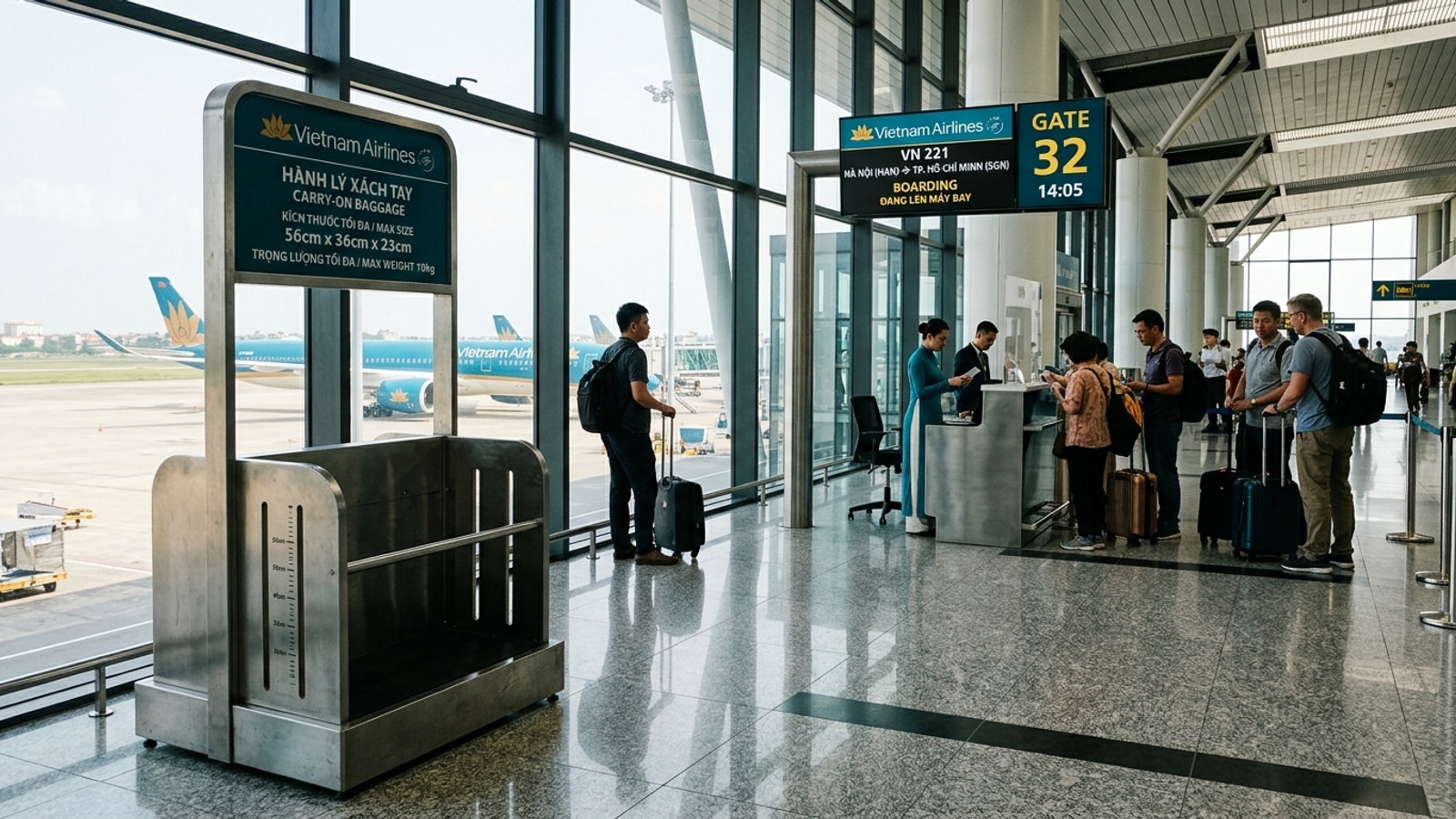
- Transit Impact: Ramp personnel and boarding gate agents at Noi Bai International Airport (HAN), Tan Son Nhat International Airport (SGN), Da Nang (DAD), and key outstations conduct rigorous weight and dimensional audits using metal sizer boxes, assessing gate excess baggage penalties between 600,000 VND domestically and up to $150 USD on long-haul routes.
- Traveler Advice: Keep your primary overhead bag within 56 x 36 x 23 cm including wheels and handles, verify that your personal accessory fits entirely under the forward seat (40 x 30 x 15 cm), and carry all power banks exclusively in your hand luggage, as Vietnamese civil aviation regulations strictly prohibit spare lithium cells in cargo holds.
Vietnam Airlines, the flag carrier of Vietnam and a prominent SkyTeam alliance member, anchors international and domestic air connectivity across Southeast Asia. Operating modern widebody Boeing 787-9, Boeing 787-10 Dreamliners, and Airbus A350-900 XWB aircraft alongside narrowbody Airbus A321neos, the carrier handles heavy passenger volumes between primary hubs—Noi Bai International Airport (HAN) in Hanoi and Tan Son Nhat International Airport (SGN) in Ho Chi Minh City—and global destinations in Europe, Australia, East Asia, and the Indian subcontinent.
On dense regional routes connecting Hanoi and Ho Chi Minh City to Delhi (DEL), Mumbai (BOM), Singapore (SIN), and Bangkok (BKK), aircraft cabins frequently operate at full capacity. Overhead stowage space is limited, prompting ground handling teams and cabin staff to enforce cabin baggage rules strictly. Passengers must understand the carrier's two-piece combined weight structure, sizer box dimensions, and boarding gate screening protocols to avoid delays and unexpected gate-check penalties.
2026 Cabin Baggage Allowances: Weight Limits and Sizer Dimensions
Vietnam Airlines employs a dual-allowance system that combines a primary overhead bag with a secondary personal accessory. Unlike airlines that enforce independent weight allowances for each item, Vietnam Airlines regulates both individual piece limits and a collective weight ceiling.
In Economy Class, travelers may bring one primary carry-on bag weighing up to 10kg (22 lbs) and one personal accessory weighing up to 2kg (4.4 lbs). The total combined weight of both items cannot exceed 12kg (26.4 lbs). Passengers in Premium Economy and Business Class receive an expanded allocation of two primary carry-on pieces (each up to 10kg) plus one accessory (up to 2kg), with an overall combined weight threshold of 18kg (39.6 lbs).
The table below outlines the structural baggage allocations and dimensional boundaries across all service classes:
| Travel Class | Standard Carry-On Pieces | Max Weight per Standard Piece | Max Dimensions (L x W x H) | Personal Accessory Allowance | Max Combined Cabin Weight |
|---|---|---|---|---|---|
| Economy Class | 1 Piece | 10 kg (22 lbs) | 56 x 36 x 23 cm (22 x 14 x 9 in) | 1 Piece (max 2 kg, 40 x 30 x 15 cm) | 12 kg (26.4 lbs) |
| Premium Economy | 2 Pieces | 10 kg (22 lbs) | 56 x 36 x 23 cm (22 x 14 x 9 in) | 1 Piece (max 2 kg, 40 x 30 x 15 cm) | 18 kg (39.6 lbs) |
| Business Class | 2 Pieces | 10 kg (22 lbs) | 56 x 36 x 23 cm (22 x 14 x 9 in) | 1 Piece (max 2 kg, 40 x 30 x 15 cm) | 18 kg (39.6 lbs) |
| Infant (Under 2 Years) | 1 Piece | 10 kg (22 lbs) | 115 cm total (56 x 36 x 23 cm) | Stroller/Bassinet (checked or gate-checked) | 10 kg (22 lbs) |
Dimensional Specifications and Sizer Frame Checks
Every primary carry-on bag must comply with the maximum dimensional limit of 56 x 36 x 23 cm (22 x 14 x 9 inches), equivalent to a combined linear dimension of 115 cm. Vietnam Airlines positions metal sizer frames at check-in desks and boarding gate entrances across its network. The bag must slide easily into the sizer without external force, accommodating all protruding components, including wheels, fixed top handles, and packed exterior pockets.
The secondary personal accessory must not exceed 40 x 30 x 15 cm (16 x 12 x 6 inches), or 85 cm in total dimensions. This accessory must fit under the seat directly in front of the passenger throughout taxi, takeoff, and landing phases.
Permissible personal accessories include:
- A compact handbag, purse, or pocketbook
- A padded laptop bag, briefcase, or slim computer backpack
- A compact camera bag or binocular case
- A small infant amenity bag containing food and diapers for the flight
- A sealed duty-free shopping bag containing purchases made at the departure airport
Passengers may also carry small personal items that do not count against the cabin allowance, such as an overcoat, jacket, small umbrella without a sharp point, walking stick, or necessary orthopedic mobility aids.
Gate Sizers, Boarding Audits, and Gate-Check Penalty Fees
Ground agents at Hanoi (HAN), Ho Chi Minh City (SGN), and Da Nang (DAD) conduct regular spot-checks at departure gates. As boarding begins, staff deploy handheld digital scales to verify combined bag weights. Passengers whose hand luggage appears visibly distended, bulky, or heavy are directed to insert their bags into the steel sizer unit.
When a bag exceeds the 56 x 36 x 23 cm boundary or the collective weight exceeds 12kg in Economy (or 18kg in Business/Premium Economy), ground staff revoke cabin access for the oversized item. The piece is reassigned to the aircraft cargo hold as checked baggage, and an involuntary gate excess baggage surcharge is applied.
The table below details gate baggage penalty rates across the carrier's primary flight sectors:
| Route Sector | Gate Action | Gate Excess Surcharge | Payment Methods at Gate |
|---|---|---|---|
| Domestic Vietnam (e.g., HAN-SGN, DAD-HAN) | Cargo hold check; bag retrieved at destination baggage carousel | 600,000 to 900,000 VND (~$24–$36 USD) | Credit card, debit card, domestic QR payment |
| Intra-Asia / Regional (e.g., Vietnam to Singapore, Thailand, Malaysia) | Involuntary hold check; ramp tag attached | $50 to $70 USD per piece | Visa, Mastercard, JCB, local currency debit |
| South Asia (e.g., Delhi, Mumbai, Ahmedabad to Hanoi / SGN) | Involuntary hold check; piece tagged to final destination | $60 to $85 USD per piece | Major international credit cards |
| Long-Haul Intercontinental (Europe, Australia, United States) | Involuntary hold check; boarding pass updated | $100 to $150 USD per piece | Major international credit cards only (no cash) |
Gate personnel do not accept cash payments at outstation boarding gates; transactions require a valid chip-and-PIN or contactless credit card. If a traveler refuses to settle the gate fee, ground handling regulations require boarding denial for flight safety reasons.
Lithium Battery Regulations and In-Cabin Electronic Rules
The Civil Aviation Authority of Vietnam (CAAV) enforces strict safety directives regarding portable electronic devices and rechargeable lithium batteries. In accordance with ICAO Technical Instructions, all lithium-ion power banks, backup camera batteries, and portable chargers are strictly forbidden from checked cargo holds due to fire and thermal runaway risks.
Power Bank Watt-Hour Ratings and Quantity Restrictions
Passengers must carry all power banks inside their personal cabin accessory:
- Under 100 Watt-Hours (Wh) / Up to 20,000 mAh: Travelers may carry up to 20 individual power banks or spare batteries for personal electronics without prior airline clearance. Each unit must display its factory-printed capacity rating clearly.
- 100 Wh to 160 Wh / 20,000 to 32,000 mAh: Permitted up to a maximum of 2 units per passenger, subject to visual inspection and formal approval by airline staff at the check-in desk.
- Exceeding 160 Wh / Over 32,000 mAh: Strictly prohibited on commercial passenger aircraft. Security screeners will confiscate these units immediately at airport x-ray checkpoints.
- Smart Luggage: Suitcases with built-in battery charging banks are accepted in the cabin only if the battery is fully removable. If the bag is gate-checked due to overhead compartment congestion, the battery must be removed and kept with the passenger in the cabin.
Warning · Operational AdvisoryRecharging mobile phones or electronics using portable power banks is strictly prohibited during taxi, takeoff, and landing phases on all Vietnam Airlines aircraft. Devices must remain unplugged and stowed securely during these periods.
Electronic Cigarettes and Vapes
Under Vietnamese public health directives and aviation safety policies, using or charging electronic cigarettes, vapes, and heated tobacco devices is strictly prohibited inside the cabin, lavatories, and jet bridges. Furthermore, Vietnamese customs law prohibits the commercial import, possession, and sale of e-cigarette cartridges and vaporizers. Travelers entering Vietnam risk having these devices confiscated and being fined by airport customs authorities.
Liquid, Aerosol, and Gel (LAG) Rules
On international departures from Vietnam (as well as transit flights through Hanoi and Ho Chi Minh City), international security screening applies the standard 100ml rule:
- All liquids, creams, gels, pastes, and aerosols must be in containers of 100ml (3.4 oz) or less.
- Containers must fit comfortably within a single clear, resealable plastic bag not exceeding 1 liter in capacity.
- On domestic flights within Vietnam, passengers may carry non-hazardous personal liquids (such as water, soft drinks, lotions, and cosmetics) in larger quantities, provided they clear security screening and meet cabin weight limits.
Prohibited Pungent Foods
Vietnam Airlines enforces a strict ban on foods with strong lingering aromas in both carry-on and checked luggage. Fresh durian fruit, jackfruit, fish sauce (nước mắm), and fermented shrimp paste (mắm tôm) are prohibited from cabin storage. Attempting to bring these items through boarding gates will lead to immediate confiscation without compensation.
Traveler Logistics Guide
Navigating cabin baggage clearance on Vietnam Airlines requires systematic preparation, particularly when connecting through high-volume Vietnamese transit hubs.
flowchart TD
    A["Packing Phase: Verify 56x36x23cm & 12kg Limit"] --> B["Pre-Flight: Place Power Banks in Personal Item (Max 100Wh)"]
    B --> C["Check-In Desk: Weight & Dimension Verification"]
    C --> D{"Passes Sizer & Weight Checks?"}
    D -- Yes --> E["Proceed Through Security Screening"]
    D -- No --> F["Pay Lower Prepaid/Desk Excess Fee & Check Bag"]
    E --> G["Boarding Gate: Secondary Sizer & Scale Audit"]
    G --> H{"Exceeds 12kg or 56x36x23cm at Gate?"}
    H -- No --> I["Priority Boarding & Overhead Bin Placement"]
    H -- Yes --> J["Pay Heavy Gate Fee ($50-$150) & Involuntary Hold Check"]
Pre-Departure Packing Protocol
- Conduct a Dual-Bag Weigh-In: Weigh your primary trolley and personal accessory together before heading to the airport. The combined sum must sit comfortably below 12kg for Economy tickets.
- Account for Structural Projections: Measure your suitcase from the floor to the top handle. Many soft-sided bags bulge past 23 cm when packed tightly, causing them to snag inside airport sizer frames.
- Separate Essential Items: Keep travel documents, passport, hotel vouchers, prescription medicines, laptop, and lithium batteries inside your personal accessory. If overhead lockers fill up and your main trolley is gate-checked, your valuables remain in your care.
Airport Check-In and Transit Strategies
- Noi Bai International Airport (HAN): Terminal 1 serves domestic routes, while Terminal 2 handles all international services. The transit between terminals requires taking an airport shuttle bus (5–10 minutes). Ensure your carry-on luggage complies with international liquid screening rules before re-entering Terminal 2 security.
- Tan Son Nhat International Airport (SGN): Domestic departures operate out of Terminal 1, while international flights leave from Terminal 2. The terminals are connected via a covered ground-level walkway (3–5 minute walk). Security lines at SGN peak between 06:00–09:00 and 17:00–20:00; arrive at least 3 hours before international flights to clear baggage and border checks smoothly.
- Lotusmiles and SkyTeam Elite Priority: Lotusmiles Platinum, Gold, and SkyTeam Elite Plus members board with SkyPriority (Group 1 and Group 2). Boarding early ensures dedicated space in overhead bins before storage room becomes scarce on popular routes.
Frequently Asked Questions
What happens if my carry-on bag exceeds the 12kg limit at the boarding gate?
If ground staff determine that your hand luggage exceeds 12kg combined or fails to slide into the 56 x 36 x 23 cm sizer, the bag will be removed from the cabin and placed in the cargo hold. You will be charged an involuntary gate baggage penalty, ranging from 600,000 VND on domestic routes to $50–$150 USD on international flights. Payment must be made immediately via credit or debit card at the gate desk.
Can I carry a laptop bag in addition to a standard trolley bag on Vietnam Airlines?
Yes. Vietnam Airlines permits one primary carry-on bag (up to 10kg, max 56 x 36 x 23 cm) and one personal accessory (up to 2kg, max 40 x 30 x 15 cm), such as a laptop bag, small backpack, or handbag. The total combined weight of both items must not exceed 12kg in Economy Class.
Are power banks allowed in checked luggage on Vietnam Airlines?
No. Civil Aviation Authority of Vietnam (CAAV) regulations strictly prohibit all power banks and spare lithium batteries in checked baggage. They must be transported in your cabin baggage. Power banks rated up to 100Wh (approximately 20,000mAh) are permitted without prior notice, while those between 100Wh and 160Wh require airline desk approval. Charging devices via power banks during taxi, takeoff, and landing is strictly forbidden.
Is fish sauce or durian permitted in carry-on baggage?
No. Vietnam Airlines strictly prohibits fresh durian fruit and pungent liquids such as fish sauce (nước mắm) and shrimp paste from cabin luggage and checked baggage due to odor contamination risks. These items will be confiscated by security and ramp personnel during baggage inspections.