

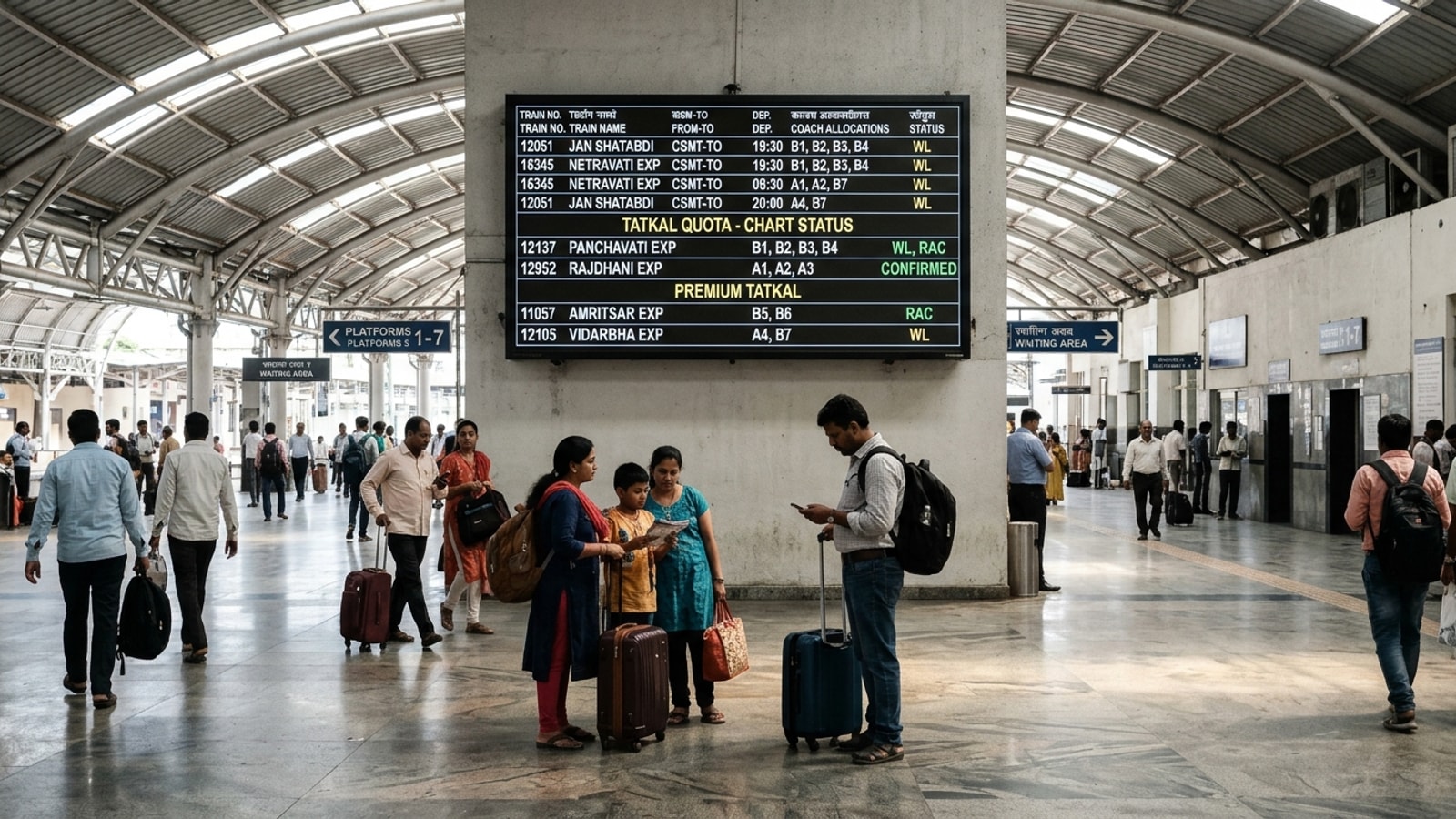
Quick Summary
- Primary Update: Indian Railways allocates emergency travel inventory through standard Tatkal (CK) and dynamic-fare Premium Tatkal (PT) quotas. Booking windows open strictly one day prior to train origin at 10:00 AM IST for Air-Conditioned classes (1A, 2A, 3A, 3E, CC, EC) and 11:00 AM IST for Non-AC classes (SL, 2S).
- Transit Impact: Up to four passengers are permitted per Tatkal PNR (compared to six on General quota). Authorised ticketing agents are blocked from accessing Tatkal inventory during the first 30 minutes of each window (10:00–10:30 AM and 11:00–11:30 AM IST), reserving initial allocations exclusively for individual retail passengers.
- Traveler Advice: Confirmed Tatkal and Premium Tatkal tickets carry a strict zero-refund policy upon voluntary passenger cancellation. Full refunds are granted only under operational disruptions (train cancellation, diversion, or delays exceeding three hours at boarding station) via timely Ticket Deposit Receipt (TDR) filing.
Securing last-minute train tickets across the Indian Railways network requires navigating precise digital reservation windows, algorithmic dynamic pricing surges, and strict verification protocols managed by the Indian Railway Catering and Tourism Corporation (IRCTC). With millions of travelers competing daily for a fixed pool of emergency berths, understanding the mechanical differences between standard Tatkal (CK) and Premium Tatkal (PT), the calculation of advance reservation dates, and the nuances of chart preparation can mean the difference between boarding a confirmed berth and being stranded with an unconfirmed waitlist.
This operational guide details the regulatory rules, fee calculations, Master List setup strategies, charting procedures, and refund cancellation frameworks governing Tatkal and Premium Tatkal ticketing.
1. Tatkal (CK) vs. Premium Tatkal (PT) vs. General (GN)
Indian Railways divides its reserved inventory into distinct quotas. While General Quota (GN) opens between 60 and 120 days in advance depending on prevailing railway board circulars, Tatkal and Premium Tatkal are short-notice inventory allocations released 24 hours ahead of journey origin.
+-----------------------+   +-----------------------+   +-------------------------+
|   General Quota (GN)  |   |   Tatkal Quota (CK)   |   |  Premium Tatkal (PT)    |
+-----------------------+   +-----------------------+   +-------------------------+
| • Opens 60-120 days   |   | • Opens 1 day prior   |   | • Opens 1 day prior     |
| • Fixed base fare     |   | • Fixed Tatkal fee    |   | • Dynamic surge fare    |
| • CNF, RAC, WL stages |   | • CNF, RAC, WL stages |   | • Confirmed (CNF) only  |
| • Standard refunds    |   | • Zero refund if CNF  |   | • Zero refund on cancel |
| • Up to 6 pax / PNR   |   | • Max 4 pax / PNR     |   | • Max 4 pax / PNR       |
+-----------------------+   +-----------------------+   +-------------------------+
Comparative Quota Specifications
| Parameter | Standard Tatkal (CK) | Premium Tatkal (PT) | General Quota (GN) |
|---|---|---|---|
| Booking Opening Window | 10:00 AM (AC) / 11:00 AM (Non-AC) 1 day prior | 10:00 AM (AC) / 11:00 AM (Non-AC) 1 day prior | 08:00 AM IST (60–120 days advance) |
| Pricing Model | Fixed base fare + standard Tatkal surcharge | Dynamic pricing: base fare + escalating surcharge | Fixed base fare only |
| Booking Channels | IRCTC Website, Mobile App, Railway PRS Counters | IRCTC Website & Rail Connect App only | All physical PRS counters, web, app, agents |
| Available Berth Statuses | Confirmed (CNF), RAC, Waitlist (CKWL/TQWL) | Confirmed (CNF) berths only | Confirmed (CNF), RAC, Waitlist (GNWL) |
| Waitlist Provision | Allowed (moves to confirmation or auto-cancels) | No Waitlist or RAC allowed | Allowed (progresses via cancellations) |
| Voluntary Cancellation Refund | ₹0 (Zero refund) on confirmed tickets | ₹0 (Zero refund) under any voluntary condition | Slab-based cancellation deductions apply |
| Agent Access | Restricted for first 30 mins (opens 10:30 / 11:30) | Completely blocked for agents at all times | Open to registered agents from 08:00 AM |
| Senior / Concession Fares | Not permitted (full adult fare mandatory) | Not permitted (full dynamic fare mandatory) | Eligible as per prevailing railway policies |
| Maximum Passengers per PNR | 4 Passengers | 4 Passengers | 6 Passengers |
2. Exact Opening Timings & Journey Date Calculations
A frequent failure point for rail passengers is miscalculating the exact date on which the Tatkal booking window opens. Tatkal inventory is released based on the train's originating departure date, not the passenger's local boarding date.
Operational Opening Schedule
- Air-Conditioned Classes (10:00 AM IST): Anubhuti (EA), Executive Class (EC), First AC (1A - select Rajdhani/Duronto routes), AC 2-Tier (2A), AC 3-Tier (3A), AC 3-Tier Economy (3E), and AC Chair Car (CC).
- Non-Air-Conditioned Classes (11:00 AM IST): Sleeper Class (SL), First Class (FC), and Second Sitting (2S).
The Originating Station Calculation Rule
The Advance Reservation Period (ARP) for Tatkal booking is one day prior to journey date from the originating station of the train.
Scenario: Intermediate Boarding Station Calculation
- Train: Train 12301 Howrah to New Delhi Rajdhani Express.
- Train Departure from Origin (Howrah Junction): Monday at 16:50 IST.
- Passenger Boarding Station (Prayagraj Junction): Tuesday at 00:50 IST (midnight).
- Correct Booking Window: The passenger must book on Sunday morning at 10:00 AM IST (one day prior to Howrah departure on Monday), NOT on Monday morning. Attempting to book on Monday morning because travel occurs in the early hours of Tuesday will result in missing all quota allocations.
3. Fee Structure and Dynamic Pricing Mechanics
Tatkal surcharges are fixed by class as a percentage of the base fare, bounded by minimum and maximum caps. Premium Tatkal, by contrast, operates on a real-time demand-driven algorithmic surge pricing system.
Standard Tatkal Surcharge Matrix
| Class of Travel | Percentage of Base Fare | Minimum Tatkal Surcharge | Maximum Tatkal Surcharge | Distance Threshold |
|---|---|---|---|---|
| Second Sitting (2S) | 10% | ₹10 | ₹15 | All distances |
| Sleeper Class (SL) | 10% | ₹100 | ₹200 | Minimum 500 km |
| AC Chair Car (CC) | 30% | ₹125 | ₹225 | Minimum 250 km |
| AC 3-Tier (3A) / 3 Economy (3E) | 30% | ₹300 | ₹400 | Minimum 500 km |
| AC 2-Tier (2A) | 30% | ₹400 | ₹500 | Minimum 500 km |
| Executive Class (EC) | 30% | ₹400 | ₹500 | Minimum 250 km |
Premium Tatkal Dynamic Pricing Algorithm
Indian Railways converts approximately 50% of the standard Tatkal quota on designated high-demand trains into Premium Tatkal (PT) inventory.
- Initial Tier: The opening fare of Premium Tatkal equals the standard Tatkal fare (Base Fare + Maximum Tatkal Surcharge).
- Surge Stepping: For every 10% of berths booked within the PT quota, the base fare increases dynamically. The fare escalates based on real-time availability and demand, with surge rates frequently reaching 2x to 3x the standard base fare.
- No Upper Ceiling on Ultra-Peak Routes: During peak festival travel windows (Diwali, Chhath Puja, Durga Puja, summer school holidays), Premium Tatkal fares in AC 2-Tier and AC 3-Tier can match or exceed economy airfares on equivalent city pairs (such as Delhi–Patna or Mumbai–Varanasi).
- Instant Price Locking: When selecting a PT berth, the displayed fare is reserved for five minutes. If payment processing fails or exceeds the session window, the released seat returns to the open pool at the higher revised dynamic slab.
4. The Master List Setup and High-Speed Checkout Blueprint
Because Tatkal inventory on major express routes (Rajdhani, Shatabdi, Vande Bharat, Duronto, and Superfast express trains) typically sells out within 60 to 180 seconds, manual data entry at the time of opening leads to booking failure. Implementing pre-configured profile data is mandatory.
T-24 Hours               T-5 Minutes              T-0 Minutes             T+1 Minute
• Create Master List     • Login to IRCTC         • Search Train          • Confirm
• Verify Aadhaar         • Sync System Clock      • Quick-Select Pax      • Fast Pay
• Top up IRCTC Wallet    • Verify Saved Card/UPI  • Solve CAPTCHA         • PNR Ready
Pre-Booking Configuration Steps
-
Build the Passenger Master List:
- Log into the official IRCTC web portal or IRCTC Rail Connect app at least 24 hours prior.
- Navigate to My Profile > Add / Modify Master List.
- Enter full legal passenger names matching government photo identity cards, birth dates, gender, berth preferences (No Preference, Lower, Middle, Upper, Side Lower, Side Upper), and food preferences.
- Designate a senior citizen flag where applicable (note: fare concessions do not apply under Tatkal, but berth priority algorithms consider passenger age).
-
Aadhaar Verification for Increased Quota:
- Standard unverified IRCTC accounts are restricted to booking a maximum of 12 tickets per calendar month.
- Accounts verified via Aadhaar OTP (under My Profile > Aadhaar KYC) can book up to 24 tickets per calendar month, provided at least one traveling passenger on each booking is also Aadhaar-verified in the Master List.
-
Login Timing Protocols:
- Logging in too early results in an automatic session timeout (IRCTC enforces session drops after 5–10 minutes of inactivity).
- Log into the portal between 09:56 AM and 09:57 AM IST for AC bookings, or between 10:56 AM and 10:57 AM IST for Non-AC bookings.
- Synchronize your device clock with the Indian Standard Time (IST) network time protocol (NTP) server.
-
Payment Gateway Selection:
- Traditional net banking redirects or debit/credit card payments requiring two-factor SMS OTP verifications are prone to telecom delivery delays during peak morning network traffic.
- Recommended Payment Channels:
- IRCTC e-Wallet / iMudra: Internal ledger transaction requiring only a transaction PIN and immediate SMS verification, bypassing external banking gateways.
- Direct UPI Intent / Autopay: Using the IRCTC mobile app to initiate an instant UPI intent call to payment applications (BHIM, Google Pay, PhonePe) eliminates gateway redirection queues.
5. Waitlist Progression, RAC, and Charting Rules
When demand exhausts confirmed Tatkal berths, the ticketing system issues Tatkal Waitlist (CKWL) or Tatkal Quota Waitlist (TQWL) tickets. Understanding how these tickets progress through the reservation hierarchy is critical for travel planning.
Waitlist Hierarchy and Allocation Order
At the time of chart preparation, vacant berths resulting from cancellations in the General quota, VIP/Emergency quotas, or Foreign Tourist allocations are cleared in the following priority order:
- General Waitlist (GNWL): Highest clearance priority.
- Alternative Route / Pooled Quota Waitlist (PQWL) & Remote Location Waitlist (RLWL): Intermediate priority for non-originating stations.
- Tatkal Waitlist (CKWL / TQWL): Tatkal waitlisted passengers are cleared only after confirmed Tatkal cancellations occur, or if surplus unallocated emergency quota berths remain after clearing general waitlists.
10:00 / 11:00 AM         4 Hours Before Origin    30 Mins Before Origin
(T-1 Day)                (T-4 Hours)              (T-30 Mins)
Tatkal Booking Opens     First Chart Generated    Second & Final Chart
• Confirmed (CNF)        • Confirmed berths fixed • Current booking closes
• RAC assigned           • RAC berths assigned    • Waitlisted e-tickets
• CKWL issued            • Vacant berths opened     auto-cancelled & refunded
Charting Schedules and Auto-Cancellation Protocols
- First Chart Preparation: Prepared four hours prior to the scheduled departure of the train from its originating station. For trains departing early in the morning (prior to 12:00 noon), the first reservation chart is prepared at 08:00 PM IST on the previous evening.
- Second and Final Chart Preparation: Prepared 30 minutes prior to the train's departure from the originating station. Between the first and second charts, vacant berths are available via "Current Reservation" counters and online portals at base fares without Tatkal surcharges.
- Auto-Cancellation of E-Tickets: If an online e-ticket purchased under Tatkal remains on the waitlist (CKWL) after final chart preparation:
- The ticket is automatically dropped and cancelled by the IRCTC system.
- The passenger's name does not appear on the final physical reservation chart.
- Travel Invariant: Passengers holding fully waitlisted e-tickets are strictly prohibited from boarding the train. Traveling on an auto-cancelled e-ticket constitutes traveling without a valid ticket under Section 138 of the Railways Act, 1989, resulting in passenger deboarding and penalty fines.
- The fare is automatically credited back to the original payment source within three to five business days, subject to a clerkage deduction of ₹60 + GST per passenger.
- Partially Confirmed Tickets: If on a single Tatkal PNR with multiple passengers, at least one passenger receives a Confirmed (CNF) or RAC berth while others remain waitlisted, the entire PNR is not automatically cancelled. The waitlisted passenger may legally travel only if an online TDR is not filed for them prior to chart preparation. If the waitlisted passenger chooses not to travel, a TDR must be filed at least 30 minutes before train departure to claim a refund for that specific passenger.
6. Cancellation and Refund Policy
Indian Railways enforces strict financial rules regarding Tatkal cancellations to deter ticket hoarding and unauthorized reselling.
Cancellation Refund Eligibility
| Ticket Type & Status | Passenger-Initiated Cancellation | Train Cancelled by Railways | Delay > 3 Hours at Boarding Station |
|---|---|---|---|
| Confirmed Tatkal (CK) | ₹0 (Zero Refund) | 100% Full Refund (Automatic) | 100% Full Refund via online TDR |
| Confirmed Premium Tatkal (PT) | ₹0 (Zero Refund) | 100% Full Refund (Automatic) | 100% Full Refund via online TDR |
| RAC Tatkal Ticket | ₹60 + GST clerkage (up to 30 mins before train departure) | 100% Full Refund (Automatic) | 100% Full Refund via online TDR |
| Waitlisted Tatkal (CKWL) E-Ticket | ₹60 + GST clerkage (if cancelled before charting) | 100% Full Refund (Automatic) | 100% Full Refund (Automatic if dropped) |
| Waitlisted Tatkal PRS Paper Ticket | ₹60 + GST clerkage (surrendered at counter) | 100% Full Refund at PRS counter | 100% Full Refund at PRS counter |
Exceptions Allowing 100% Full Refund on Confirmed Tatkal Tickets
While voluntary cancellations yield zero refund, passengers holding confirmed Tatkal or Premium Tatkal tickets are legally entitled to a full refund of base fare and Tatkal surcharges under the following specific operational contingencies:
- Complete Train Cancellation: The train is marked cancelled by Indian Railways along the booked corridor due to weather, accidents, or operational blocks. E-ticket refunds are processed automatically without requiring manual intervention.
- Train Running Late by More than Three Hours: The train is delayed by more than three hours at the passenger's scheduled boarding station, and the passenger elects not to travel. The passenger must file an online TDR prior to the actual departure of the train.
- Train Diverted via Alternative Route: The train is diverted and does not touch the passenger's booked boarding or destination station, or the passenger refuses to travel via the diverted route. TDR must be filed up to 72 hours from scheduled train departure.
- Lower Class Accommodation Provided: If Indian Railways attaches a coach of a lower class than what was booked (e.g., 3A instead of 2A), the passenger may:
- Accept the lower class and receive a refund of the difference in base fare and Tatkal charges.
- Refuse accommodation and file a TDR prior to departure for a full 100% refund.
- Air-Conditioning Malfunction: If air conditioning fails in an AC coach for a substantial part of the journey, a TDR filed with a certificate issued by the Train Ticket Examiner (TTE) entitles the passenger to a refund of the difference between AC and Non-AC fares.
7. Ticket Deposit Receipt (TDR) Filing Framework
When an operational contingency occurs, passengers must utilize the IRCTC Ticket Deposit Receipt (TDR) mechanism. Failure to select the accurate reason or adhere to filing timeframes will result in claim repudiation by the zonal railway audit office.
TDR Filing Rules and Deadlines
| Operational Contingency | Mandatory TDR Reason Code | Filing Deadline | Verification Document Required |
|---|---|---|---|
| Train running late > 3 hours | Train Late More Than Three Hours and Passenger Not Traveled | Before actual departure of train from passenger's boarding station | National Train Enquiry System (NTES) delay record |
| Coach not attached / downgraded | AC Failure / Coach Not Attached / Lower Class Attached | Within 72 hours of train arrival at destination | Conductor/TTE memo or Excess Fare Ticket (EFT) receipt |
| Train diverted / route missed | Train Diverted & Passenger Not Traveled | Within 72 hours of scheduled departure | System schedule logs |
| Partially waitlisted PNR not traveling | Difference of Fare / Passenger Not Traveled on Waitlisted Status | Up to 30 minutes prior to train departure | System chart audit |
8. Traveler Logistics Guide: Peak Season Action Plan
Follow this standardized operational checklist when planning high-demand travel during festive windows, summer vacations, or long weekends.
Critical Operational Rules
- IP Address Concurrency Limits: IRCTC tracks active IP connections. Opening multiple browser tabs with the same user login or multiple accounts from the same household IP address simultaneously triggers automated bot-detection filters, resulting in immediate session termination.
- Physical PRS Counter Tatkal: If booking via physical railway station PRS counters, passengers must join the dedicated Tatkal queue early in the morning. PRS counters issue token numbers starting around 08:00 AM. A separate physical requisition form must be filled out for a maximum of four passengers, accompanied by a self-attested government photo ID copy.
- Identity Verification Onboard: During journey verification, the Train Ticket Examiner (TTE) requires at least one passenger named on the Tatkal ticket to present an original government-approved photo ID (Passport, Aadhaar Card, PAN Card, Voter ID, Driving License, or verified m-Aadhaar / DigiLocker display). Photocopies or unverified smartphone screenshots are not accepted.
9. Frequently Asked Questions (FAQ)
What happens if my Tatkal ticket remains on RAC status after charting?
An RAC (Reservation Against Cancellation) ticket is a legally valid travel document. Unlike waitlisted tickets, RAC tickets do not auto-cancel. Passengers with RAC status are permitted to board the train and are allocated a shared side-lower berth (two RAC passengers per physical berth). If confirmed passengers fail to turn up or cancel late, the onboard TTE upgrades RAC passengers to full berths based on chart seniority.
Why does the Premium Tatkal fare increase while I am selecting my berth?
Premium Tatkal uses real-time dynamic inventory caching. If other passengers complete payments on the same train while your transaction is in progress, the remaining berths move into the next higher pricing tier. To minimize exposure to price increases, complete the payment transaction within 60 to 90 seconds of seat selection.
Can I change passenger names or travel dates on a confirmed Tatkal ticket?
No. Indian Railways strictly prohibits name modifications, date adjustments, or boarding station modifications on Tatkal tickets, except for name transfers to immediate blood relatives (father, mother, spouse, brother, sister, son, daughter) requested at a railway divisional office at least 24 hours prior to departure upon submission of proof of relationship.
Does Senior Citizen concession apply to Tatkal or Premium Tatkal bookings?
No. Indian Railways does not offer any concessions (senior citizen, student, or medical patient) under Tatkal or Premium Tatkal quotas. All passengers, regardless of age or category, must pay the full adult base fare along with the applicable Tatkal or dynamic surge charges.
What is the maximum number of Tatkal bookings allowed per user per day?
An individual IRCTC user is restricted to booking a maximum of two Tatkal tickets per day (from 10:00 AM to 12:00 noon) across all devices and platforms. Furthermore, users cannot book more than one Tatkal ticket within a single user session during opening hours.
What is the refund policy if my train is delayed by more than three hours?
If a train is running late by three hours or more at your booked boarding station, you are entitled to a 100% full refund of both base fare and Tatkal surcharges, with zero clerkage deductions. However, this refund is not automatic: you must file an online TDR before the actual departure of the train from your boarding station. Once the train departs, your refund entitlement is forfeited.