

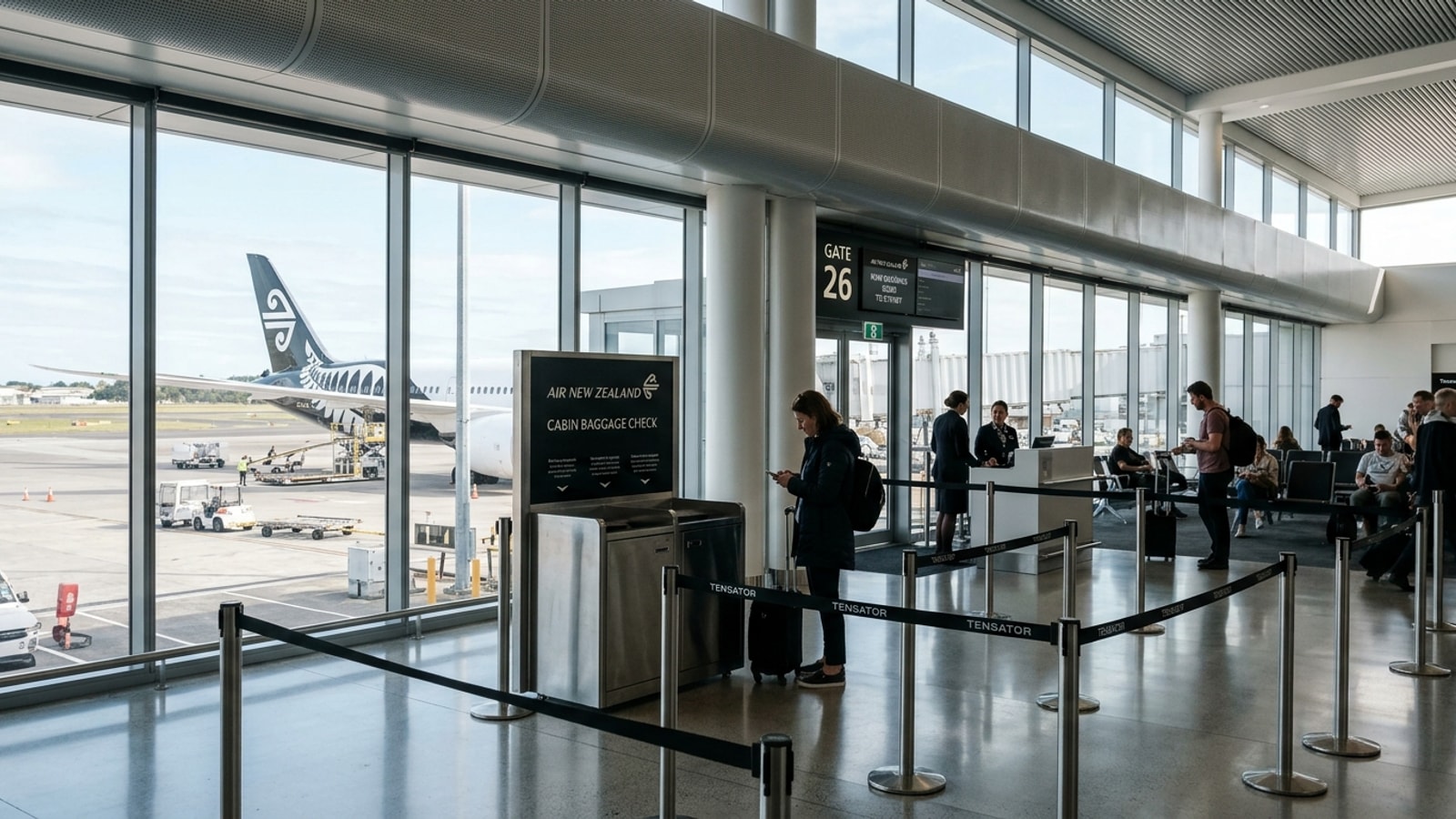
Quick Summary
- Primary Update: Air New Zealand strictly enforces its 7kg single-piece carry-on limit for Economy passengers across domestic, trans-Tasman, and long-haul networks, using rigid sizer units and boarding gate scale audits.
- Transit Impact: Non-compliant bags that exceed 7kg or fail the 118cm linear dimension check are intercepted at the boarding gate, tagged for cargo hold stowage, and billed gate baggage fees up to $65 NZD on domestic routes and $150–$200 NZD on international routes.
- Traveler Advice: Weigh carry-on luggage before leaving for the airport, ensure personal items fit under the forward seat, keep power banks strictly in the cabin, and pre-purchase hold luggage online if total weight exceeds allowances.
Managing cabin luggage on Air New Zealand requires strict attention to weight restrictions and dimension boundaries. As passenger numbers remain high across New Zealand domestic trunk lines, trans-Tasman corridors to Australia, and long-haul sectors linking Auckland with North America and Asia, ground operations teams have standardized boarding gate inspections. Air New Zealand enforces an exact 7kg cabin baggage limit for standard Economy travelers, paired with rigid dimensional sizers placed at check-in halls, security approaches, and boarding gates.
Travelers who arrive at departure gates with oversized roller bags or overweight backpacks face immediate boarding interventions. When overhead bins reach volumetric capacity on Airbus A320neo, Airbus A321neo, Boeing 787-9 Dreamliner, or Boeing 777-300ER aircraft, ground handlers offload surplus or non-compliant bags directly into the cargo hold, billing passengers gate-rate baggage penalties before boarding passes are revalidated. Understanding the carrier's cabin baggage matrix prevents costly delays and baggage disputes at the gate.
Air New Zealand Cabin Baggage Allowances by Fare Class
Air New Zealand allocates cabin baggage allowances according to ticketed class of travel, fare product family, and frequent flyer loyalty tier. Unlike certain North American carriers that permit carry-on items without weight caps, Air New Zealand adheres to Australasian aviation safety standards that mandate individual piece weight caps to protect cabin crews and passengers during unexpected turbulence.
Travel Class         | Primary Cabin Bag  | Max Piece Weight  | Small Personal
/ Loyalty Tier       | Allowance          |                   | Item Allowed

Economy (Seat,       | 1 Piece            | 7 kg (15 lbs)     | 1 Item
Seat+Bag, The Works) |                    |                   | (Under seat)

Premium Economy      | 2 Pieces           | 14 kg combined    | 1 Item
                     |                    | (Max 10 kg/bag)   | (Under seat)

Business Premier     | 2 Pieces           | 14 kg combined    | 1 Item
                     |                    | (Max 10 kg/bag)   | (Under seat)

Airpoints Elite      | 2 Pieces           | 14 kg combined    | 1 Item
/ Gold / Star Gold   | (Any class)        | (Max 10 kg/bag)   | (Under seat)

Infant (Under 2,     | 1 Piece            | 7 kg (15 lbs)     | 1 Stroller/Seat
without seat)        | (Nappies/Food)     |                   | (Gate-checked)
Economy Class Rules
Passengers traveling on domestic "seat" only, "seat + bag", "the works", or international Economy tickets receive an allowance of one main carry-on bag weighing no more than 7kg (15 lbs). In addition to the main bag, passengers are permitted one small personal item, such as a handbag, slim laptop bag, or small daypack, which must fit entirely underneath the seat in front.
The combined physical footprint of both pieces must respect aircraft storage constraints. The primary bag must be stowed in the overhead compartment, while the accessory must remain under the seat.
Premium Economy and Business Premier
Passengers booked in Premium Economy or Business Premier cabins receive an expanded cabin baggage entitlement of two primary bags with a combined weight allowance of up to 14kg (30 lbs). However, an individual piece restriction applies: no single bag may exceed 10kg (22 lbs). This ensures that heavy pieces can be lifted safely into overhead lockers without exceeding structural shelf tolerances. Premium passengers also retain their allowance for one small personal item to be placed under the seat.
Frequent Flyer Tier Waivers
Air New Zealand Airpoints Elite, Gold, and Star Alliance Gold status holders enjoy an enhanced cabin baggage privilege regardless of the cabin in which they fly. When traveling in Economy Class, these elite members are permitted two carry-on pieces totaling up to 14kg (with no single item exceeding 10kg), plus their personal item. Airpoints Silver members do not receive extra cabin baggage allowances and must follow standard cabin limits for their ticketed class.
Sizer Dimensions and Aircraft Overhead Bin Fit
Air New Zealand enforces strict dimensional limits based on total linear measurements. Every primary carry-on bag must not exceed 118cm (46.5 linear inches), calculated by adding length, width, and height together:
$$\text{Linear Dimensions} = \text{Length} + \text{Width} + \text{Height} \le 118\text{ cm}$$
The standard operational dimension profile accepted across the airline's sizer frames is:
$$\mathbf{56\text{ cm (Height)} \times 36\text{ cm (Width)} \times 23\text{ cm (Depth)}}$$
These measurements include wheels, handles, external structural frames, and expanded exterior organizer pockets. A bag measuring 56x36x23cm equals exactly 115cm linear, providing a small margin of compliance. If an expandable zipper is unzipped, expanding the bag's depth beyond 23cm, the bag will jam against the metal sizer rails and fail inspection.
       56 cm (Height)
   +--------------------+
   |                    |
   |                    |
   |   PRIMARY CABIN    | 36 cm (Width)
   |       BAG          |
   |                    |
   |  Max Weight: 7 kg  |
   +--------------------+
     Depth: 23 cm
     Total Linear: 118 cm
Regional Aircraft Limitations (ATR 72 and De Havilland Q300)
Passengers traveling on regional routes operated by Air New Zealand's turboprop fleet—comprising ATR 72-600 and De Havilland Dash 8-Q300 aircraft—encounter significantly smaller overhead bins.
On these regional aircraft:
- Standard roller cases measuring 56x36x23cm cannot fit horizontally or vertically into overhead lockers.
- Air New Zealand operates a complimentary "Ramp Bag" or "Plane-side Loading" service for regional sectors.
- Passengers deposit their compliant carry-on bags on luggage trolleys placed beside the aircraft steps or on the boarding ramp.
- Ground handlers place the bags into the aircraft's rear or belly hold and return them to the tarmac ramp immediately upon arrival at the destination airport.
- Personal items containing laptops, essential medicines, travel documents, and lithium-ion batteries must remain with the passenger inside the passenger cabin.
Personal Item Regulations: Laptop Bags, Purses, and Duty-Free
In addition to the main carry-on piece, Air New Zealand permits each passenger one small personal accessory. The airline defines an acceptable personal item as:
- A slim laptop computer sleeve or briefcase
- A small lady's purse or handbag
- A compact daypack or camera case
- A duty-free shopping bag purchased at the airport terminal
   Personal Item Constraints
   +------------------------------------+
   | Must fit completely under seat     |
   | Maximum depth: Approx. 15–20 cm    |
   | Must NOT occupy overhead bin space |
   | Bulkhead / Exit rows: Locker only  |
   +------------------------------------+
Under-Seat Placement Requirement
The personal item must fit completely under the seat directly in front of the passenger without encroaching on legroom corridors or protruding into aisle pathways. If a traveler attempts to treat a 40-liter hiking rucksack as a "personal item" alongside a rolling carry-on, gate agents will classify the backpack as a second main bag, requiring one of the items to be checked.
Emergency Exit Row and Bulkhead Seating Rules
Passengers seated in emergency exit rows or behind cabin bulkhead dividers are subject to Civil Aviation Authority safety regulations. Because there is no forward seat beneath which to place items, all luggage—including small handbags, laptop sleeves, jackets, and duty-free goods—must be stowed in overhead bins during taxi, takeoff, and landing. Gate agents frequently verify that exit row passengers do not possess multiple oversized pieces that could overwhelm shared locker space in these rows.
Boarding Gate Audits: Sizers, Scales, and Hold Offloading
Over the past operational cycles, Air New Zealand has intensified cabin baggage surveillance at major hubs, notably Auckland International Airport (AKL), Wellington Airport (WLG), Christchurch Airport (CHC), and Sydney Kingsford Smith Airport (SYD). Ground handling agents conduct systematic audits before passenger boarding sequences commence.
Step               | Ground Staff Action

1. Queue Review    | Visual assessment of passenger luggage volume in gate lounge

2. Sizer Check     | Bulky or expanded bags tested in 56x36x23cm metal frame

3. Scale Weigh-In  | Digital scale weigh-in; tags issued for bags under 7.0 kg

4. Hold Tagging    | Overweight (>7.0 kg) or oversized pieces tagged for hold

5. Fee Collection  | Mobile EFTPOS terminal used to collect gate baggage penalty
Scale Inspections and Cabin Bag Tagging
At Auckland and Christchurch, roaming customer service teams equipped with portable digital hanging scales spot-check carry-on wheelies and backpacks in the gate seating lounge. Bags that weigh 7.0kg or less receive a color-coded paper or adhesive tag confirming cabin approval. Passengers carrying untagged or noticeably bulging bags are stopped at the electronic boarding turnstiles for mandatory weigh-in.
Cargo Hold Offloading Penalties
If a carry-on piece weighs more than 7kg (or 10kg for eligible premium/elite travelers) or fails to slide into the sizing frame, the bag cannot board the cabin. Ground staff attach a ramp baggage tag, route the item down to the cargo hold via tarmac chutes, and collect a gate baggage fee.
Air New Zealand does not accept cash payments at boarding gates. All fees must be settled immediately using a debit or credit card via wireless EFTPOS card terminals. Failure to pay results in denied boarding and flight rebooking at the passenger's expense.
Structured Comparison: Air New Zealand Cabin Baggage Rules
| Ticket Category / Fare Family | Max Cabin Pieces | Max Weight Allowance | Sizer Dimensions (H x W x D) | Personal Item Allowed? | Gate Check Penalty (Hold Offload) |
|---|---|---|---|---|---|
| Domestic Seat Only | 1 Bag | 7 kg (15 lbs) | 56 x 36 x 23 cm (Max 118 cm) | Yes (Under seat) | $65 NZD per piece |
| Domestic Seat + Bag | 1 Bag | 7 kg (15 lbs) | 56 x 36 x 23 cm (Max 118 cm) | Yes (Under seat) | $65 NZD per excess piece |
| Trans-Tasman / Pacific (Works) | 1 Bag | 7 kg (15 lbs) | 56 x 36 x 23 cm (Max 118 cm) | Yes (Under seat) | $100 NZD / $95 AUD |
| International Long-Haul Economy | 1 Bag | 7 kg (15 lbs) | 56 x 36 x 23 cm (Max 118 cm) | Yes (Under seat) | $150–$200 NZD / $100–$130 USD |
| Premium Economy (All Routes) | 2 Bags | 14 kg total (Max 10 kg per bag) | 56 x 36 x 23 cm each | Yes (Under seat) | $150–$200 NZD if combined > 14 kg |
| Business Premier (All Routes) | 2 Bags | 14 kg total (Max 10 kg per bag) | 56 x 36 x 23 cm each | Yes (Under seat) | $150–$200 NZD if combined > 14 kg |
| Airpoints Elite / Gold / Star Gold | 2 Bags | 14 kg total (Max 10 kg per bag) | 56 x 36 x 23 cm each | Yes (Under seat) | Standard gate fee if limits exceeded |
| Infant Without Booked Seat | 1 Bag | 7 kg (15 lbs) | 56 x 36 x 23 cm | No | Free gate check for stroller/car seat |
Lithium Batteries, Power Banks, and Dangerous Goods
Aviation safety mandates established by the Civil Aviation Authority of New Zealand (CAA NZ) and the International Air Transport Association (IATA) govern hazardous materials in cabin baggage. Because lithium-ion battery thermal runaways cannot be readily extinguished inside aircraft cargo compartments, portable batteries face strict carriage restrictions.
Equipment Type                     | Cabin Baggage         | Checked Cargo Hold

Power Banks up to 100 Wh           | PERMITTED (In bag)    | STRICTLY FORBIDDEN

Power Banks 101 Wh to 160 Wh       | PERMITTED (Max 2)     | STRICTLY FORBIDDEN
                                   | (Airline approval)    |

Power Banks over 160 Wh            | STRICTLY FORBIDDEN    | STRICTLY FORBIDDEN

Spare Lithium Batteries (Loose)    | PERMITTED (Terminals  | STRICTLY FORBIDDEN
                                   | insulated)            |

E-Cigarettes / Vaping Devices      | PERMITTED (On person) | STRICTLY FORBIDDEN

Smart Bags with Removable Battery  | PERMITTED             | ONLY IF BATTERY
                                   |                       | REMOVED TO CABIN
Power Bank Watt-Hour Calculation
Air New Zealand permits passengers to carry power banks rated up to 100 Watt-hours (Wh) without prior airline authorization. To determine the Watt-hour rating of a power bank marked only in milliampere-hours (mAh), apply this formula:
$$\text{Watt-hours (Wh)} = \frac{\text{Capacity (mAh)} \times \text{Voltage (V)}}{1000}$$
For a standard 20,000mAh battery cell running at 3.7 Volts:
$$\text{Wh} = \frac{20000 \times 3.7}{1000} = 74\text{ Wh} \quad (\text{Compliant})$$
A 30,000mAh battery operating at 3.7V yields 111Wh, placing it in the restricted 101–160Wh category, which requires airline dangerous goods authorization prior to check-in. Power banks lacking visible manufacturer ratings or specifications stamped on the casing are confiscated during aviation security screening.
In-Flight Charging Prohibitions
Air New Zealand prohibits passengers from using portable power banks to recharge mobile phones, tablets, or laptops while seated on the aircraft. Power banks must not be connected to onboard seat power outlets or left plugged into charging cables while stored inside overhead compartments. E-cigarettes and personal vaporizers must remain turned off and stowed on one's person or in carry-on baggage; using or charging them onboard is an offence under New Zealand civil aviation legislation.
Traveler Logistics Guide
Navigating Air New Zealand's baggage checkpoints smoothly requires proactive preparation before arriving at the airport. Follow these practical steps to avoid unexpected boarding disruptions and hold penalty charges:
1. Pre-Departure Weight and Sizer Verification
- Test with Home Scales: Weigh your packed cabin bag using a digital luggage scale. Aim for a maximum packed weight of 6.5kg to allow a safety margin for scale calibration differences at airport gates.
- Measure Wheel Protrusions: Confirm that your trolley bag does not exceed 56cm in height when measured from the floor to the top of the collapsed handle. Ensure wheels and external side pockets do not project beyond 36cm wide or 23cm deep.
- Pack Dense Items in Personal Bags: Heavy reading materials, camera bodies, and electronic chargers can be distributed into your personal item (laptop bag or small purse), which is rarely weighed provided it fits under the seat.
2. Airport Check-In Hall Protocol
- Use Public Sizer Frames: Test your bag inside the test sizer frames located near Air New Zealand self-service kiosk zones at Auckland (Domestic Terminal Door 2, International Check-In Zone C), Wellington, and Christchurch. If the bag binds on the frame, redistribute items into your checked baggage before printing bag tags.
- Consolidate Loose Handhelds: Do not carry loose duty-free bags, neck pillows, and extra coats as separate individual items. Merge extra items into your primary carry-on or personal bag before approaching boarding gates.
3. Regional Prop Flight Transfers
- Prepare Ramp Valet Items: When connecting from an international Boeing 787 service to a regional ATR 72 flight (such as Auckland to Napier, Nelson, or Tauranga), be prepared to hand over your primary roller bag at the aircraft steps.
- Extract Valuables Promptly: Keep your laptop, passport, prescription medication, and lithium power bank inside your small personal bag so you can hand over your main roller bag without delays on the windy tarmac.
4. Gate Dispute and Payment Mitigation
- Request Immediate Re-Weigh: If an automated or handheld scale records your bag at 7.2kg, remove a heavy jacket, sweater, or camera, wear the jacket, and ask for an immediate re-weigh.
- Keep Credit Cards Accessible: If your bag is rejected and directed to the hold, present an accepted contactless credit card to expedite payment and avoid missing the final boarding call.
Frequently Asked Questions
Can I bring a laptop bag in addition to my 7kg carry-on on Air New Zealand?
Yes. Air New Zealand allows one primary carry-on bag (up to 7kg in Economy) plus one small personal item, such as a laptop bag, handbag, or small daypack. The personal item must fit under the seat in front of you. It does not count toward the primary 7kg weight limit, but must remain modest in size and cannot be placed in the overhead lockers unless you are seated in an emergency exit or bulkhead row.
What happens if my carry-on bag weighs 8kg or 9kg at the boarding gate?
If ground staff weigh your carry-on bag at the gate and it exceeds the 7kg limit (or 10kg in Premium/Business/Elite tiers), you will not be permitted to bring it aboard the cabin. Ground handlers will tag the bag for cargo hold loading and charge a gate baggage fee—ranging from $65 NZD on domestic flights to $150–$200 NZD on long-haul routes. Fees must be paid by credit or debit card at the gate.
What are the exact sizer dimensions for Air New Zealand cabin luggage?
The maximum linear dimension for a cabin bag is 118cm (46.5 inches), which corresponds to standard dimensions of 56cm in height, 36cm in width, and 23cm in depth (22 x 14 x 9 inches). These measurements include all wheels, side pockets, and retracted handles. Bags that do not fit into the rigid metal sizer box at the gate must be checked into the aircraft hold.
Are power banks allowed in checked luggage on Air New Zealand flights?
No. Lithium-ion power banks and spare batteries are strictly prohibited in checked baggage under CAA NZ and IATA dangerous goods regulations. All power banks must be transported in your cabin baggage. Power banks up to 100Wh require no prior approval, while units between 101Wh and 160Wh require airline consent. Power banks over 160Wh are strictly forbidden from passenger aircraft. You may not charge devices using power banks during flight.